



There’s something almost addictive about a great curly wig. One minute you’re pulling it out of the box — the spirals slightly compressed, the fibers catching the light — and the next, you’re looking at a version of yourself that feels bolder, fuller, and somehow more. That’s the specific magic of curly wig hairstyles: they deliver a level of volume, texture, and visual personality that most people spend years and a lot of heat damage trying to achieve with their natural hair.
What separates a great curly wig look from a forgettable one comes down to curl pattern selection, wig density, and how the style works with your face shape and lifestyle. A tight 4A coil wig creates a completely different impression than a loose 3A spiral — both stunning, but doing very different work. Matching the right curl texture to the right occasion, the right cut, and the right styling technique is where the real artistry begins.
Curly wigs also do something straight and wavy styles can’t replicate: they add genuine structural volume that changes your entire silhouette. Whether you’re wearing a curly bob that grazes your jawline or a full sweep of waist-length spirals, the curl itself reshapes how you’re perceived. That’s why so many people — whether wearing wigs for protective styling, convenience, or creative expression — keep coming back to curly textures.
The 12 styles below cover the full range of what curly wigs can do, from maximalist kinky afros to precise old Hollywood ringlets. Each one comes with specific styling guidance, practical tips, and honest notes on what makes it work — so you can choose with real confidence and wear each look with attitude.
1. Big Bouncy Glamour Curls
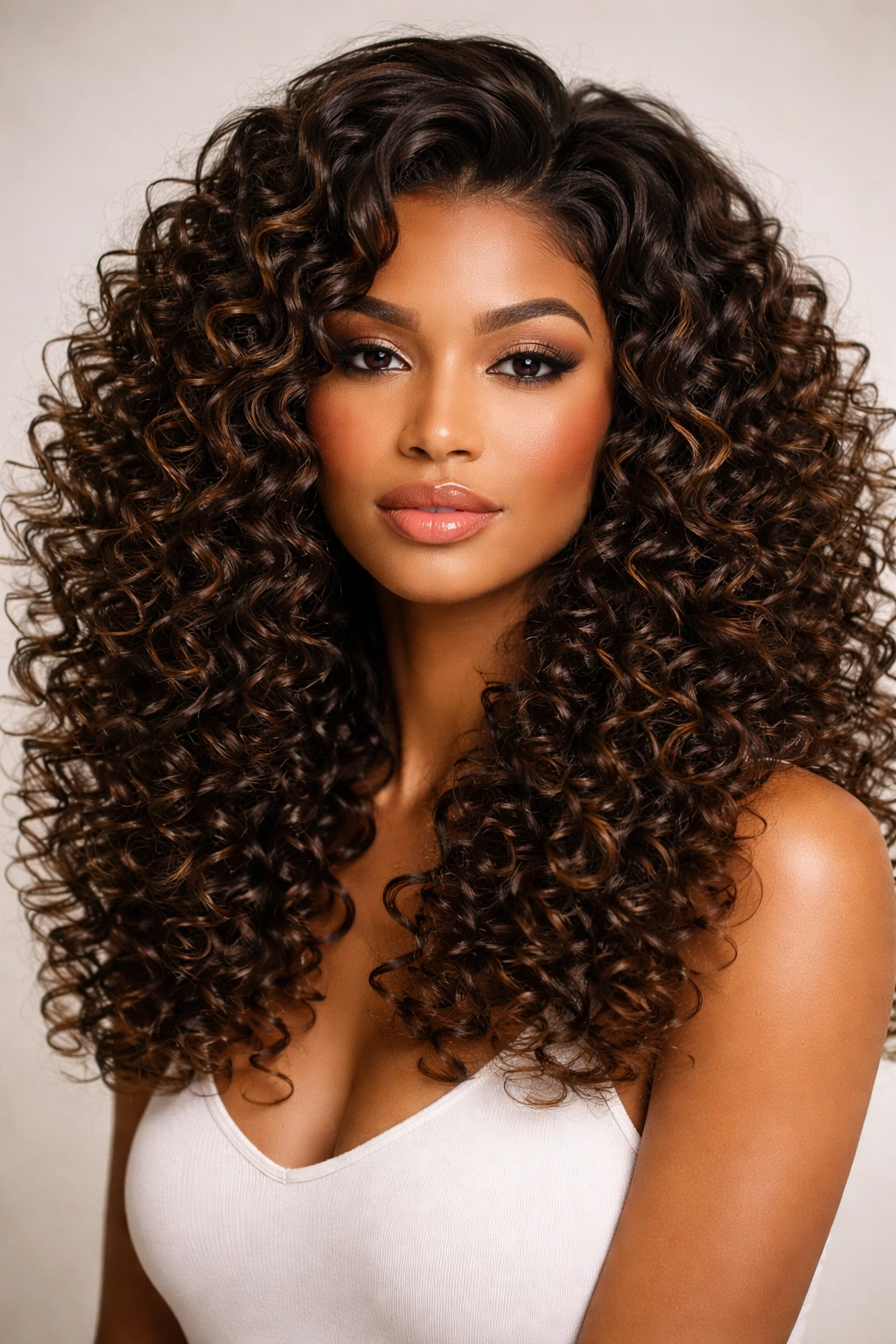
These are the curls that built a thousand beauty campaigns. Big, voluminous, 3B/3C curl pattern with defined spirals that hold their shape while still moving freely — this is the style that reads as effortlessly dramatic without trying too hard. Think red carpet moments where the hair is doing half the work, full and luminous, spiraling down past the shoulders in a way that commands attention from across the room.
The 3B/3C texture sits in that sweet zone between tight coils and loose waves, creating curls with enough definition to look intentional and enough softness to look effortless. It’s one of the most photogenic curl patterns available in wig form.
Why Density Matters for This Style
On a wig, this texture typically comes in densities ranging from 150% to 200%. For big bouncy glamour curls specifically, 180% or higher is worth the investment. At lower densities, the curls can look flat and sparse around the crown — and this style lives or dies by that crown volume. You want the curls to stack on each other and create that cloud-like, full-bodied silhouette that makes this look so striking.
Length is equally important. Shoulder-length to collarbone-length works beautifully because it lets the curls bounce without collapsing under their own weight. Go significantly longer and the spirals start to stretch out and lose their spring; stay too short and you sacrifice the movement that defines this style.
How to Style and Maintain Big Bouncy Curls
- Mist the curls lightly with a water and leave-in conditioner mix (about a 2:1 ratio of water to conditioner) to revive any compression from storage or shipping
- Use a wide-tooth comb or your fingers only — a brush will break up the curl clumps and create horizontal frizz that’s difficult to reverse
- If the wig uses heat-resistant human hair, a diffuser on low heat lifts volume at the roots dramatically
- For synthetic fibers, skip heat entirely and scrunch sections upward from the ends to encourage lift and bounce
- Secure the perimeter with a strong-hold edge control or adhesive spray to prevent lifting during movement
Pro tip: Sleep with big bouncy curls loosely pineappled at the crown using a satin scrunchie — never a standard elastic — to preserve the curl pattern and avoid compression overnight.
2. Natural Kinky Afro Curls
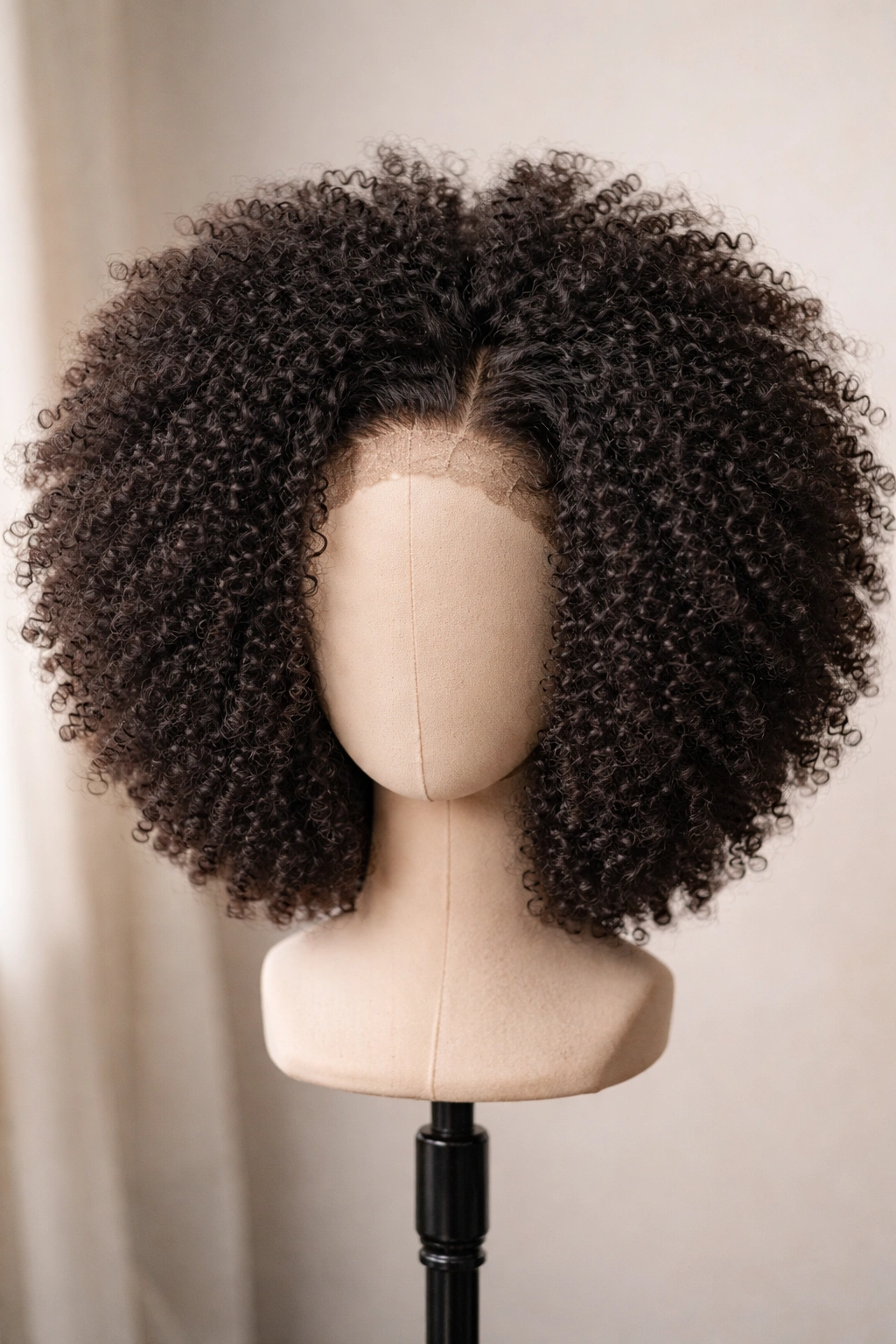
Few wig styles carry the visual authority of a full, uncompromised afro. Whether you’re working with tight 4B coils or a slightly softer 4A texture, the kinky afro wig occupies space and turns heads in the best way. It’s also one of the most popular choices for protective styling — the natural hair rests comfortably underneath while the wig delivers a full, textured, culturally rich statement on top.
Type 4 curl patterns create the densest, most structural silhouette of any wig texture. The coils are tight enough to hold their shape without product, and the overall look radiates a confidence that looser styles don’t replicate.
What to Look for in an Afro Wig
Cap construction matters enormously here. A 360 lace wig or full lace wig gives you the flexibility to part the hair in any direction, which is essential for a natural-looking afro. Look for wigs with kinky, coily fibers along the hairline itself — not silky, pressed-down baby hairs — for an authentic finish. The pre-shaped wigs that come already picked out offer maximum immediate volume, while the more compressed shapes give you the option to build and customize the silhouette yourself.
Wigs described as “pre-picked” or “blown out” tend to offer more height from the moment you put them on. Those with a more natural, unpicked shape sit closer and softer — a different kind of beautiful.
Styling and Caring for the Kinky Afro Look
- Use an Afro pick (a pick with a fist handle gives the most control) to lift the roots after putting on the wig — work from the ends and gradually move upward to avoid pulling or tangling
- Apply a light sheen spray to add moisture without weighing down the coils
- Avoid heavy creams or butters on synthetic afro wigs — they coat the fibers and create a dull, greasy appearance over time
- For human hair afro wigs, a small amount of argan or jojoba oil applied with fingertips adds shine without heaviness
- Store the wig on a wide wig stand between wears to maintain the full, round shape rather than letting it compress in a bag
3. Defined Spiral Ringlets
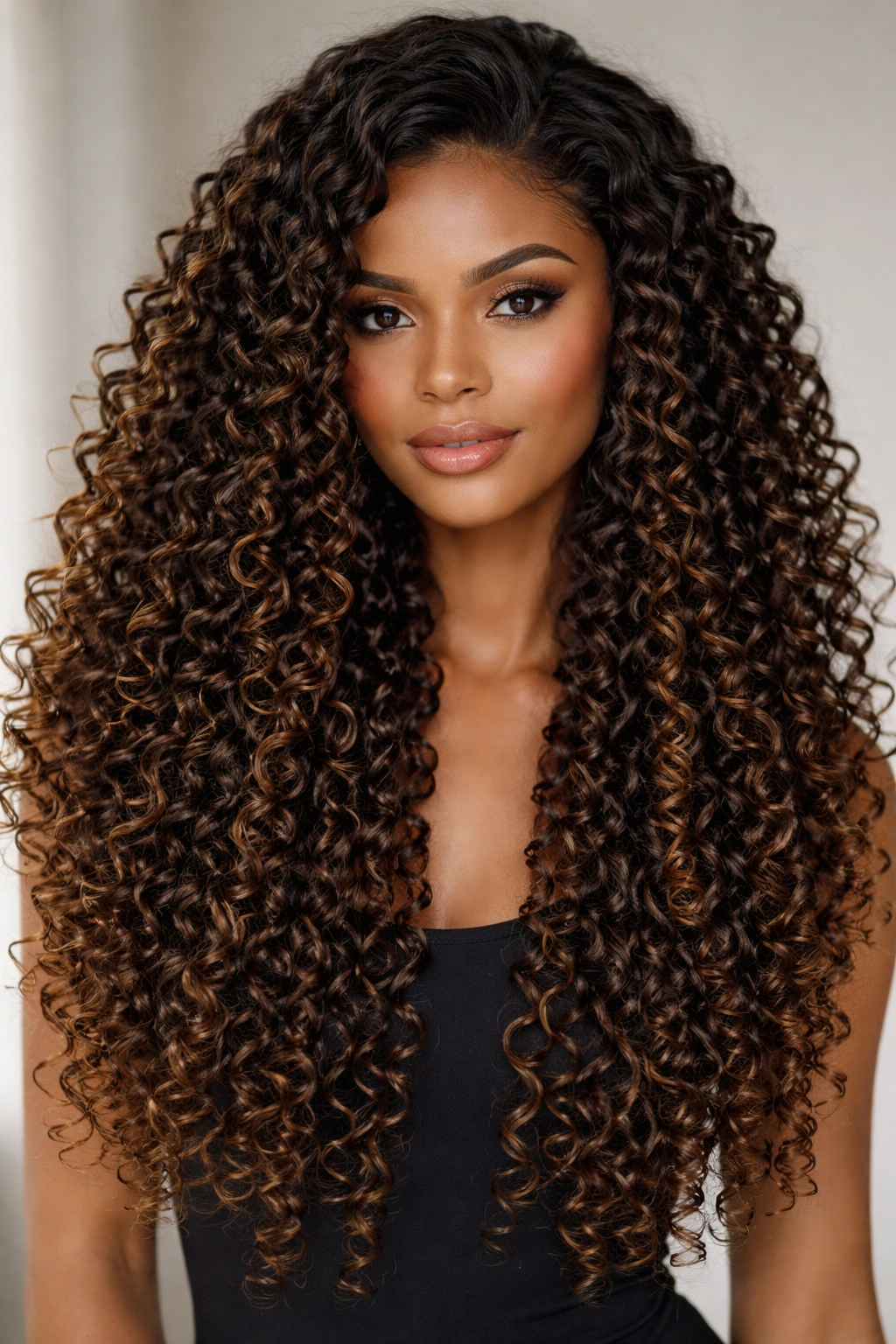
Spiral ringlets are what happens when curls get serious about definition. These tight, corkscrew-shaped coils — typically 3C or tighter — hang in elongated springs and catch light with a clarity that loose waves simply don’t achieve. If big bouncy curls are dramatic, spiral ringlets are precise. They look architectural, deliberate, and genuinely striking in a way that pairs naturally with both minimalist and maximalist outfits.
The key distinction is elongation. Where a bouncy 3B curl creates a round spring, a true ringlet stretches downward and holds that elongated shape through length and tension.
The Science of Spiral Curl Structure
Ringlet-textured wigs have tighter curl circumferences — roughly the diameter of a pencil or a drinking straw — and when they’re well-maintained, each coil hangs separately with clean, consistent definition. These wigs look best at medium to long lengths, where the ringlets have room to hang freely and move with the body. At very short lengths, the tightly defined coils can feel dense and cramped; the style needs vertical length to do its thing.
Human hair lace front wigs with 3C ringlet textures are particularly worth the investment here. The curl pattern holds up through washing, conditioning, and restyling in a way that most synthetic versions struggle to match after repeated wear.
Refreshing and Defining Ringlets Over Time
- Separate any fused or tangled ringlets by gently pulling apart individual coils with water-dampened fingers — never with a comb through the curl
- Apply a defining cream sparingly by smoothing it along each ringlet from root to tip, encouraging the spiral shape
- A handheld steamer or steam refresh (holding the wig section near, not over, a hot water source) restores ringlets that have lost definition
- Avoid touching the curls while they’re wet after refreshing — let them air dry or diffuse fully before handling
- To elongate ringlets for a more stretched effect, pull each one gently lengthwise and pin briefly while drying, then release
4. Loose Beachy Waves
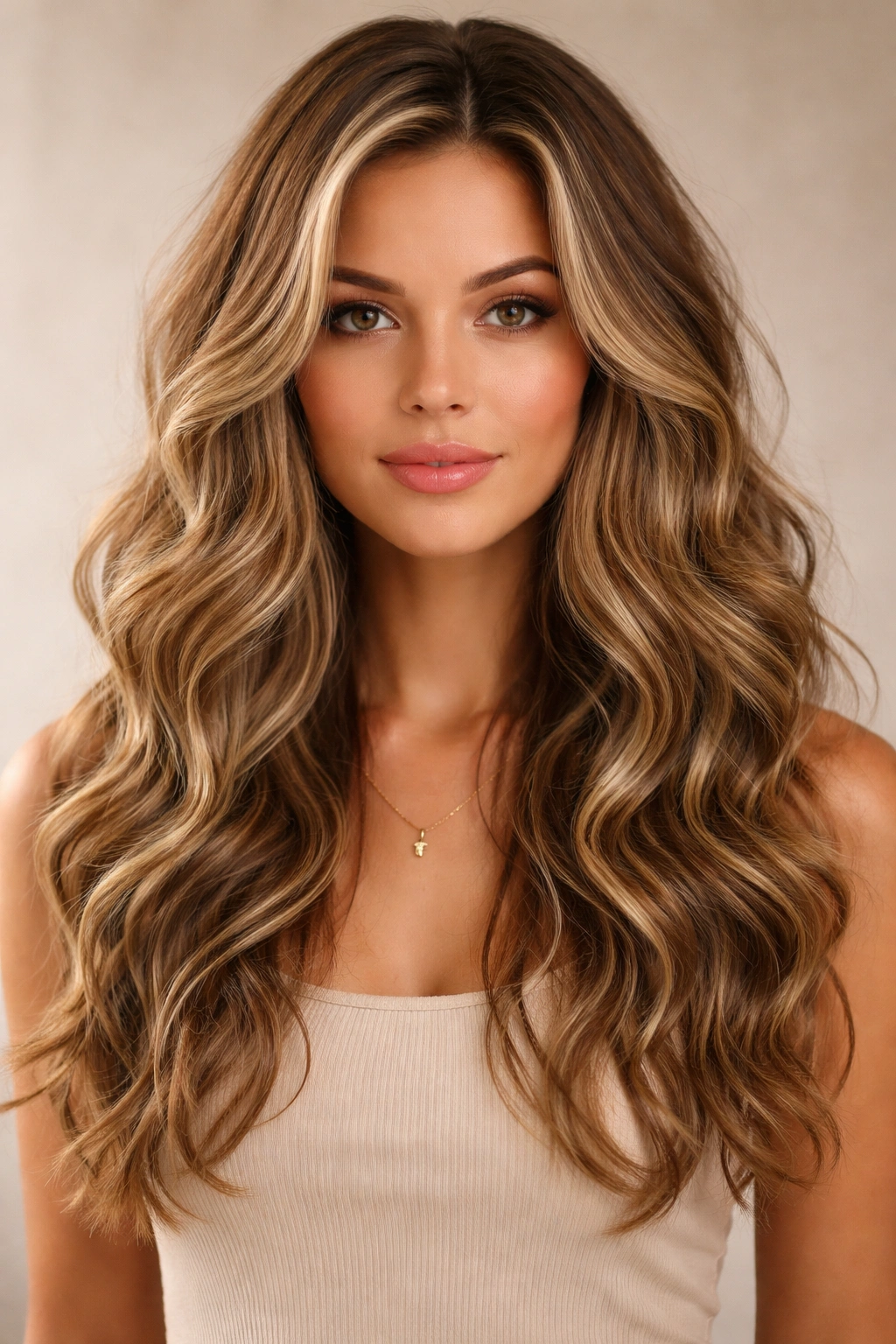
Not every curly wig hairstyle needs tight definition or maximum volume. Loose beachy waves — sitting at the 2C to 3A point on the curl spectrum — offer something the tighter styles don’t: effortless movement and a relaxed, lived-in quality that works as well on a casual afternoon as it does on a weekend out. The curls are soft enough to look relaxed but defined enough to read as intentional.
The 2C/3A curl pattern is one of the most universally flattering wig textures because it doesn’t overpower delicate or petite features — the waves are relaxed enough to sit softly around the face without dominating it.
Why Beachy Waves Look So Natural on a Wig
Loose waves blend more naturally with bio hair at the hairline than tighter curl patterns, which makes the lace melt more seamlessly on lace front and HD lace wigs. If you’re newer to wearing wigs and want something that reads as biological from across the room, a loose wave wig is one of the more forgiving options available. The slight imperfection built into a relaxed wave pattern actually works for the look — it mimics the natural variation in real hair.
These waves respond beautifully to length. A lob (long bob) with loose 3A waves gives you the beachy aesthetic in a compact, manageable cut. Waist-length loose waves create a bohemian, free-spirited look that tighter curl patterns can’t replicate.
Getting the Best Out of a Loose Wave Wig
- Avoid over-handling — the more you touch loose waves, the more they separate into frizz rather than staying in their natural clumps
- A lightweight curl cream or sea salt spray (for heat-safe human hair wigs) refreshes the wave pattern without heaviness
- Air drying is always gentler than heat; if speed matters, a diffuser on the lowest setting minimizes disruption to the wave pattern
- Finger-detangle only — a brush will destroy the wave and create a puffy, frizzy texture that’s hard to recover
- Loose wave wigs often look their absolute best after two or three wears, once the initial freshness softens slightly and the waves settle into a more organic, natural pattern
5. The Curly Bob
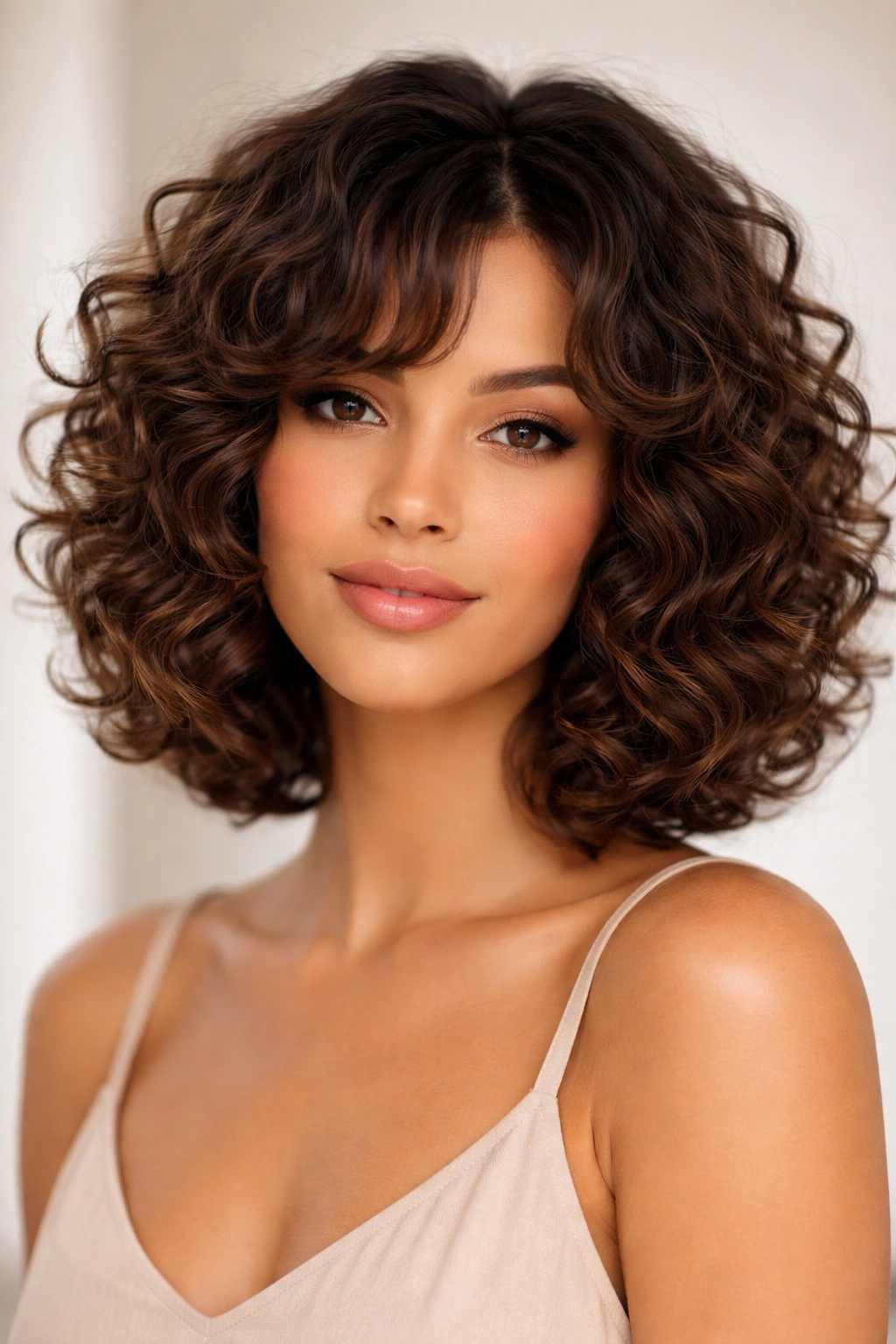
The curly bob is one of those hairstyles that never really falls out of rotation — and on a wig, it’s one of the most precise, intentional looks you can wear. Cut anywhere from just below the ear to collarbone length, the curly bob focuses all that texture into a tight frame around the face. It’s quietly powerful in a way that longer styles sometimes aren’t.
Straight bobs can look severe. Curly bobs don’t — the texture breaks up the bluntness of the cut and adds softness that flatters the jaw and cheekbones naturally.
Why Curl Texture Transforms the Bob Cut
Curls add apparent length because they stack vertically. A curly bob actually reads as longer than a straight cut at the same measured length, which means you can wear a dramatically short bob on a wig and still feel the fullness and presence of a longer style. For anyone who wants a cropped, fashion-forward look without sacrificing the sense of fullness, the curly bob threads that needle precisely.
The best curly bob wigs have some layering or graduation built into the cut rather than a perfectly blunt edge. A blunt-cut curly bob creates a square, blocky silhouette that looks artificial. Look for wigs described as “curly layered bob” or “curly lob with movement” for a more natural result.
The Right Bob Length for Your Face Shape
- Oval faces: Work well with a curly bob at any length — freedom to go as short as you like
- Round faces: Aim for a collarbone-length bob with added crown volume to elongate the face slightly
- Square faces: Curly texture at the sides softens angular jawlines — avoid a sharp, chin-length cut in this case
- Heart faces: A bob ending just below the chin with soft volume at the ends balances a wider forehead beautifully
- Long faces: A chin-length curly bob with maximum width at the sides adds visual breadth that longer styles can’t provide
6. Half-Up Half-Down Curly Style
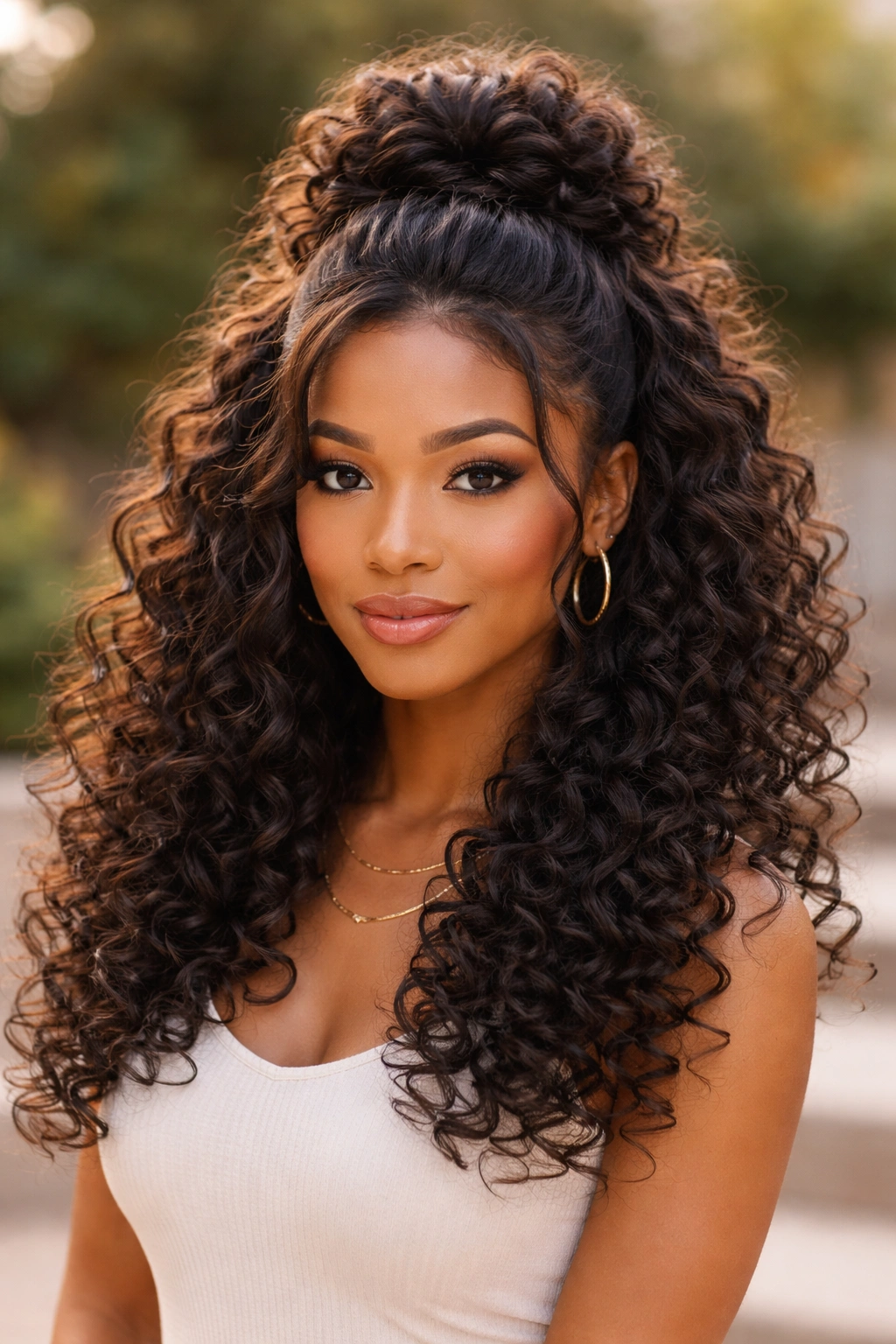
One of the most versatile ways to wear a curly wig is to pull it half-up while letting the rest fall freely. This isn’t just a style choice — it’s a practical one. Half-up styling takes a bold, voluminous curly wig and transforms it into something more structured and intentional without giving up the texture that makes it interesting.
Pulling the top half of a curly wig into a puff, a loose bun, or a twisted knot creates a crown effect that adds vertical height and draws immediate attention to the face and cheekbones.
How Half-Up Styling Solves Common Curly Wig Problems
This technique is genuinely useful for rescuing a curly wig that has compressed or lost definition at the crown after repeated wear. By gathering and elevating that section, you conceal the flatness and create intentional structure where the volume has deflated. It’s also a style that extends the life of a curly wig — instead of restyling the entire piece, you can simply put it up and wear it differently.
Satin-wrapped spiral hair coils are significantly gentler on wig fibers than standard elastic bands, which snag, stretch, and weaken the fibers at the gathering point over time.
Creating the Half-Up Look on a Curly Wig
- Section off the top half of the wig from ear to ear using the narrow end of a tail comb
- Gather the section loosely at the crown — pulling too tightly distorts the curl pattern at the roots and creates an unnatural flat zone
- Twist the gathered section once or twice into a loose bun, or leave it as a high puff held in place with a coil tie
- Pull two or three face-framing curls loose from the front section before securing — this softens the look significantly
- Gently shake and separate the lower half curls to restore any compression from handling
Pro tip: Wrap a thin coil of curl around the base of the bun to hide the hair tie completely — this finishing detail elevates the entire style.
7. Long Layered Curly Wig
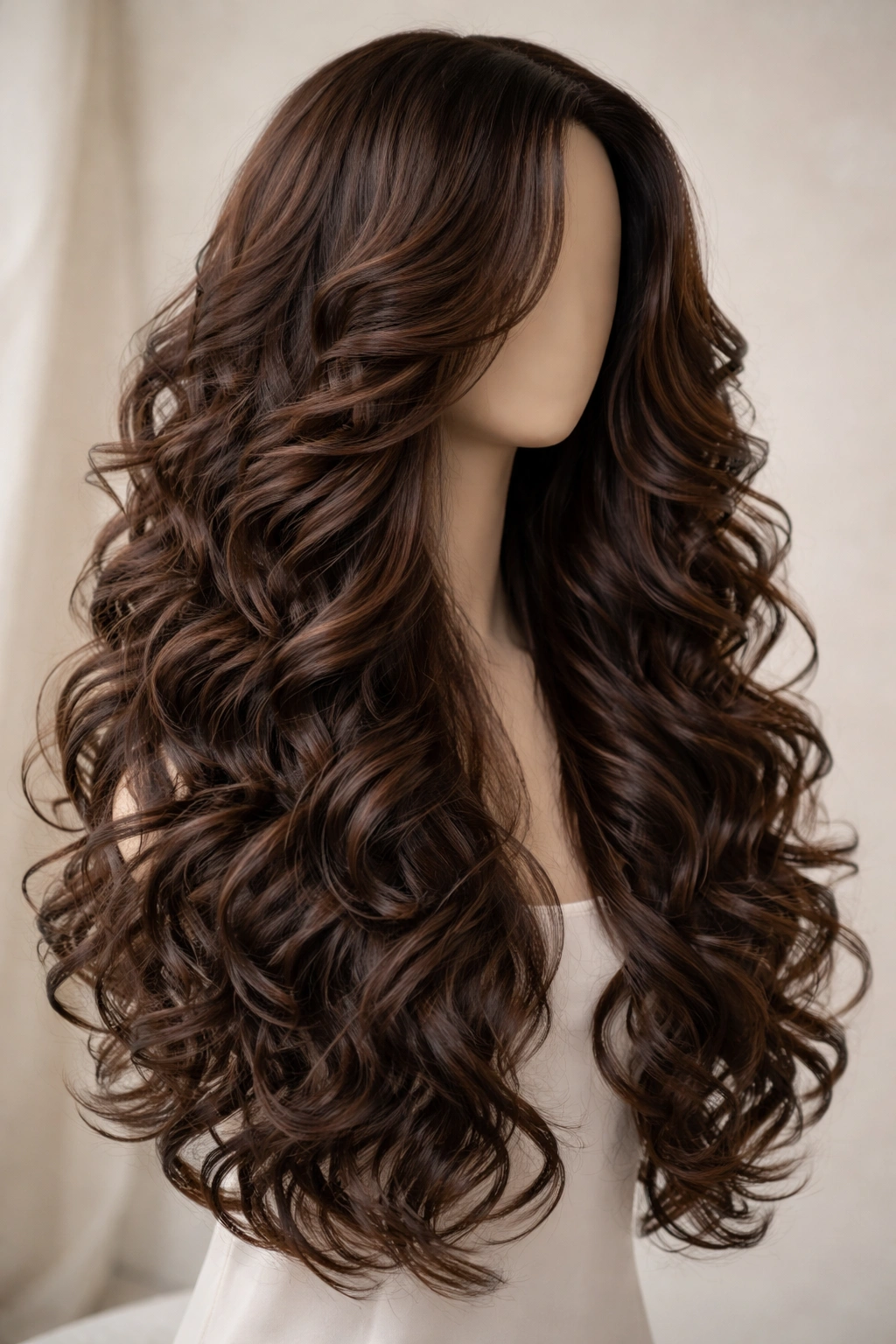
There’s a specific kind of drama that only belongs to long, layered curly hair — the kind that falls past the shoulders, toward the chest or waist, each layer swinging freely and catching the light at different angles. Long layered curly wigs are the most statement-making option in this entire list, and when they’re styled and maintained well, they look genuinely extraordinary.
The critical element here is the layers. Without them, long curly wigs collapse under their own weight — the curls at the bottom stretch out and go stringy, the middle section becomes a dense, shapeless mass, and the whole silhouette turns into an unflattering triangle.
Why Layering Changes Everything at Long Lengths
Layers remove bulk strategically, which lets each section of the wig move freely and maintains curl definition from root to tip rather than only at the crown. This is particularly important because long curly wigs carry more fiber weight than any other style, and that weight actively works against the curl pattern over the course of a wear.
When shopping for a long curly wig, look for constructions described as “v-cut layers” or “feathered layers” rather than a blunt-cut silhouette. The difference in movement and naturalness is significant.
Choosing the Right Length and Density
- 22–26 inch lengths are the practical sweet spot — long enough for drama, short enough to avoid constant tangling and maintenance burden
- 180% density or higher keeps the wig full even at long lengths where the curl pattern stretches and individual coils separate
- Human hair wigs perform significantly better at long lengths than synthetic — the weight of synthetic fibers at 24 inches or beyond can pull straight and lose curl definition within a few hours of wearing
- Deep conditioning every 6–8 wears keeps human hair long curly wigs manageable and prevents the matting that plagues neglected long curly styles
- Store long curly wigs loosely gathered in a silk or satin bag, never tightly rolled or compressed into a box
8. Side-Swept Old Hollywood Curls
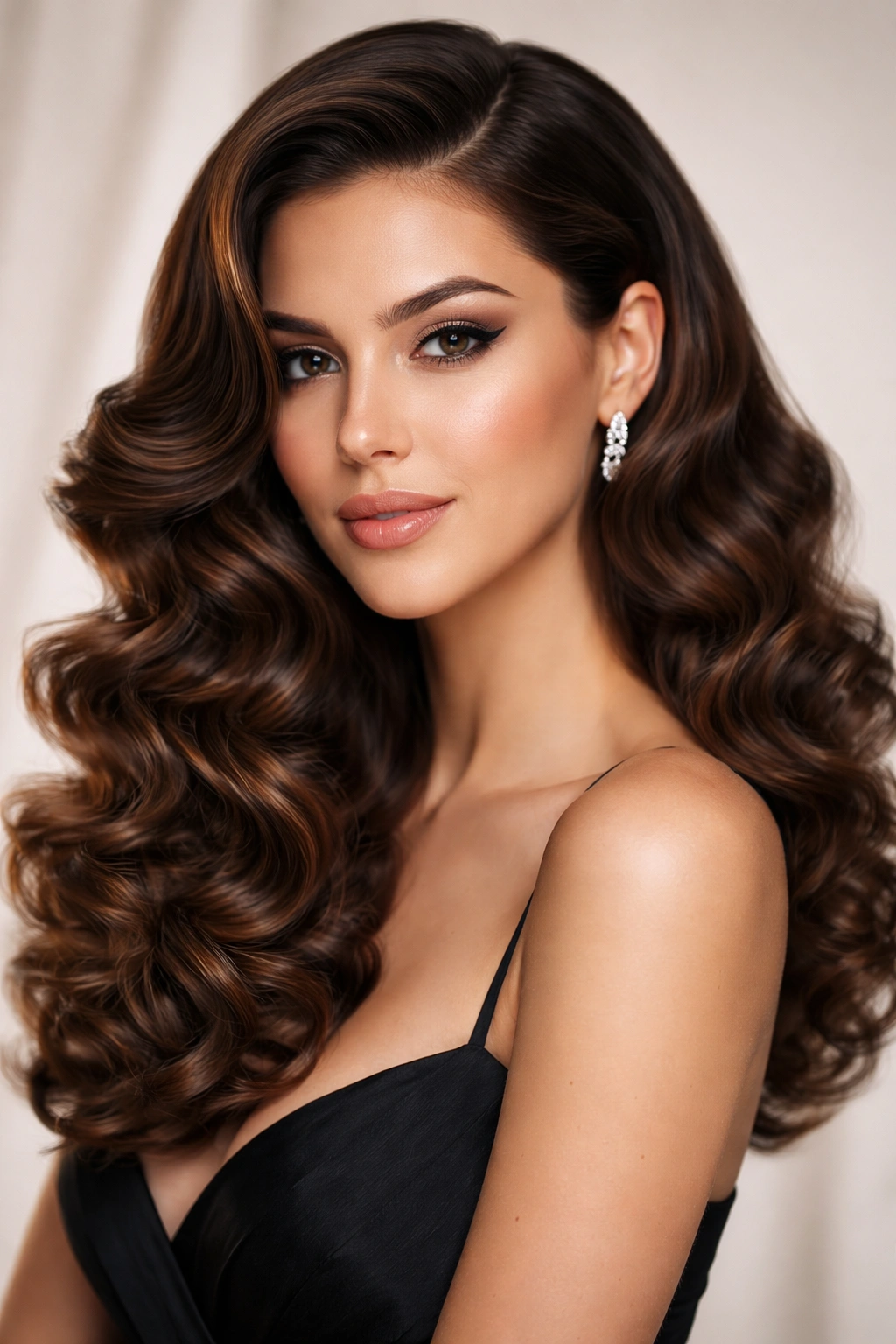
Old Hollywood glamour curls are the style that put wigs on the map long before modern protective styling culture made them mainstream. Think silver screen elegance — perfectly set, deep side-parted waves that roll smoothly from the crown and cascade in soft, intentional spirals down one shoulder. This look is theatrical, polished, and unmistakably elegant, and it translates beautifully to contemporary styling when done with intention.
What separates vintage Hollywood curls from regular bouncy curls is structure. These curls are set, not free-form — they follow a deliberate directional pattern with a defined wave at the crown and tighter ringlets at the ends.
How to Identify the Right Wig for This Style
On a wig, achieving this look depends heavily on the base curl pattern. A 3A or 3B spiral wig works best because the curls are defined enough to hold a directional set. Kinky or afro-textured wigs aren’t ideal for this specific style — the tighter coil patterns don’t lay into the smooth, directional wave shape that defines the Hollywood aesthetic. You want curls that can be coaxed into following a path, not coils that spring back to their natural formation regardless of how you style them.
The deep side part is non-negotiable here. A 70/30 split — or even more extreme — is what creates the asymmetrical cascade that makes this style so recognizable.
Achieving the Old Hollywood Effect
- Apply a strong-hold mousse to damp wig fibers (on heat-safe human hair wigs) and set on large velcro or pin curl rollers in a consistent directional pattern
- For synthetic wigs, use flexi rods at low tension and allow to cool fully before removing — heat-styling synthetic wigs without heat-resistant fibers damages the fiber coating
- Once the curls are set, apply a glossy shine serum with fingertips, smoothing along the direction of each curl to enhance the smooth, refined finish
- Pin the front section behind one ear with a decorative clip or jeweled hairpin for the classic asymmetrical look
- A light-hold finishing spray locks the directional shape without adding stiffness or crunch
9. The Curly Fringe Wig Style
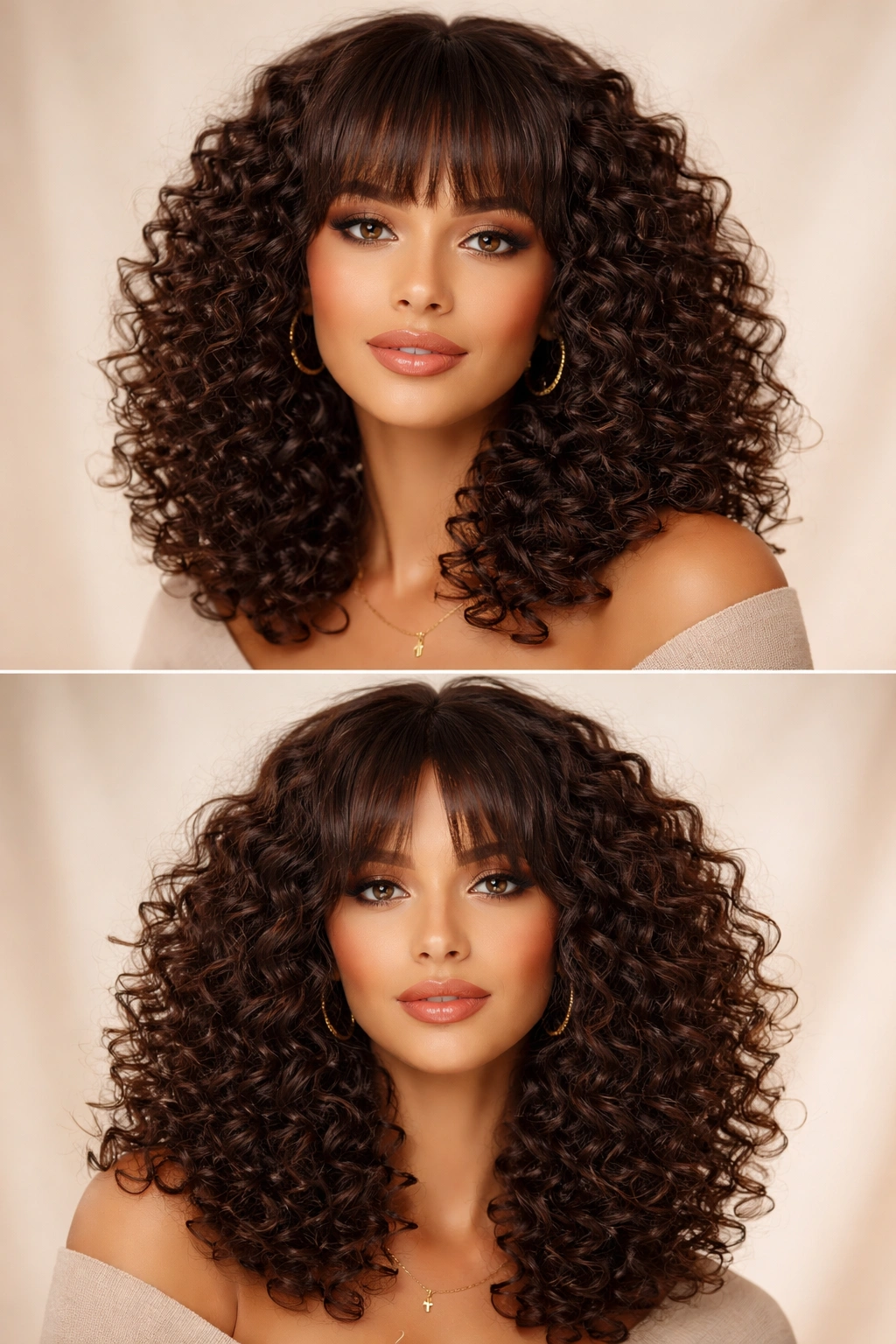
Bangs and curls together sound chaotic on paper but consistently deliver one of the most face-flattering results in wig styling. A curly wig with a defined fringe — whether full and blunt across the forehead, or wispy curtain-style bangs parted in the center — creates a face-framing effect that no other styling choice quite matches. The bangs pull focus to the eyes and cheekbones in a way that’s both soft and intentional.
Curly bangs behave differently from straight ones, and that difference is almost always an advantage. The texture means they never look harsh, and the natural spring of the curl means they have built-in volume that flat bangs lack.
Why Curly Fringe Is More Versatile Than It Looks
Because curly bangs naturally move and have texture, they can be swept in multiple directions — pushed to one side, parted in the center, or piled forward for maximum drama — without extensive restyling. The curl does the structural work that straight bangs require products and tools to achieve. On a wig, the fringe is usually pre-cut into the construction, but the best curly fringe wigs come with the bangs cut slightly longer than you’d ultimately want — because you can always trim, but you can’t add length back once it’s gone.
Curtain bang wigs and full fringe wigs serve different purposes: curtain bangs are softer and work for more casual, laid-back styling, while a full curly fringe creates a more dramatic, editorial effect.
Styling and Managing Curly Bangs
- Mist the fringe lightly with water and scrunch upward to revive curl definition before wearing — don’t skip this step after the wig has been stored
- For curtain bangs, use fingers to part and encourage the fringe to open naturally in the center rather than forcing it with a brush
- Keep a small jar of curl cream specifically for the bangs — heavier edge products overwhelm delicate fringe curls
- Bangs getting too wide or fluffy? A very light application of anti-frizz serum along the surface of the curl calms the silhouette without losing definition
- Always trim curly bangs dry — they spring up dramatically when they dry, and wet-cut bangs will end up significantly shorter than intended
10. Wash-and-Go Natural Texture Wig
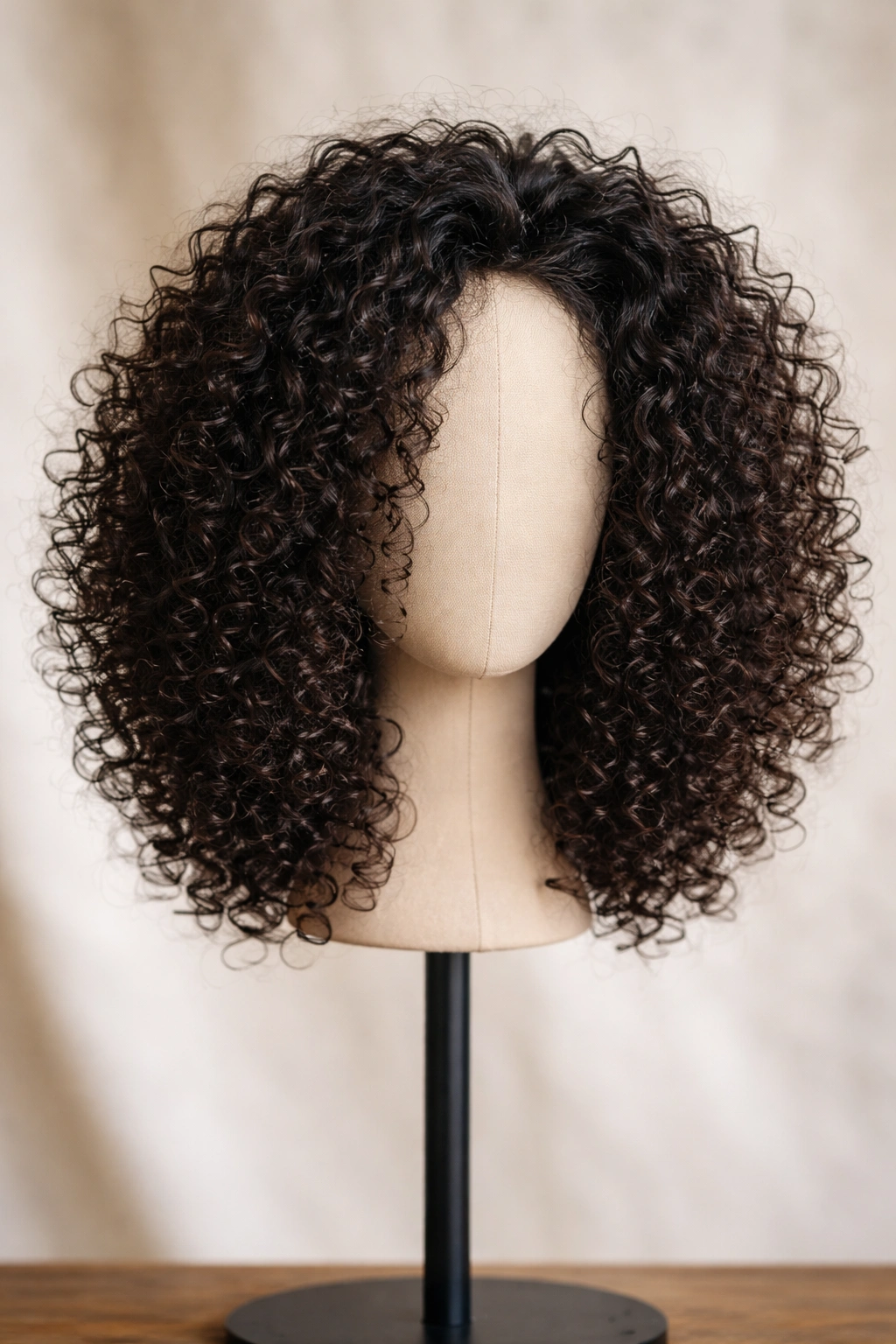
The wash-and-go is less a specific style and more a philosophy of wearing: minimal manipulation, maximum texture, curl pattern allowed to do exactly what it wants. On a wig, this aesthetic is about choosing a curl pattern that closely resembles natural hair — or the natural hair you’d love to have — and wearing it with as little intervention as possible. It’s effortless in the best way.
The difference between a natural-looking curly wig and an obviously styled one comes down to a few specific details. Root movement is the big one. Wigs that are perfectly uniform from root to tip read as artificial because natural hair doesn’t behave that way.
What Makes a Wig Look Biological Rather Than Constructed
Natural curls vary in definition, change direction across the head, and have moments of frizz and spontaneous clumping. Wigs with a randomized curl pattern and slight variation in coil tightness across different sections look far more authentic than wigs with a perfectly consistent curl from the front to the nape. For the wash-and-go look specifically, HD lace wigs (ultra-thin lace that blends with a wider range of skin tones without detectable demarcation) are the standard recommendation among experienced wig wearers.
The less visible the lace, the more the hairline reads as natural, which is the single biggest factor in whether a wig looks “real” from a normal social distance.
Creating Authentic Natural Texture
- Part the wig the same way you part your natural hair — familiar part placement registers as more authentic to both your own eye and others’
- Gently tug the roots of curls nearest the hairline to create the slight frizziness and lift that makes the wig look grown-in rather than placed
- A curl refresher spray every 2–3 wears maintains moisture and definition without requiring a full wash
- Let the wig air dry after washing — air-dried curls on human hair wigs develop a more organic, variable texture than heat-dried ones
- Leave some sections with natural clumping and slight frizz deliberately — over-defining every single curl is what makes a wig look product-heavy and unnatural
11. Faux Locs with Curly Ends
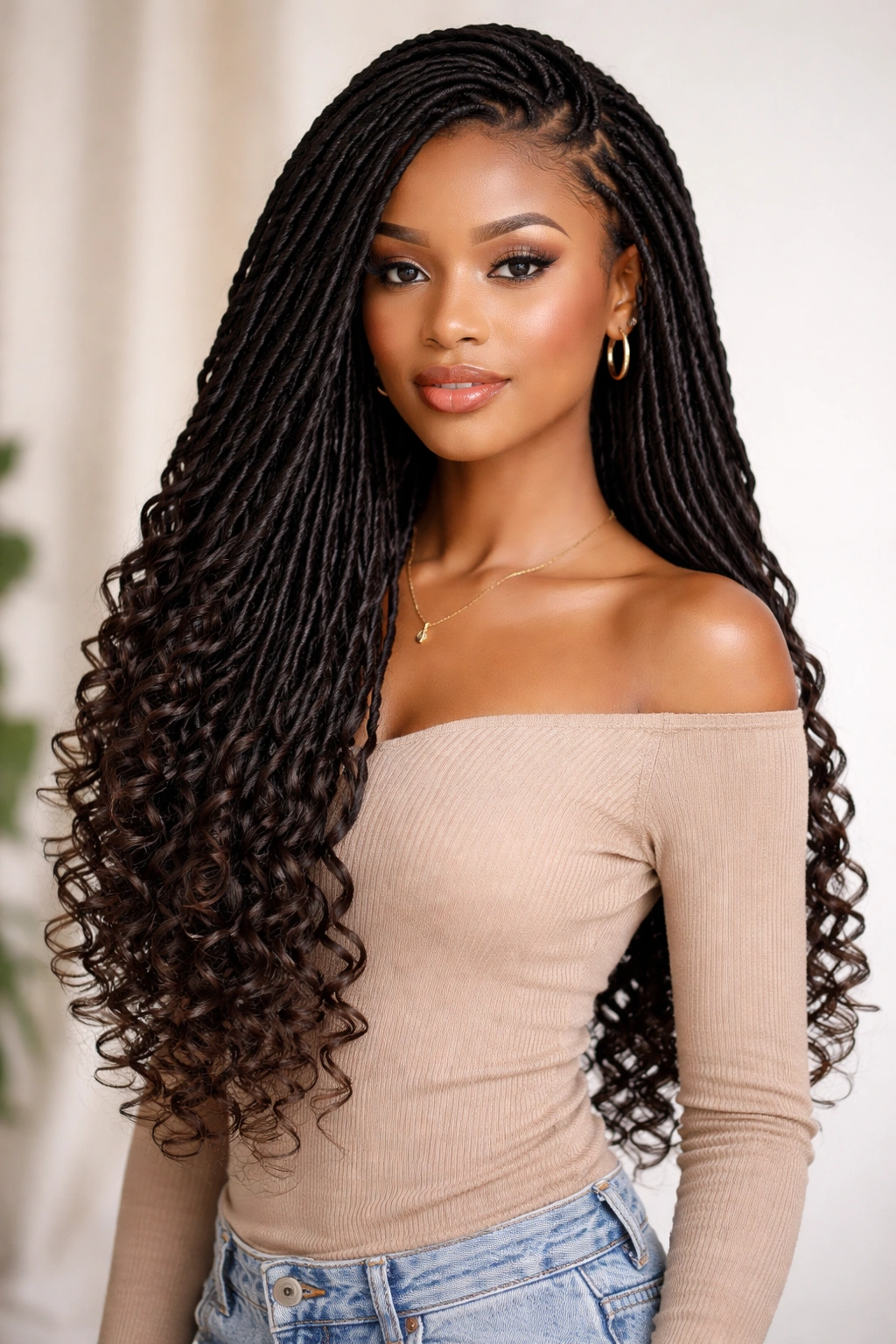
Faux locs wigs sit in a fascinating space between structure and softness. They have the intentionality of a protective style in their wrapped, defined loc bodies, but the curly ends add a free, organic quality that gives the whole look an undone charm. It’s a hybrid style — and one of the most fashion-forward wig options available for anyone who wants the aesthetic of protective styling without the installation time or the commitment to a fixed style for weeks.
A well-constructed faux locs wig wraps each loc unit tightly from the root down to a transition point — usually about two-thirds of the way down the length — where the fiber opens up into a curly or wavy end.
What Separates Quality Faux Locs Wigs from Cheap Ones
The quality of those curly ends is the dividing line between a faux locs wig that looks intentional and one that looks messy. Low-quality versions use synthetic curly ends that tangle, mat, and frizz after only a few wears — and once the ends go, the entire wig reads as neglected. Higher-quality versions use more durable curly fiber or human hair ends that hold their curl pattern with light moisture and basic maintenance.
Pay attention to the number of locs when shopping — wigs with fewer, thicker locs have a bolder, more structured look, while wigs with many fine locs read as lighter and more delicate. Both are striking; the choice depends on the overall aesthetic you’re building.
Caring for a Faux Locs Wig
- Spritz the curly ends lightly with a water-glycerin mix (about 3:1) to keep them moisturized and defined between wears
- Avoid heavy oils on the loc bodies — they attract lint, dust, and environmental debris that gets trapped in the wrapped fiber and is nearly impossible to remove
- Store the wig flat or on a wide mannequin head to prevent the locs from bending or creasing at sharp angles
- To refresh compressed curly ends, dip them briefly in warm (not hot) water or hold near steam, then re-curl gently around a finger and allow to dry
- Apply a very small amount of lightweight scalp oil using a dropper bottle through the parting spaces to keep the visible scalp area looking natural and moisturized
12. Short Curly Pixie Wig
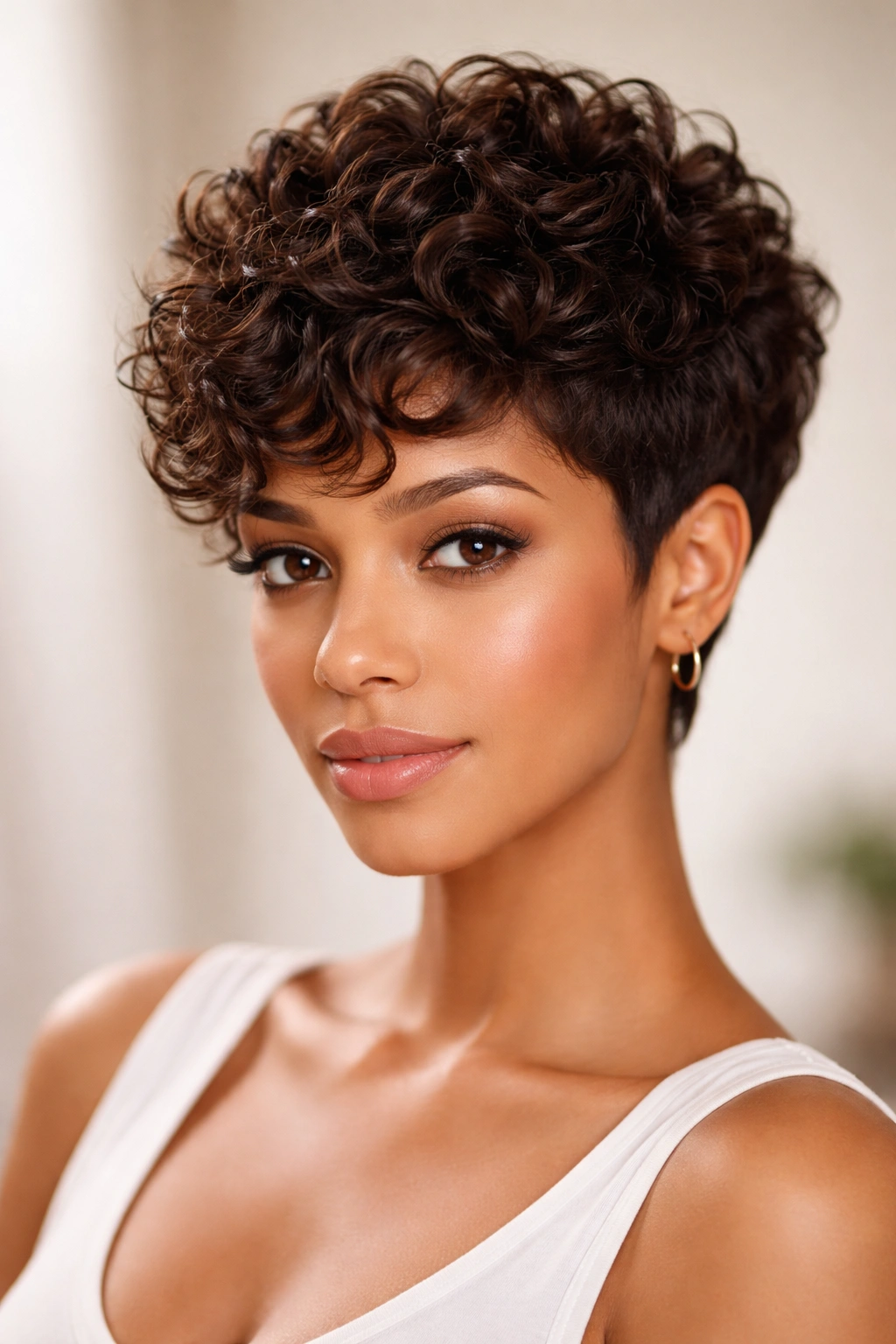
Short curly wig styles deserve far more attention than they typically get in wig styling discussions, which tend to gravitate toward length and volume. The curly pixie brings all of its compact, expressive energy in one of the most underrepresented cuts in the conversation — and it proves that less hair can create just as much impact as a full, long style. Sometimes more.
A pixie cut with curly texture reads as bold, intentional, and fashion-forward in a way that longer styles sometimes don’t. The shortness means every single curl is visible and defined — the style has nowhere to hide.
What Makes the Curly Pixie Work on a Wig
The precision of the cut is everything. Look for curly pixie wigs with tapered sides, defined texture at the crown, and slightly longer curls at the top — this layered construction creates the dimensional, styled appearance that separates a curly pixie from a uniformly close-cropped style. Wigs that are evenly short all over without that crown volume look flat and shapeless; the architecture of the cut is what gives this style its character.
The best curly pixie wigs for wig wearers specifically tend to use lace front or full lace construction, which allows for natural-looking hairlines even at very short lengths where the perimeter is fully exposed.
Styling a Curly Pixie Wig for Full Impact
- Use an edge brush with a strong-hold edge control to shape and define the perimeter and any face-framing curls at the temples and forehead
- Finger-style the crown curls upward and slightly forward for height — a pixie that lies flat against the head loses its personality entirely
- Apply a small amount of curl cream or light pomade to the crown curls for hold and shine without the crunchy, stiff finish that heavy products create
- A single decorative clip or pearl pin placed at the temple adds a finishing touch that elevates the pixie from casual to deliberately stylish
- Keep the lace line clean, pressed, and well-melted — with a pixie cut, there’s no length to draw attention away from the hairline, so the installation needs to be precise
Pro tip: A curly pixie wig in a bold color — copper, burgundy, or even platinum — hits with a different kind of energy than the same color would on a longer style. The close crop amplifies color in a way that makes even subtle tones look vivid and intentional.
Final Thoughts
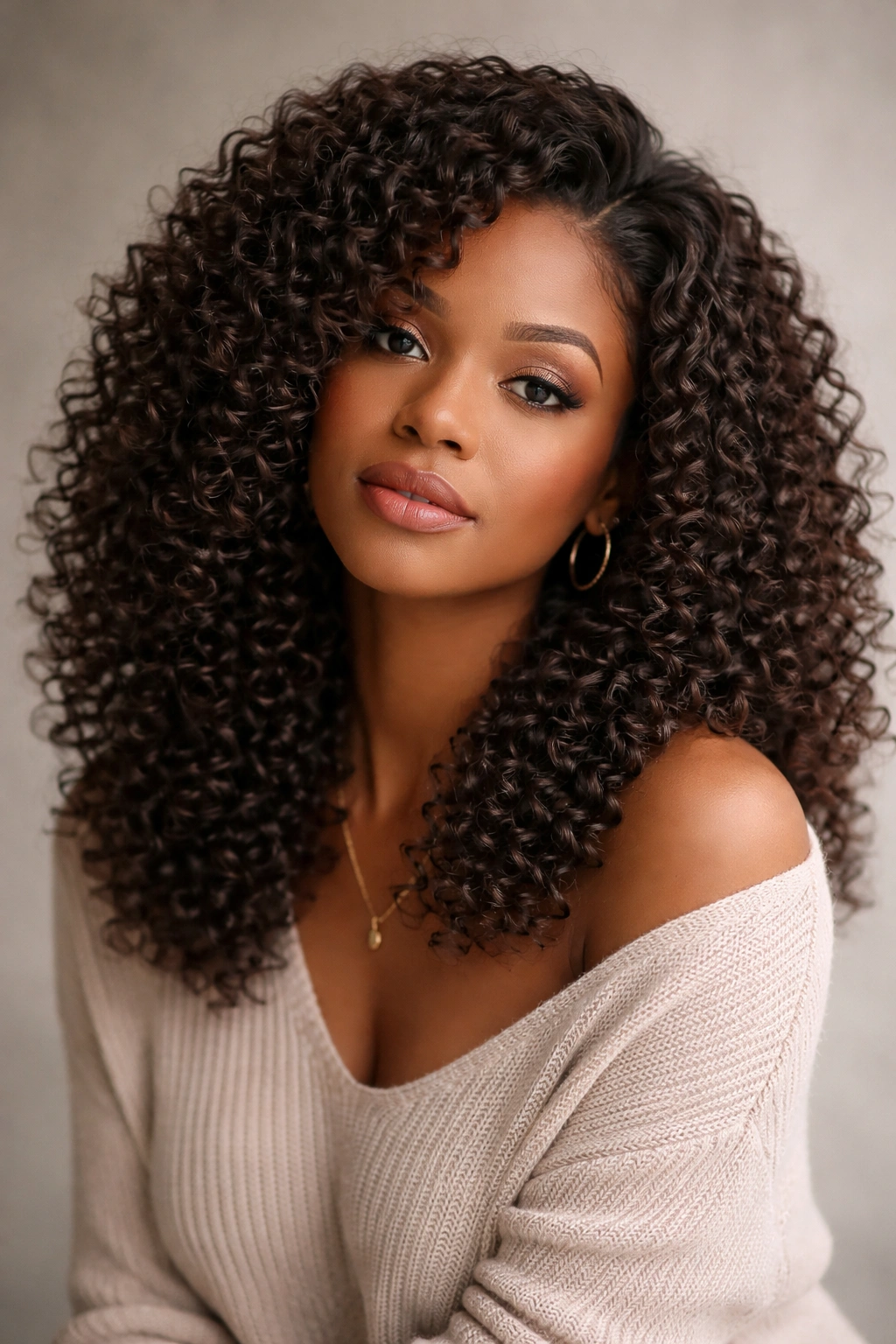
Curly wig hairstyles work precisely because they cover so much ground — from the polished drama of old Hollywood ringlets to the free, unapologetic volume of a full kinky afro. The variety isn’t just aesthetic; it reflects the full range of what curly hair can actually do when it’s given the right structure, the right cut, and the right care.
If you’re building out your wig collection or choosing your first curly style, match the curl pattern to your actual lifestyle, not just the look you love in photos. Big bouncy curls are gorgeous, but if you’re low-maintenance by nature, a wash-and-go natural texture wig or loose beachy waves will serve you better on a daily basis. The style you’ll reach for again and again is the one that fits your routine, not the one that requires the most maintenance.
Whichever style you choose, invest in proper wig care from the start — satin storage, gentle detangling, moisture maintenance for human hair wigs, and careful heat avoidance for synthetic ones. A well-maintained curly wig looks exponentially better after twenty wears than a neglected one does after two.
The best curly wig hairstyle, ultimately, is the one you wear with genuine confidence. Curl pattern, density, and construction are technical factors — but the real variable is always the person wearing it.
