



Black-tie hair has one rule people keep learning the hard way: if the style wobbles, the whole outfit feels less expensive. Braids solve that problem better than most updos because they bring structure, shine, and enough hold to survive a long dinner, a packed dance floor, and a stretch of time when you do not want to think about your hair at all.
That is why braid updos for black-tie events have staying power. They can look sharp and formal without feeling stiff, and they work across natural textures, relaxed hair, extensions, and protective styles. The trick is not piling on more hair or more product. It is getting the braid pattern, placement, and finish right.
A braid only reads formal when the base looks deliberate. Clean parts matter. So do pinned ends, a smooth hairline, and a shape that matches the neckline of the dress instead of fighting it. A tight braid with no shape looks casual. A braid with purpose looks expensive. That is the whole game.
Some styles lean sleek, some lean soft, and some bring a little drama without turning the whole head into a sculpture. Good. Black-tie hair should have a point of view. The styles below cover the range, from the quiet ones that melt into a satin gown to the bolder ones that hold their own beside statement earrings and an open back.
1. Crown Braid Into a Low Chignon
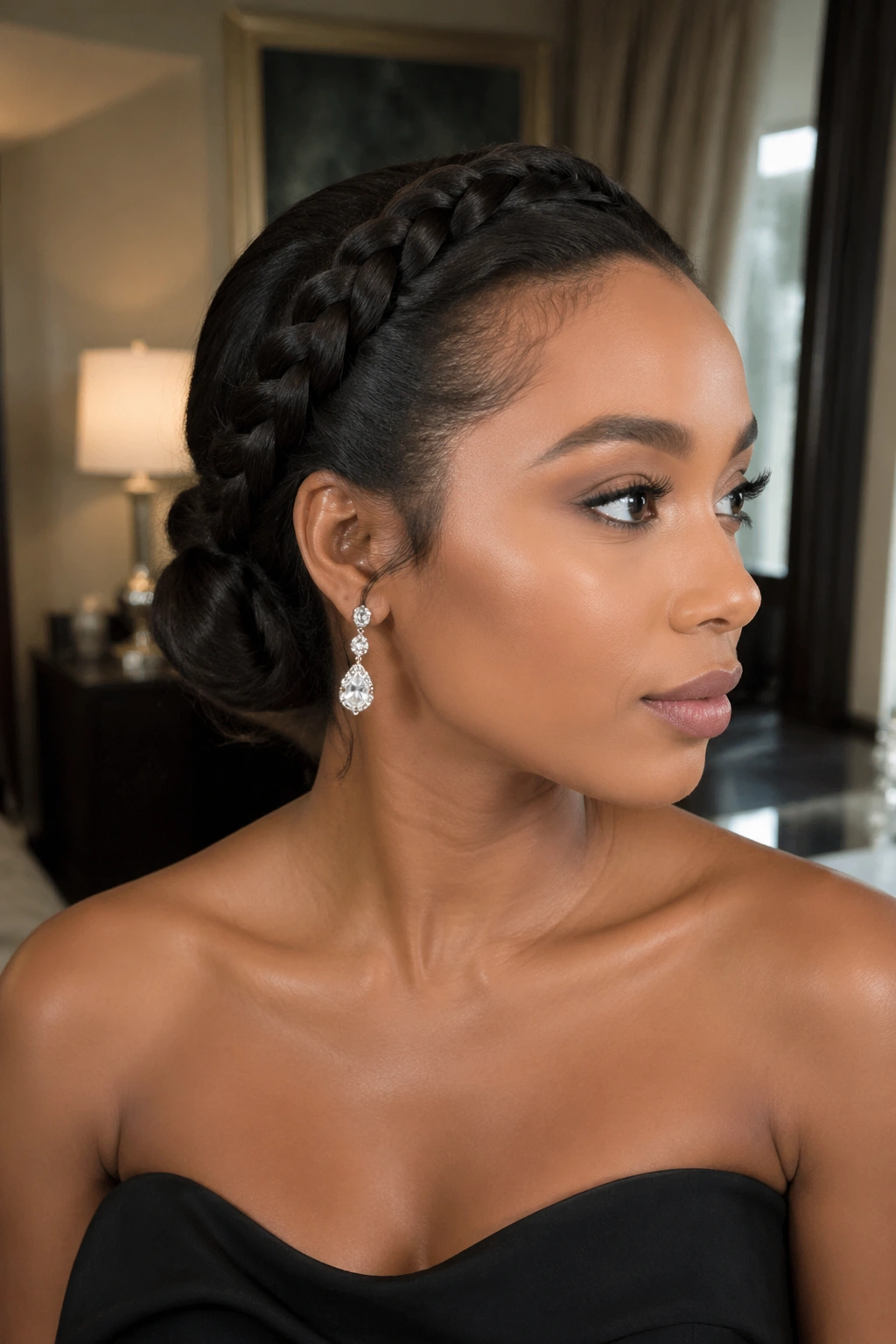
A crown braid into a low chignon is the sort of style that makes a neckline look sharper the second you turn your head. It keeps the top of the head clean and moves the visual weight lower, which is exactly what you want when the dress already has beading, lace, or a strong shoulder line.
Why It Reads Formal
The crown braid acts like a frame. It pulls the eye around the face, then drops everything into a smooth knot at the nape. That shape feels controlled, not fussy. It also works when you need your earrings to matter; the braid stays close to the head and leaves room for the jewelry to do its job.
A good version uses medium tension. Too loose, and the braid slumps by hour two. Too tight, and the hairline starts to look strained. The sweet spot is a braid that sits flat at the scalp but still has visible texture.
Best with:
- Strapless gowns
- Square necklines
- Pearl studs or drop earrings
- Hair that is shoulder length or longer, with or without extensions
Pro tip: Hide the chignon pins under the base of the knot, not through the top. Visible pins kill the whole effect.
2. Sleek Center-Part Braided Bun
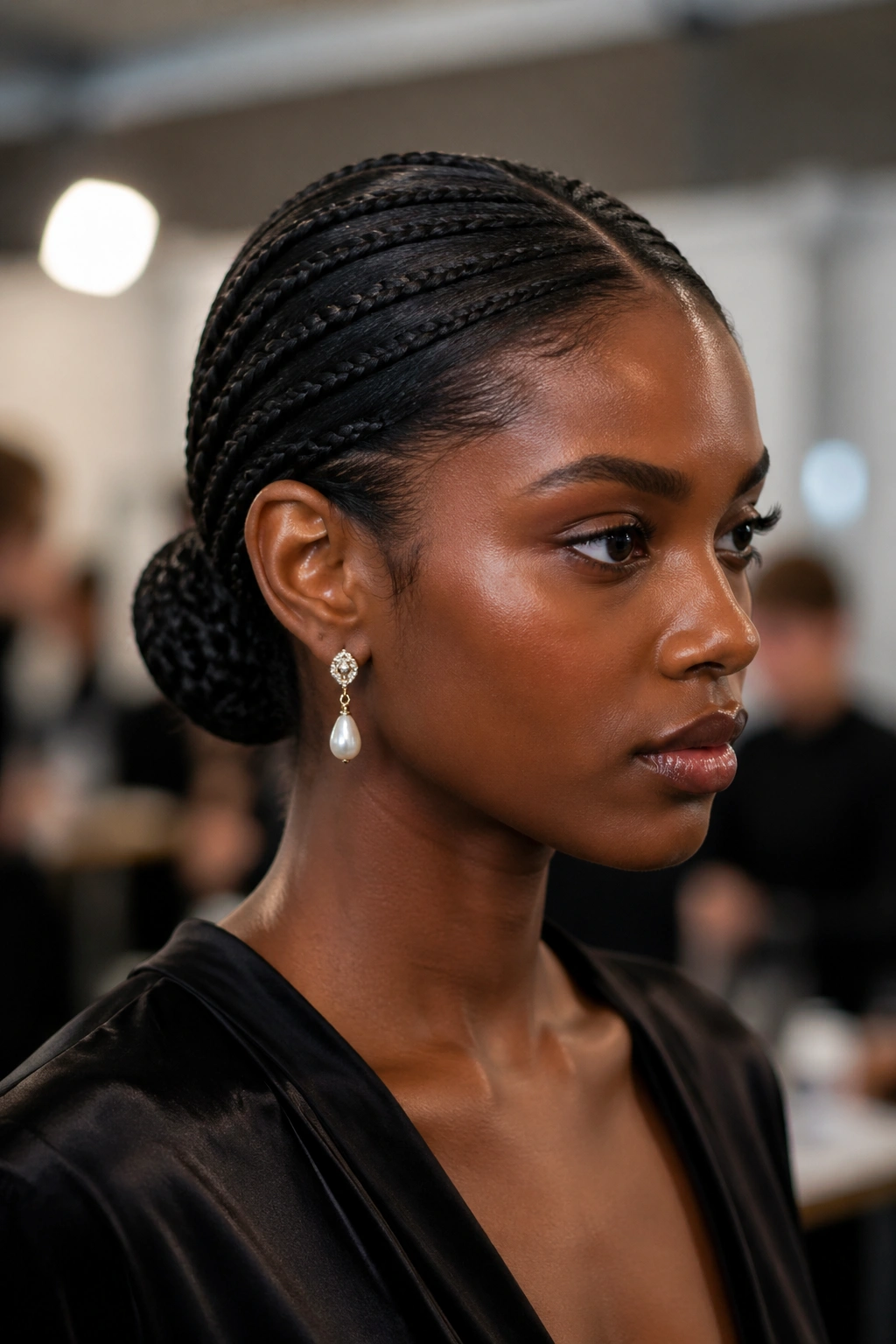
If you want the cleanest black-tie silhouette, start with a middle part. A center-part braided bun has a calm, formal feel that works beautifully with minimalist dresses, sharp tailoring, and satin fabrics that already do a lot of the talking.
The part matters more than people think. A precise center line gives the face symmetry, and symmetry reads polished from across a room. Then the braids feed straight back into a low bun or a tucked coil, which keeps the profile neat. I like this look when the outfit has strong geometry — a column dress, a square back, a deep V, that kind of thing.
Use a small amount of gel or styling cream at the roots, then brush everything flat before braiding. The finish should look smooth at the scalp and textured where the braid begins. That contrast is what keeps it from looking flat.
No fluff. No stray volume at the sides. Just shape.
3. Halo Braid with Tucked Ends
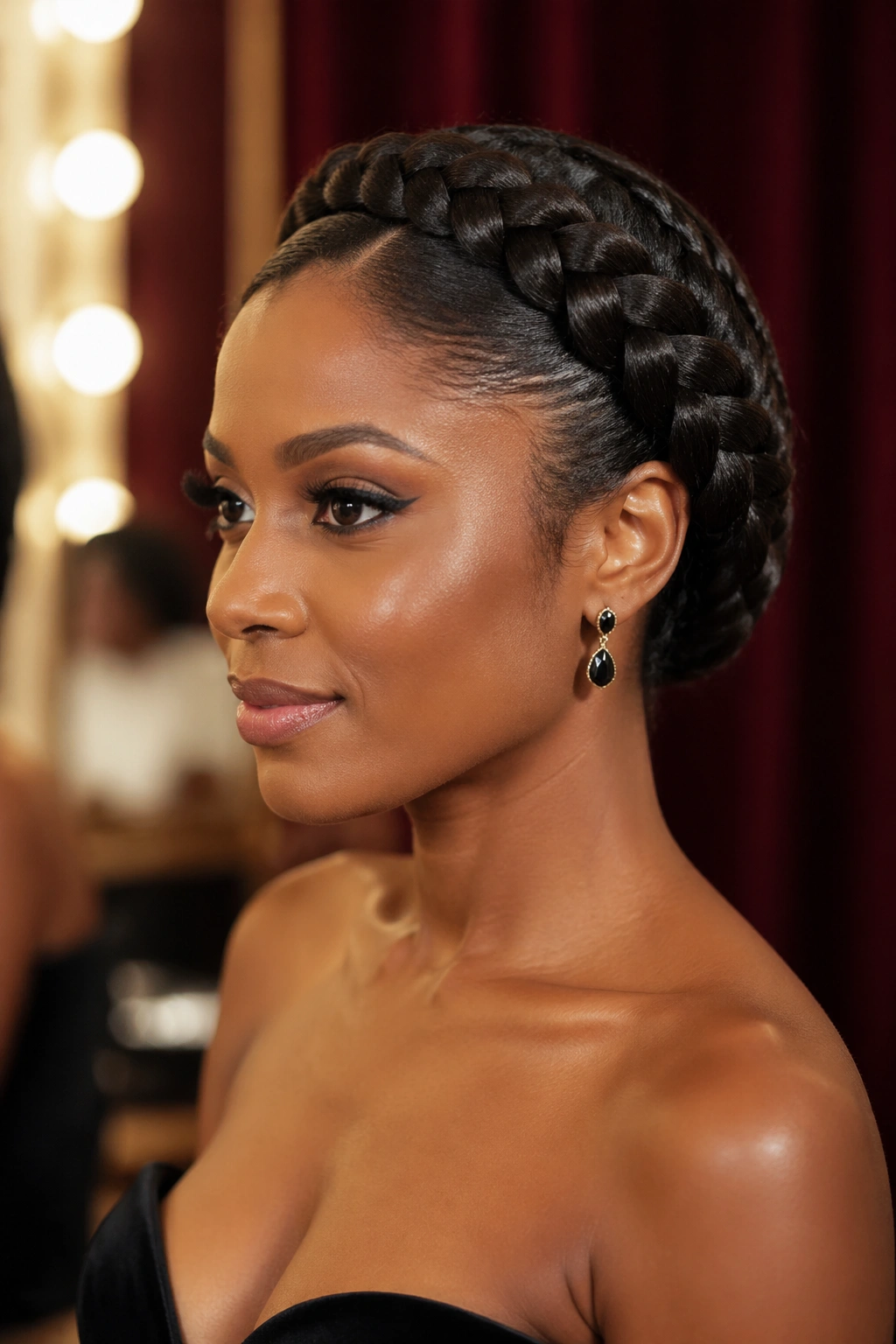
Why does a halo braid keep showing up at formal events? Because it gives you a full, finished frame without needing a heavy bun or a lot of extra height. It draws a clean circle around the face, then leaves the back quiet, which is a nice trick when your dress already has sparkle.
How to Wear It Without Looking Too Sweet
The mistake with halo braids is making them too soft and too round, which can push the look toward bridal or garden-party territory. For black-tie, the braid should be snug and a little sleek, with the ends tucked low and hidden near the nape. That keeps it elegant instead of sugary.
A side part works well if you want the look to feel less rigid. A center part makes it more formal and symmetrical. Either way, the braid should sit close enough to the hairline that it looks like part of the head shape, not a band placed on top.
Jewelry Pairing
- Long earrings work best when the halo is slim
- A bare neckline gives the braid room to stand out
- Hairpins with small crystals can be tucked near the nape if the dress is very simple
This one is quietly strong. It does not beg for attention, which is exactly why it earns it.
4. Side-Swept Feed-In Braid Knot
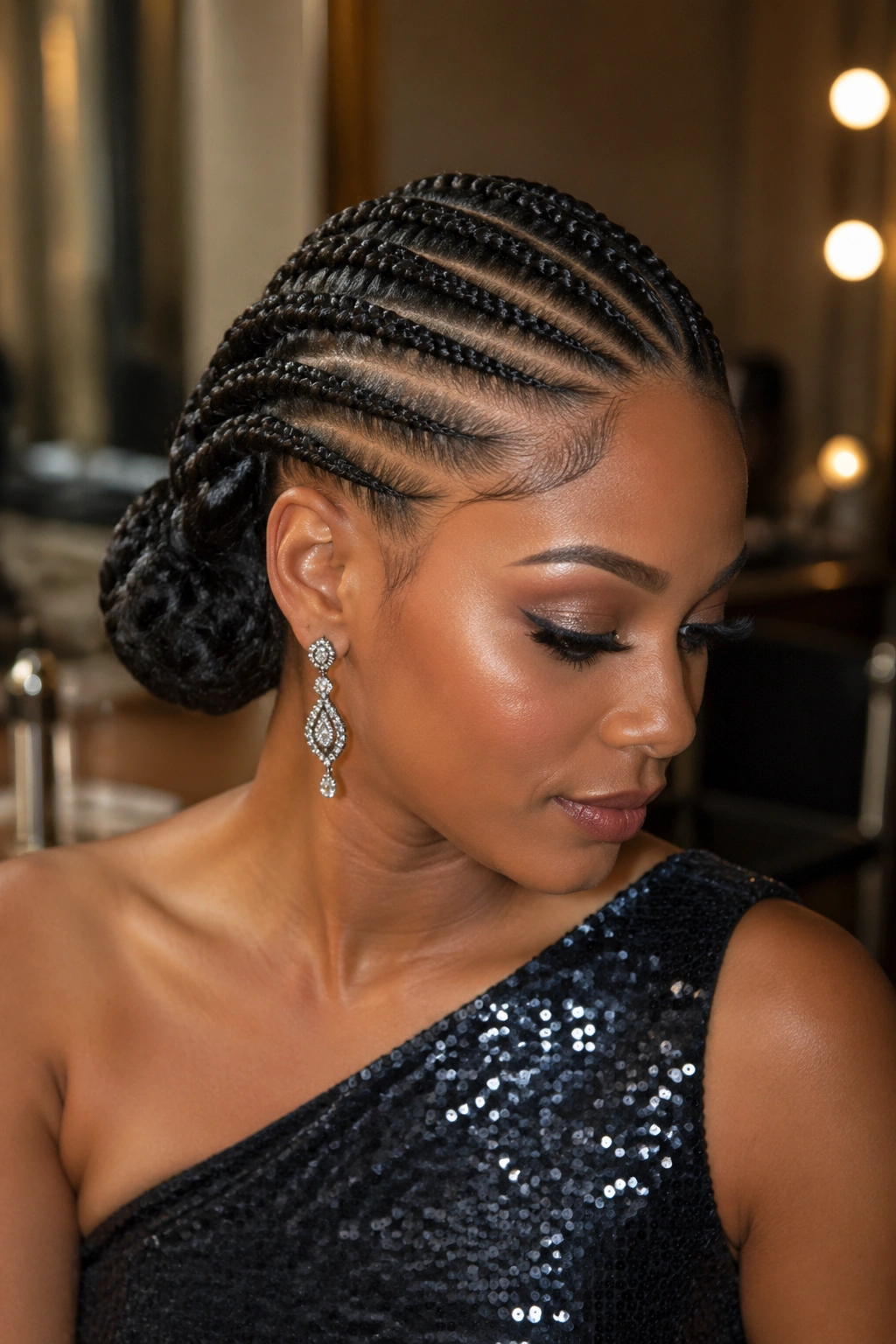
A one-shoulder gown needs hair with a little movement. A side-swept feed-in braid knot does that job better than a center-split bun ever could. It starts with a strong braid line near one temple, then sweeps diagonally toward the nape where the knot sits low and secure.
Feed-in braids make the front look clean without building a bulky ridge at the scalp. That is useful for formal hair because you want structure, not a helmet. The diagonal line also gives the face a lift. It sounds small. It is not.
What Makes It Work
- The braid begins thinner at the hairline and gets fuller as it moves back
- The knot sits just below the occipital bone, so it stays visible from the side
- One shoulder stays open, which keeps the dress in the conversation
- It works especially well with metallic dresses and statement cuffs
I like this style when the event has a little movement to it — cocktails first, dinner later, then a long stretch of sitting and standing and pretending not to check your reflection. The braid holds. The knot stays put. That matters more than people admit.
5. Braided French Twist
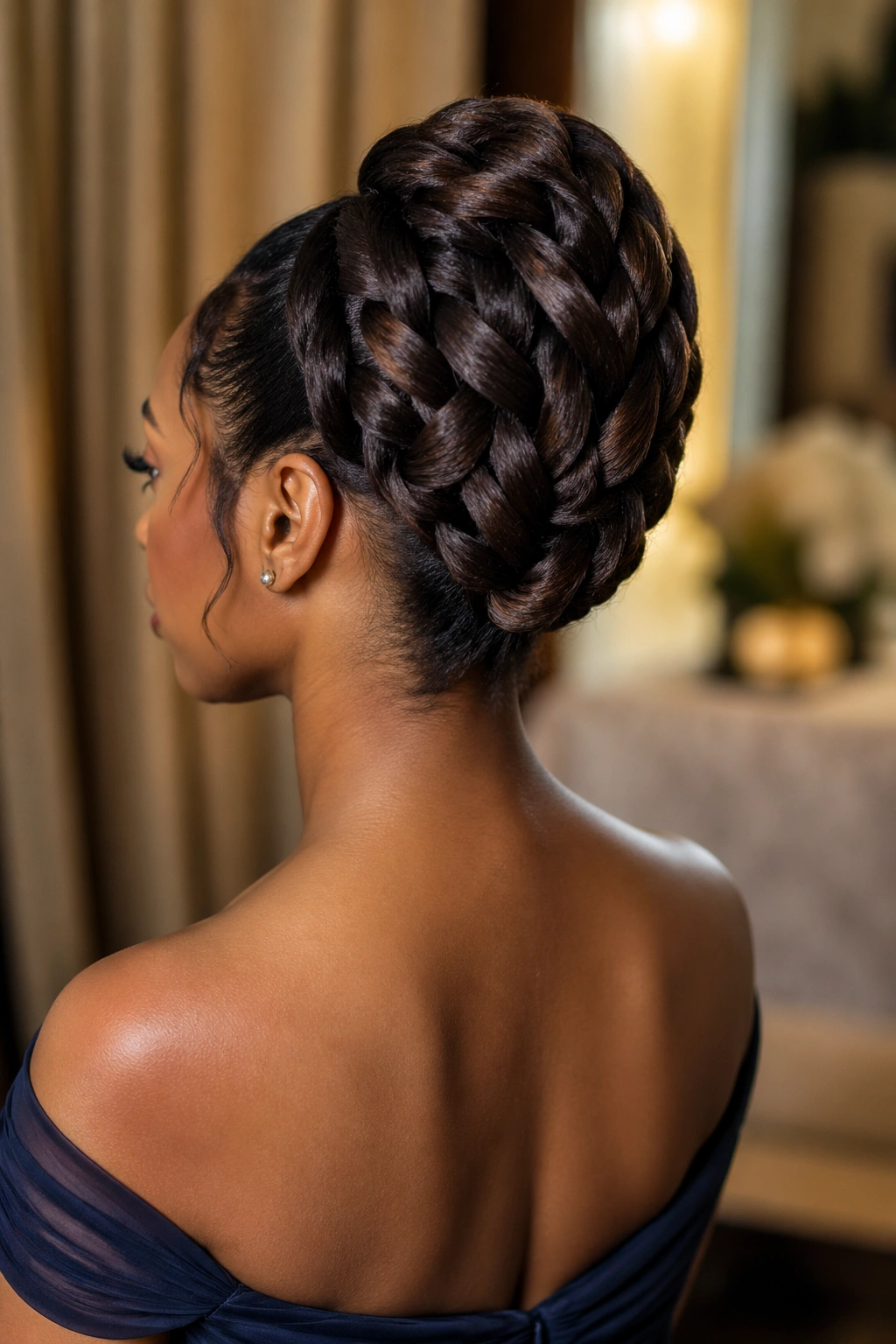
The braided French twist is a neat answer for anyone who wants something formal without a lot of visible fuss. It gives you vertical lift at the back of the head, which makes the neck look longer and keeps the style close to the body of the dress.
There is a reason the French twist hangs around. It flatters. Add braiding and it becomes less old-school and more textured, which is the right move for black-tie. The braid can run straight up the center before being tucked inward, or it can begin off-center and fold into the twist from one side. Both work. The choice depends on how much drama you want at the crown.
This style is especially good when the dress has a high collar or a tricky back detail you do not want to hide. It clears the shoulders cleanly. It also handles fine hair better than some fuller braided buns, because the twist creates lift without needing too much bulk.
A tiny detail, but a useful one: keep the twist narrow at the base. A wide twist starts to look heavy in photos. A slim one looks sharp from every angle.
6. Cornrow-to-Wrapped Bun
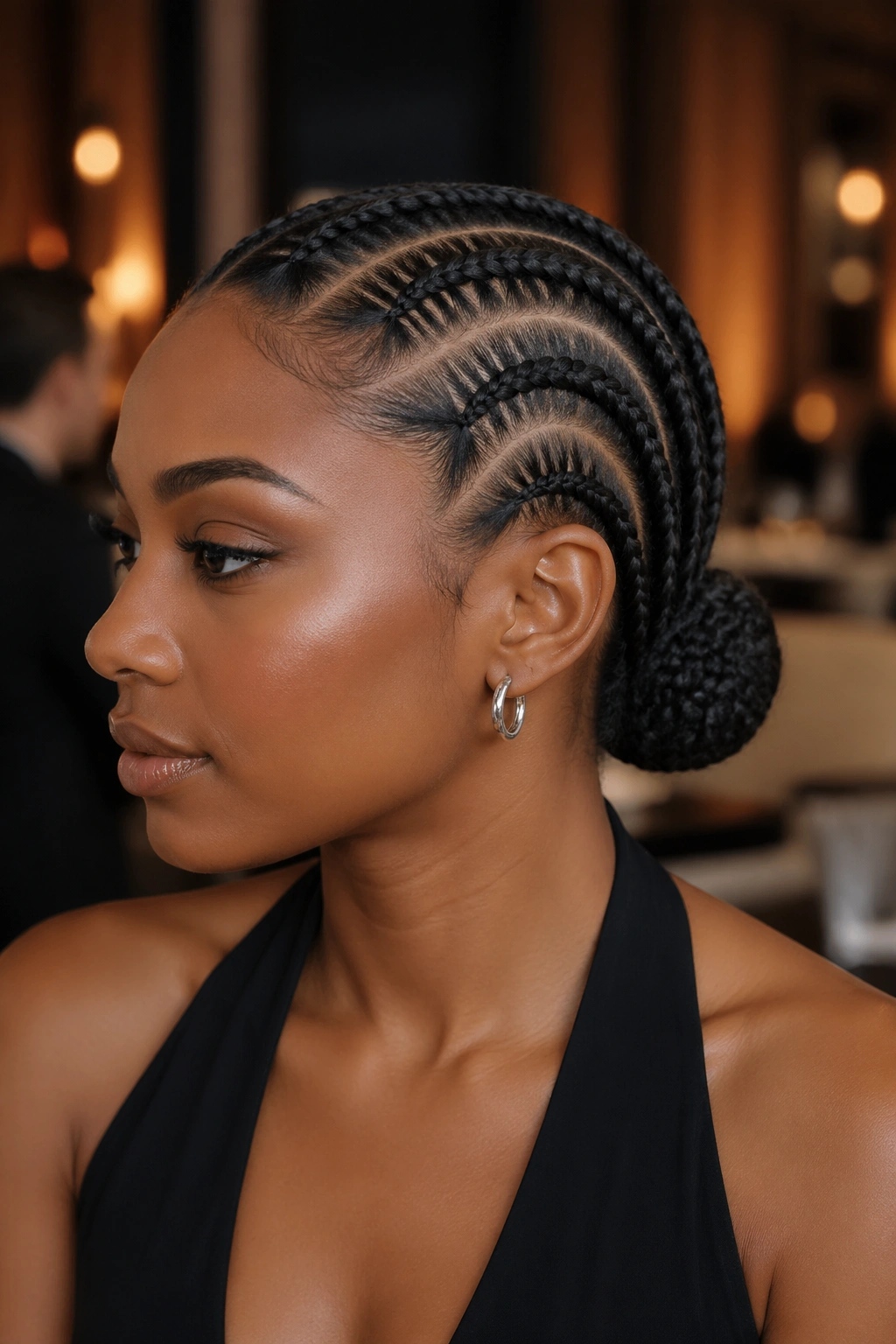
A plain bun can be nice. Cornrows feeding into a wrapped bun look more finished. The braid pattern builds the shape first, so the bun at the nape feels anchored instead of pinned on as an afterthought.
This style is a smart pick for thick hair, long hair, and anyone who wants something that can last through heat, humidity, and a long evening without needing a mid-event touch-up. Four to six straight-back cornrows usually give enough structure without making the scalp pattern too busy. The bun itself can be small and tight or a little fuller, depending on the dress.
If the event leans formal formal — ballroom, gala, black tie with a strict dress code — this is one of the strongest options. It is clean. It stays put. It keeps the face open.
And because the braid pattern does the heavy lifting, the bun does not have to be enormous to read well. That is the part I like most. The style feels intentional even when it is compact.
7. Goddess Braid Updo with Curled Ends
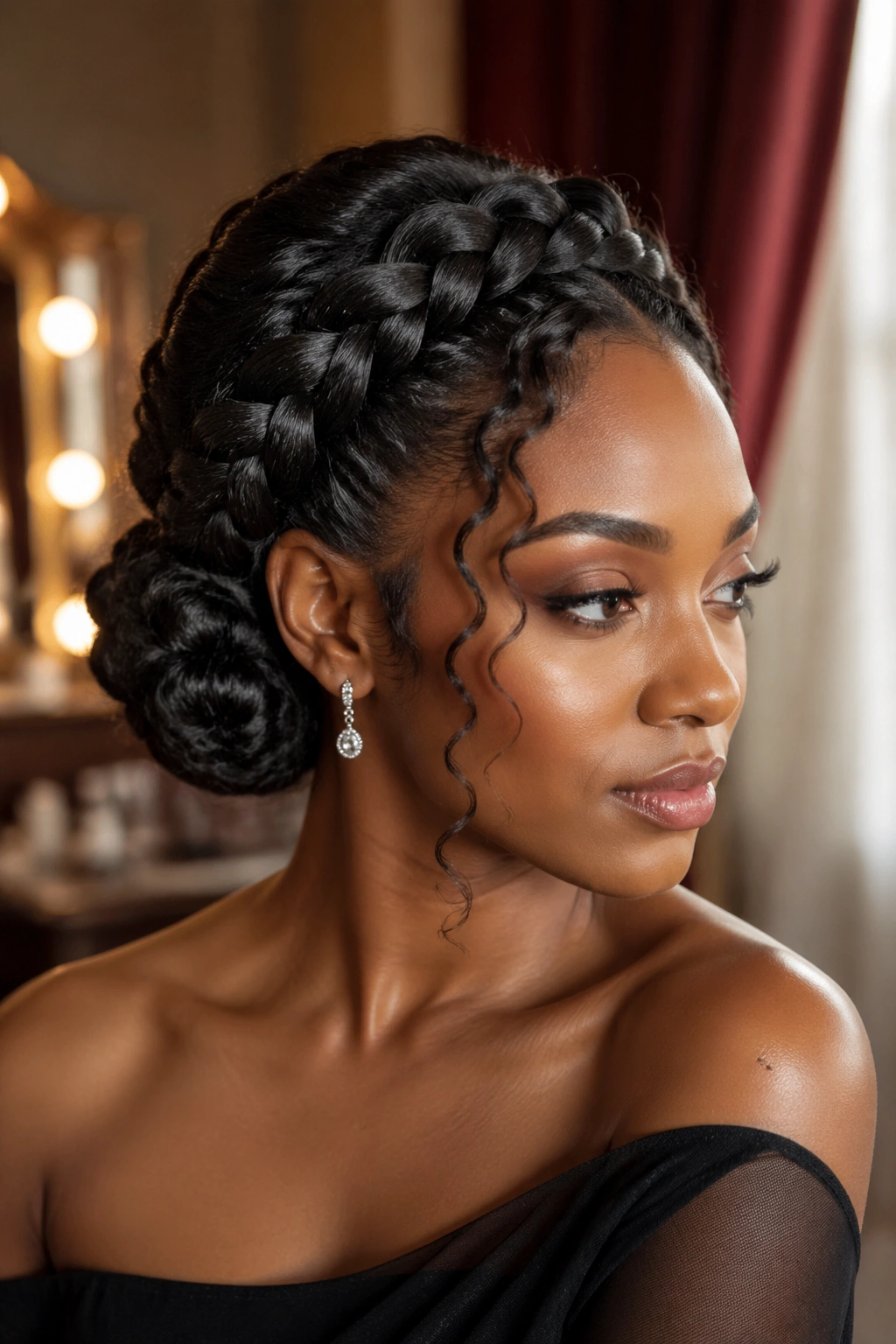
Softness can be formal. A goddess braid updo with curled ends proves it, especially when the dress is satin, velvet, or anything that already has a rich texture. The trick is keeping the braid base controlled while letting the ends bring a little movement near the face or at the nape.
Where the Softness Belongs
Curled ends should look placed, not random. If the curls are too tight, the style starts to feel dated. If they are too loose, the whole updo loses shape. I prefer a 3/4-inch curling iron or flexi rods set on damp extensions, then brushed lightly once the curls cool.
What to Ask for
- Braid the crown close to the scalp
- Leave one or two curled pieces to soften the front
- Pin the main bun low and smooth
- Use shine spray only on the finished braid, not the curls themselves
A style like this looks especially good with off-shoulder dresses because the curls echo the softness of the fabric near the collarbone. No need to overcomplicate it. The braid carries the formal part. The curls keep it from feeling severe.
8. Basket-Weave Braided Bun
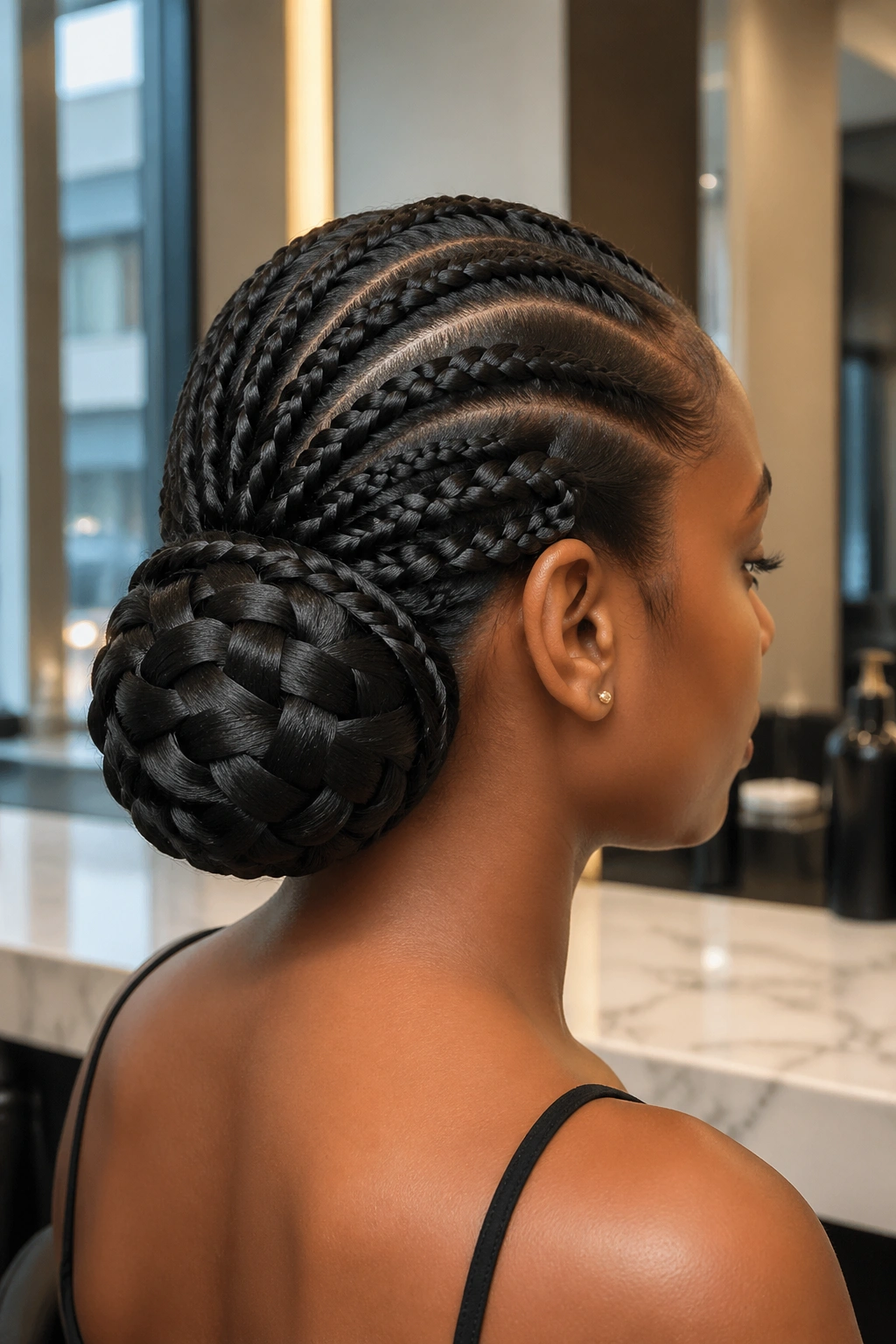
A basket-weave bun is not subtle. That is the point. The interlaced pattern gives the hair a woven, architectural look that feels right when the rest of the outfit is clean and simple.
This is one of those styles that can go wrong fast if the sections are uneven. The braid widths need to stay consistent, usually around half an inch to three-quarters of an inch, depending on hair density. Too many tiny strands and the design gets muddy. Too few and the weave loses its charm. I prefer this style on medium to long hair with enough grip to hold a crisp section.
It works best when the bun sits low or mid-low. A high basket-weave bun can start to look crowded. A lower placement keeps the pattern readable and lets the braids cross over each other in a neat, deliberate way.
Serious shine helps here. So does a flat part and a calm hairline. The whole style depends on the woven surface looking clear. If the parts are messy, the effect disappears.
9. Braided Ponytail Rolled Into a Chignon
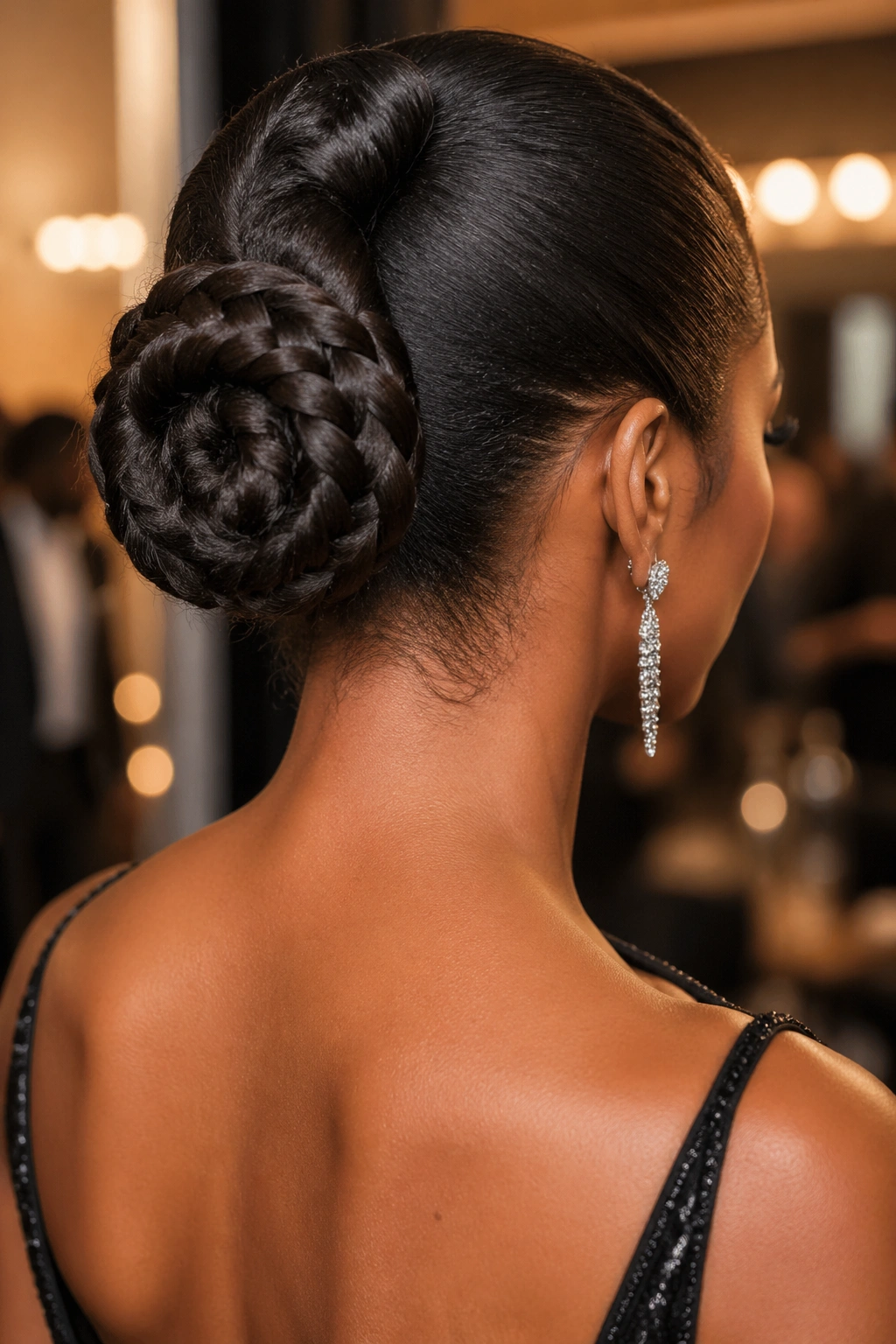
Some of the best formal braid styles start as a ponytail, not a braid crown. A braided ponytail rolled into a chignon keeps the shape compact and gives you a clean back view from every angle. It is a good choice when the dress back matters and you do not want hair swallowing it.
Why Stylists Reach for It
The ponytail base creates lift. The braid adds texture. The rolled chignon keeps the finish controlled. That combination is useful when hair is thick enough to feel heavy but you still want the back to sit close to the head.
A high ponytail version feels more dramatic. A low version feels more grounded and formal. For black-tie, I usually prefer the low one unless the dress has a very open back and wants a little height. The braid can be a single plait or a few smaller braids wrapped together before they are rolled into place.
What to Watch For
- Keep the elastic hidden with a wrapped strand
- Pin the roll from the inside so the outer braid stays visible
- Use a fine-tooth comb at the crown for a smooth finish
- Leave the tail just long enough to create a full coil
It is simple, but not plain. That makes it useful.
10. Double Dutch Crown with Low Knot
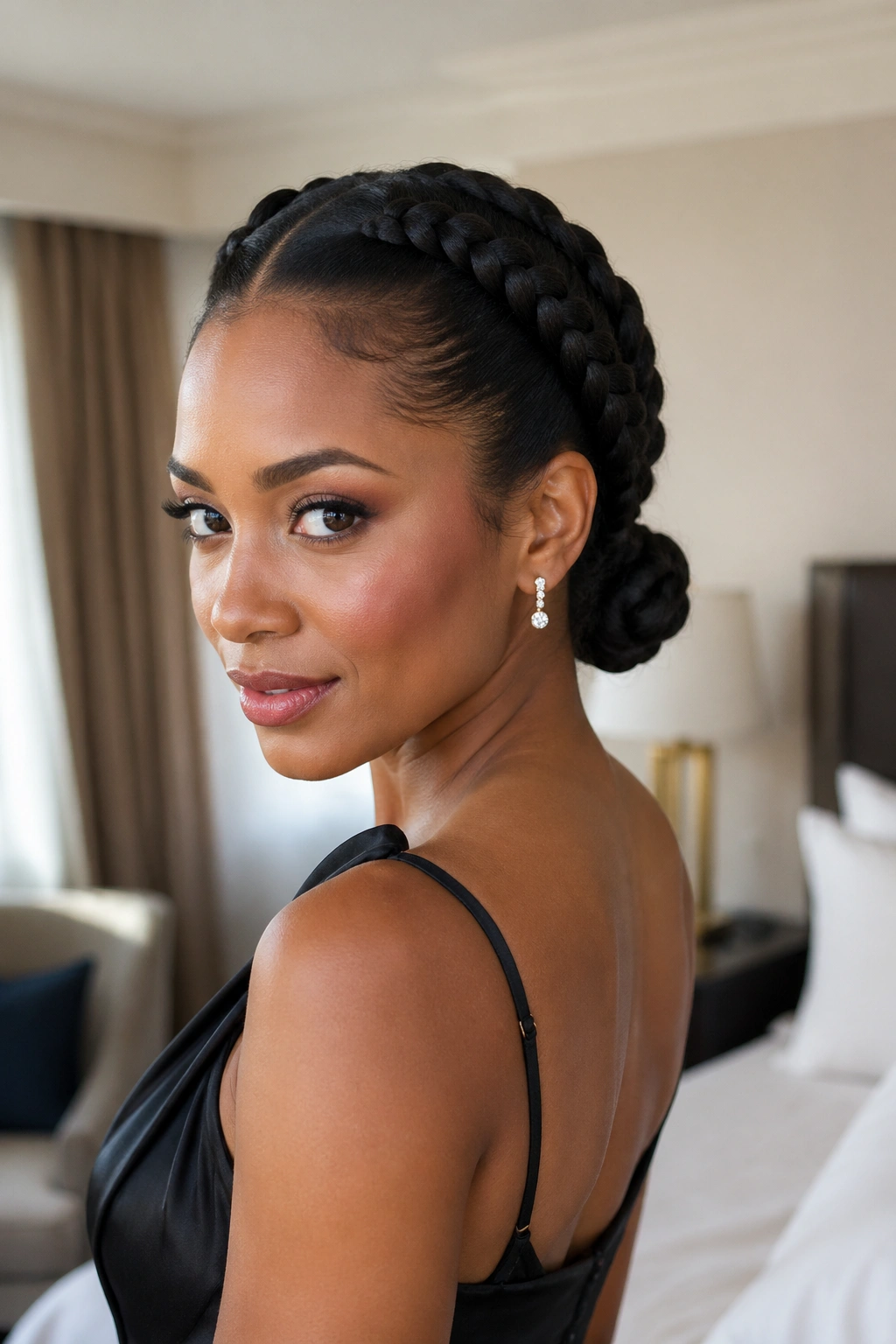
Two braids can look more formal than one when the lines are clean enough. A double Dutch crown with a low knot gives the head a balanced frame, then drops the rest of the shape into a knot at the nape so the style does not sprawl.
The double-braid setup is especially good for dresses with simple silhouettes. A clean column gown, a slip dress with structure, a sharp strapless shape — all of them benefit from the symmetry. The braids sit like rails along the sides of the head, which helps keep the face framed without crowding the cheeks.
I also like this one for hair that needs real staying power. Dutch braids are raised, so they hold their shape better than a flat braid when the evening goes long. Once the two braids meet at the back, the knot can be tucked tightly and pinned from underneath.
A small detail changes everything: keep the braid widths matched from front to back. Uneven sides make the whole look feel accidental.
11. Braided Mohawk Updo
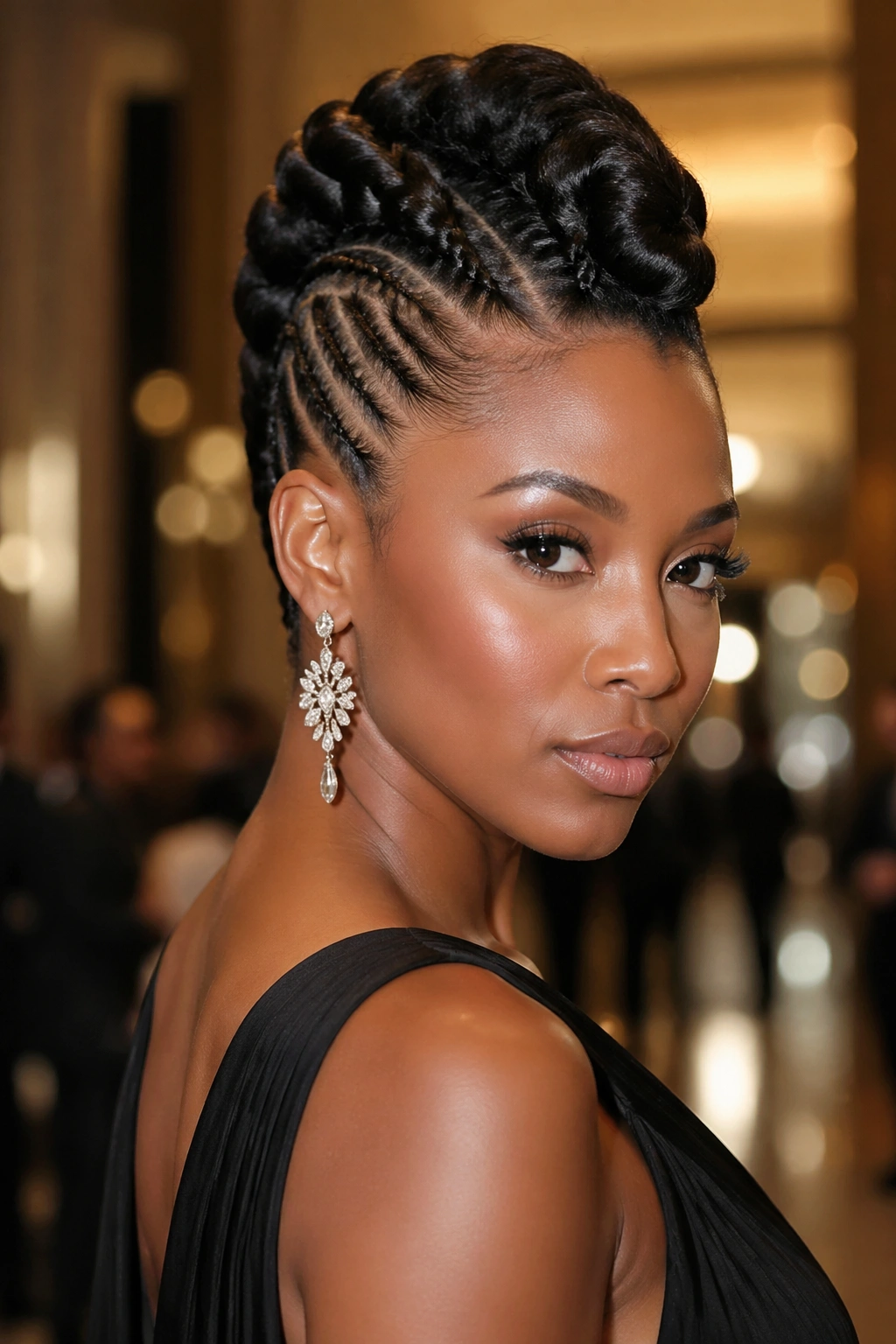
A braided mohawk updo is for the person who wants formal hair with edge. It lifts the center of the head and smooths the sides tight, which creates a strong line that works especially well with strapless gowns, deep necklines, and sharp earrings.
Unlike a soft bun, this style brings some height. That matters if your dress is long and sleek, because the hair needs to keep up. The braid can run straight down the middle or sit in several connected ridges, then get pinned into a knot or folded shape near the back. The sides stay close to the head. No puff. No looseness.
Best Uses
- Dramatic earrings
- Sleek gowns with little embellishment
- Natural hair that benefits from controlled tension
- Events where you want a bolder profile in photos
This style has attitude, but it still belongs at a black-tie event if the finish is smooth. The whole trick is restraint on the sides. Too much looseness and it turns casual. Keep the edges clean and the center structured, and it does its job beautifully.
12. Rope Braid Halo Bun
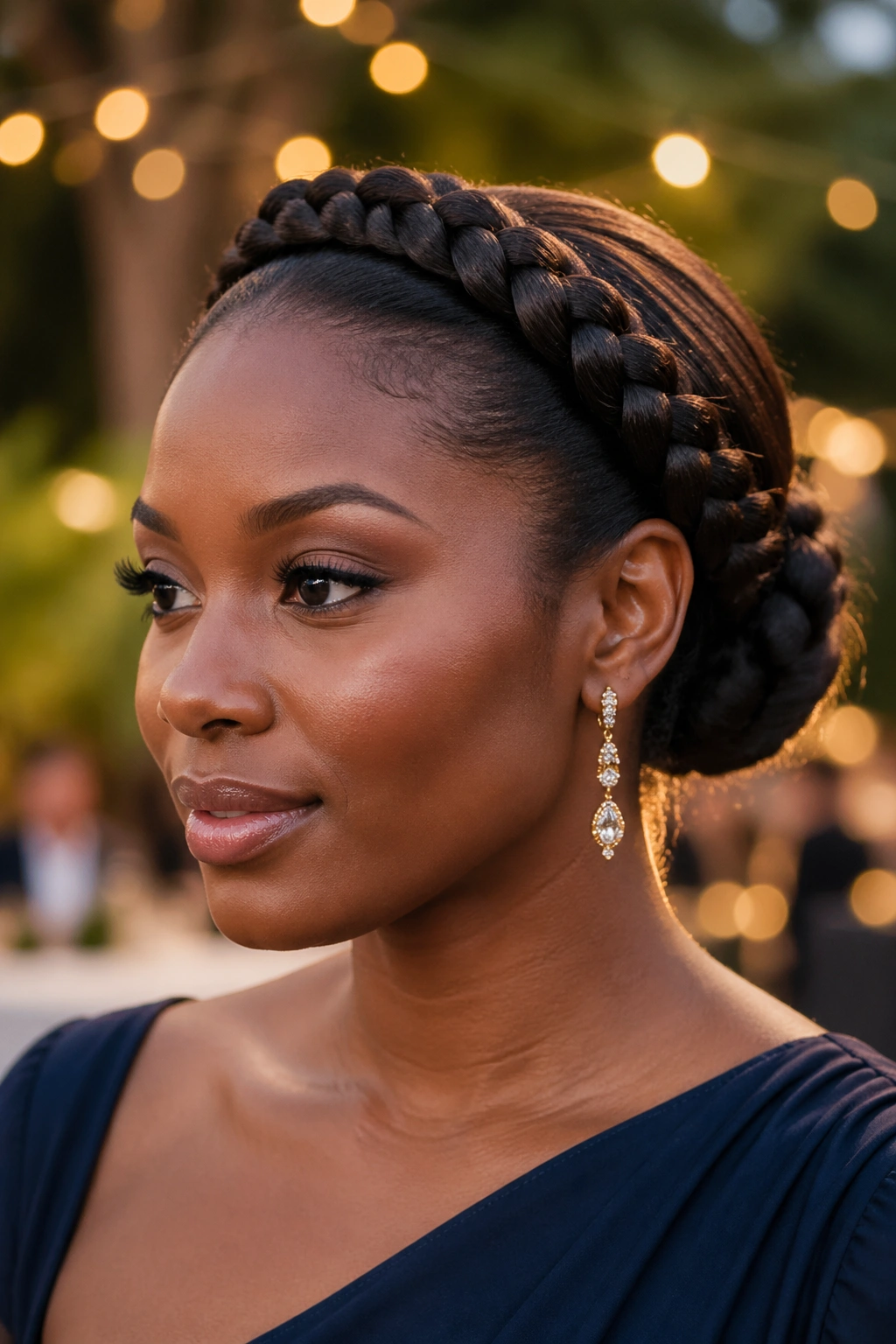
Rope braids do not get enough attention. They look tighter and smoother than many three-strand braids, which is one reason they work so well for formal hair. A rope braid halo bun wraps that smooth texture around the head, then tucks the rest into a bun or coil at the back.
Why Rope Braids Look So Sharp
The twist pattern catches the eye in a narrow line, so the braid reads neat even when the hair is not extremely thick. That makes it good for finer textures or for anyone who wants less visual bulk around the crown. Rope braids also sit close to the scalp in a way that feels deliberate, almost tailored.
How to Keep It Strong
- Twist each section tightly before crossing them
- Apply a light cream first so the strands do not fray
- Pin the bun low and conceal the anchor points
- Smooth the front hairline with a small brush, not a heavy hand
This is a strong choice when the dress is detailed and the hair should not compete. It is tidy without feeling stiff. That balance is hard to fake.
13. Fishtail Braid Folded Bun
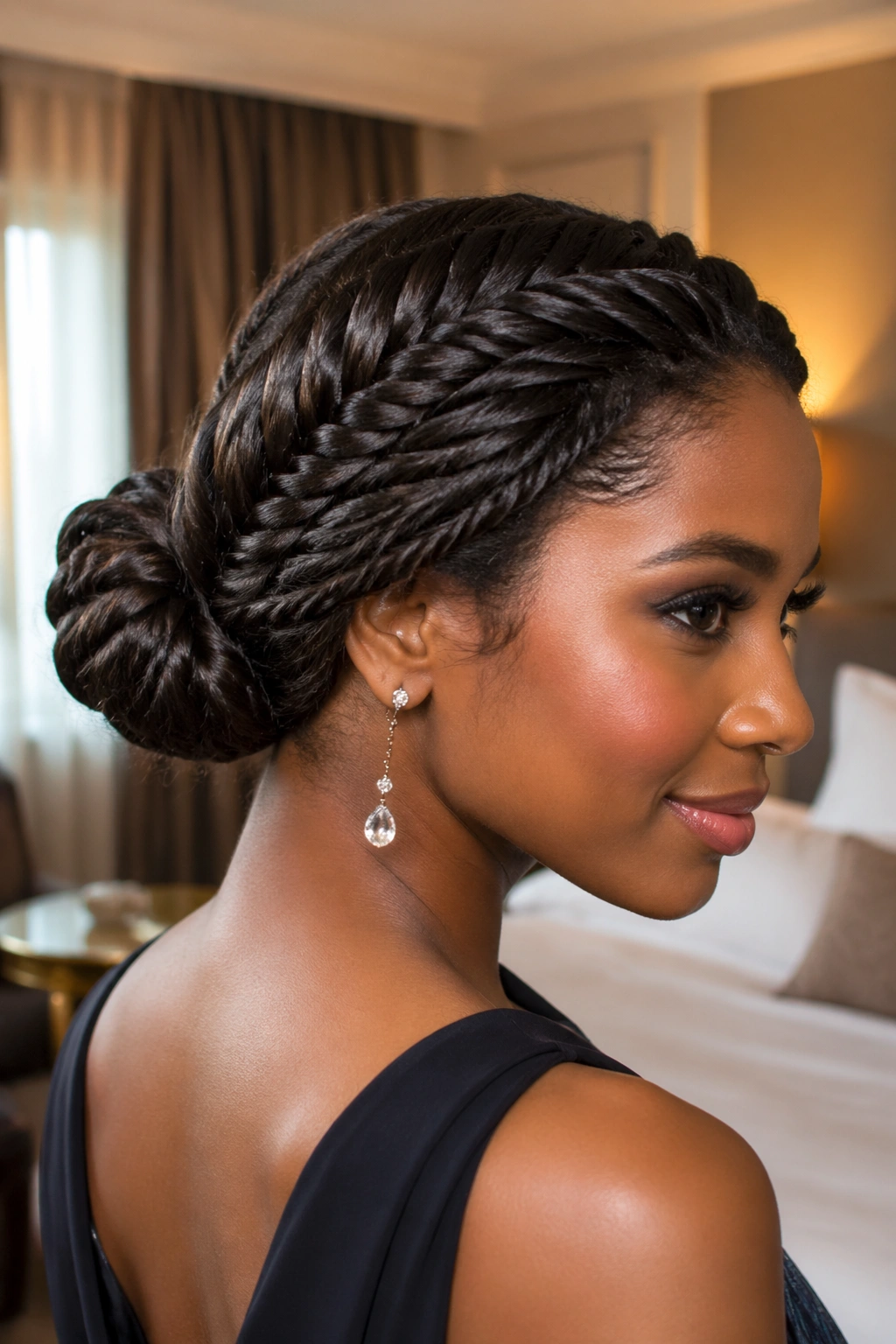
A fishtail braid changes the texture immediately. Even when it is folded into a bun, the weave looks finer and more intricate than a standard plait, which makes it a good match for evening wear.
The main thing to know is that a fishtail needs patience and even tension. If the sections drift, the braid starts to look fuzzy rather than refined. I prefer this style when the hair has some length, because a longer tail gives you a fuller fold at the back. Once the braid is finished, fold it upward or into a low looped bun and pin it flat.
The payoff is in the texture. From a few feet away, it looks almost like a woven ribbon. Up close, it gives the hair more depth than a regular braid. That can be enough to make a simple black dress feel considered without needing extra accessories.
Keep the rest of the hair calm. A fishtail already brings enough detail. No need to crowd it with too much volume near the top.
14. Stitch-Braid Sculpted Bun
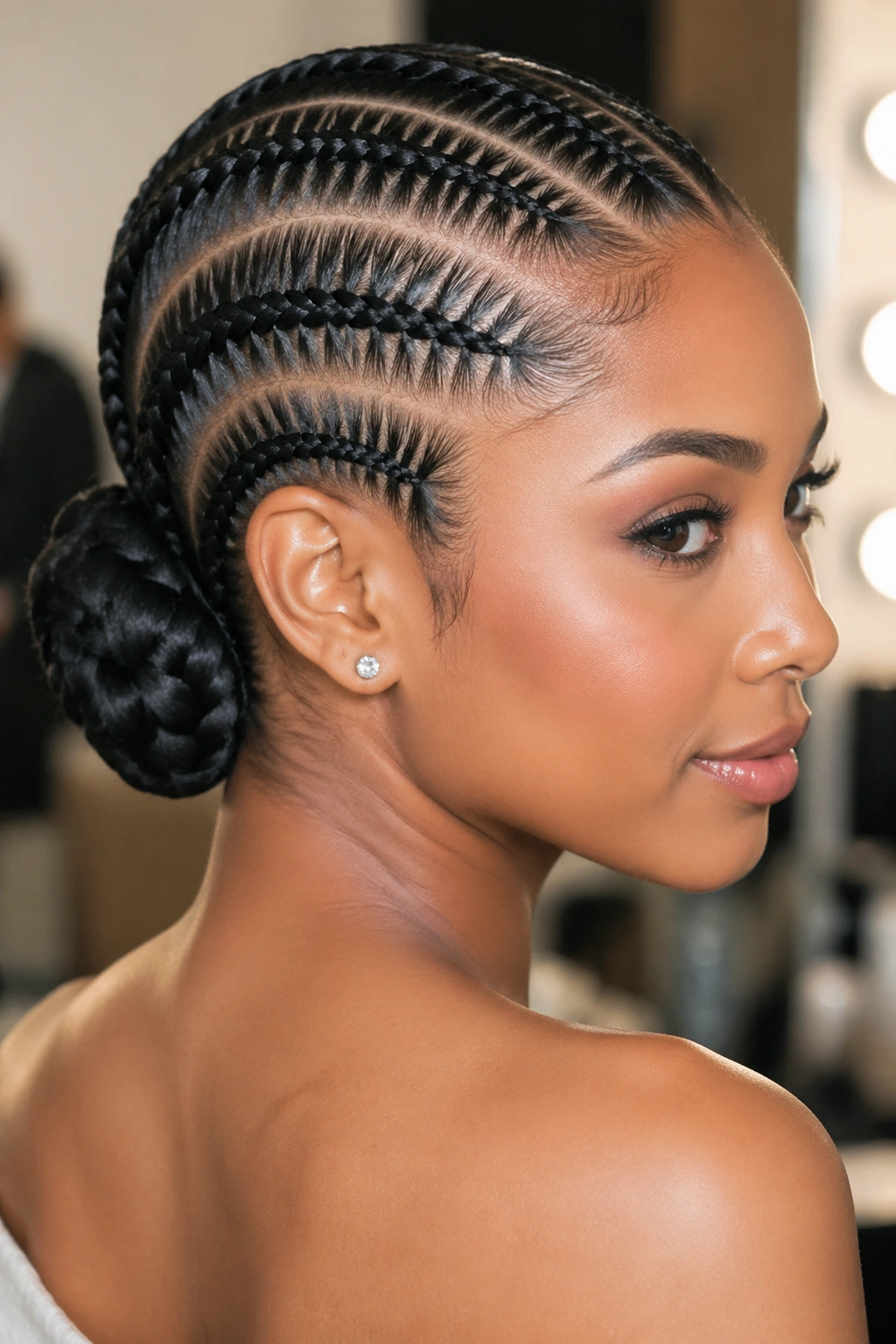
How do you make a braid look formal instead of sporty? Use stitch braids and keep the sections crisp. The stitched look creates graphic lines at the scalp, and those lines become the whole point when they feed into a sculpted bun.
What Makes the Stitch Show
The parting is the star here. You need clean sections, a rat-tail comb, and enough gel to keep the rows sharp. Stitch braids are built by placing the comb in even, narrow moves, which makes the braid pattern visible instead of soft. That sharpness is what pushes the look into black-tie territory.
A sculpted bun works best when the braids are gathered low and wrapped into a compact coil. If the bun gets too loose, the stitch detail on top loses its contrast. If it stays tight, the whole head looks controlled from front to back.
My Favorite Finish
- A light sheen spray on the braid lengths
- A matte edge control at the hairline
- Hidden pins that stay under the bun
- Earrings that are bold but not huge
This style has a lot of shape, but not much fuss. That is a good thing. It gets the job done.
15. Double-Braid Side Knot
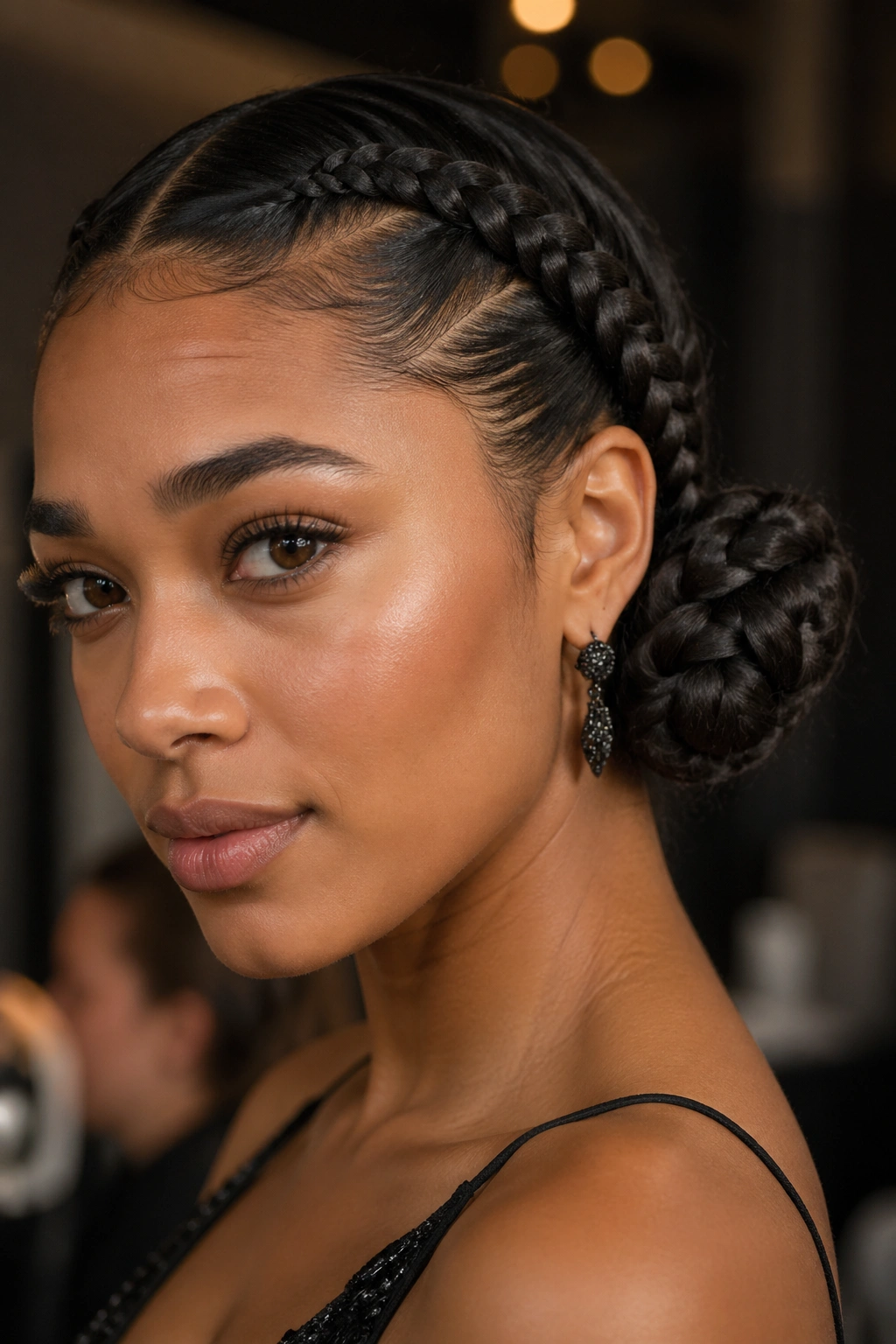
A double-braid side knot is one of those styles that quietly fixes the whole outfit. If your dress has a plunging back, asymmetrical neckline, or a shoulder detail that deserves room, this braid updo keeps the line open and the shape off to one side.
You can think of it as a conversation between two braids. They start apart, travel toward the same side, then gather into a knot near the ear or just behind it. The result feels relaxed on purpose, which is harder to pull off than people think. For black-tie, the key is keeping the knot low enough that it does not fight the neckline.
Key Details
- Braids should be tight at the base and looser through the length
- The knot needs enough pins to hold, because side styles shift more than center styles
- A smooth crown helps the side placement feel deliberate
- One tucked curl near the front can soften the face if the dress is severe
This style is good when you want movement but not chaos. There is a difference, and it matters.
16. Braided Puff Updo
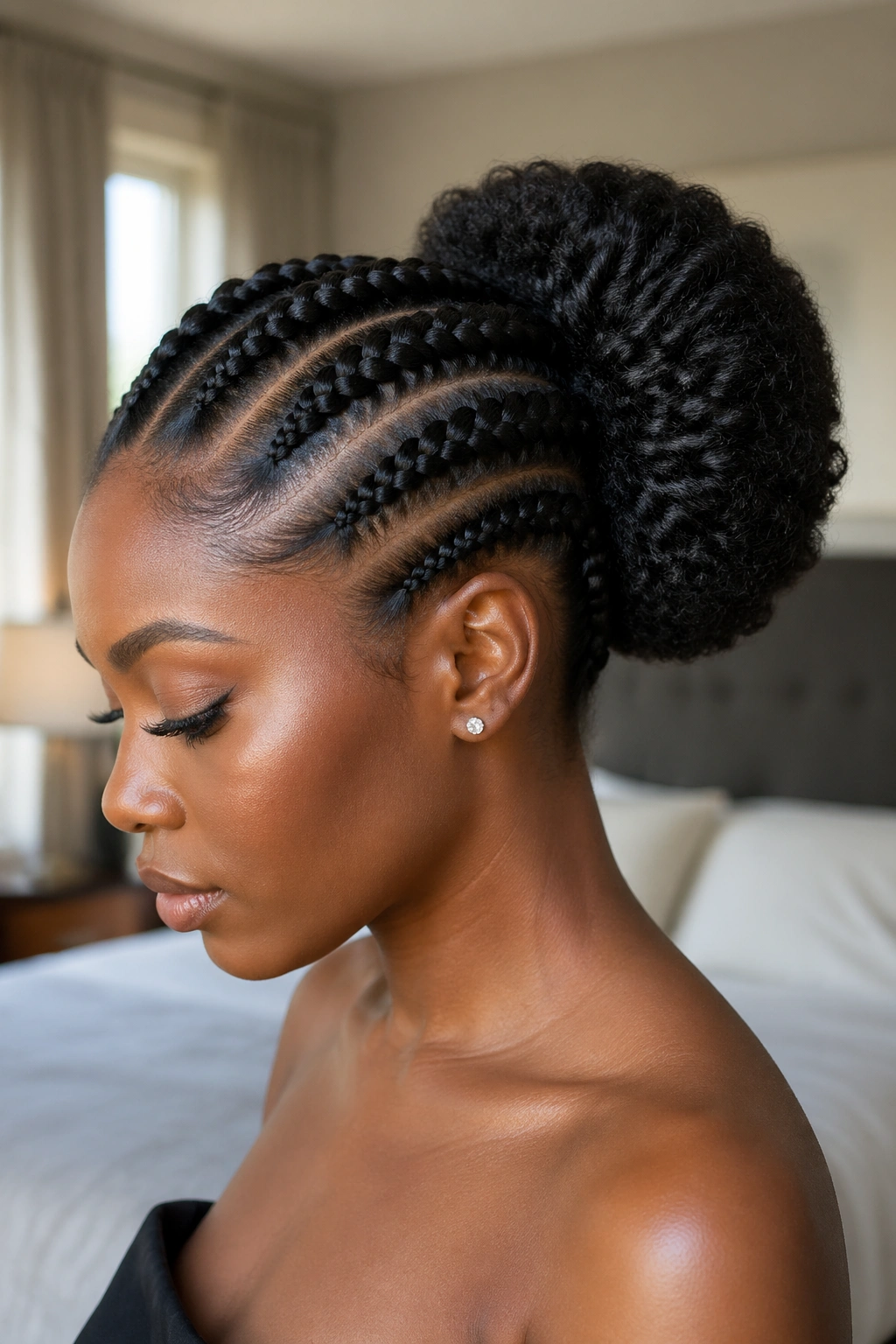
A puff can be formal when the front is controlled. That is the part most people miss. A braided puff updo keeps the crown or sides braided flat, then lets the puff sit higher or farther back so the texture feels intentional instead of casual.
This style is especially strong for natural hair because it respects volume instead of fighting it. The front braids can be cornrows, side braids, or a braid that sweeps from the hairline into the puff base. The puff itself should be shaped, not just gathered. A satin scarf overnight helps. So does stretching the hair before styling.
The best versions look full but not loose. You want a round silhouette with a clean base and a defined edge around the puff. If the hair at the front frizzes out, the whole thing starts to read like a daytime look. Keep that front section neat, and the updo can absolutely hold its own at a formal event.
A little sheen spray helps. Too much, and the puff collapses. Light hand. Better result.
17. Microbraid Tucked Shell Bun
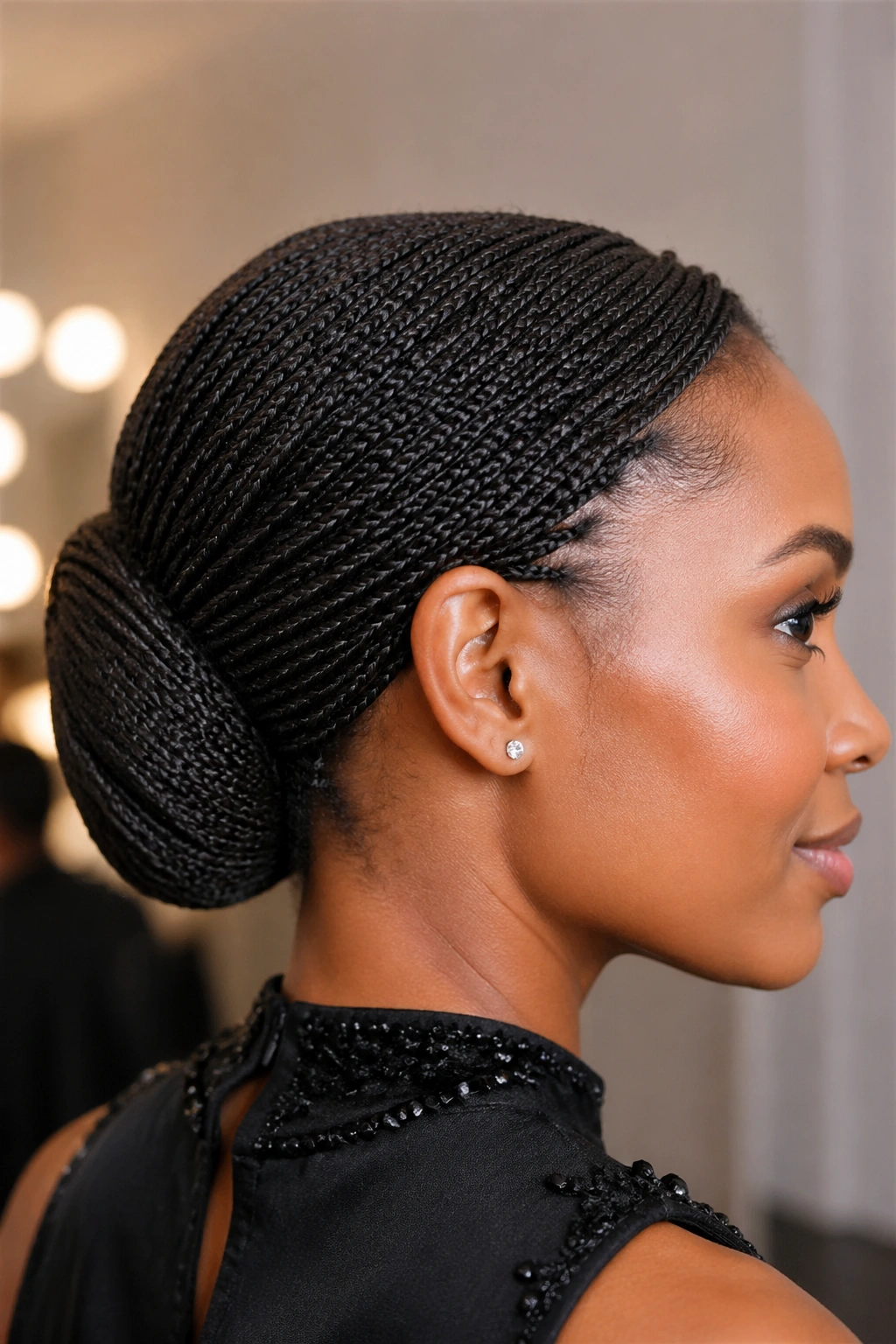
Microbraids can do something larger braids cannot: they create a surface that reads almost like fabric. A microbraid tucked shell bun feels elegant because the texture is fine, dense, and uniform. From a distance, the bun looks smooth. Up close, it has a soft woven pattern that keeps it from feeling flat.
This style works well when you want a compact shape that sits close to the head. The shell-bun finish tucks the braids inward in a curved roll, which gives the back a graceful arc. It is a strong option for high necklines, detailed collars, and dresses with a lot going on at the shoulders.
The main thing is restraint. Microbraids already bring plenty of detail, so the bun itself should stay low and clean. A huge bun can swallow the texture. A tighter one lets the braid work shine through. Use pins generously under the curve, then check the shape from the side before you leave the house. That side view is where this style either works or falls apart.
18. Zig-Zag Part Braided Updo
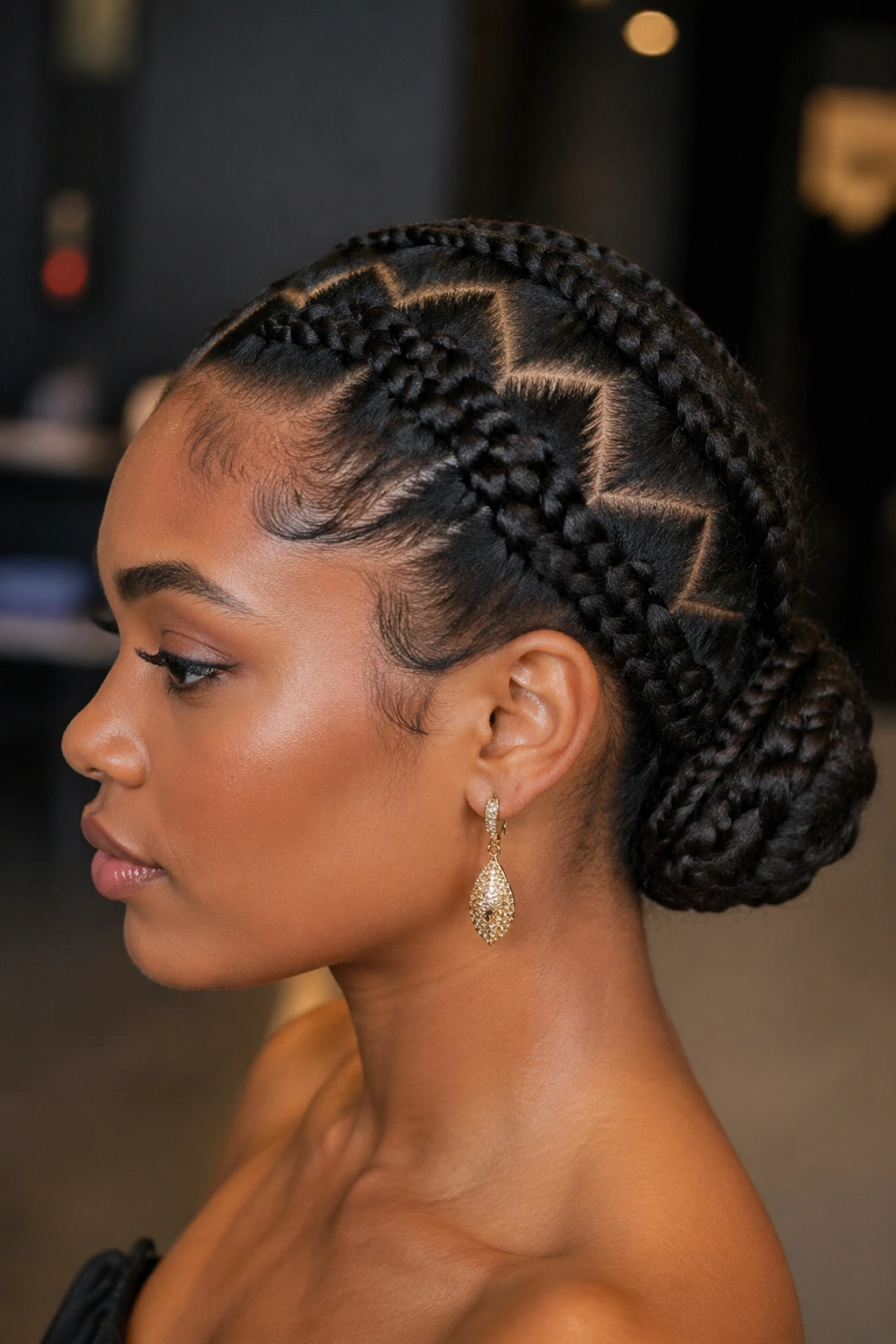
A zig-zag part is a small detail that changes the mood fast. It gives a braided updo a sharper, more styled look before the braid even starts. That matters for black-tie, where the hair should feel planned from the scalp out.
When the Part Becomes the Statement
The zig-zag should be clean, not jagged. Draw it with a rat-tail comb on damp or slightly damp hair so the lines stay visible. Once the part is set, braid the sections into a low bun, a side knot, or a wrapped shape at the nape. The part does most of the visual work, so the rest of the style can stay fairly simple.
Best Pairings
- Sleek satin gowns
- Sharp blazers with wide lapels
- Statement necklaces with open collars
- Natural hair that holds a crisp part well
The nice thing about this look is that it adds interest without needing extra decoration. No clips. No extra shine dust. The part pattern is enough. If you like hair that looks deliberately styled from every angle, this one earns a spot near the top of the list.
19. Soft Side-Swept Braid Bun
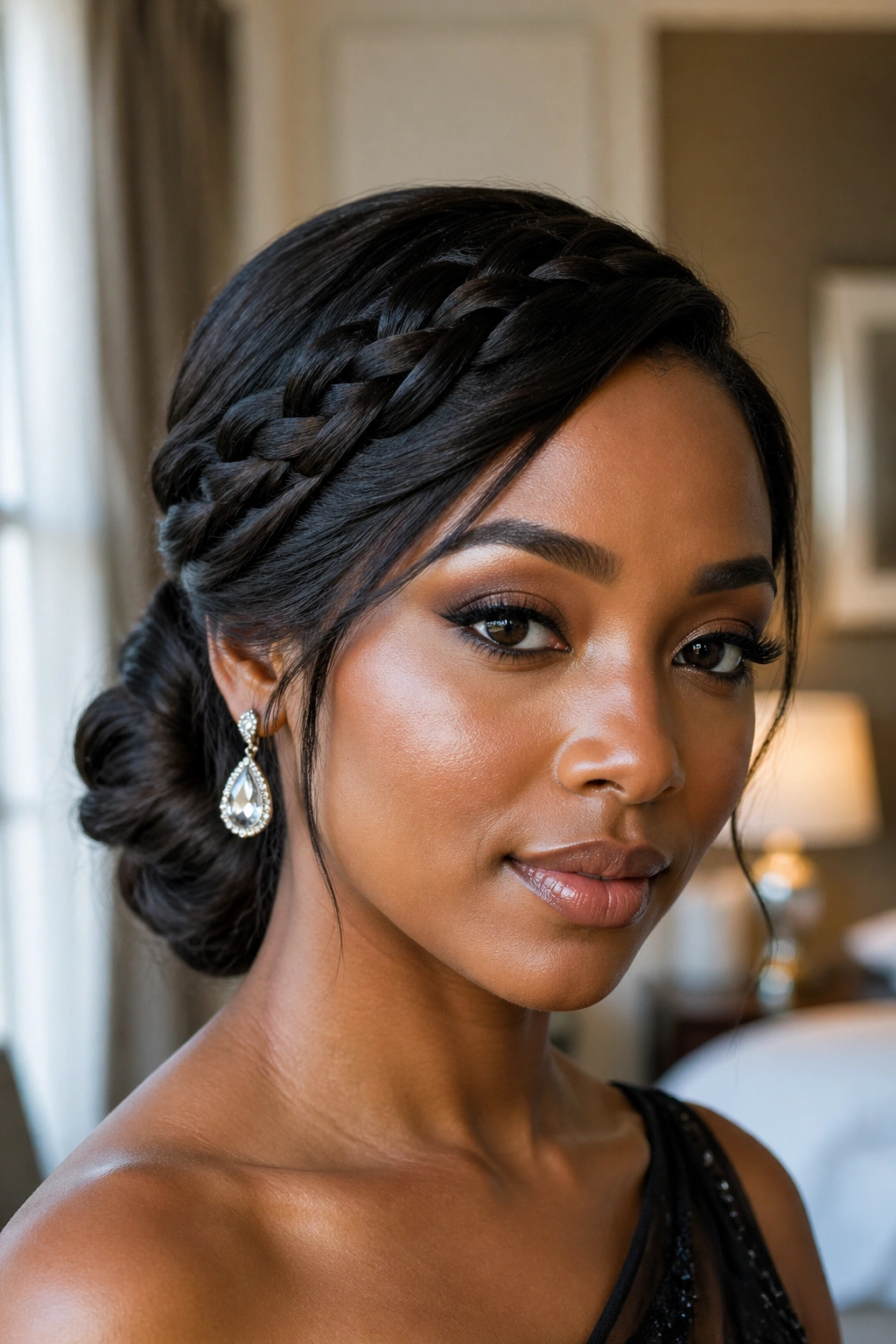
If I had to pick one braid updo that flatters almost every black-tie neckline, I’d start here. A soft side-swept braid bun gives you shape, movement, and a little romance without turning the head into the main event.
The braid begins off to one side, curves across the crown, then gathers into a low bun that sits just behind the jawline or at the nape. That slight diagonal does a lot of work. It draws attention to the face, softens a strong shoulder, and leaves enough space for earrings to matter. It also plays nicely with gowns that have beading or an interesting back, because the hair stays close and controlled.
I like this style when the rest of the look already has texture. Lace dress? Good. Velvet? Even better. A clean braid and a soft bun keep the whole outfit from feeling too hard. And if you want a touch of movement, leave one narrow side piece loose and smooth it with a little cream instead of letting it frizz.
For most black-tie events, that is the sweet spot: neat enough to look formal, soft enough to feel human.
