



A fishtail braid gets prettier when it loosens up. The tight, school-photo version can look stiff fast, while a slightly rumpled one has movement, shadow, and that soft ropey texture people keep reaching for when they want hair to feel styled but not overworked.
The trick is not to make it sloppy. You still want the weave to read clearly, but the sections can be uneven, the crown can lift a little, and a few face-framing pieces can fall where they want. That little bit of disorder is doing a lot of the heavy lifting here.
Second-day hair helps. So does a dusting of dry shampoo at the roots, a few quick bends from a flat iron if your hair is pin-straight, and a refusal to fuss over every strand like it needs to obey military rules. Tiny shifts matter.
Some versions work for errands, some for weddings, and some for those days when your hair has already decided to do its own thing. Start with the classic pulled-apart braid; once that shape makes sense, the rest becomes much easier to read.
1. The Classic Messy Fishtail Braid
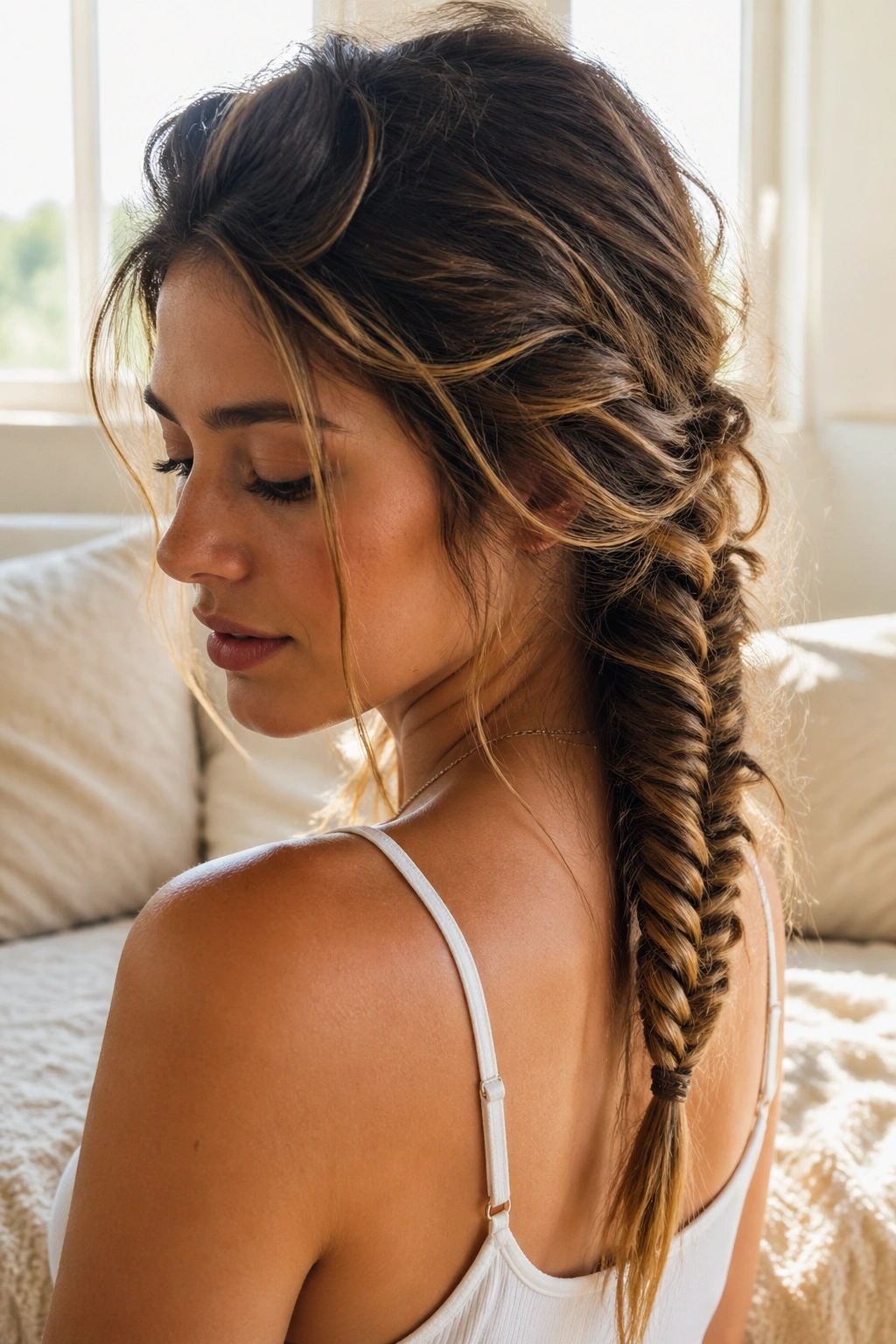
This is the version that teaches your hands the braid. Split the hair into two sections, take a skinny piece from the outside of one side, cross it over, then switch sides until the tail forms. Once the elastic is in place, tug the braid apart a little—not every loop, just enough to blur the edges and soften the line.
Why It Looks Softer Than a Tight Fishtail
A neat fishtail braid can look sharp in a way that feels a bit formal. The messy version keeps the braid pattern visible, but the pulled-apart loops give it a thicker, fuller look that sits better against real hair texture.
Use it on hair that has a little grip. Day-old hair, lightly waved hair, and hair with a bit of dry shampoo are easier to handle than glassy-clean hair that slips through your fingers. Tiny pieces stay tiny when the hair has some texture to hold them.
- Best on medium to long hair.
- Works well with a 1-inch clear elastic.
- Easier to fluff if you leave 2 to 3 inches at the ends unbraided.
- A tail comb helps, but your fingers work fine.
Pro tip: Pull the braid apart from the outside loops first. If you yank the middle too hard, the braid falls flat fast.
2. The Side-Swept Messy Fishtail Braid
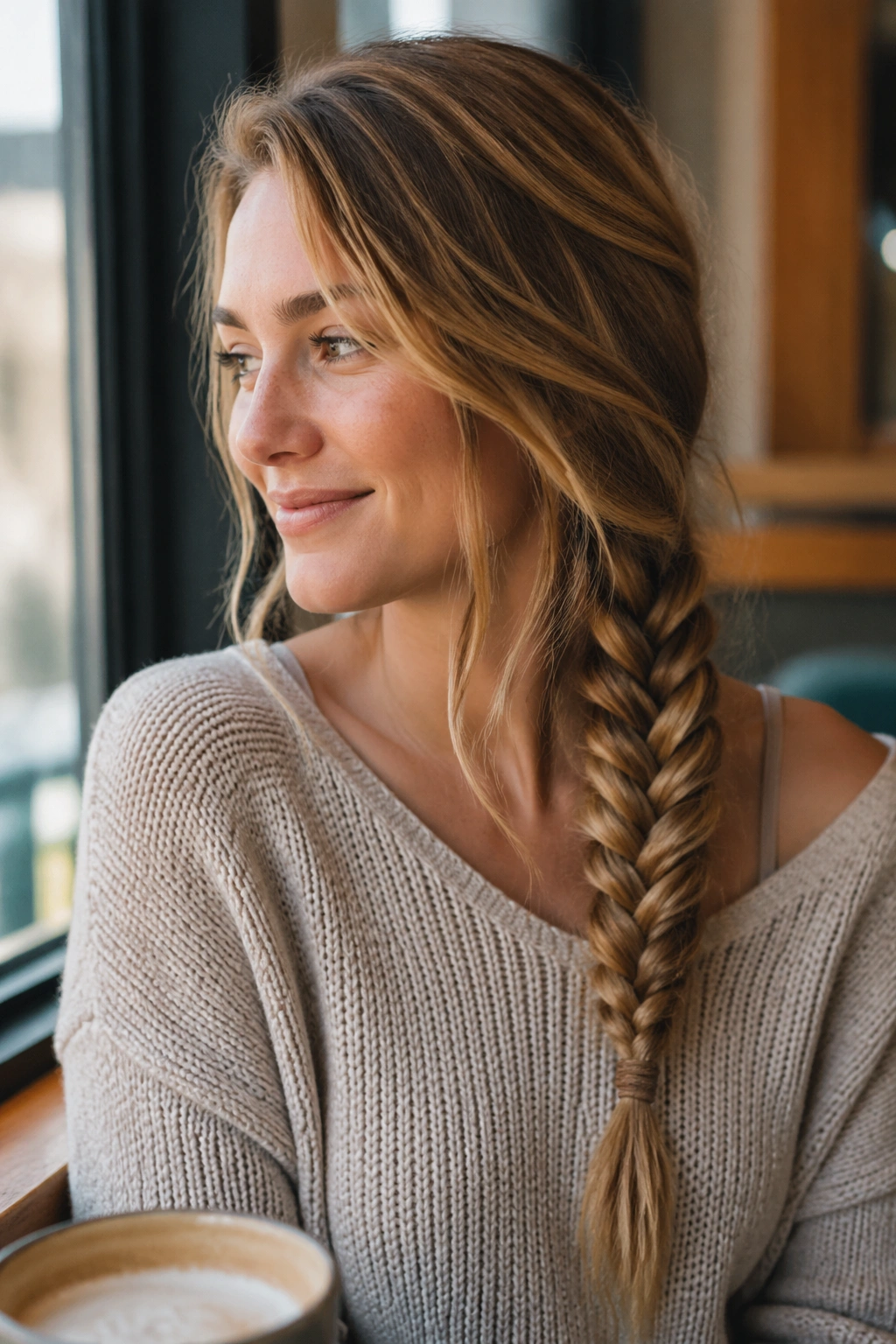
Side-swept braids do one smart thing: they make asymmetry look deliberate. A fishtail falling over one shoulder feels softer than one hanging straight down the back, and the off-center line gives the whole style a little more movement.
The trick is to start with a deep side part or to gather the braid just behind one ear. From there, keep the weave loose at the crown and let the braid dip over the collarbone instead of clinging to the neck. That drop changes the mood immediately.
It’s also forgiving if one side of your hair always behaves better than the other. Pull the more cooperative side into the braid first and leave the troublemaker side a touch looser near the face. The imbalance stops looking like a problem and starts looking like style.
If you want the braid to feel lived-in instead of polished, tuck one bobby pin under the base and hide it under a thicker loop. A side-swept fishtail does not need a lot of extra help. It needs one good sweep and then a light hand.
3. The Low Messy Fishtail Braid at the Nape
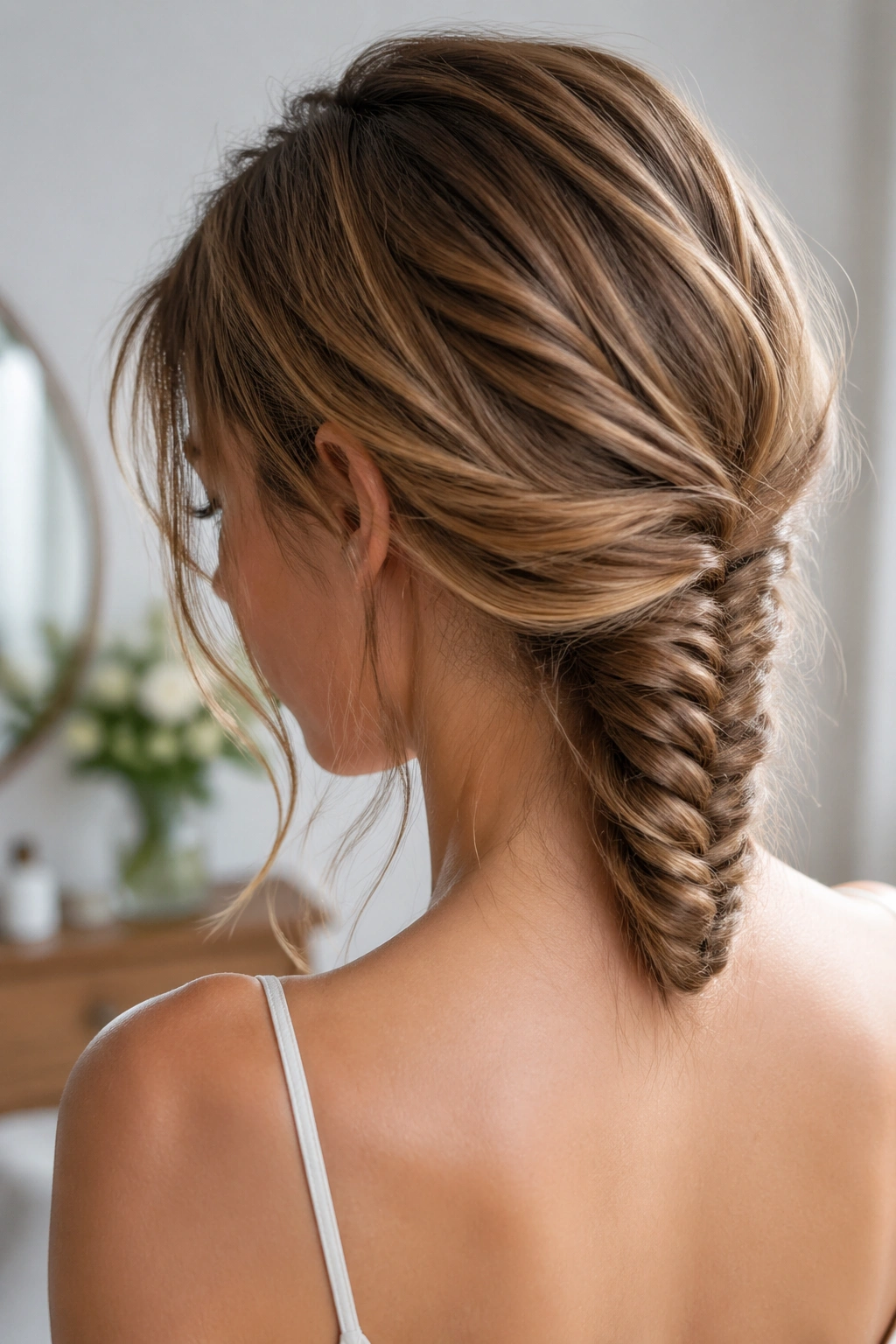
Why does a low fishtail feel calmer than one sitting higher on the head? Because the braid settles into the shape of the neck and shoulders, which makes the looseness look intentional instead of accidental. It is a good place to keep the braid soft without losing the pattern.
How to Keep the Nape Soft
Start with the braid slightly below the occipital bone, not at the crown. That tiny shift keeps the roots from pulling too hard and makes the base easier to loosen later. If your hair is slippery, mist the roots with texturizing spray before you start.
A low braid also gives you room to leave a few strands free near the temples. Those pieces can skim the cheeks and keep the style from feeling too tidy. The braid itself can be fairly tight for the first inch, then loosened once you reach the back of the neck.
What Usually Goes Wrong
The nape is where people over-tighten. They think the braid will hold better if they pull hard from the start, but that just makes the top look strained and the bottom look thin. Better to secure the base, then open the braid with your thumbs after the elastic goes on.
If you have layers, watch the shortest pieces around the neckline. They escape fast. Leave them out on purpose or pin them under the braid instead of fighting them every three seconds.
4. The Half-Up Messy Fishtail Braid
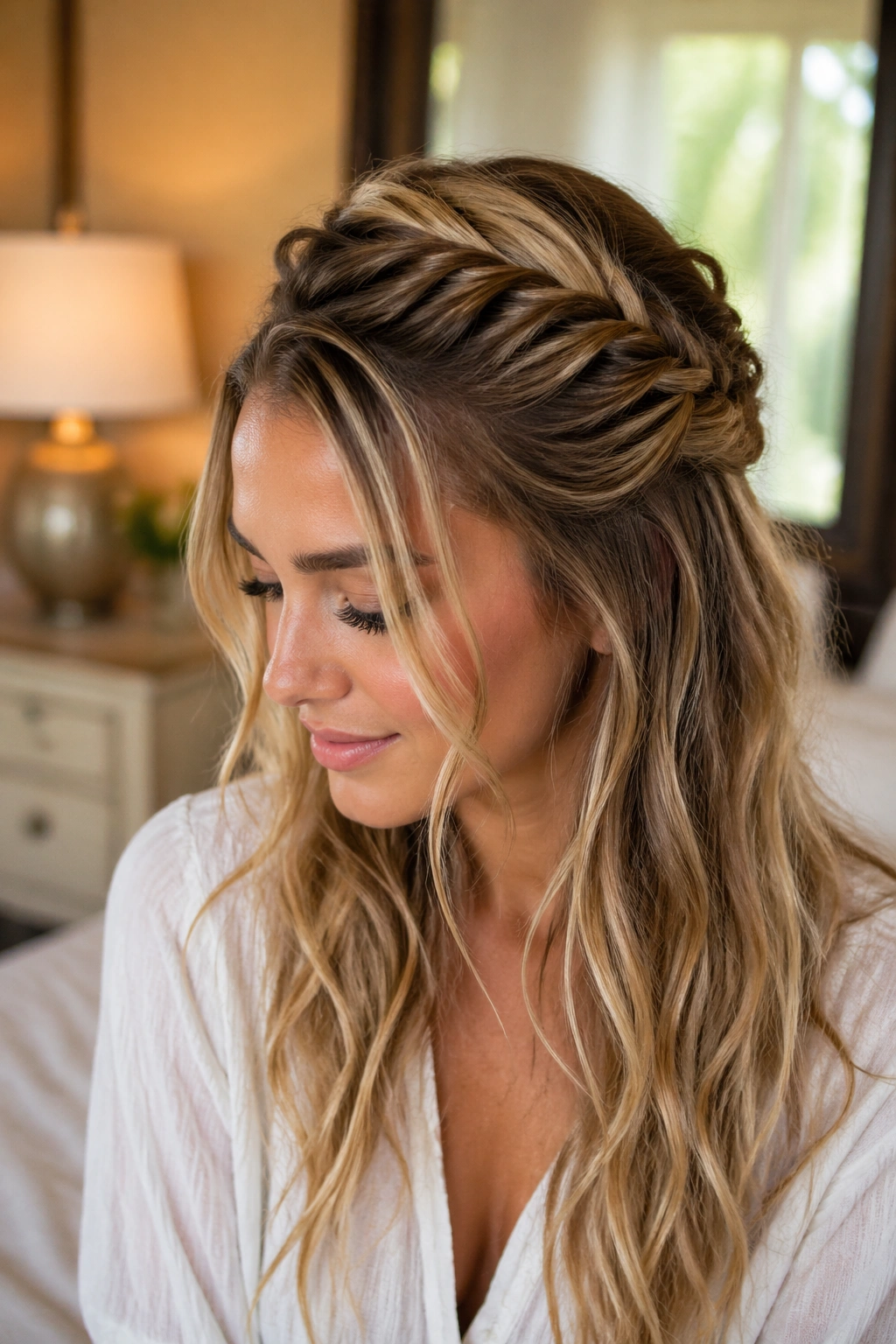
If your hair keeps sliding into your face by lunchtime, the half-up fishtail solves the part you actually care about. It keeps the top half controlled and leaves the rest loose, which is why it works so well when you want a braid without committing to a full updo.
Gather the hair from temple to temple, braid that top section into a fishtail, and stop when you reach the back of the head. Secure it with a small elastic, then loosen the loops so the braid fans out a little. The bottom half stays free and usually needs only a quick wave or a light scrunch.
- Leave the bottom section untouched if your hair already has bend.
- Curl only the front pieces if the rest of your hair is straight.
- Use one pin under the braid if it starts to droop.
- Keep the braid close to the head so it does not stick out like a shelf.
The half-up version is nice on layered hair because the loose length absorbs the messiness instead of fighting it. One small braid, one loose fall of hair, and suddenly the whole style feels less staged.
5. The Crown-Style Messy Fishtail Braid
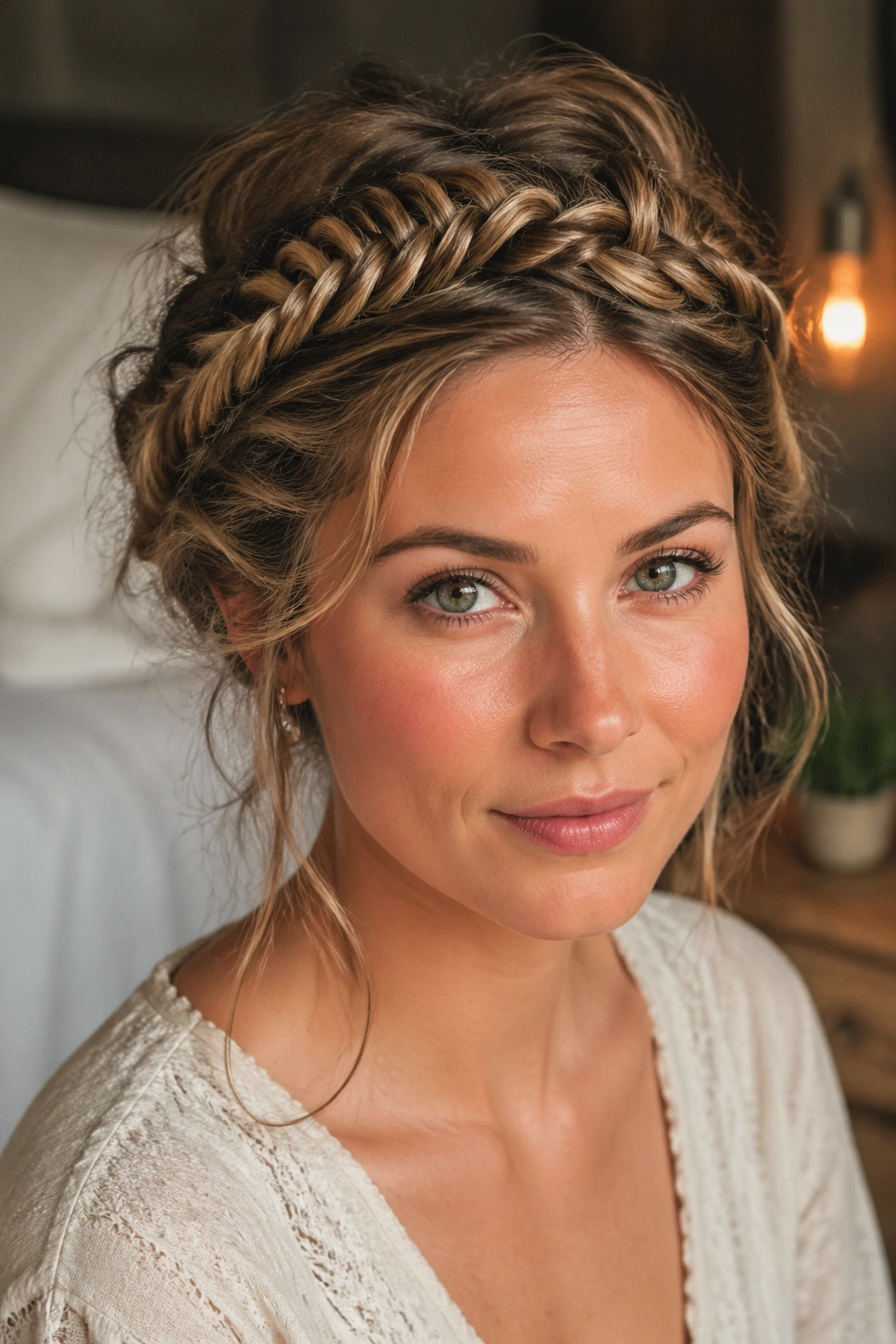
A crown braid changes the shape of the whole style. Instead of hanging heavy at the back, the braid wraps around the head and sits like a soft band, which means any loose pieces read as part of the look rather than as flyaways you forgot to tame.
The messy version matters here because a crown braid can turn severe fast. Keep the sections a little uneven, let the braid sit slightly away from the hairline, and use your fingers to tug tiny loops loose near the temples. That stops the shape from looking flat against the scalp.
Pins do the real work. Lots of people overdo the braiding and underdo the anchoring, which is backwards. Pin the braid every few inches, hide the pins under the braid itself, then loosen the crown after it is secure—not before. That order saves a lot of frustration.
This style likes hair that has texture and a little bend in it. Straight hair can work too, but it usually needs a mist of dry shampoo or texturizing spray first. Otherwise the braid slides and you spend half the morning chasing it around your head.
6. The Twin Messy Fishtail Braids
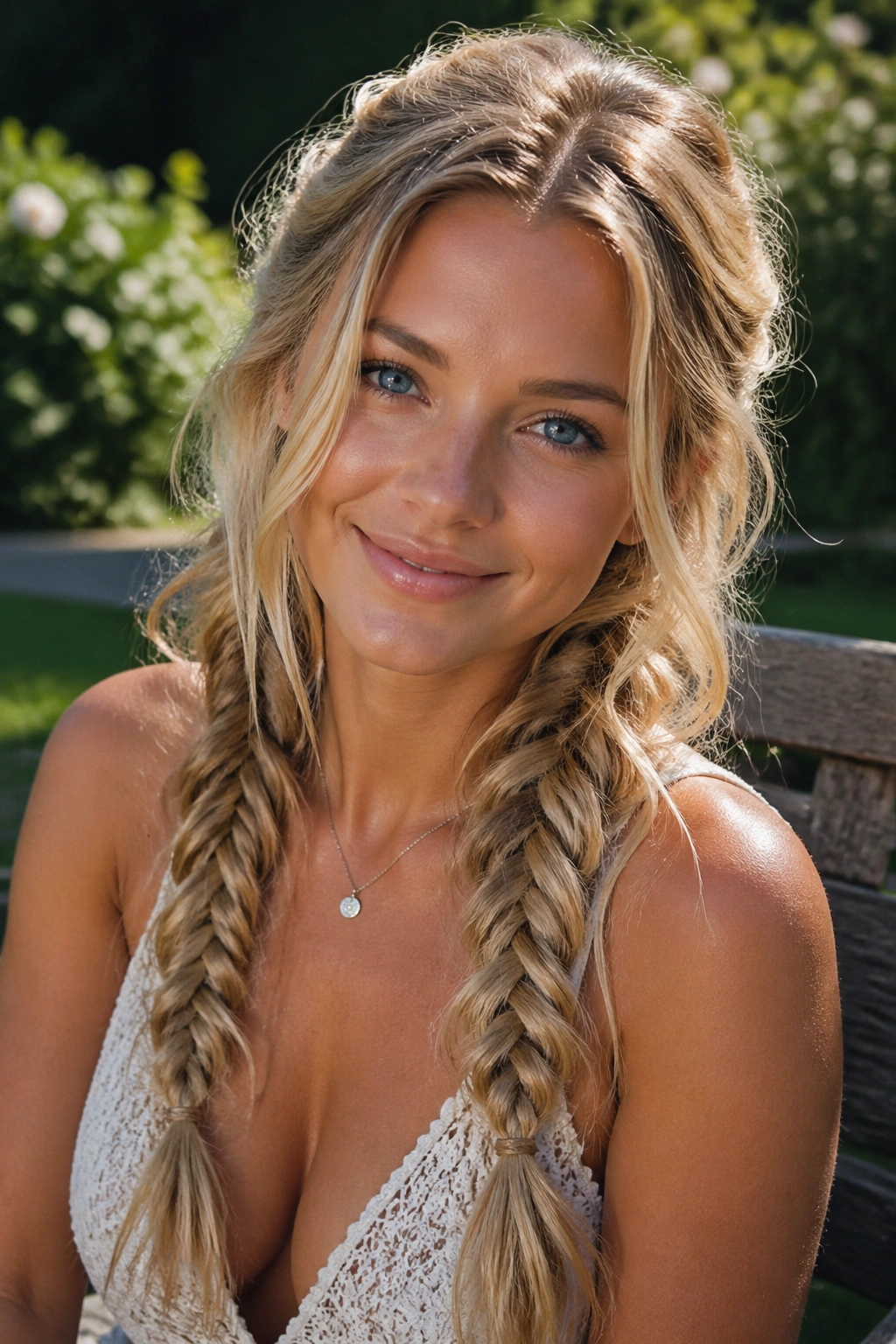
Unlike one braid down the back, two messy fishtail braids give you movement from both shoulders. That makes the style feel younger and more active, even when the braids themselves are loose and relaxed.
Part the hair down the middle, then split each side into two sections and fishtail braid them separately. Keep the tension slightly different on each side. I like one braid a touch fuller than the other; it keeps the style from looking too matched, which can feel stiff.
This version is especially good if you have thick hair and want to spread the bulk around instead of stacking it all in one tail. It also works on fine hair if you pancake the loops after braiding, because the twin shape gives the eye more to look at. One braid can disappear. Two usually do not.
Wear them over the shoulders or tie the ends low with small elastics. If the braids feel too tidy, pull a few hairs out from the front hairline and let them fall naturally. Tiny imbalance makes the whole thing better.
7. The Messy Fishtail Braid with Face-Framing Pieces

A braid stops looking severe the moment you leave a few front pieces alone. That is the whole move here. The face-framing strands soften the line from forehead to jaw, and they make the braid feel like it belongs to the face instead of sitting beside it.
What to Leave Out
- One slim piece from each temple.
- A slightly shorter section near the cheekbone if you wear layers.
- A small curl at the nape if your hair tends to look heavy around the neck.
Those pieces do not need to be identical. In fact, they usually look better when they are not. One piece can skim the cheek, another can sit closer to the ear, and a third might tuck behind the jawline. That little mismatch looks lived-in in the best way.
Curl the loose pieces with a 1-inch iron if your hair is straight. If your hair already bends, just twist the strands around your finger after a light mist of water. You want them soft, not stiff. A braid with front pieces that move feels far less formal than one that is pasted back.
8. The Fishtail Ponytail Braid
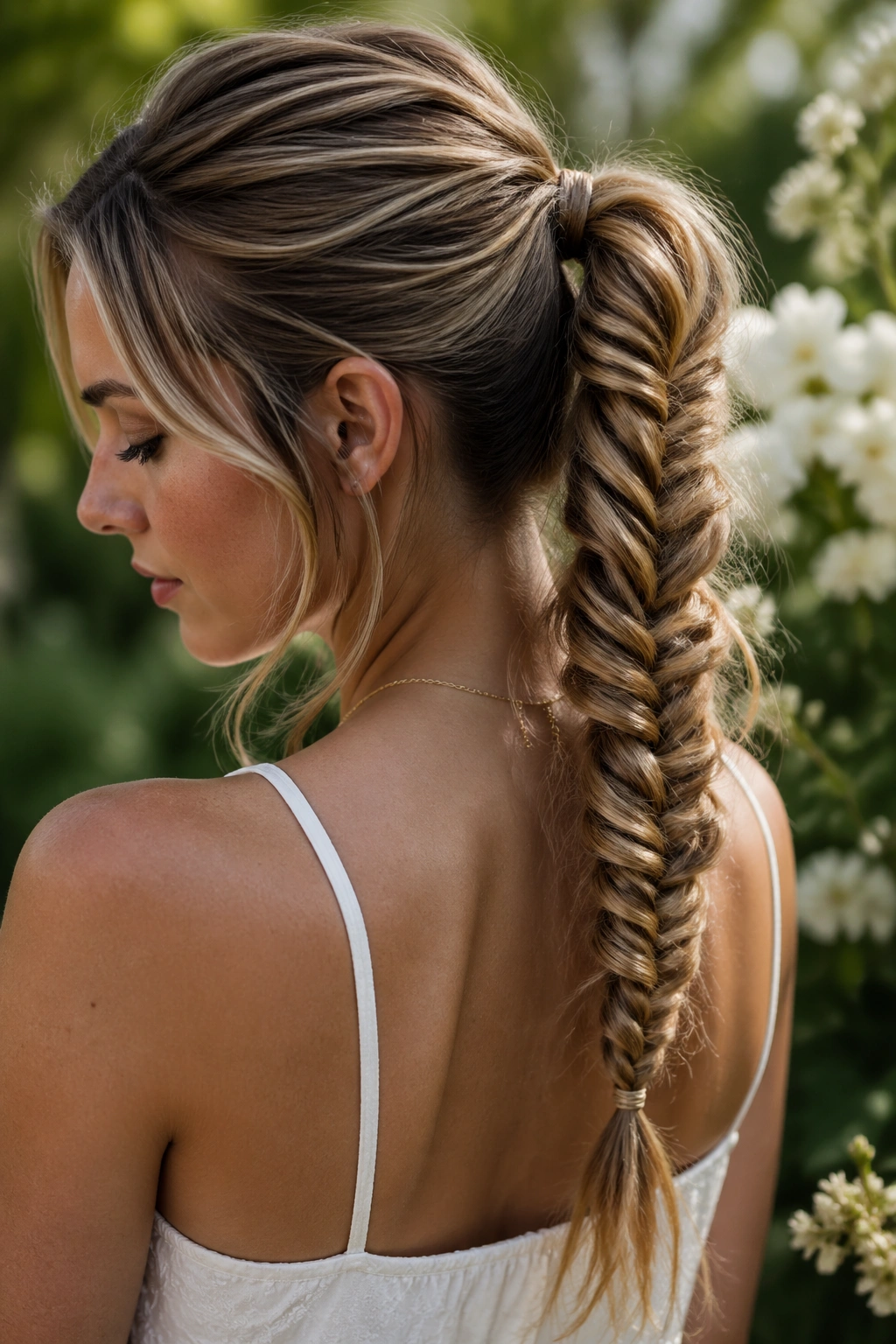
A ponytail gives the braid a tighter base and a looser tail. That’s why this version is so easy to wear. You get control at the top, movement at the bottom, and a style that stays put even when the day gets a little busy.
Gather the hair into a mid or high ponytail first. Secure it with a firm elastic, then fishtail the length from there. Since the ponytail already creates a starting point, the braid can be messy without looking untidy at the scalp. The looseness belongs below the elastic, which keeps the shape clean.
This style is smart for layered hair because the ponytail keeps shorter pieces from drifting all over the place. It also works well if you want to wrap a small piece of hair around the base to hide the elastic. That tiny finish makes the whole thing look more considered.
If you want the braid to feel softer, pull the ponytail base upward a little after braiding. It gives the crown a touch of lift. Not much. Just enough.
9. The French Fishtail Braid with Loose Lift
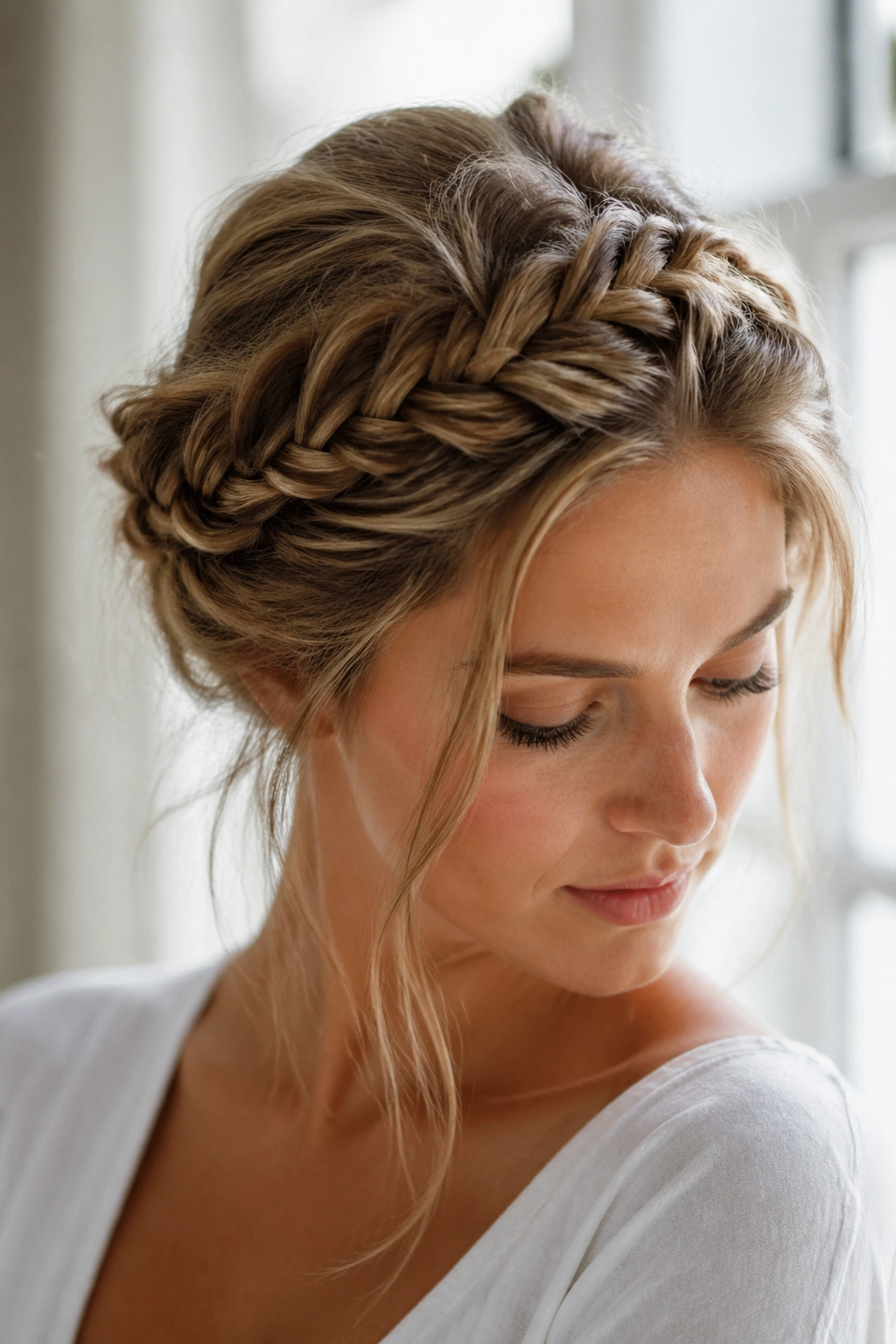
What makes a French fishtail feel softer than a regular French braid? The weave. A fishtail already has smaller, more delicate strands, so when you start adding hair from the sides as you go, the result looks textured instead of chunky.
Where the Braid Starts
Begin at the crown or slightly below it, then add hair from both sides as you cross the small outer pieces. Keep the added sections thin. Thick additions make the top look blocky, and the braid loses the fine, woven look that makes fishtails interesting in the first place.
How to Keep the Crown Airy
Do not pull the top section tight. That is the whole mistake. Leave a little space between the braid and the scalp, then pinch the edges after the braid is finished to create lift. If the crown looks too flat, slide the braid forward a few millimeters and loosen the base.
This style is one of the easiest ways to make a messy braid look intentional. The structure is still there, but the crown has enough softness that it never feels fussy. It is especially good with highlights, because the woven strands catch the color differently as the braid twists.
10. The Dutch Fishtail Braid with Soft Volume
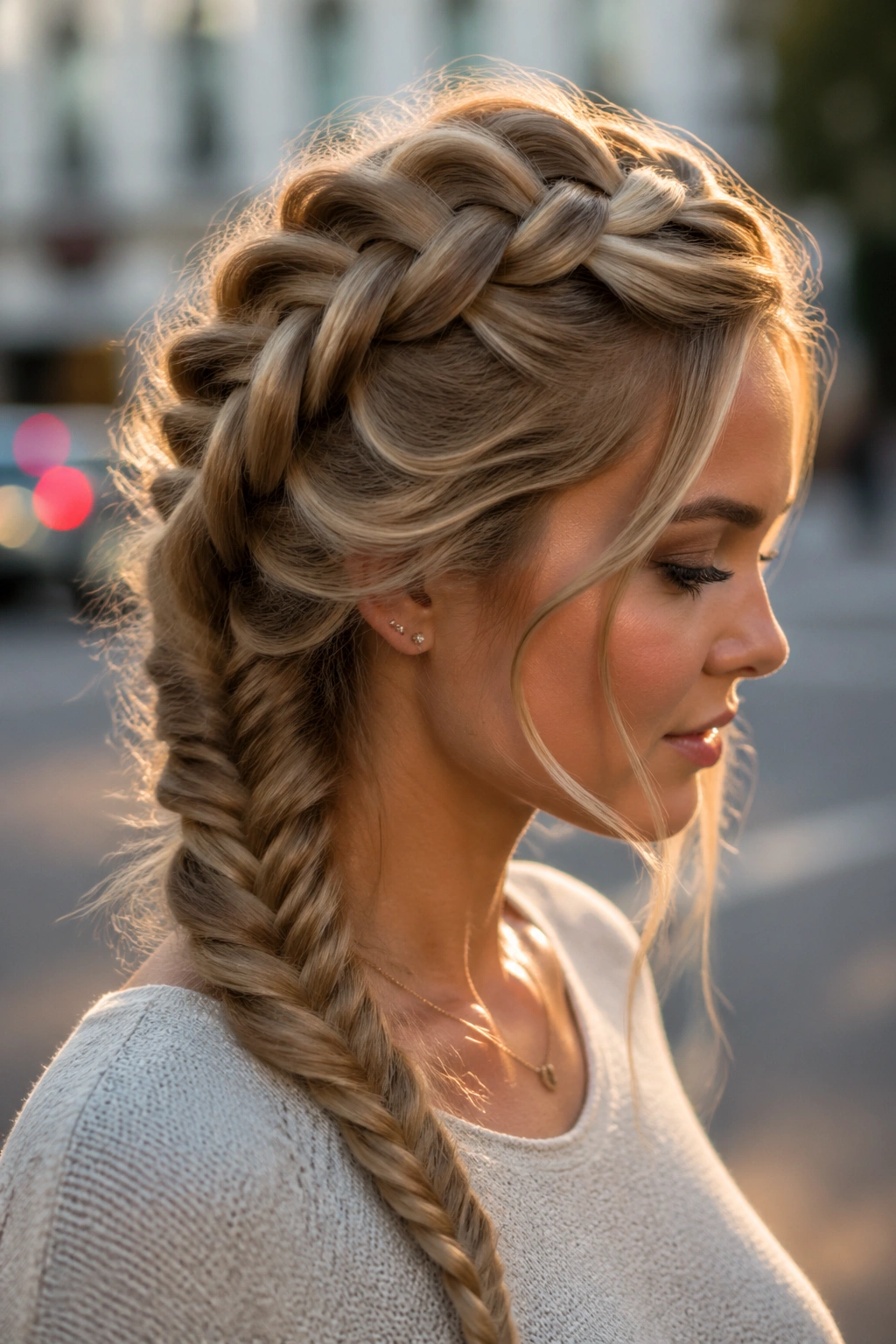
A Dutch fishtail braid sits on top of the hair instead of sinking into it, and that raised shape makes the messy version feel fuller right away. You see the braid from the side, from the back, and even from a slight angle. That matters more than people think.
To build it, cross the outer pieces under rather than over as you add hair. The braid pops up from the head instead of tucking inward. Once the braid is finished, loosen each outer loop just enough to widen the shape without flattening the ridge.
This style is especially nice on medium-thick hair because the under-crossing gives the braid a little backbone. If your hair is fine, you may need a touch of mousse at the roots first. Fine hair without grip can slide apart before you finish the third section.
The messy Dutch fishtail feels a bit bolder than a standard braid, but the softness keeps it from looking too hard-edged. That contrast is the whole charm. Raised braid, loose texture, easy finish.
11. The Fishtail Braid Bun
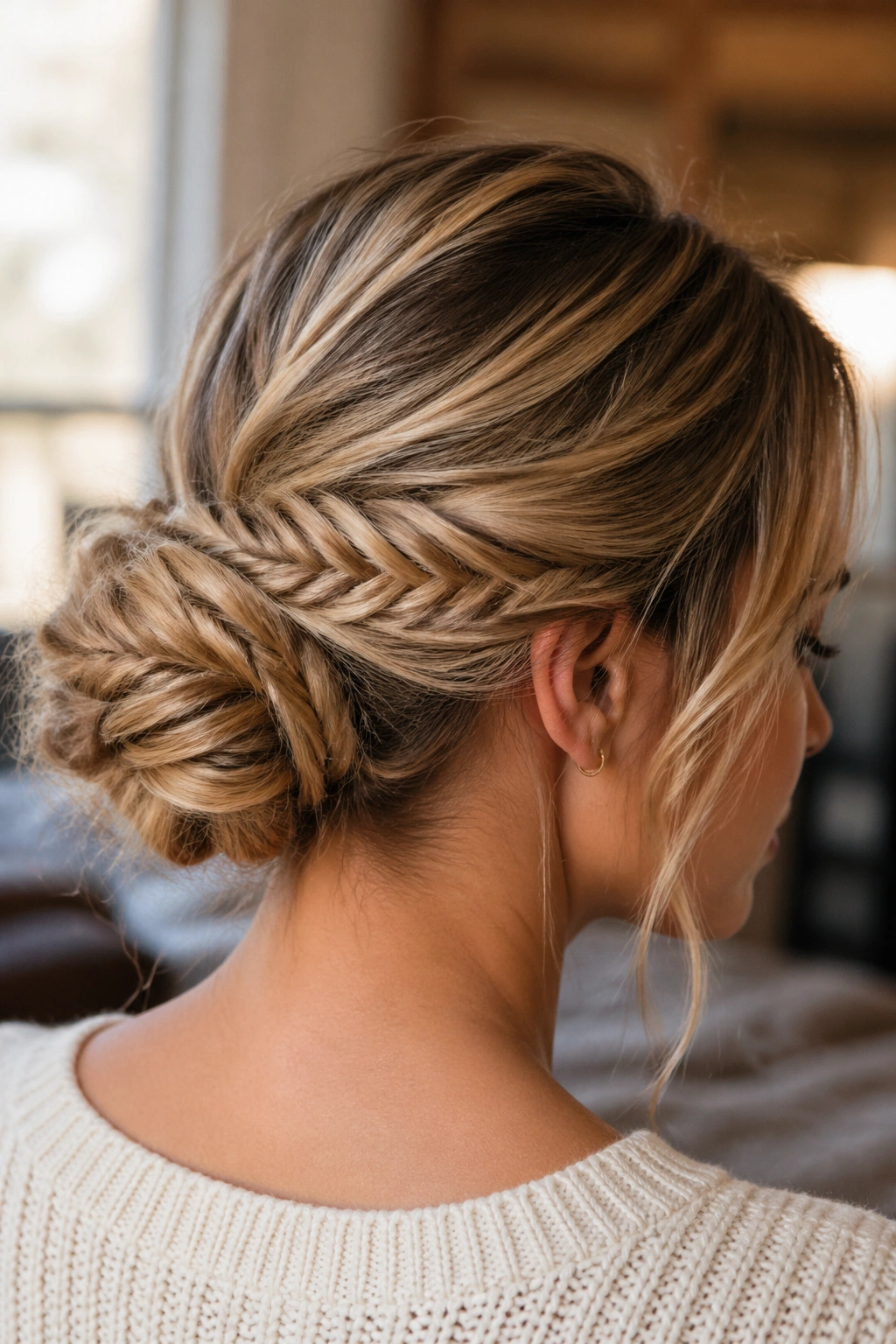
A messy fishtail braid bun is what you want when you need the shape to stay put but the ends to disappear. It looks a little more thoughtful than a plain bun, mostly because the braid gives the knot a ridged surface and keeps it from looking like a hair donut with a pin in it.
Braid the hair into a loose fishtail, then wrap it around itself at the nape or slightly higher. Secure the coil with bobby pins pushed in from different angles. The braid should still show in the bun. If it vanishes completely, the style loses its point.
This works especially well on hair that has a bit of grit. Newly washed hair can be slippery, which makes the bun slide. A little dry shampoo at the roots and a light mist of texturizer at the mid-lengths fix that fast.
I like this version for long days when you want the face open but still want some shape at the back. It holds up better than a loose twist, and it looks more finished than a scrunchy bun. That is a useful middle ground.
12. The Scarf-Woven Messy Fishtail Braid

A simple scarf can change a braid fast. Tuck one end into the elastic at the base, then let the fabric travel through the fishtail as you braid. The pattern becomes softer, and the braid suddenly has more color and movement without needing extra styling.
Pick the Right Fabric
- Use a scarf about 1 to 2 inches wide if you want a visible accent.
- Choose cotton or silk if you want a lighter drape.
- Skip slippery fabric if your hair is very fine; it can slide out of place.
Keep It From Sliding
Tie the scarf tightly at the base before you start braiding. Then braid the scarf in with the hair as if it were one of the sections. Leave the ends long and uneven at the bottom. That loose tail is part of the charm, and it keeps the style from feeling too tidy.
The messy part matters because a scarf can make a braid look very done very quickly. Softening the braid loops and leaving a couple of pieces free around the face keeps the whole thing from crossing into costume territory. That balance is easy to miss.
13. The Ribbon-Tied Messy Fishtail Braid
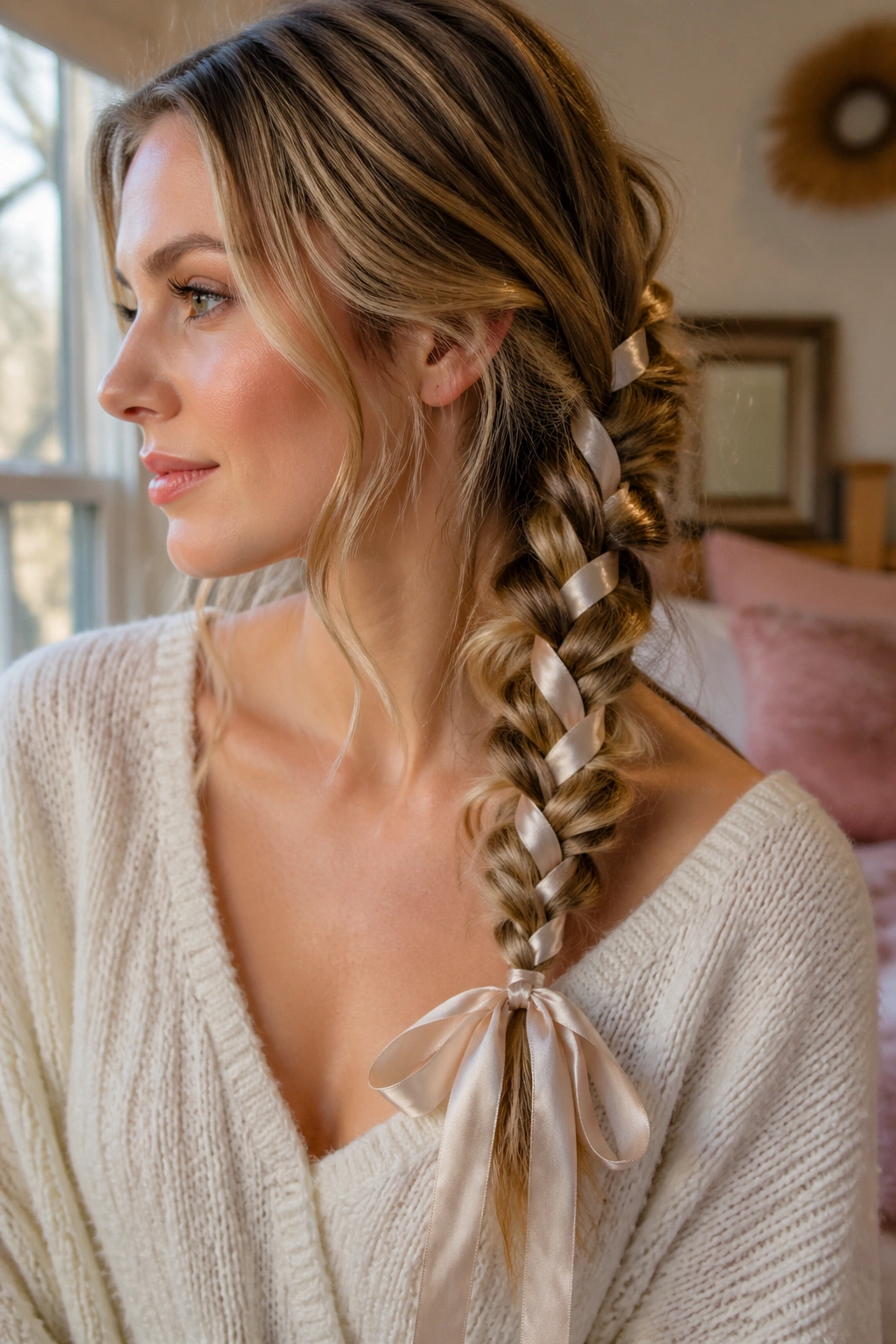
Ribbon is one of the fastest ways to make a fishtail feel dressed up without making it stiff. The trick is choosing the right width. A 1/4-inch grosgrain ribbon gives a small, neat line. A 3/4-inch ribbon reads bolder and more obvious.
- Grosgrain grips well and stays put.
- Satin looks smoother, but it can slide.
- Velvet adds weight and works well on thick hair.
- Cotton twill gives a matte finish that feels casual.
Tie the ribbon at the base, braid it alongside the hair, and knot it at the end with enough length left to trail. If you want the braid to stay messy, keep the ribbon slightly loose through the middle sections. Tight ribbon pulls the braid flat and kills the airy look.
This style does a lot on its own, so the hair underneath can stay fairly simple. A little root lift, a few face pieces, and a loose fishtail are enough. If you add too many extras, the ribbon starts fighting the rest of the style instead of supporting it.
14. The Messy Fishtail Braid for Curly Hair
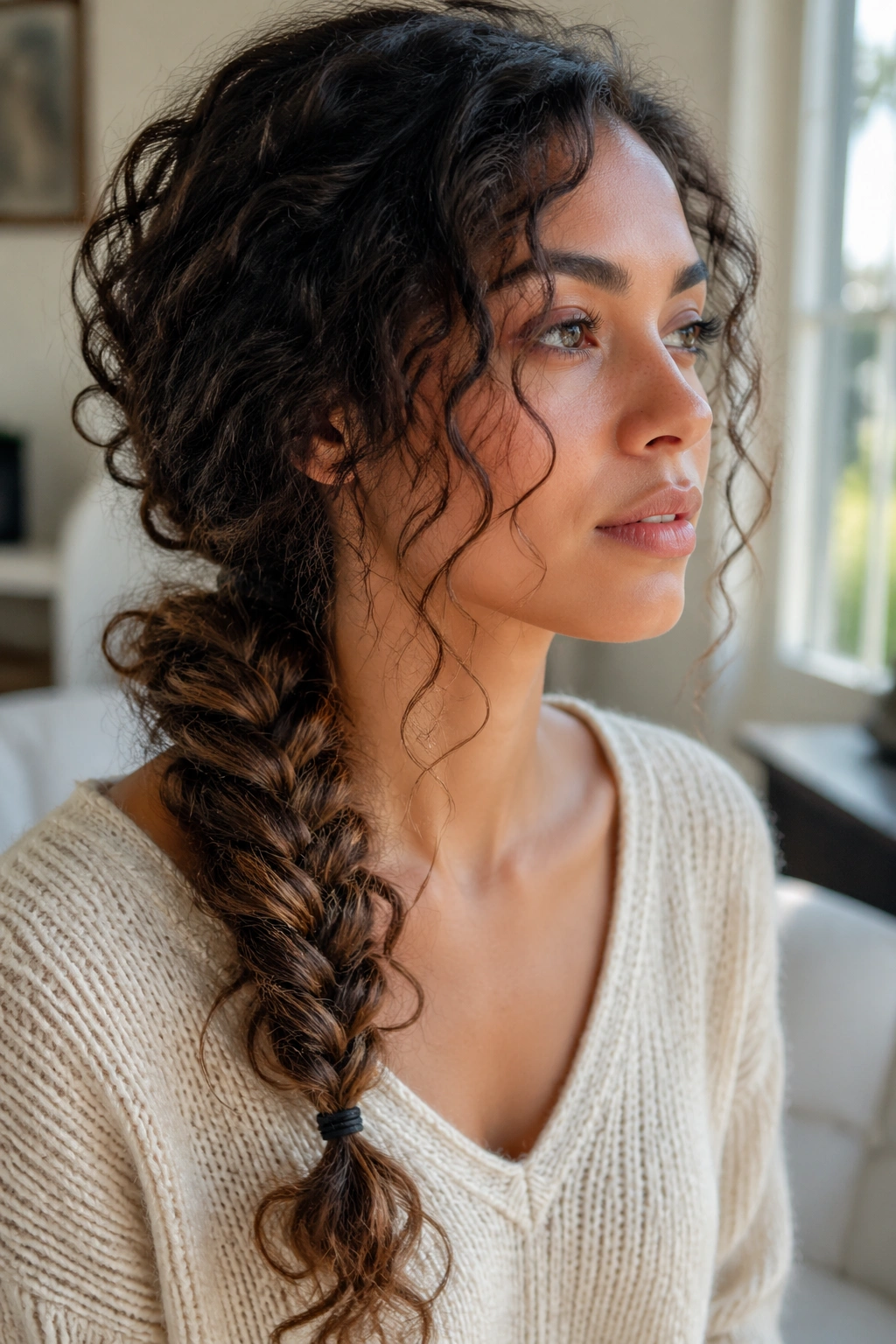
Can curly hair do a fishtail braid without losing its shape? Absolutely. The braid can actually look richer on curls because the texture gives each section more body, and the messy finish blends with the curl pattern instead of arguing with it.
Braiding on Dry Versus Damp Hair
Dry curls give a chunkier braid with more volume. Damp curls give a softer, more compact result. I prefer dry or nearly dry hair for this style, because the braid holds its shape and the curl pattern keeps some life at the ends.
Use a curl cream or a light leave-in through the lengths first. That keeps the sections from puffing up in a frizzy way. You do not want crunchy hold here. You want soft grip and a braid that still moves when you turn your head.
Where Curly Hair Looks Best
Curly fishtails shine when the braid starts low or to the side. High braids can stretch the curl pattern too hard, and the tension shows. A low, loose braid lets the curls frame the face and keeps the ends from shrinking all the way out of sight.
A few wisps are fine. More than fine, actually. On curly hair, those escapees help the braid look natural instead of overmanaged.
15. The Messy Fishtail Braid for Short Hair
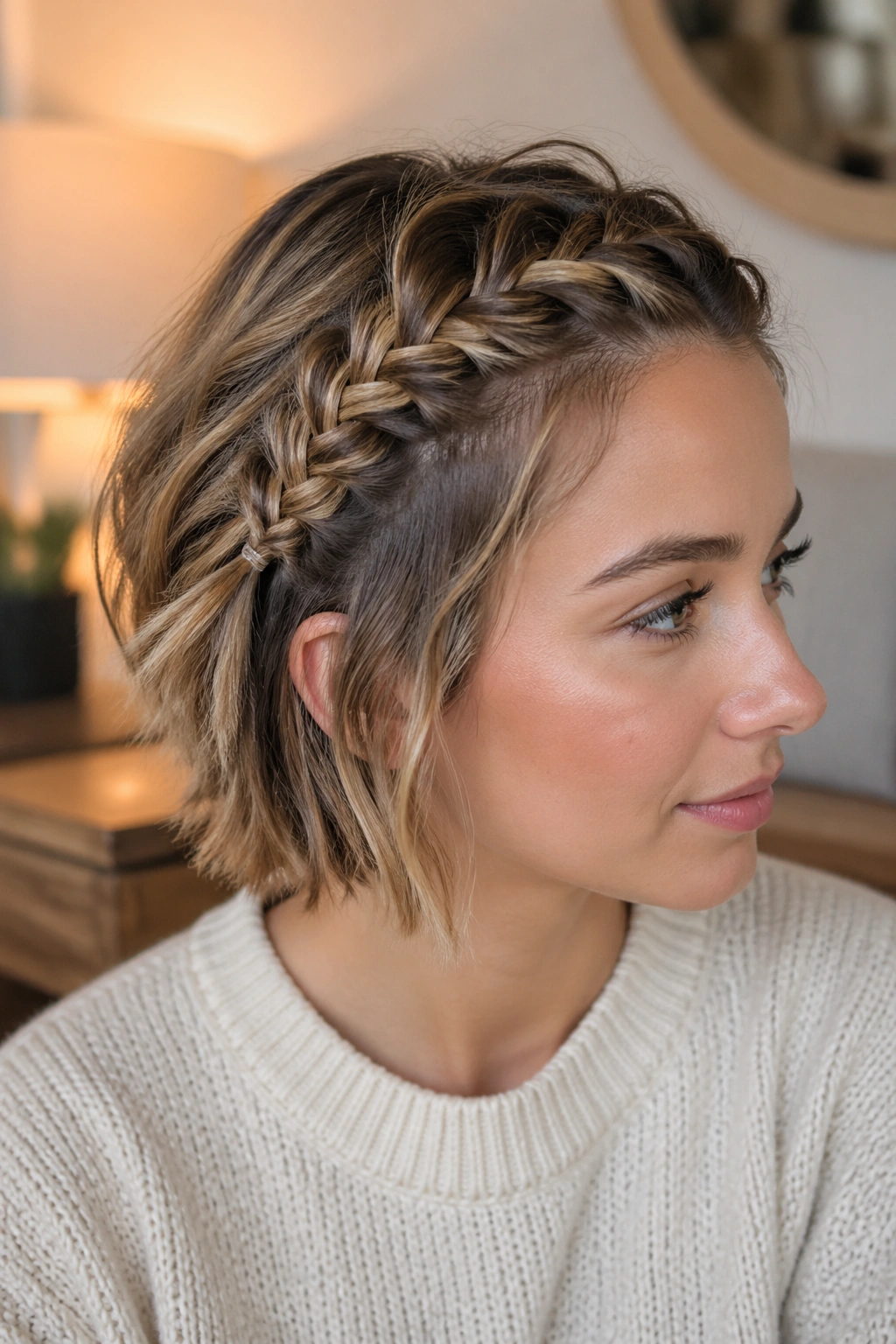
Short hair can do a fishtail braid, but you need to stop expecting a full-length tail if the hair is a bob or lob. The fun here is in the texture near the head and the slightly unfinished end that makes the braid feel casual instead of forced.
Start at the side or just above the ear. Work with smaller pieces than you would on long hair, and use a tiny clear elastic to secure the braid once the hair starts to run out. If the braid reaches only the middle of the neck, that is still enough. The rest can stay loose or be tucked under.
The messy look helps short hair more than polished hair ever could. Layers and shorter pieces fall out on their own, which can be frustrating if you want a neat braid, but useful if you want softness. Pin the pieces you like and leave the rest where it lands.
A little pomade on the ends can stop the braid from fraying too much. Use a pea-sized amount. Too much and the hair goes limp fast.
16. The Thick Pancaked Fishtail Braid
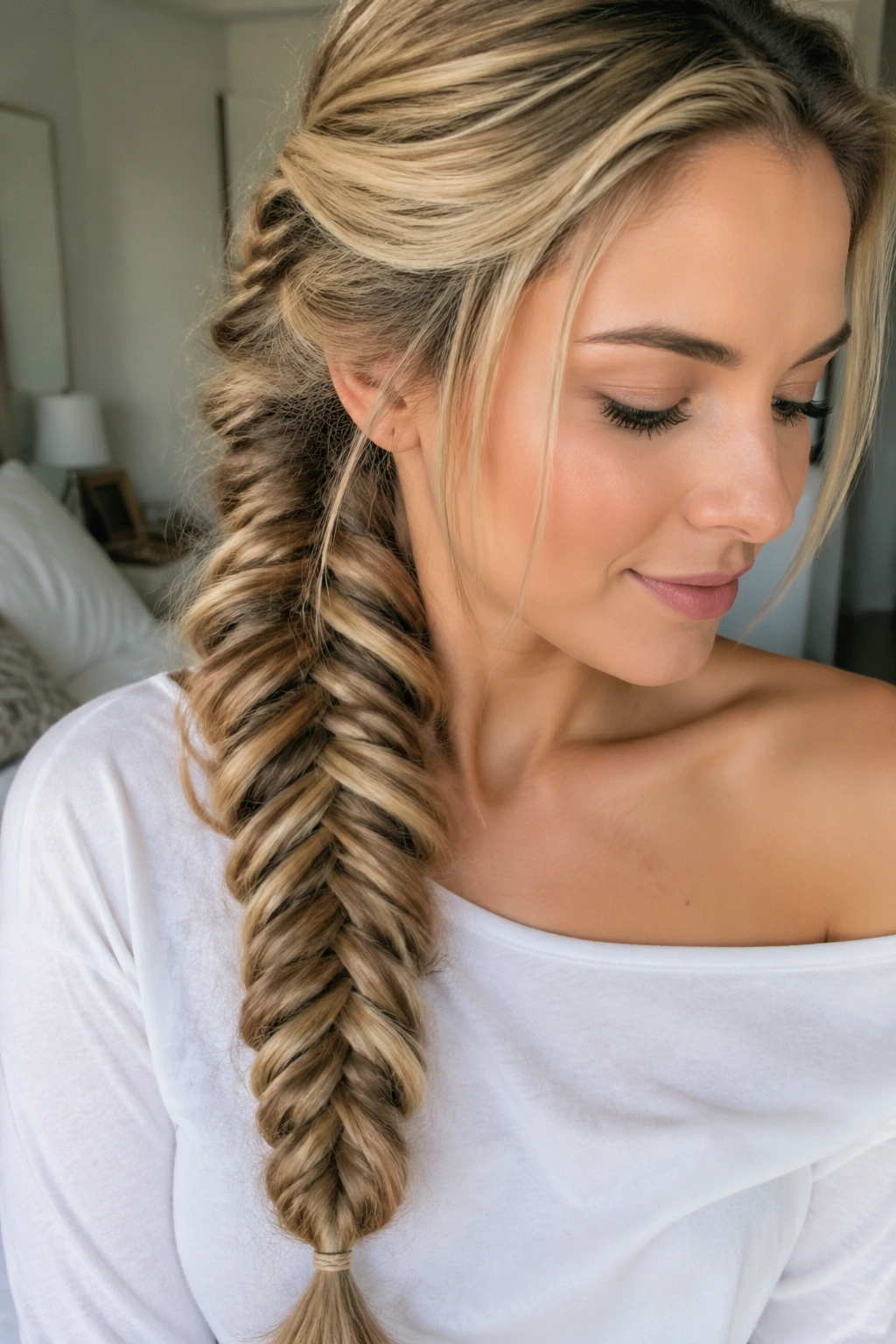
Pancaking is the move that makes a fishtail look bigger in a matter of seconds. You pull the outer edges of each loop outward, almost like opening a folded fan, and the braid gets wider, softer, and easier to see from a distance.
This works beautifully on thick hair because the braid can take the expansion without falling apart. It also helps fine hair look fuller. The catch is pressure. If you pull too hard, the weave stretches unevenly and the braid starts to look loose in a bad way.
What To Watch For
- Stop pulling when the braid still has visible pattern.
- Use both thumbs so the tension stays even.
- Start at the bottom and work upward.
- Avoid over-pancaking near the elastic, where the braid can split.
A thick pancaked fishtail has a bit of drama to it. Not loud drama. Just enough shape that the braid catches the eye from across the room. If you wear layers, leave a few wispy pieces around the face so the bulk of the braid does not overwhelm your features.
17. The Accent Fishtails in a Bigger Style
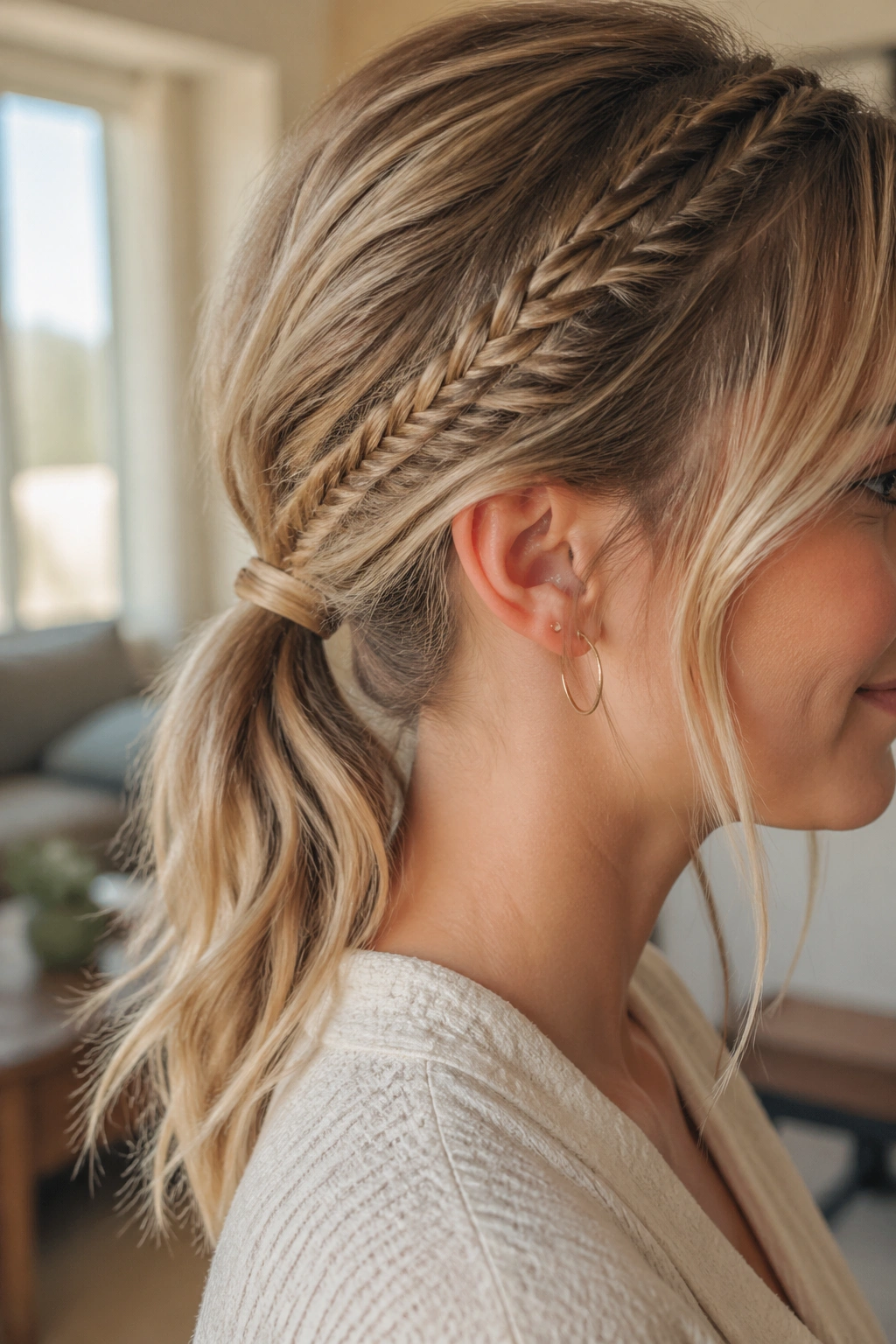
Sometimes the prettiest move is not a full braid at all. A tiny fishtail tucked into a ponytail, bun, or half-up style gives you the texture without asking the whole head of hair to behave.
You can braid a 1-inch section at the temple and pin it back, add two small fishtails into a low ponytail, or weave one tiny braid into the side of a loose wave. Each version works because it breaks up the surface and gives the hair some visual rhythm.
- Good placement near the temple if you want the style to frame the face.
- Better placement near the crown if you want height.
- Nice near the nape if you want the braid to hide under a bun or ponytail.
Accent fishtails are useful on days when your hair is clean and too slippery for a full braid. One small section gives you grip and detail without a long styling session. That is enough sometimes.
18. The Waterfall-Inspired Messy Fishtail Braid
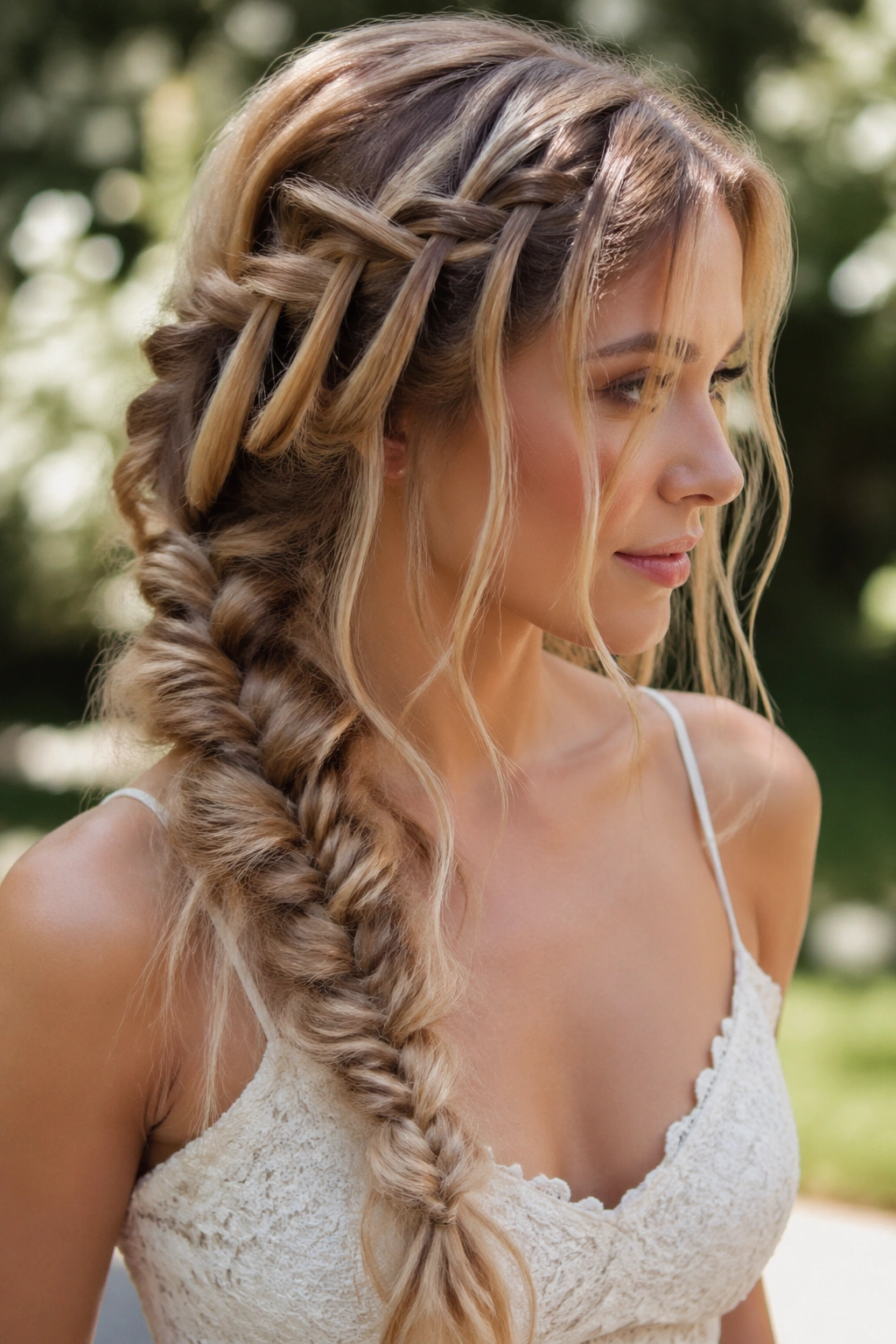
What happens when you mix a fishtail with the loose, dropping feel of a waterfall braid? You get a style that looks airy right away, because part of the hair keeps slipping free instead of being locked into the weave.
How Much Hair to Drop
Leave out a thin strand every few passes, then let a fresh piece replace it from underneath. The pattern does not need to be exact. In fact, a little irregularity makes the style feel better. If every dropped strand is the same size, the braid starts to look engineered.
Where It Works Best
This version is lovely on wavy hair, because the free pieces blend into the rest of the texture. It can work on straight hair too, but the loose strands usually need a quick bend with a curling iron so they do not hang there like forgotten threads.
The best part is how soft the sides stay. A waterfall-inspired fishtail never feels too contained. It lets the braid show off while keeping the edges light, which is exactly why messy suits it so well. Clean braids like rules. This one likes a little drift.
19. The Worn-In Weekend Fishtail Braid
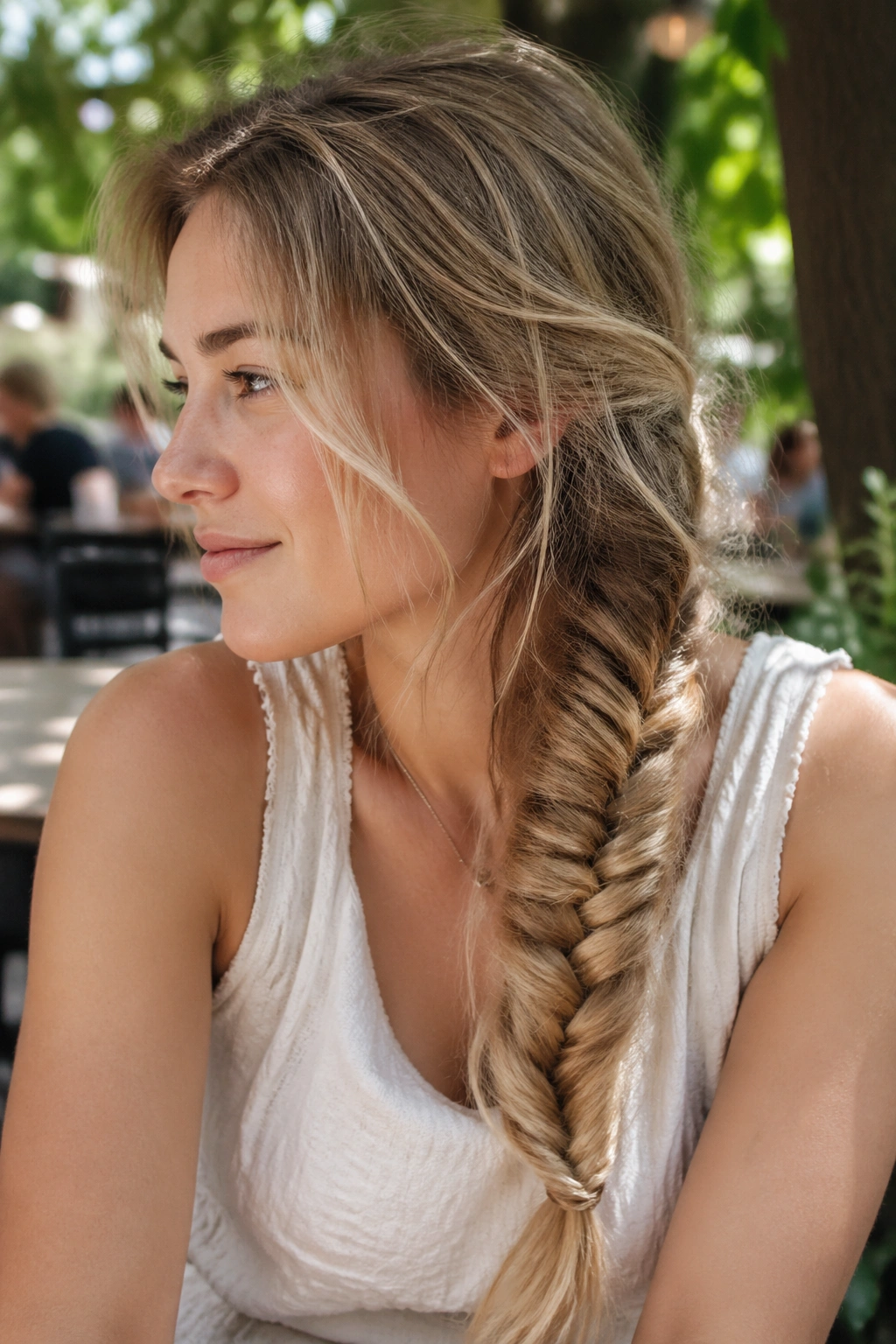
Some hair wants neatness. Some hair looks better after you touch it, shake it, and leave a few flyaways alone. The worn-in weekend fishtail belongs to the second group, and it might be the easiest one to wear all day because it gets better after a little movement.
Start with loose texture in the hair. Braids from freshly brushed, pin-straight hair can feel a little too obedient, so bend the mid-lengths first or work in a touch of dry shampoo. Then braid without chasing symmetry. Uneven sections, a softer crown, and one or two stray pieces around the ears are part of the charm.
The nice thing about this version is that it improves as you wear it. A walk outside, a scarf rubbing against it, or even tucking it behind one shoulder adds to the shape. That is a rare quality in hair, and I think it’s why people keep coming back to messy fishtails instead of tighter braids.
If you want one braid that can go from coffee run to dinner without a full reset, this is the one I’d pick. It wears in well. And a braid that still looks better after a little life has happened to it is usually the right braid to keep around.
