



There’s something effortlessly chic about a ponytail that doesn’t look like you tried too hard. The loose ponytail sits in that sweet spot between polished and relaxed — it’s acceptable at the office, flattering enough for a night out, and honestly, it’s one of the easiest ways to look put-together when you’re having a bad hair day. But here’s the thing: not all loose ponytails are created equal. A truly relaxed, intentional-looking ponytail depends on the right base texture, the placement, how you finish the style, and which techniques you use to create that coveted “soft but not sloppy” vibe.
The beauty of loose ponytails is their versatility. Whether your hair is naturally curly, straight, fine, or thick, there’s a loose ponytail approach designed for your hair type and lifestyle. Some styles work best with textured, undone waves. Others actually shine when you start with sleek, smooth hair and strategically pull out face-framing pieces. Some are perfect for a casual weekend, while others deserve a spot in your professional styling rotation. The key is knowing which loose ponytail style matches your hair texture, face shape, and the occasion you’re dressing for.
What makes loose ponytails stand apart from standard sleek ponytails is the deliberate softness. You’re not going for tight and polished — you’re creating the impression of effortless texture, strategic movement, and a slightly undone aesthetic that’s somehow more sophisticated than it first appears. These styles rely on layers, wave patterns, pulled-out face-framing pieces, and sometimes a bit of intentional dishevelment that takes more skill to execute than people realize.
Let’s walk through twelve distinct loose ponytail styles, each with the specific texture, technique, and finishing touches that make it work.
1. Low Messy Bun Ponytail
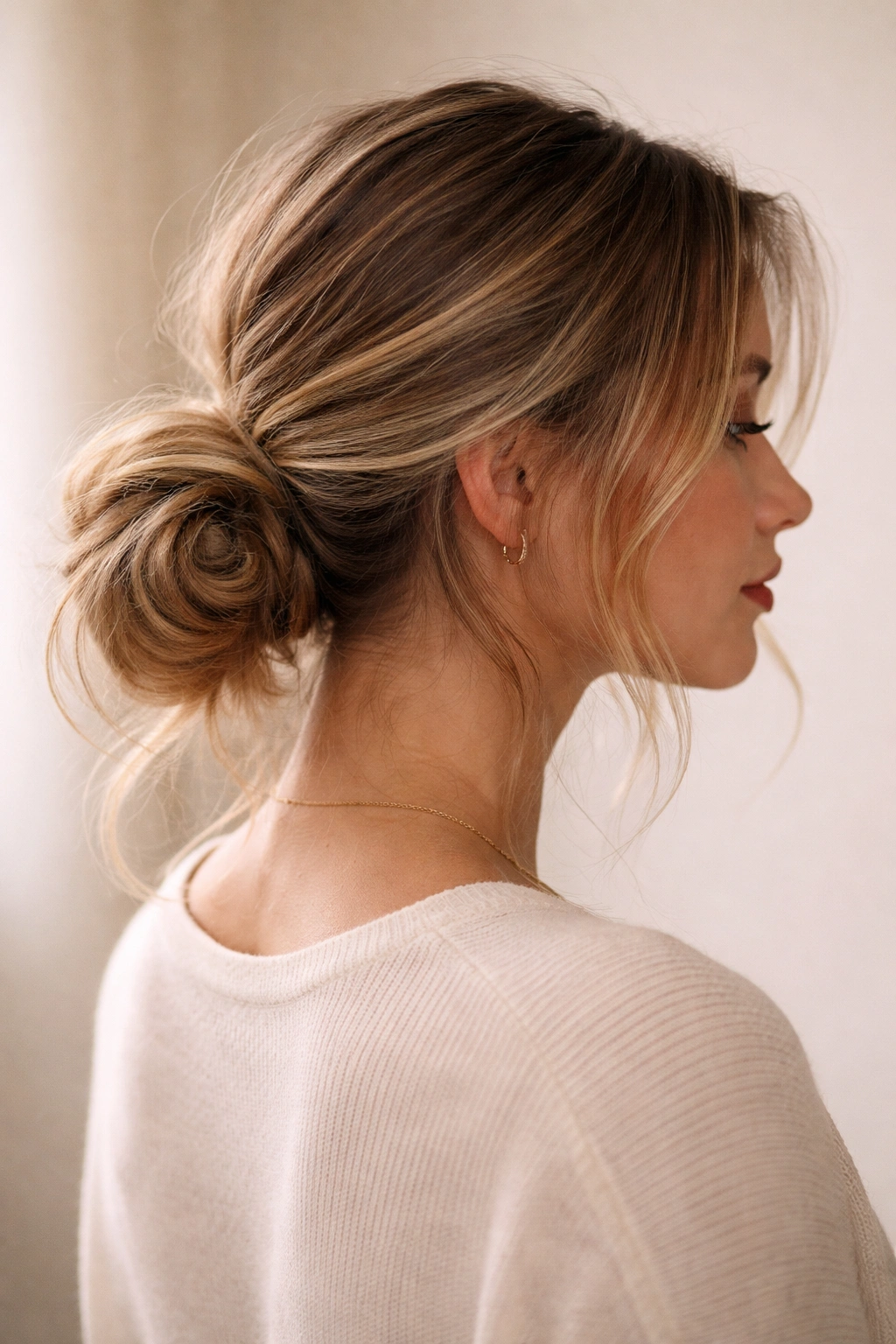
This is the king of casual elegance — a loose ponytail that sits low at the nape of your neck and tousles upward into something that hovers between a ponytail and a bun. It’s ideal for second-day or third-day hair that already has some natural texture, but you can absolutely create this from scratch by adding texture with a curling iron, sea salt spray, or by braiding your hair while damp.
What Makes It Work
The magic here is intentional messiness without looking unkempt. You’re creating visible texture by twisting, coiling, or bunching the ponytail base loosely rather than smoothing it flat. Face-framing pieces fall naturally around your cheekbones, and the back section sits higher and looser than a standard low ponytail. This style reads as relaxed and approachable while still looking thoughtfully arranged.
How to Create It
- Start with your hair down and slightly textured — this could be natural waves, braided waves, or curled sections
- Apply a volumizing mousse or sea salt spray to damp roots and let hair air-dry, or blow-dry with a texture product for more deliberate waves
- Create a low ponytail at the nape of your neck, pulling it loosely so face-framing pieces fall free
- Divide the ponytail into 2-3 sections and gently twist each around itself, then loosely coil or bunch it upward
- Secure with bobby pins tucked inside the loops rather than visibly fastened at the base — this keeps the undone look intact
- Use a light hairspray to hold without making it look stiff
Pro tip: If your hair is very fine and won’t hold texture naturally, backcomb the section under your ponytail base to create invisible grip for the bobby pins — this prevents slipping and lets you style more loosely.
2. Textured Beach Wave Ponytail
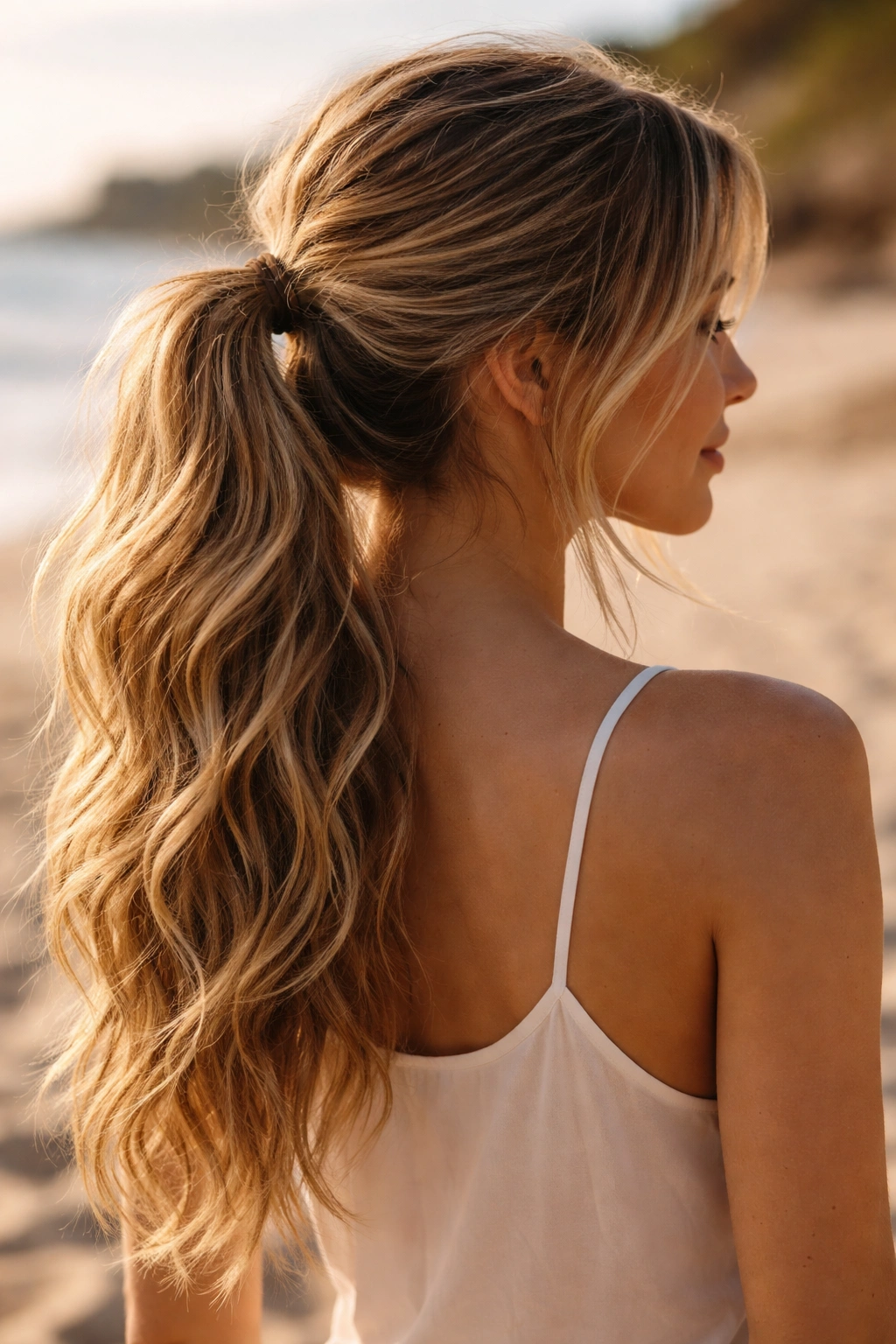
This loose ponytail celebrates movement and relies entirely on your hair’s ability to flow. It works best when you start with deliberate, lived-in waves that create natural dimension, spacing, and that windblown-on-purpose quality.
What Makes It Work
Beach waves mean your ponytail isn’t one solid column of hair — it’s made up of distinct wave sections that catch light differently and create visual texture even when gathered. The ponytail isn’t pulled tight; instead, it’s a loose gathering of waves that maintain their individual character even when secured. This style screams relaxation and works beautifully with longer, medium-length, or even shoulder-length layers.
How to Create It
- Start with damp hair and apply a salt spray or texturizing product from mid-length to ends
- Use a curling iron (1.5 to 2 inches depending on your wave size preference) to create loose, alternating waves throughout
- Curl each section away from your face, then away again, creating an undulating pattern
- Flip your head and finger-comb through the waves to break them up and distribute the texture naturally
- Gather hair into a low or mid-height ponytail, securing it loosely with a hair tie
- Leave several face-framing pieces out and gently pull apart the base of the ponytail to create more volume
- Lightly mist with a flexible hold spray
Worth knowing: Salt spray adds grip and enhances natural wave patterns, but too much can make hair feel sticky. Use it sparingly and combine it with a finishing product designed to enhance texture without crunch.
3. Soft Side-Swept Ponytail
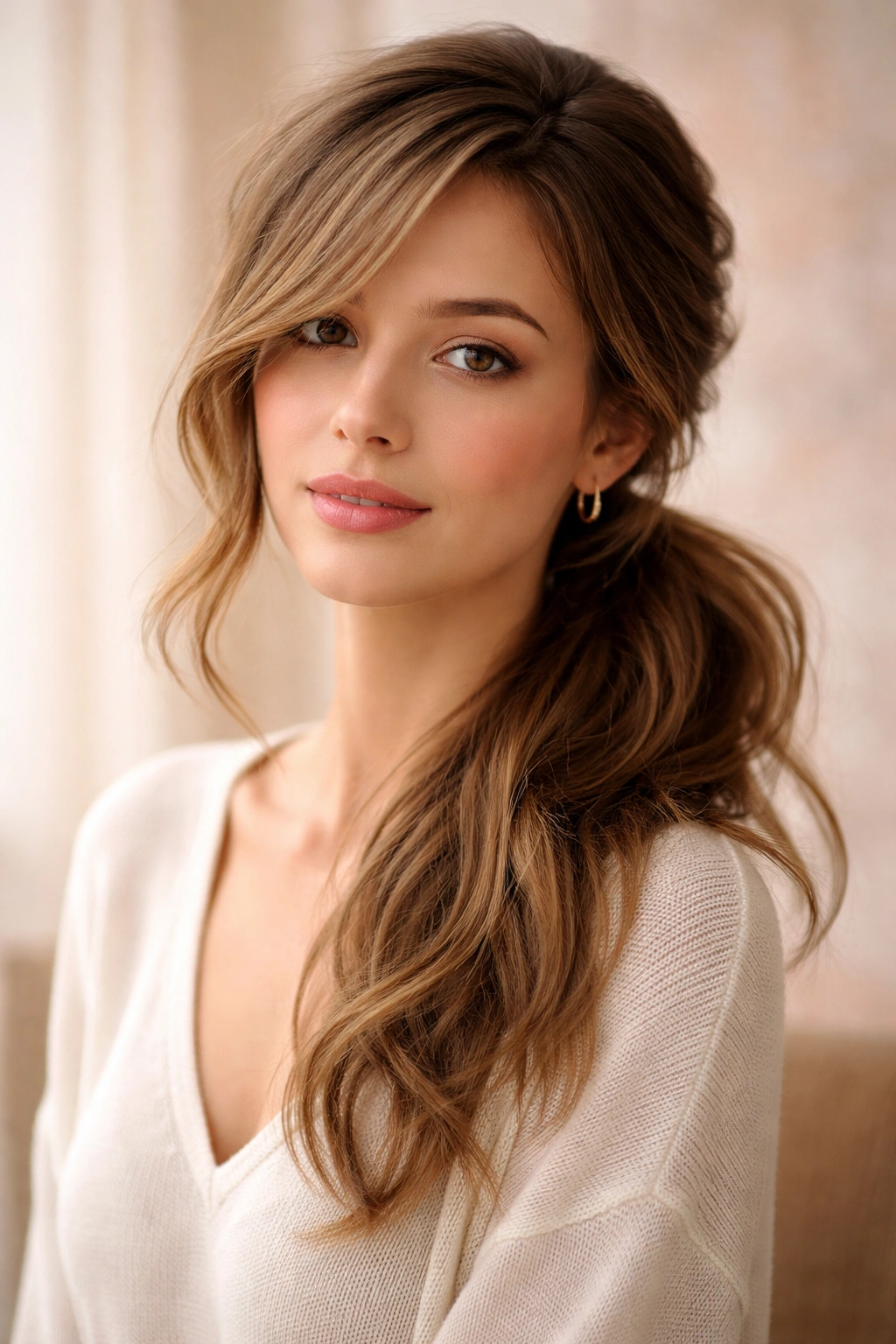
This style shifts the entire visual balance of your face by gathering the ponytail off to one side. It’s romantic, slightly dramatic, and surprisingly flattering because it elongates the face and creates an asymmetrical line that feels intentional and thoughtful.
What Makes It Work
Instead of centering the ponytail at the back of your head, you’re pulling it to the side — typically toward your stronger side or the side of your face you prefer. The softness comes from leaving front pieces loose and keeping the gathered section itself relaxed rather than slick and smooth. This style pairs beautifully with gentle waves, loose curls, or even straight hair with subtle texture added to face-framing pieces.
How to Create It
- Begin with your hair down and lightly styled — waves are ideal but not required
- Take the front section on one side of your face and loosely twist it away from your face
- Gather this twisted section along with the back and side hair into a low side ponytail at approximately ear level on one side
- The ponytail should sit toward the back of your head, not directly at the temple
- Leave at least 1-2 face-framing pieces loose and slightly curled away from your face
- Gently pull a few small sections from the base of the ponytail to create softness and volume
- Use a soft elastic or fabric hair tie that won’t crease your hair
Insider note: This works beautifully for covering one side of your face if you’re having a breakout or self-conscious moment, making it both practical and elegantly flattering.
4. Sleek Low Ponytail with Face-Framing Pieces
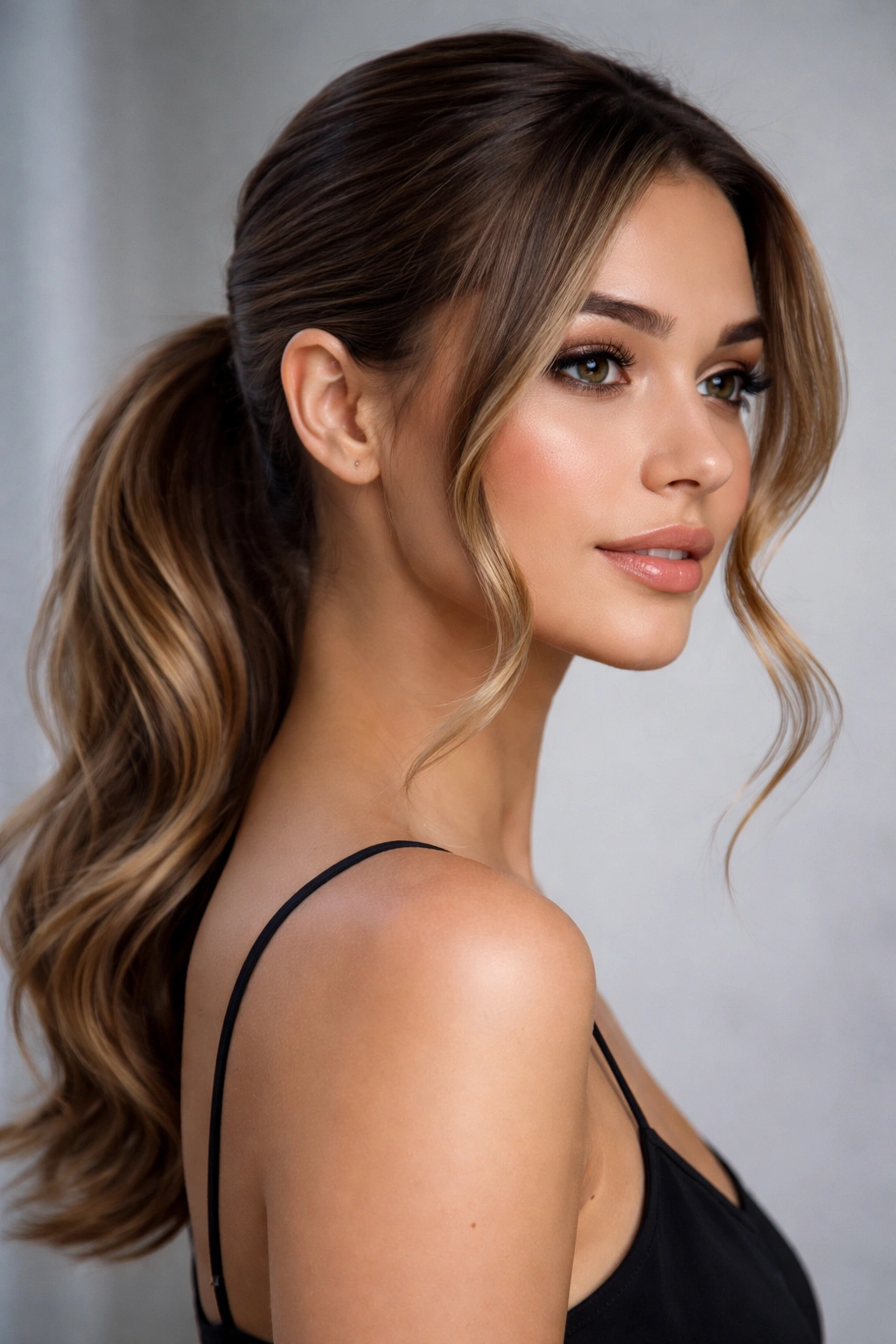
This is your go-to polished-but-relaxed style — a sleek, smooth ponytail base paired with deliberately curled face-framing pieces that soften the overall look. The contrast between the sleekness and the texture around your face creates sophistication without feeling overdone.
What Makes It Work
The tension here is what makes the style. You’ve got structure and control in the main ponytail, but softness and movement in the pieces framing your face. This combination feels intentional and high-polish while still reading as relaxed. The face-framing pieces do most of the heavy lifting in terms of making you look approachable rather than severe.
How to Create It
- Start with smooth, blow-dried hair (use a smoothing product and a flat paddle brush for a sleek base)
- Section out two small pieces at your temples and set them aside — these will be curled later
- Gather the remaining hair into a low ponytail at the nape of your neck, smoothing it with a fine-tooth comb as you go
- Secure with a sleek elastic, then wrap a small section of hair around the base to hide the tie (take a thin piece from the bottom of the ponytail, wrap it around the base, and pin inside)
- Use a 1-inch curling iron to curl each face-framing piece away from your face, creating a subtle wave or spiral
- Finger-comb the curl to soften it slightly
- Apply a lightweight smoothing serum to the ponytail base and a flexible hold spray to the curled pieces
Pro tip: The wrapped-base technique makes even a simple ponytail look infinitely more refined. It takes 30 seconds and completely changes the finished polish level.
5. Romantic Twisted Ponytail
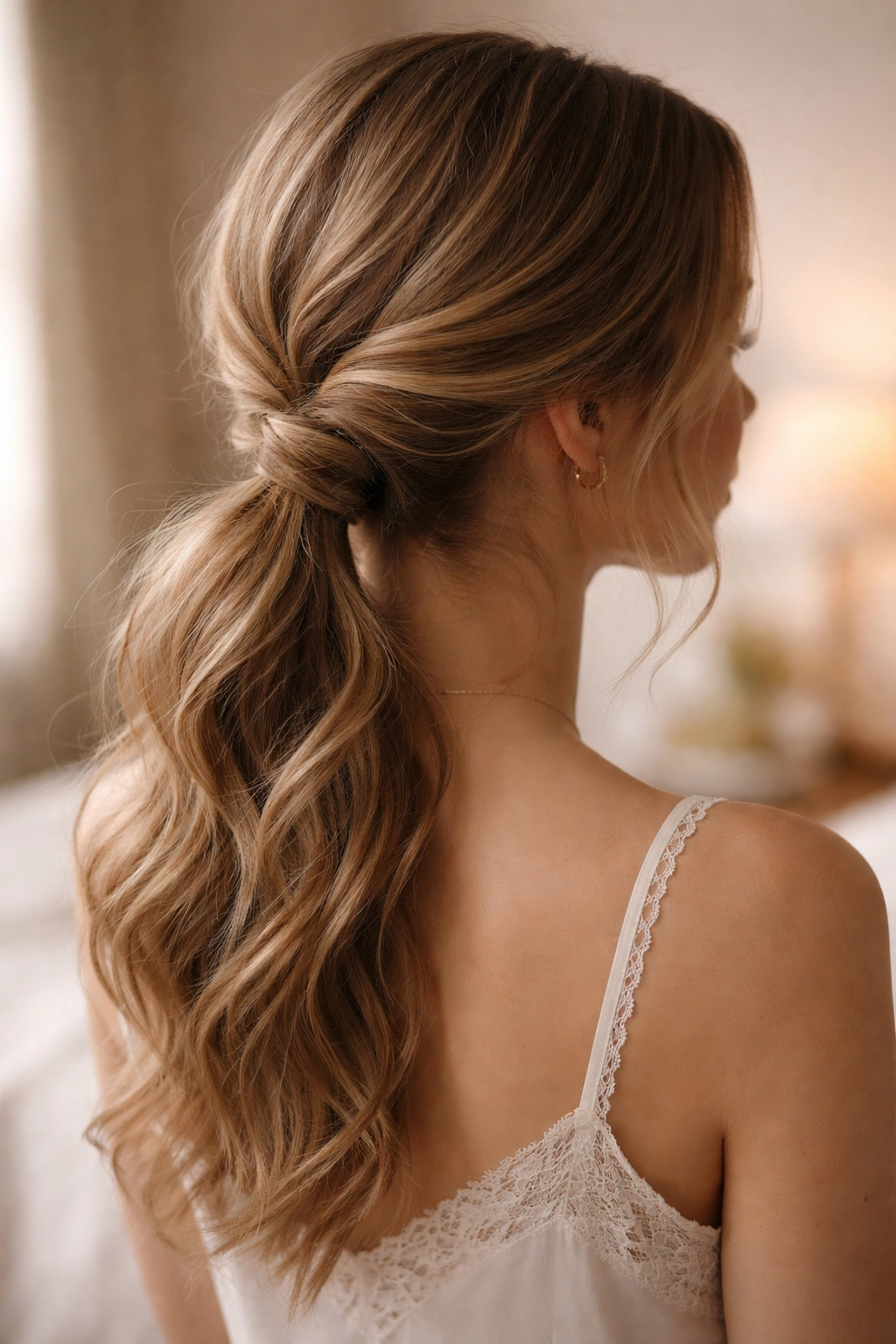
This style incorporates twists into the actual ponytail base, creating visual interest and a sense of movement without the ponytail being technically undone. It’s romantic, a bit more elevated than your everyday loose ponytail, and surprisingly easy to execute once you understand the twist placement.
What Makes It Work
Instead of a standard gathered ponytail, you’re creating twists that spiral into and out of the base, adding dimension and texture. The twists can be pulled slightly loose to increase the romantic, effortless vibe. This works beautifully with longer hair and becomes especially striking when you have layers or longer pieces that catch light as they twist.
How to Create It
- Start with damp or textured hair (waves or a slight curl pattern help this style enormously)
- Take a small section from one side of your head near your temple and begin a two-strand twist working backward toward the back of your head
- As you twist, gradually add small sections of hair from your crown and side, creating a spiral that grows larger as it moves back
- Repeat on the other side, creating a mirror-image twist
- Gather all your hair at the nape of your neck, where the two twists meet, into a low ponytail
- Take another small section from the side of the ponytail and twist it around the base where the elastic sits, pinning it underneath
- Gently pull apart the twists slightly to create a softer, more voluminous appearance
- Lightly mist with a flexible hold spray to maintain the twisted texture
Worth knowing: Twists appear tighter and more defined in straight hair, while they integrate more softly into wavy or curly hair. Choose your twist style based on how much visual structure you want.
6. Tousled High Ponytail
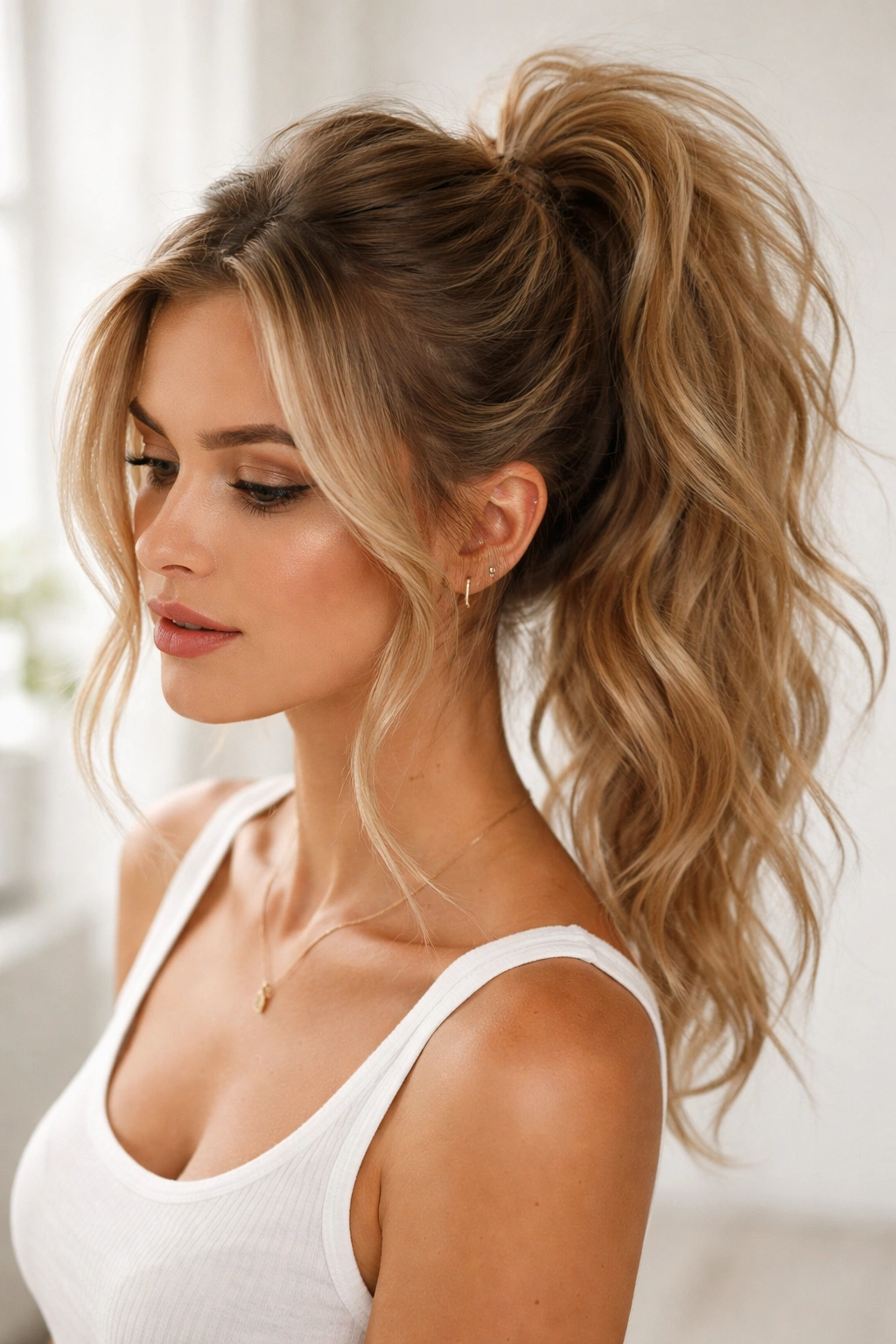
This loose ponytail sits higher on your head than the traditional low versions, creating more height and youthful energy while still maintaining that effortless, undone aesthetic. It’s perfect for active days, casual outings, and any time you want your style to feel fun rather than serious.
What Makes It Work
The height creates instant lift and volume, while the tousled texture prevents it from looking overly styled or severe. You’re balancing the higher placement with intentional messiness and movement. This style works beautifully with all hair lengths and textures, but it’s especially striking with layered hair that naturally creates variation in length and flow.
How to Create It
- Apply a volumizing mousse or texture spray to damp roots at your crown area
- Blow-dry your hair, focusing on creating root lift and using your fingers to create piece-y texture rather than a smooth finish
- Flip your head upside down and roughly flip it back — this creates natural volume and movement
- Gather hair into a mid-to-high ponytail at the crown (sitting about 2-3 inches from the top of your head)
- Secure loosely with an elastic, leaving face-framing pieces down on both sides
- Take small sections from the ponytail base and gently pull them loose to create volume and softness
- Use a rattail comb to tease very lightly under the ponytail base if you need extra grip
- Finish with a light hairspray that holds without feeling stiff
Pro tip: A claw clip or decorative hair clip placed horizontally through the base of a high ponytail adds instant style and makes the whole thing feel more intentional.
7. Braided Base Loose Ponytail
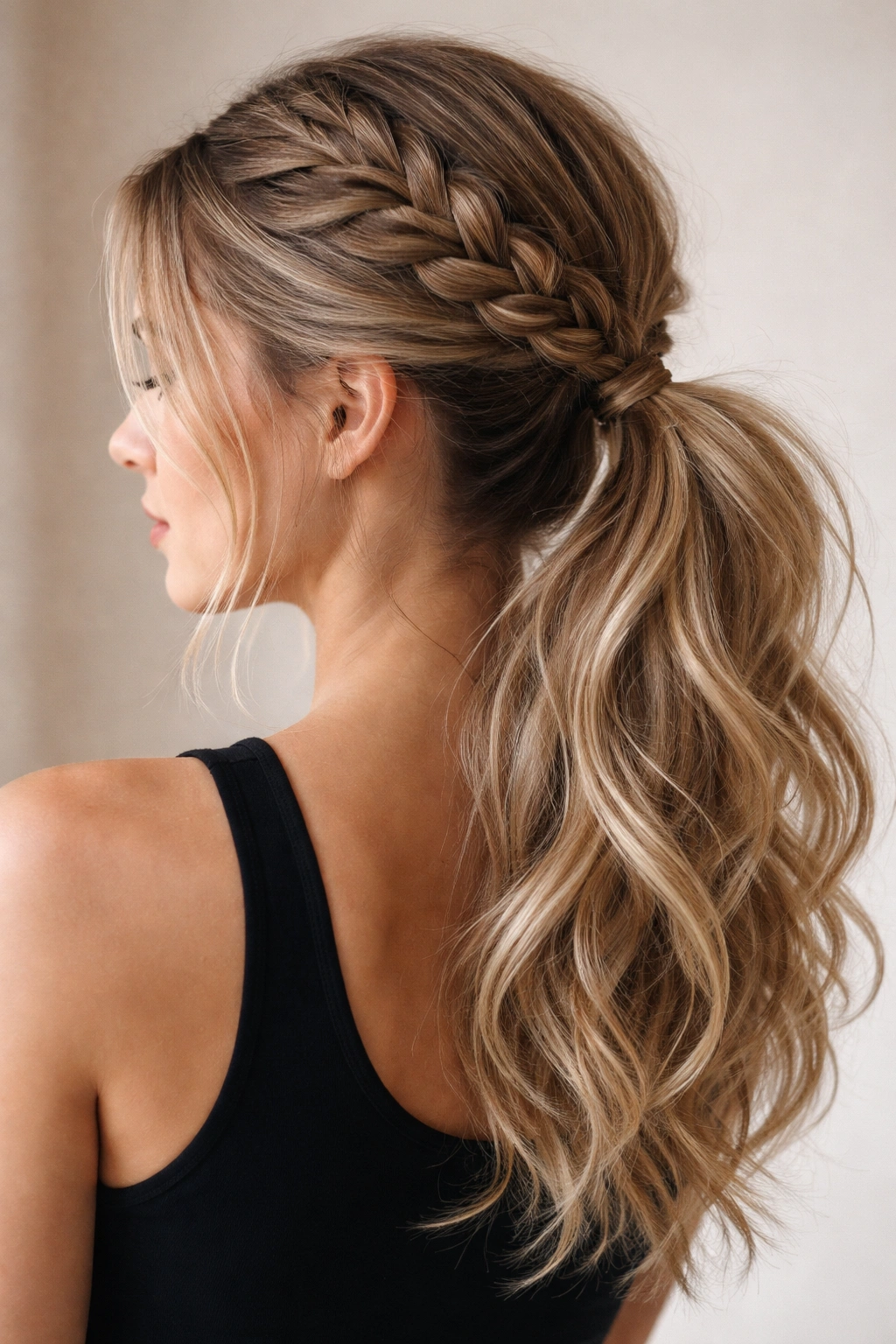
This style incorporates a braid (or braids) into the base structure, creating visual interest and texture that makes the ponytail feel more intricate than it actually is. The braid adds sophistication and works for a wider range of occasions than a simple gathered ponytail.
What Makes It Work
Braids create automatic visual texture and convey that you took time to style your hair, even if the ponytail itself is completely relaxed. You can use a Dutch braid, French braid, or side braid — the key is that the braid draws from the crown and front sections, feeding into a ponytail at the back or side. The rest of the ponytail remains loose, textured, and undone.
How to Create It
- Start with dry or slightly textured hair (waves help tremendously)
- Begin a French braid or Dutch braid at your crown, taking small even sections and braiding back toward the nape of your neck
- As you reach the back, braid any remaining free-hanging sections into the structure
- Once the braid reaches your ponytail gathering point, stop braiding and gather all hair (braided and loose) into a ponytail
- Secure with an elastic placed where the braid naturally ends
- Gently pull small sections from both the braid and the ponytail to create a softer, less structured appearance
- If your braid appears too tight, use your fingers to gently widen the braid sections — this creates a more relaxed look
- Finish with a flexible hold spray
Worth knowing: Three-strand braids read as more romantic and polished, while fishtail or Dutch braids create a more textured, modern vibe. Choose your braid style based on the mood you’re going for.
8. Undone Bubble Ponytail
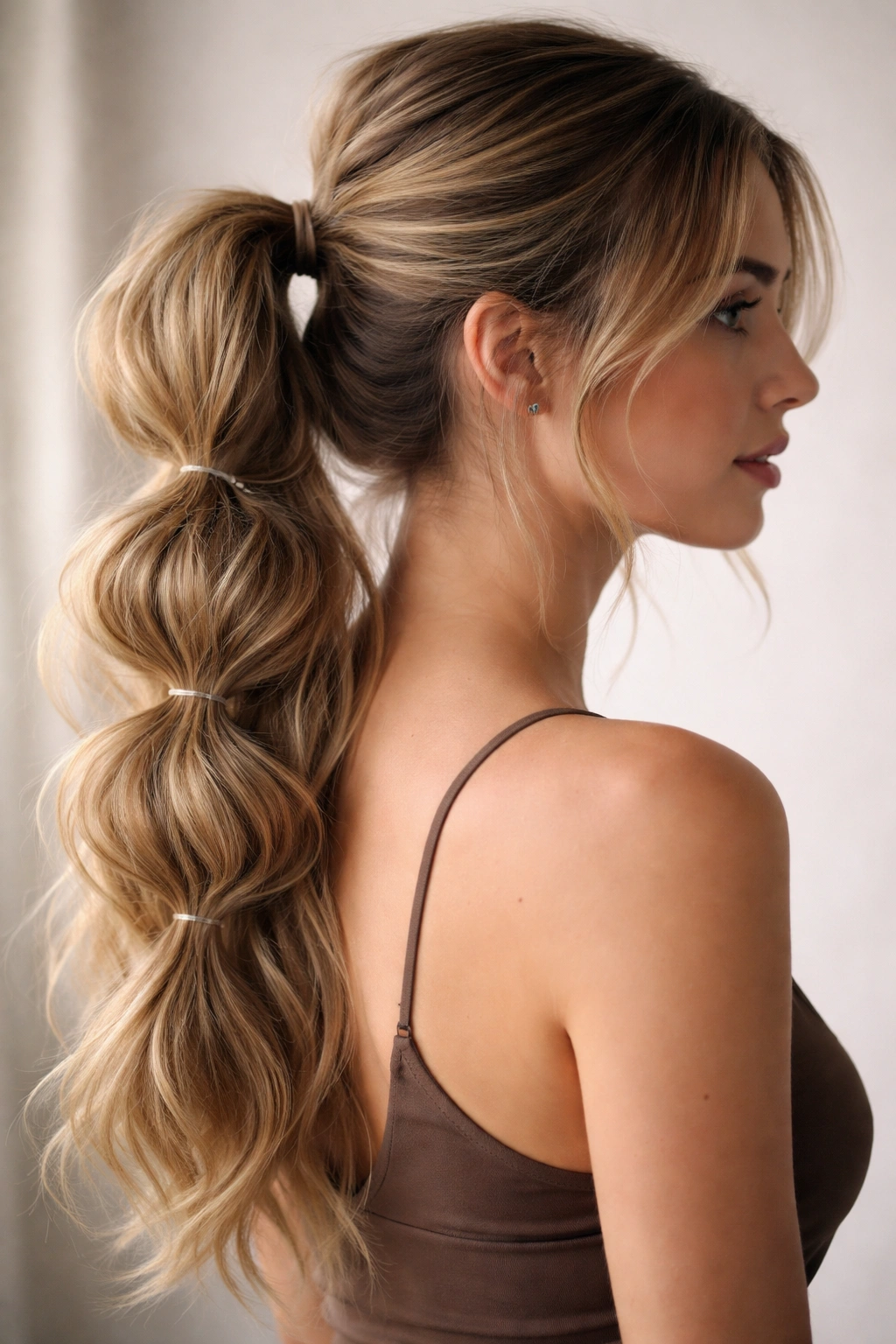
This playful style uses multiple elastics to create bubble sections within the ponytail itself, generating volume and visual interest throughout the length. It sounds more complicated than it is, and it’s surprisingly flattering because the bubble structure lifts and frames your face while remaining completely relaxed and youthful.
What Makes It Work
Instead of one continuous ponytail, you’re creating distinct sections secured at intervals, each section naturally pouffing out slightly between the elastics. The gaps and bubbles create movement and catch light in multiple places. This style celebrates your hair’s texture and volume rather than trying to sleek it down, making it ideal for anyone with naturally fuller hair or after you’ve added waves and texture.
How to Create It
- Begin with textured hair — waves, curls, or hair that’s been dried with volume — are essential for this style
- Create a loose ponytail at the back of your head, securing it loosely with the first elastic
- About 2-3 inches down from the first elastic, add a second elastic around the same ponytail (you’re wrapping the elastic around the existing ponytail section)
- Gently pull the ponytail section between the two elastics outward and upward to create a bubble shape
- Repeat this process, adding elastics every 2-3 inches down the length of your ponytail
- After securing all elastics, gently pull each bubble section outward to create volume and dimension
- Leave the very ends somewhat loose rather than neatly gathered
- Use bobby pins hidden in the bubble sections if needed for any pieces that won’t stay in place
Insider note: Use small, thin elastics in a color matching your hair — they’ll be less visible and won’t interrupt the visual flow of the bubbles.
9. Loose Wrap-Around Ponytail
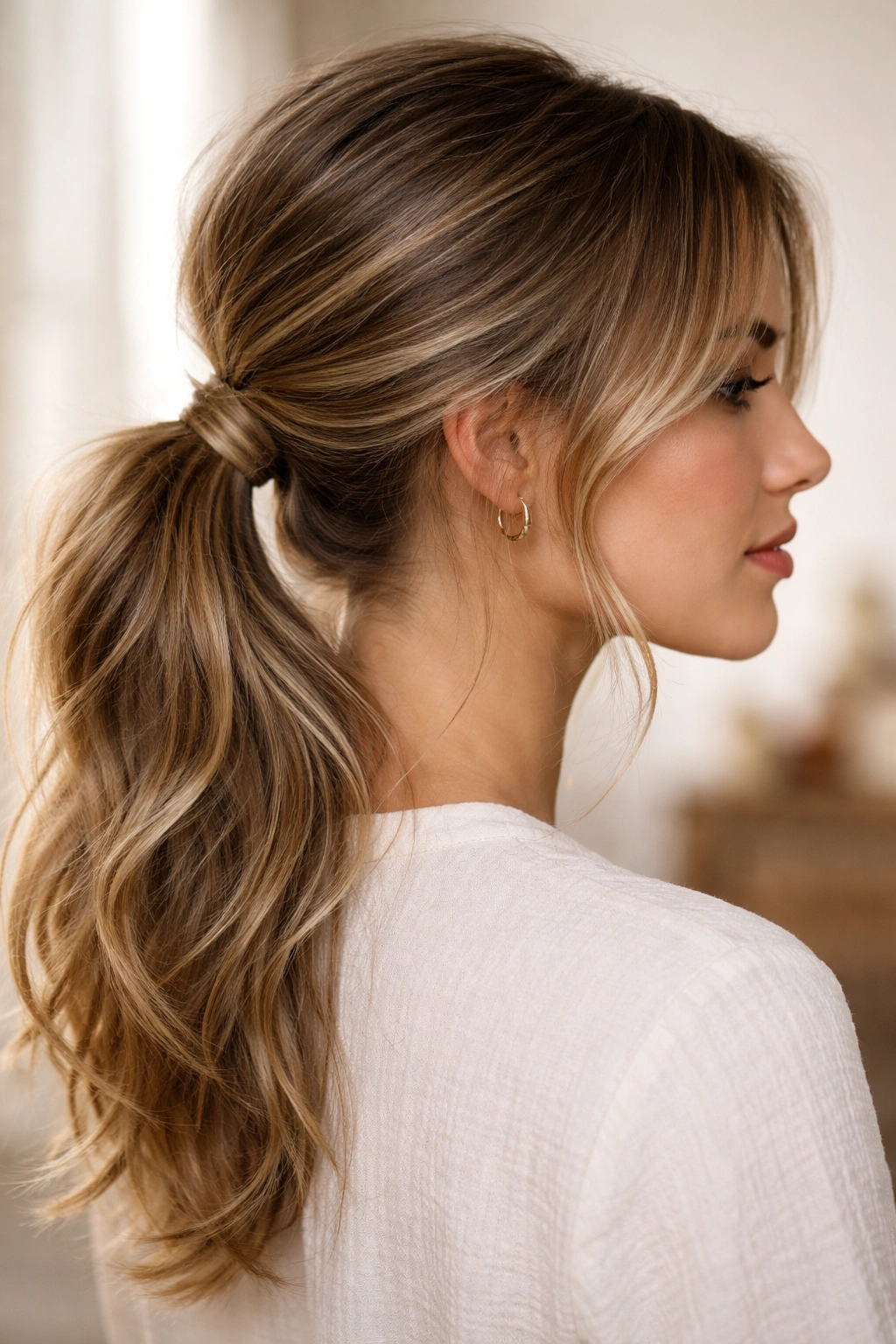
This sophisticated style uses a section of hair from the ponytail itself to wrap around the base, creating a finished, intentional look while keeping the ponytail itself completely soft and undone. The wrap adds visual interest and polish without requiring any additional styling or products.
What Makes It Work
The wrapped base creates a polished frame for the loose ponytail, making the overall style feel more refined. You’re creating a visual anchor that says “this is intentional” while the ponytail below remains completely relaxed. This works beautifully with all hair textures and reads equally well whether your ponytail is textured with waves or smooth and sleek.
How to Create It
- Begin with your hair down, styled with whatever texture you prefer (waves, straight, curls — all work)
- Create a low or mid-height loose ponytail, securing it with a clear elastic or one matching your hair color
- Take a small, thin section from the bottom of the gathered ponytail (about ½ inch wide)
- Wrap this section around the base of the ponytail, covering the elastic completely
- Secure the wrapped piece underneath the ponytail by pinning it with a bobby pin hidden under the wrap
- Gently tug the wrapped section to distribute it evenly around the base
- You can leave the wrapped section hanging down as part of the ponytail, or tuck it and pin it for a cleaner look
- Add any face-framing pieces you’d like by gently pulling them loose from the ponytail base
Pro tip: If you’re wrapping with a very thin section, don’t pull too tightly — you want the wrap to sit smoothly without distorting the ponytail base underneath.
10. Effortless Textured Crown Ponytail

This style gathers hair from just below your crown in a way that creates the illusion of height and volume, while keeping everything soft and texture-forward. It’s the sweet spot between a high ponytail and a crown-level gathering, and it works beautifully with layers, waves, and any hair texture that holds soft movement.
What Makes It Work
By gathering at the crown level rather than directly at the very top, you create a style that feels elevated without looking stiff or overly formal. The texture keeps it accessible and relaxed, while the placement and slight backward flow create elegance. This style is particularly flattering for longer faces because the horizontal line created by the ponytail placement helps balance proportions.
How to Create It
- Start with textured hair — waves, curls, or piece-y layers work beautifully
- Use a texturizing spray or salt spray throughout your hair to enhance any natural wave pattern
- Identify the crown area of your head (imagine a line connecting your ears; your crown is at the very top)
- Gather hair at this crown level into a loose ponytail, not pulling too tightly
- Leave some face-framing pieces loose and slightly curled away from your face
- Take small sections from both sides of the ponytail base and gently tease them backward — this creates a soft, billowing effect
- Secure with an elastic that matches your hair color
- Wrap a thin section of hair around the base if you want to conceal the elastic
- Finish with a light, flexible hold spray
Worth knowing: This style photographs beautifully because the crown placement creates natural balance and draws attention upward to your face.
11. Half-Up Loose Ponytail with Waves
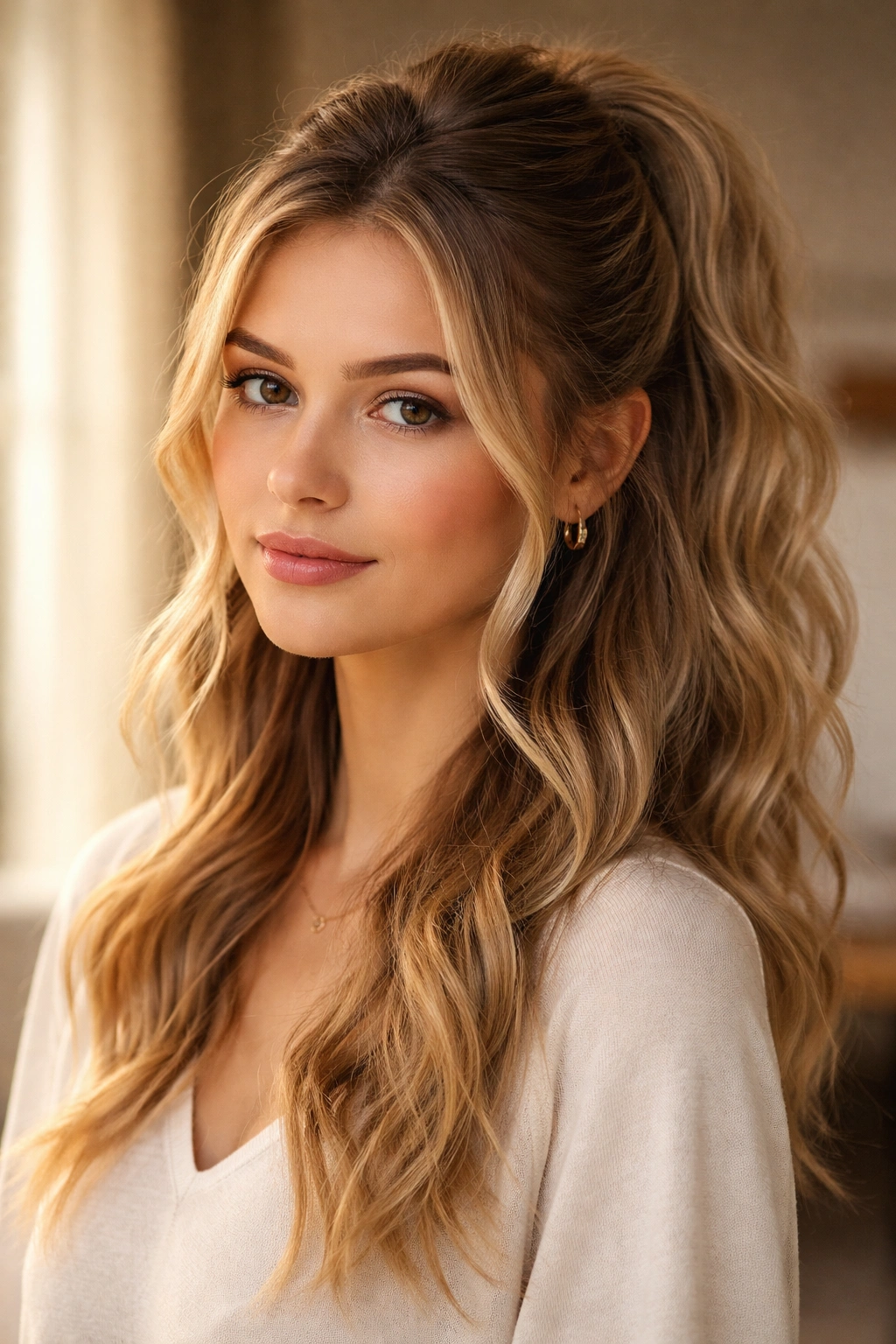
This style bridges the gap between down hair and a full ponytail — you’re gathering only the upper portion of your hair while leaving the bottom section completely down and loose. It’s deeply romantic, suits virtually every face shape, and works for everything from casual to moderately formal occasions.
What Makes It Work
The half-up structure creates height and visual interest at the crown while the loose, wave-textured bottom half maintains movement and flow. You’re not committing to a full ponytail, which makes the style feel more relaxed and approachable. The waves in the lower section do the heavy lifting in terms of looking intentionally styled rather than simply half-fastened.
How to Create It
- Begin with your hair down and curled or waved throughout, paying special attention to the bottom half
- Use a 1.5-inch curling iron to create soft waves in the bottom sections, curling away from your face
- Gather the top portion of your hair (from approximately your temples back to your crown) into a half-up section
- Secure this section loosely with an elastic at the back of your crown
- Leave face-framing pieces loose and softly waved
- Gently pull a few pieces from the gathered section to create softness at the crown
- Allow the bottom half of your hair to flow freely, maintaining the wave pattern
- Use a flexible hold spray to help the waves last without making hair feel stiff
- Optional: wrap a thin section from the half-up around the base for a more finished look
Pro tip: You can create this style in minutes with pre-existing waves or curls, making it perfect for days when you want to look put-together without spending time styling.
12. Gathered Loose Ponytail with Face-Framing Layers
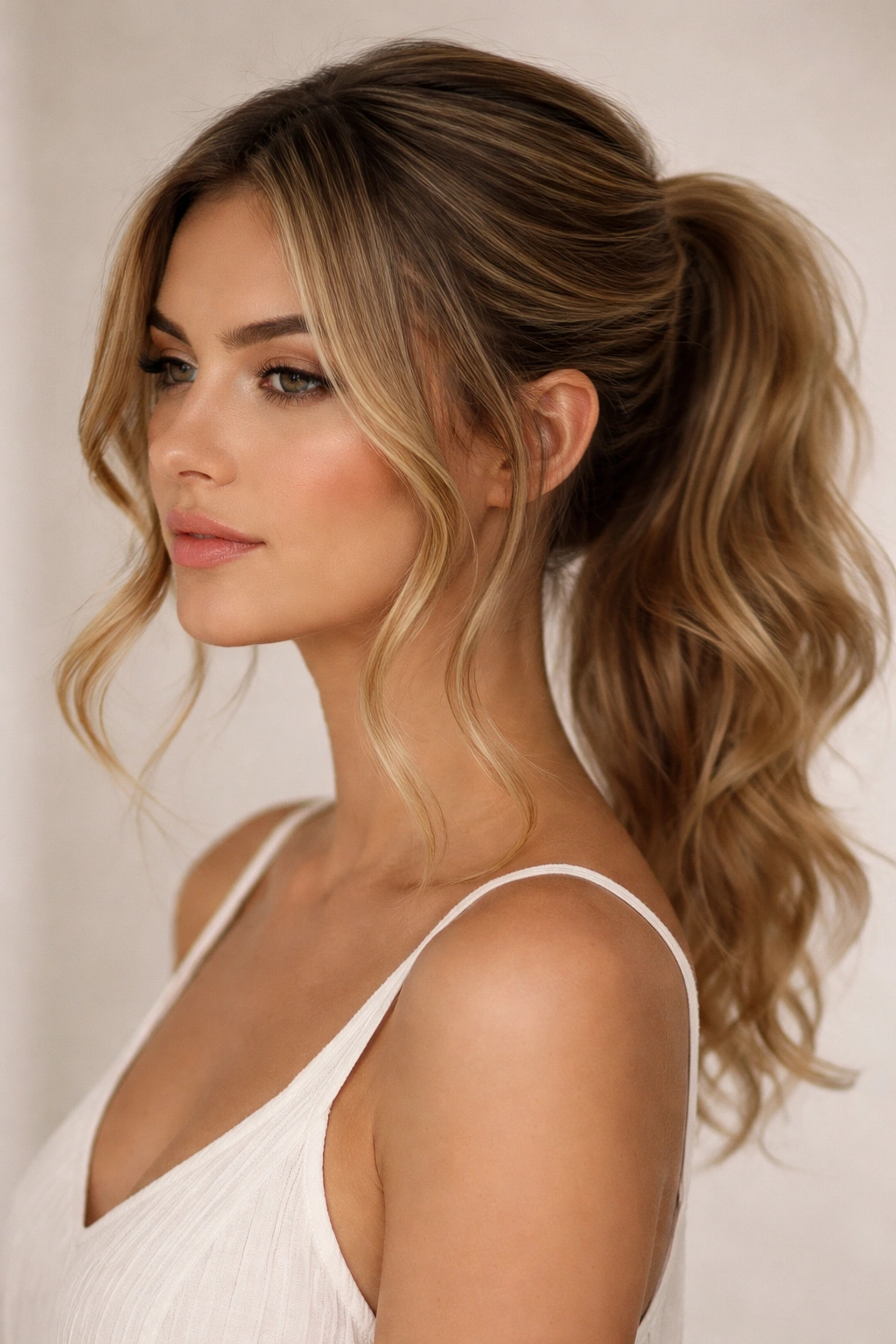
This final style emphasizes face-framing pieces that are intentionally styled differently from the main ponytail. The contrast between the soft, curled face-framing layers and the looser, more relaxed ponytail creates dimension and balance that’s flattering on most face shapes.
What Makes It Work
Your face-framing pieces are the stars here — they’re deliberately curled, waved, or piece-y in a way that draws attention to your face and creates softness around your features. Meanwhile, the ponytail remains more textured and undone, creating a balanced, multidimensional look. This style works whether your face-framing pieces are naturally layered or if you’re simply styling certain sections to fall around your face.
How to Create It
- Blow-dry your hair with root lift, focusing especially on creating volume at your crown and around your face
- Section out the hair you want as face-framing pieces — typically from your temples and cheekbones on both sides
- Take a 1-inch curling iron and curl each face-framing piece away from your face, creating a distinct curl or wave
- Finger-comb these curled pieces to soften the curl and create a more romantic, undone appearance
- Gather the remaining hair (crown, back, and sides minus the face-framing pieces) into a low or mid-height loose ponytail
- Secure with an elastic, leaving the curled face-framing pieces completely loose and free to move
- Gently pull small sections from the ponytail base to create volume and softness
- Finish the curled face-framing pieces with a lightweight hairspray that provides hold without crunchiness
- Optional: wrap the ponytail base with a thin section of hair for additional polish
Worth knowing: The more dramatically you curl your face-framing pieces compared to the rest of your hair, the more intentional and styled the overall look becomes — perfect for occasions when you want to look like you took time with your appearance.
Final Thoughts
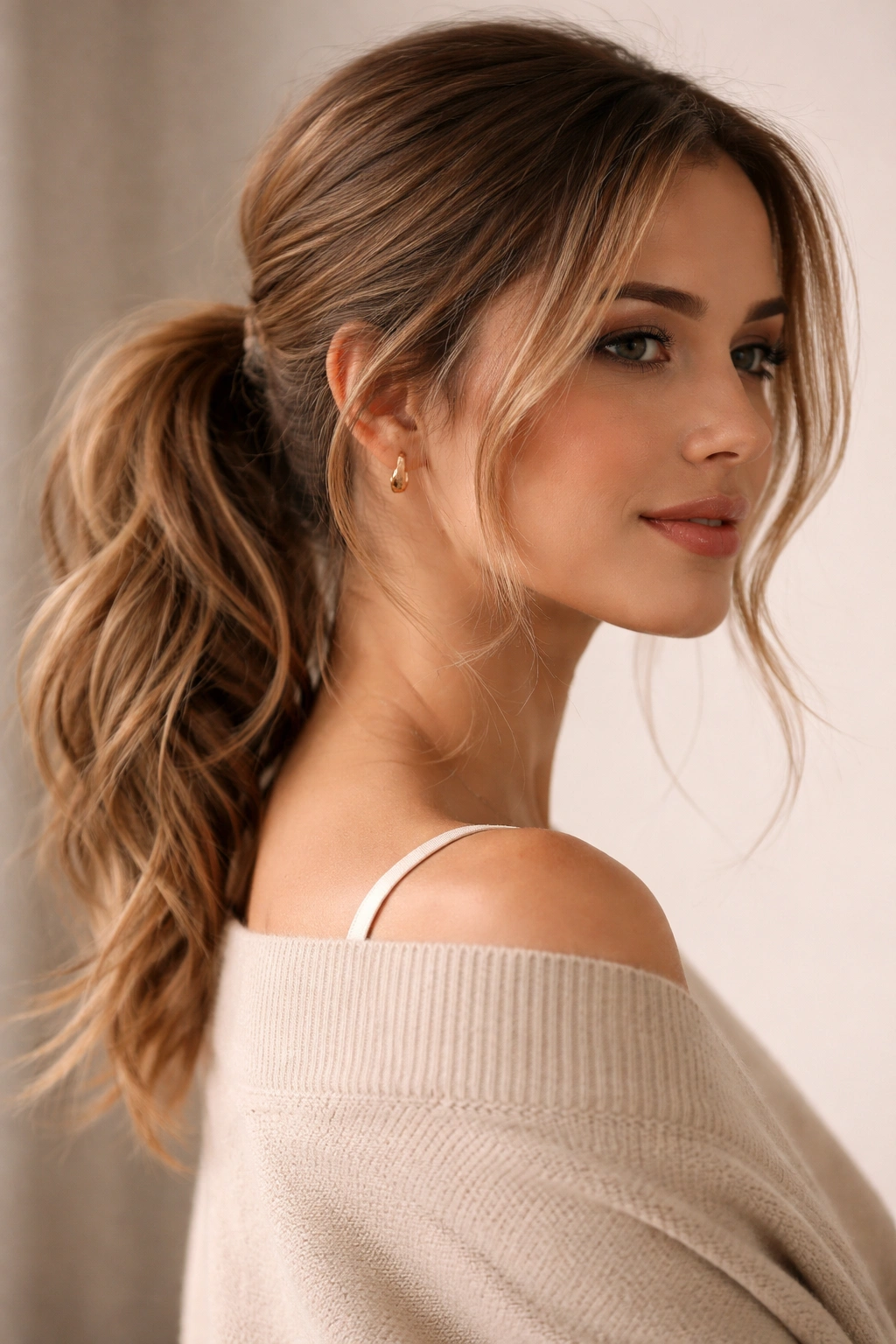
The beauty of loose ponytails is that they offer something for every mood, occasion, and hair type. Whether you’re drawn to the romantic softness of twisted styles, the casual ease of textured waves, the playfulness of bubble ponytails, or the sophisticated polish of wrapped bases, there’s a loose ponytail approach that works for your life.
The real secret behind every one of these styles is that looseness isn’t about sloppiness — it’s about intentional relaxation. You’re deliberately creating texture, strategically leaving pieces loose, and choosing placements and wrapping techniques that signal you’ve thought about your style. The effort is there; it’s just hidden enough that the final result feels effortless.
Start with the styles that match your natural hair texture and lifestyle. If your hair naturally holds waves and has movement, lean into the beach wave and textured ponytail styles. If you prefer sleeker bases, explore the wrapped and face-framing options. Once you’ve found your favorites, you can experiment with hybrids — combining a braided base with a bubble structure, or adding twists to a textured crown ponytail. The most personal, flattering styles often come from understanding the fundamentals and then adapting them to what makes you feel confident.
