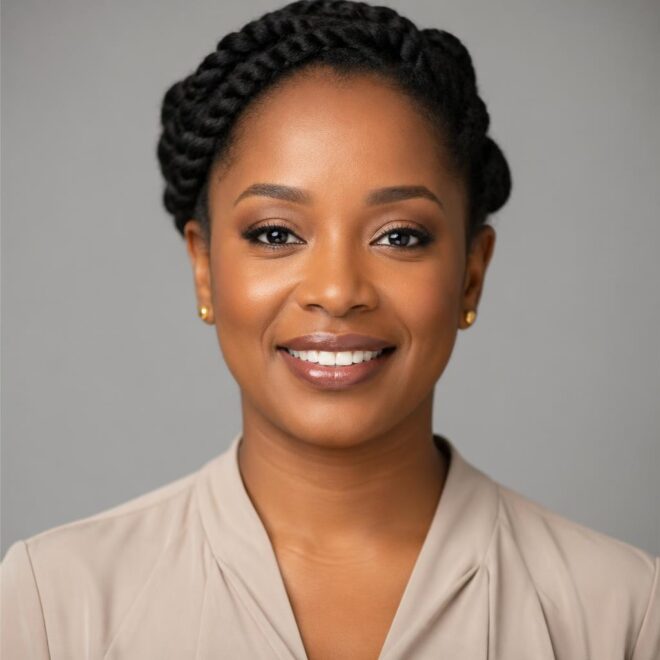


Braided ponytails have become one of the most versatile and elegant hairstyling options for anyone looking to add dimension and visual interest to their look. When you combine the intricate texture of braids with the framing effect of bangs, you create a hairstyle that’s simultaneously polished, playful, and undeniably chic. The beauty of braided ponytails with bangs is that they work across virtually every hair type, length, and texture — whether you’re styling thick, voluminous hair or working with finer strands that need strategic layering. Bangs add an extra layer of sophistication while also serving a practical purpose: they frame the face beautifully and can help balance certain face shapes while you wear your hair pulled back.
What makes this hairstyle category so compelling is the sheer range of possibilities. You’re not locked into a single look — you can play with different braid patterns, adjust the tightness or looseness of your weave, experiment with braid placement, and customize how much of your hair goes into the ponytail versus flows freely. Some styles work beautifully for formal occasions like weddings or professional events, while others are casual enough for everyday wear or outdoor adventures. The bangs themselves offer equal flexibility: you can wear them blunt and dramatic, soft and wispy, side-swept for a sultry vibe, or even incorporate them into the braid pattern itself for a completely unified look.
The styling process doesn’t require advanced techniques, though mastering a few key braiding methods will open up endless possibilities. Whether you’re creating a sleek, polished style for work or a tousled, textured version for the weekend, the fundamentals remain consistent. You’ll discover that the right combination of braid style, bang placement, and ponytail positioning can completely transform your appearance — sometimes dramatically, sometimes subtly. Let’s explore twelve distinct approaches to braided ponytails with bangs, each with its own personality and purpose.
1. The Center-Braid Ponytail With Straight-Across Bangs
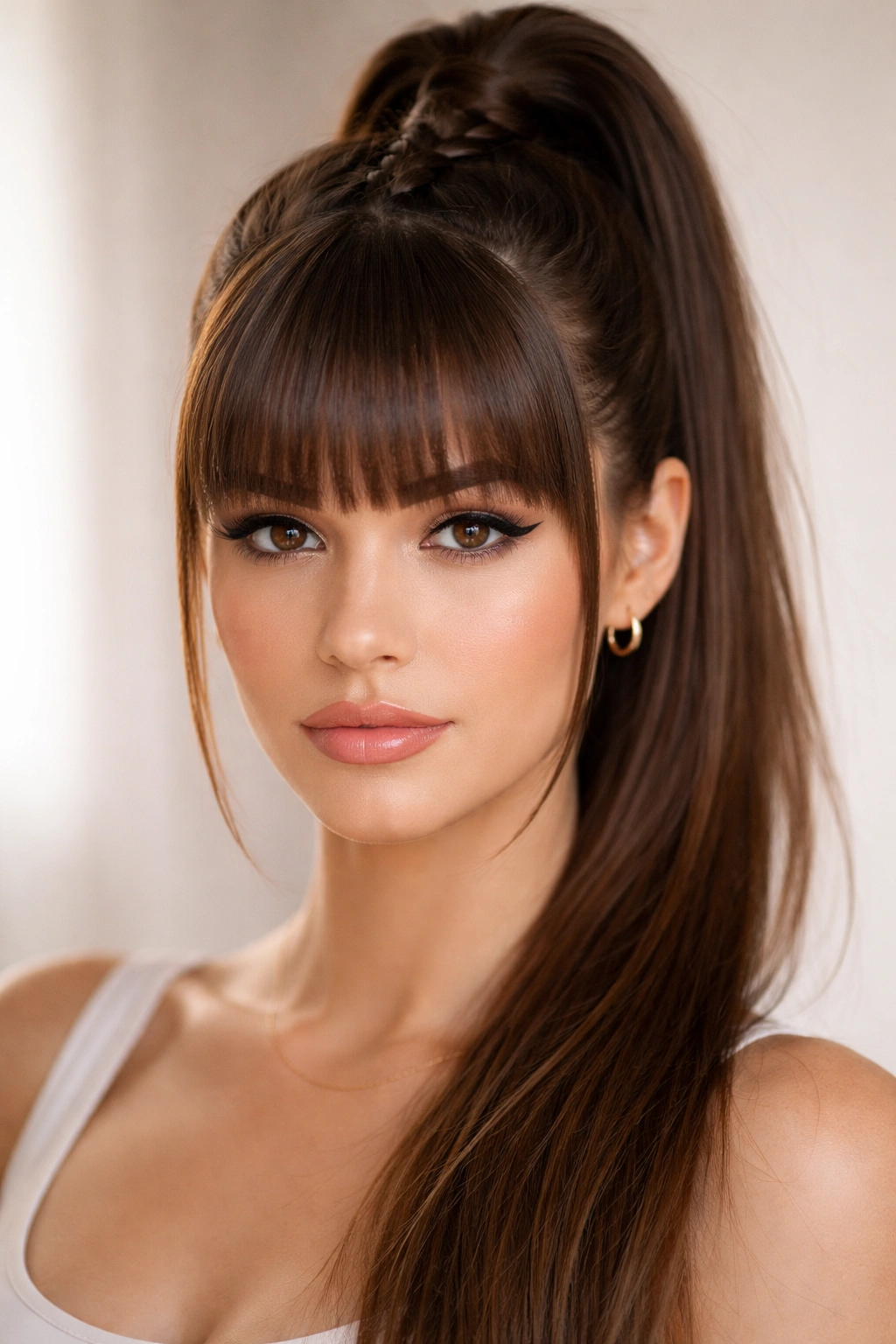
This is the quintessential braided ponytail with bangs — a style that combines timeless elegance with modern edge. A single Dutch or French braid runs down the center of your head from your crown straight down into a sleek, high ponytail, while straight-across bangs frame the forehead with clean, blunt lines. The contrast between the structured braid and the smooth bangs creates a visually striking effect that looks intentional and put-together.
Why This Works So Well
The center braid acts as a visual anchor that draws the eye through the middle of your face, while the bangs frame everything above. This combination creates excellent balance for oval and heart-shaped faces, and it’s surprisingly forgiving on most hair types. The single braid means you’re not managing multiple sections — just one continuous, manageable plait from crown to tail.
How to Execute It Perfectly
- Start by establishing your bangs first if you’re styling around existing ones, or section them out as part of your overall styling plan
- Apply a light texturizing spray or mousse to damp hair to give yourself grip for braiding
- Begin your center braid at the crown using the Dutch method (crossing sections under rather than over for that raised, dimensional look)
- Feed hair into the braid as you travel downward, keeping it centered and consistent in width
- Once you reach the nape, gather the remaining hair into a ponytail and secure it with an elastic that matches your hair color
- Gently pull at the braid edges to loosen and widen it for a more modern, relaxed feel
- Pro tip: Curl the ponytail section lightly with a 1.5-inch barrel to add softness and break up the severity
2. The Double Dutch Braids Into Ponytail With Side-Swept Bangs
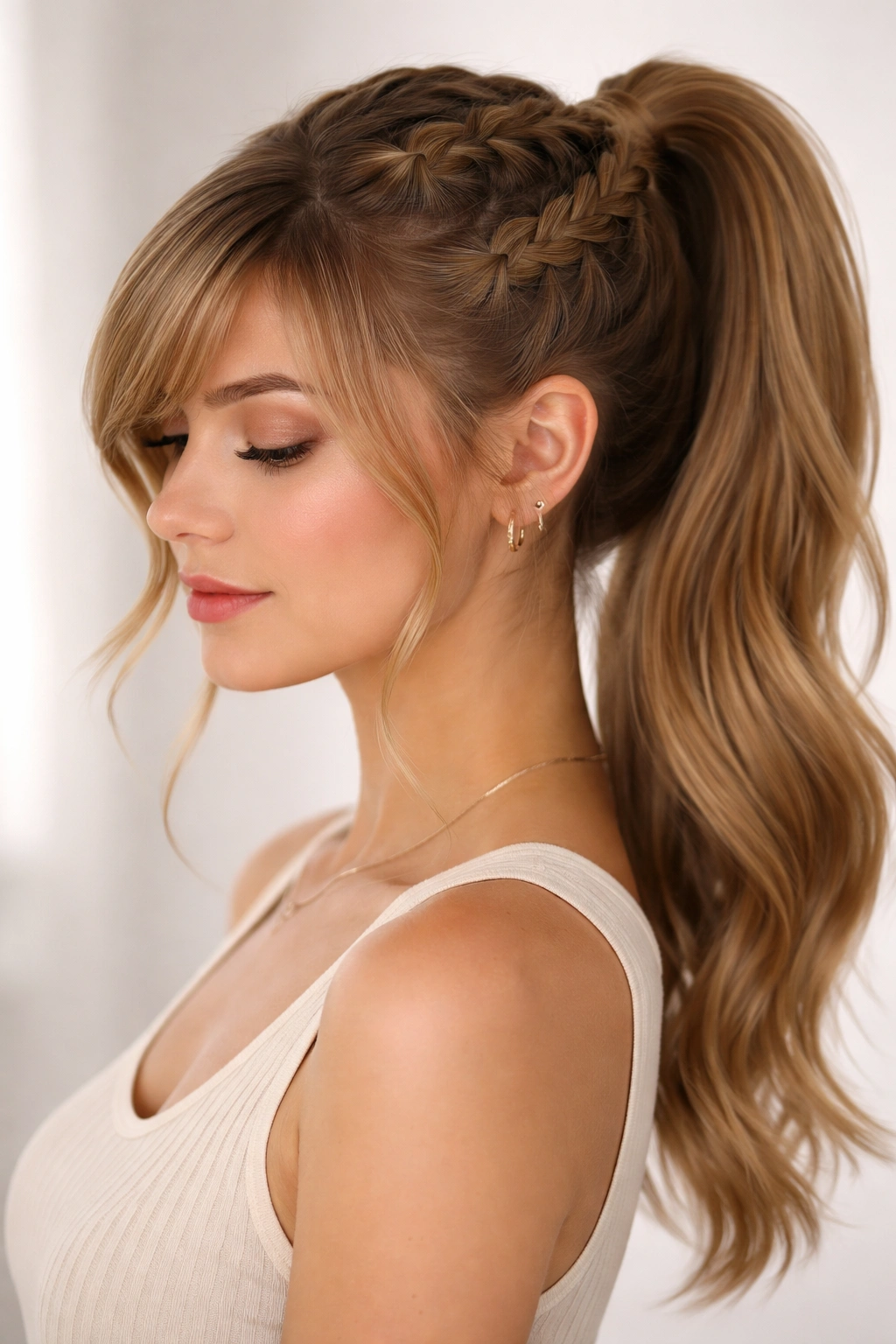
This style splits the attention: two symmetrical Dutch braids travel down either side of your head and converge into a single, unified ponytail at the back, while side-swept bangs drift across the forehead with romantic, flowing movement. The double-braid approach creates architectural interest while the soft bangs soften the overall aesthetic, making this an ideal choice for anyone seeking balance between structure and femininity.
The Visual Impact
Two parallel braids create a naturally framing effect that’s flattering on most face shapes, especially rectangular or square faces where you want to soften angular lines. Side-swept bangs add to this softening effect by directing the eye diagonally rather than straight across. The combination feels current and polished without requiring extensive styling experience.
Styling Steps for Success
- Part your hair down the center from forehead to nape
- Create one Dutch braid from your left hairline down to the back of your head, then repeat on the right side, mirroring the technique
- Keep both braids at consistent tension so they look intentional, not accidental
- Gather both braids and the remaining loose hair into a ponytail positioned at your mid-scalp rather than high on your crown
- Sweep your bangs to one side (typically the side that feels most natural for your face), pinning them back slightly with a small clip if they’re longer
- Allow 2-3 face-framing pieces to fall loose around your ears for softness
- A texturizing spray applied before braiding helps the braids hold their shape longer and look more intentional
3. The Fishtail Braid Ponytail With Wispy Bangs
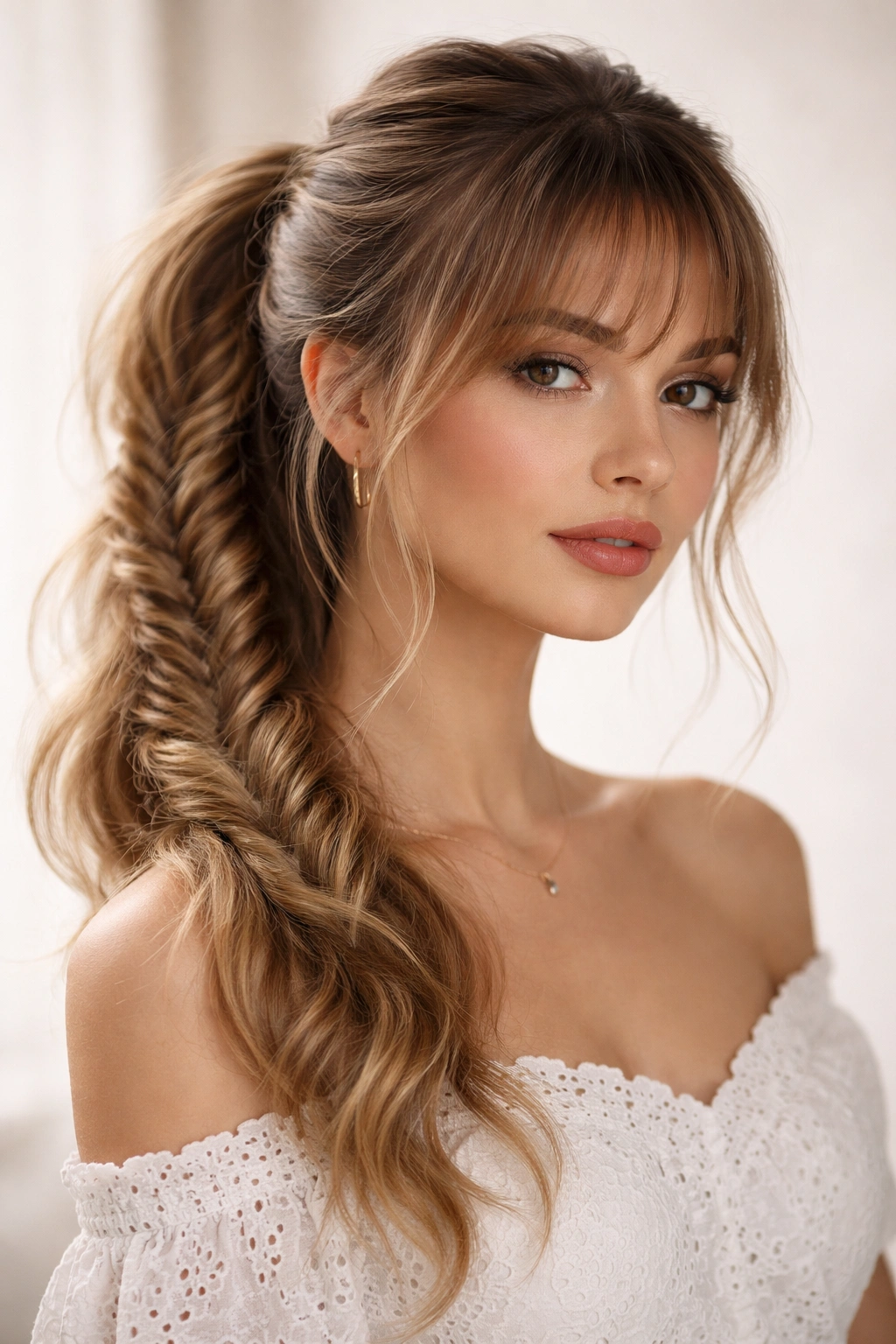
The fishtail braid offers a more delicate, intricate aesthetic than traditional three-strand braids. This version starts from the crown and feeds into a ponytail while wispy bangs flutter softly around the face. The fishtail creates a feathered, almost lace-like appearance that photographs beautifully and feels effortlessly romantic. Wispy bangs complement this softer approach by maintaining the delicate theme throughout the entire style.
What Makes the Fishtail Special
A fishtail braid creates visual texture without requiring the hair to be wound tightly. The interlocking two-strand pattern creates natural gaps that feel airy and modern. This technique works particularly well on longer hair, where the lighter weight allows the braid pattern to show more clearly. Wispy bangs enhance this effect by echoing that soft, feathered quality.
Step-by-Step Fishtail Execution
- Begin with hair that has slight texture — either naturally wavy, curled from the night before, or lightly waved with a curling iron
- Section out your bangs and apply a lightweight smoothing serum to keep them lying flat and soft
- Start your fishtail braid by taking a small section from the right side and crossing it over to the left, then taking a small section from the left side and crossing it over to the right
- Continue this alternating pattern all the way down to the base of your skull
- Secure the fishtail into a low ponytail (typically positioned at the nape or just above it)
- Gently pull and widen the fishtail strands to create that delicate, feathered appearance
- Trim and style bangs to fall just below the brow, allowing them to part naturally in the center or sweep gently to one side
4. The Crown Braid With Wispy Curtain Bangs
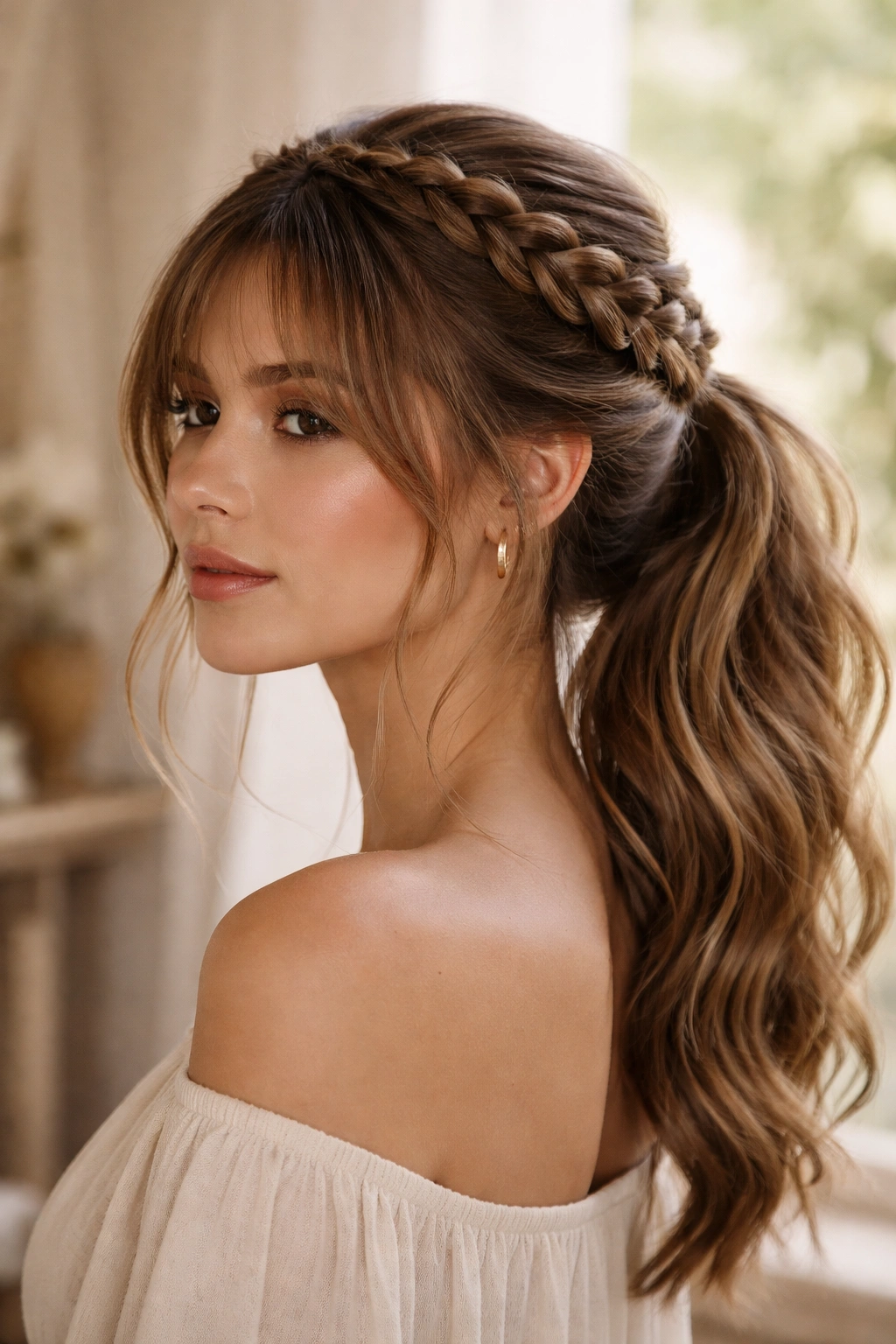
A crown braid that wraps partially around the head while feeding into a back ponytail offers a distinctly romantic, bohemian aesthetic. Wispy curtain bangs — where the center sections are longer and frame the face while the outer sections taper shorter — complement this style by softening the face and adding dimension. This approach feels particularly suited to softer hair types and anyone drawn to effortless, bohemian-inspired aesthetics.
The Romance Factor
Crown braids create a literal halo effect that makes any face feel softer and more approachable. The braid doesn’t have to be tight — in fact, a slightly loose, textured crown braid looks more intentional and modern. Curtain bangs are experiencing renewed popularity because they work across multiple hairstyles and face shapes, offering flattering framing without the commitment of traditional blunt bangs.
How to Create This Look
- Section your hair so that you’re keeping the crown area (from ear to ear across the top) available for braiding
- Begin your braid at the temple on one side, braiding across the back of the crown toward the opposite temple
- As you braid, you can either braid under the remaining hair or braid over the top — the under-braid method creates a more integrated, woven appearance
- Once you reach the opposite temple, secure the end of the braid and gather all your hair into a ponytail at your crown or slightly lower
- The ponytail can be left straight, curled, or left partially loose for a relaxed feel
- Curtain bang styling requires minimal effort: just let them dry naturally or blow-dry with your fingers to encourage the center parting
5. The Twisted Braid Ponytail With Blunt Bangs
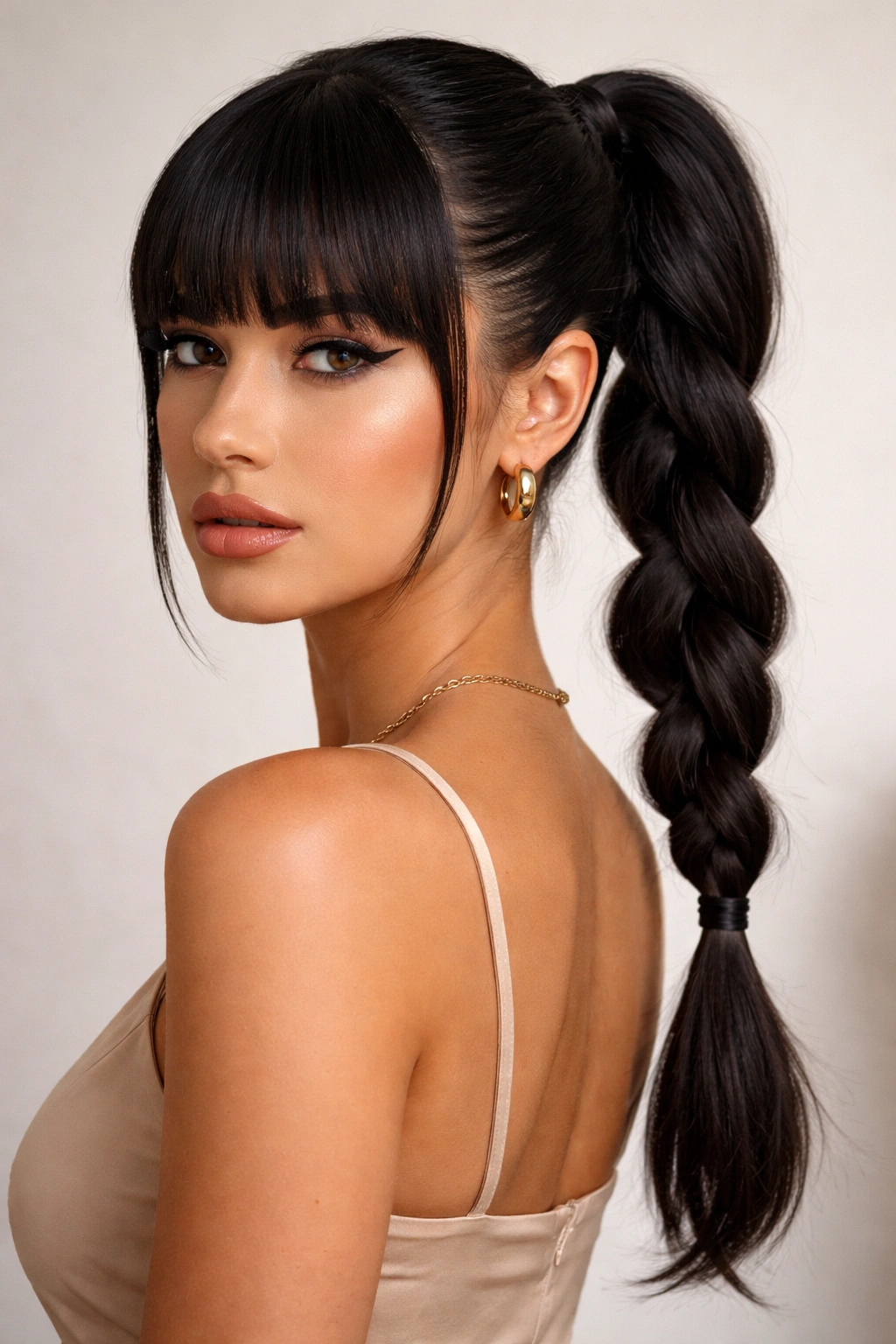
A twisted braid is technically simpler than a traditional braid — you’re working with just two sections of hair that wrap around each other rather than three. This twisted approach into a ponytail feels more modern and less fussy than traditional braiding, making it perfect for someone who wants the visual interest of a braid without the labor-intensive technique. Blunt bangs paired with this style create a sharp, contemporary aesthetic.
Why Twisted Braids Feel So Current
Twisted braids bridge the gap between casual and polished. They require less precision than three-strand braids, so they actually look better slightly imperfect and textured. This style gained popularity as part of the “undone elegance” movement — hairstyles that look effortless rather than meticulously perfected.
The Twisted Braid Technique
- Divide your hair into two equal sections from crown to nape
- Keeping the sections separated, twist one section clockwise while twisting the other counterclockwise
- Cross the twisted sections over each other in an alternating pattern, feeding in loose hair as you go
- The result should look like two twisted ropes wrapped around each other
- Secure at the base into a ponytail at your preferred height
- Tousle the twist slightly with your fingers to enhance that deliberately undone feeling
- Blunt bangs should fall just above the brow, creating a striking frame for this modern style
6. The Dutch Braid Wrapped Around a High Ponytail With Curtain Bangs
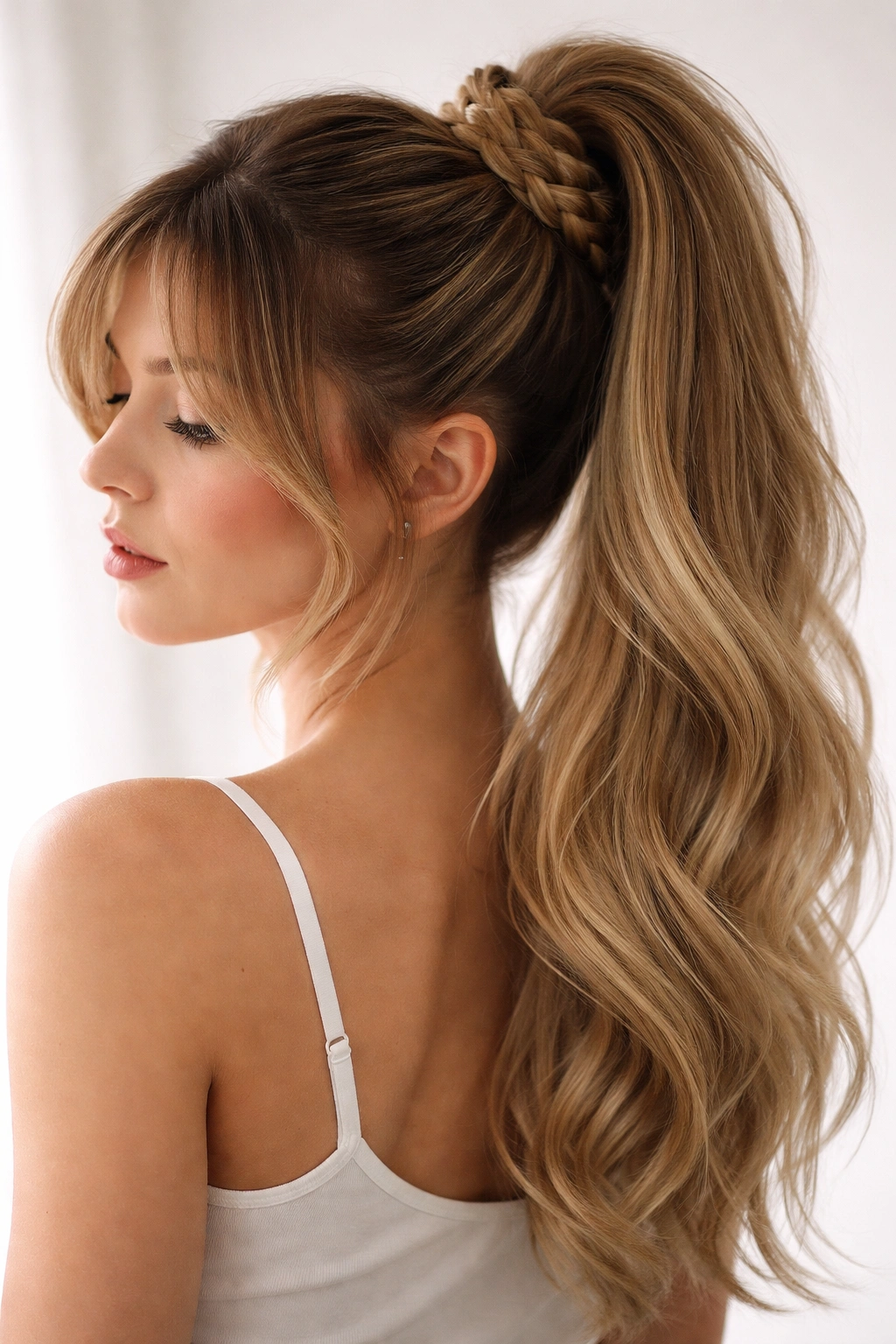
This technique is different from the center or side braids: here, you’re creating a high ponytail first, then wrapping a Dutch braid around its base like a crown. This creates a sculptural, artistic effect that’s particularly striking from behind. Curtain bangs add softness and prevent the overall look from feeling too severe, making this an ideal style for someone who loves bold, architectural hairstyles.
The Sculptural Appeal
Wrapping a braid around a ponytail base creates dimension and visual interest that a simple ponytail can’t match. It’s a technique that photographs beautifully because of the way the braid catches light and creates shadows. This style works best on medium to thick hair that can support the weight and bulk of both the ponytail and wrapped braid.
Creating the Wrapped Braid Effect
- Begin by creating a very high ponytail at your crown, securing it tightly with an elastic
- This ponytail will be your canvas; use a light hairspray to keep flyaways in check
- Take a section of hair from the side of your head and begin a Dutch braid, positioning it to eventually reach the base of the ponytail
- Braid across the back of the head, following the curve of the scalp
- Once your braid reaches the opposite side of the ponytail base, you can either secure it with bobby pins or spiral it around the elastic
- Pin the braid securely so it won’t shift throughout the day
- Leave your ponytail loose and wavy, or curl it for added dimension
- Style curtain bangs to frame the face softly, allowing them to create a gentle contrasting element to the structured braiding
7. The Halo Braid Ponytail With Side-Swept Bangs
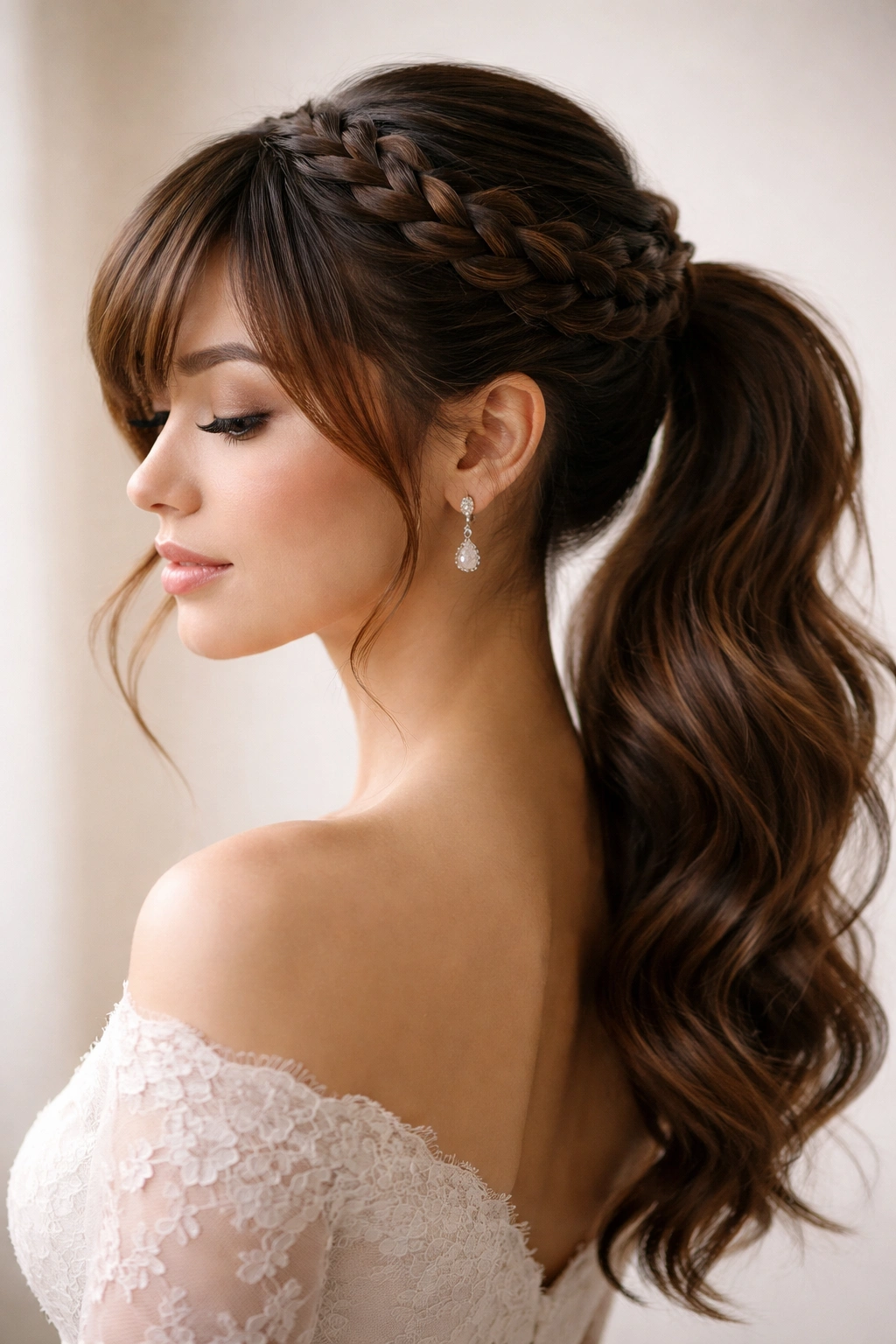
A halo braid that sits like a crown around the back of your head while feeding into a low, romantic ponytail creates wedding-worthy elegance. Unlike a crown braid that wraps around the sides of the face, a true halo braid sits entirely in the back, creating a visual frame without obscuring any facial features. Side-swept bangs complete the romantic aesthetic while keeping the face entirely visible.
The Elegance Factor
Halo braids are beloved by everyone from brides to anyone seeking a special-occasion hairstyle. They’re more practical than a full crown braid because they don’t require as much styling precision around the face. The halo-effect braid feels more dramatic and intentional than simpler braid styles while maintaining an approachable, feminine aesthetic.
The Halo Braid Method
- Section the hair at ear level from one ear to the other, creating what will eventually become your ponytail
- Begin your braid at one ear, braiding backward toward the crown
- Feed hair into the braid as you travel, creating a fuller, more dimensional braid
- Braid all the way around to the opposite ear, creating a complete circular arc
- Once you’ve completed the halo, secure the end of the braid at the ear
- Gather all the hair from the halo braid section plus the lower section into a ponytail positioned at your nape
- The ponytail should sit low and can be left straight, curled into waves, or left partially loose
- Style side-swept bangs by directing them across the forehead, pinning them back gently with bobby pins
8. The Four-Strand Braid Into Ponytail With Blunt Bangs
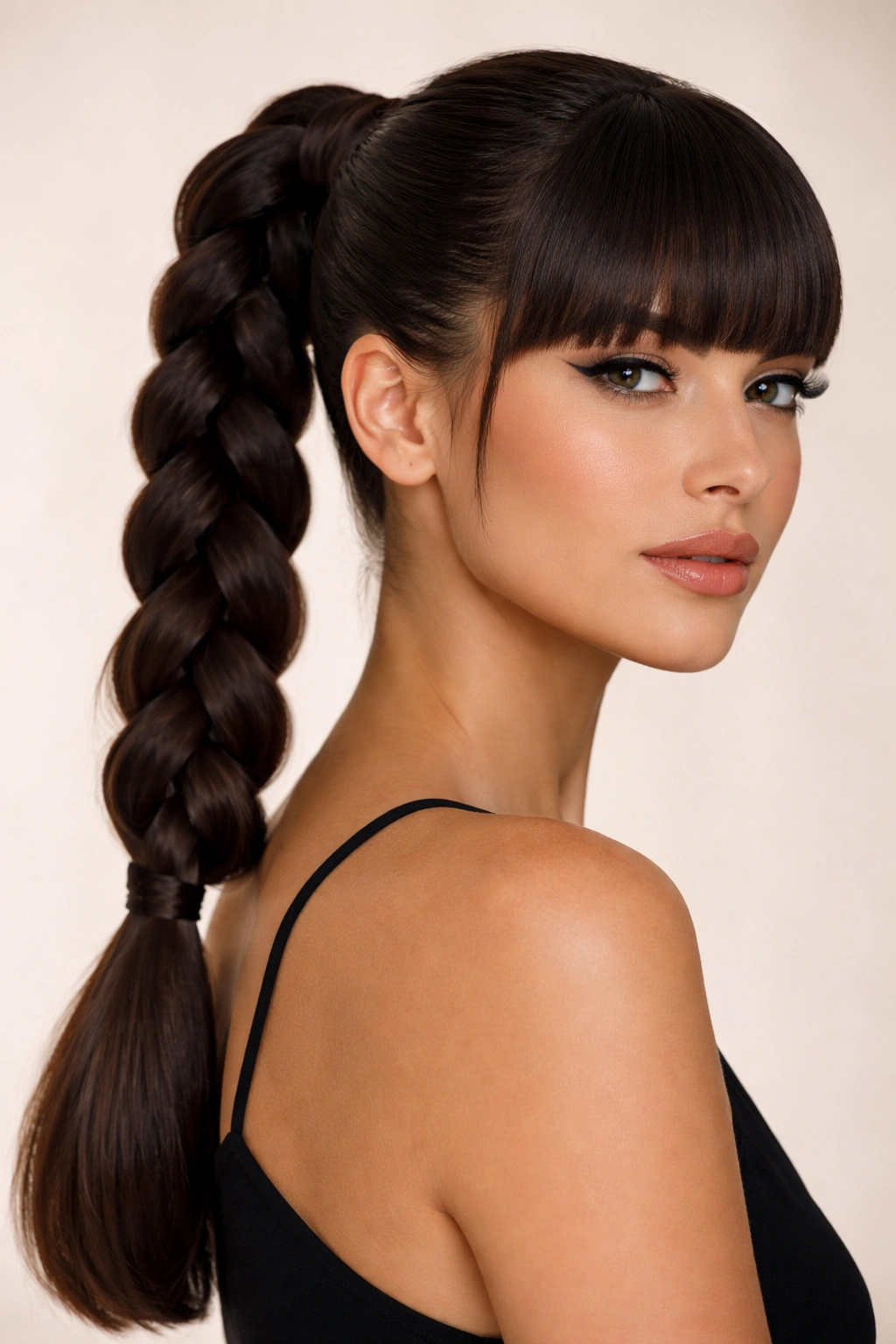
A four-strand braid is more intricate than a three-strand version, creating a thicker, more textured appearance that looks simultaneously sophisticated and complex. This style catches the eye because of its obvious intricacy, making it perfect for anyone who wants to showcase technical skill. Blunt bangs create a striking contrast with the ornate braiding, making this an ideal choice for formal events or anyone seeking a statement-making style.
The Technical Complexity
Four-strand braiding involves managing four sections of hair simultaneously, which requires more concentration than three-strand braiding but creates a noticeably more elaborate result. The extra strand creates visual depth and texture that reads as particularly impressive and intentional. This style definitely rewards practice, but once you’ve mastered it, you’ll have an immediately recognizable signature look.
Four-Strand Braiding Basics
- Divide your hair into four equal sections from crown to nape
- Begin weaving the outermost right section under two center sections and over the left section
- Then take the outermost left section and weave it under two center sections and over the right section
- Continue this alternating pattern all the way down
- Feed additional hair into each section as you progress downward (as you would with a French or Dutch braid)
- Secure at the base into a ponytail
- Gently widen and loosen the four-strand braid to enhance its texture
- Keep blunt bangs sharp and defined for maximum impact alongside the intricate braiding
9. The Braided Bangs Into Ponytail Style
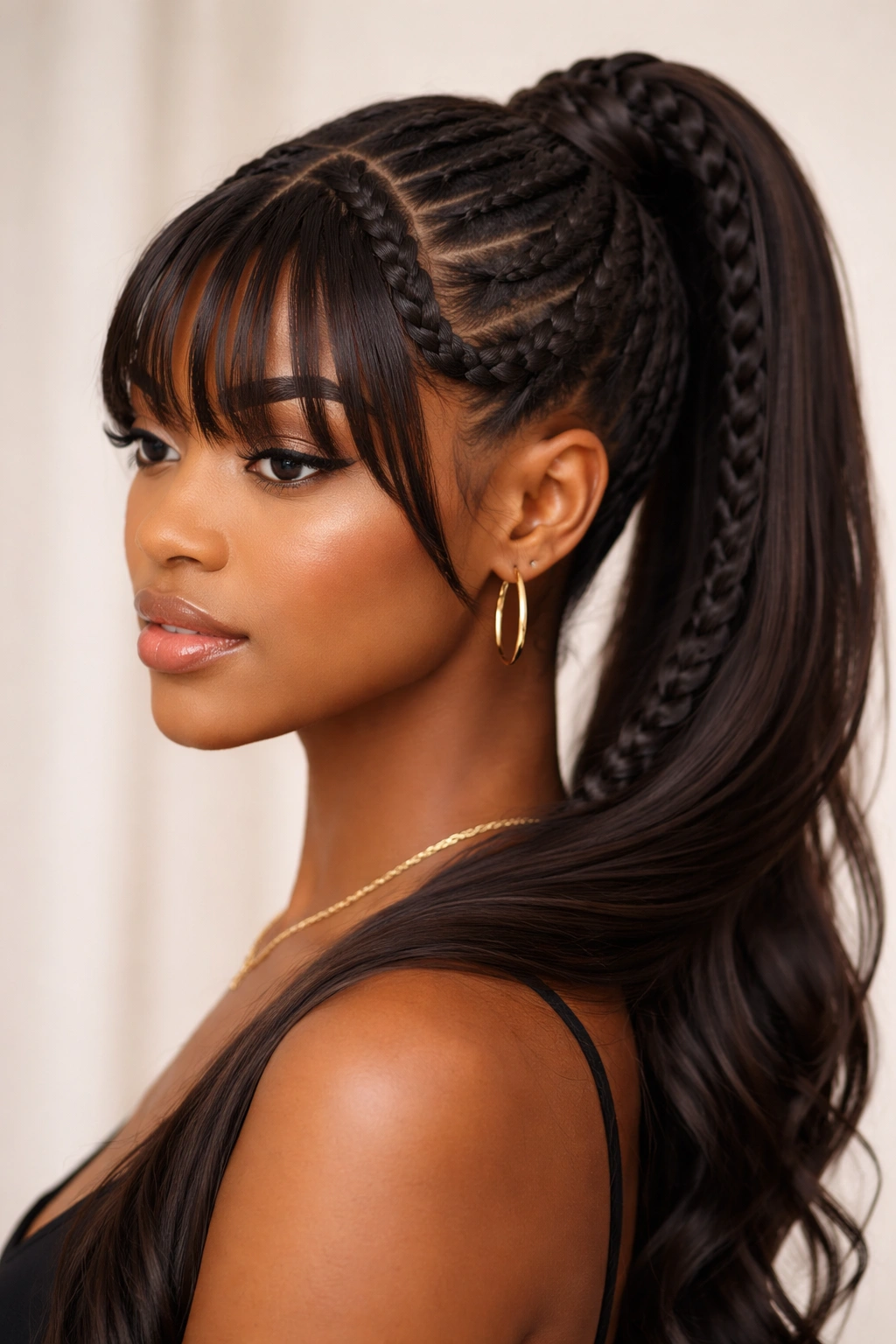
This is a completely different approach: instead of leaving bangs separate, you actually incorporate them into your braiding pattern. A front section braid begins with your bangs, feeds into a larger side or center braid, and eventually flows into your ponytail. This creates a completely unified, integrated look where no element feels separate or disconnected.
The Unified Aesthetic
By braiding your bangs directly into your overall hairstyle, you create a cohesive, architectural effect that feels thoughtfully designed. Nothing competes for attention — every element flows naturally from one to the next. This approach works best on hair that’s at least shoulder-length to give you enough material to work with.
How to Braid Your Bangs In
- Section your bangs from the center hairline outward to your temples
- Create a small three-strand braid starting at your center part, using your bangs as the initial hair source
- As you progress, add hair from the top of your head, gradually expanding the braid
- Feed this expanding braid toward the side, adding more hair as you go
- Once you reach your temple area, you can either continue the braid around to the back or transition into a larger side braid
- Eventually merge all braided sections into your main ponytail
- The result should look like one continuous braid that flows seamlessly from your bangs through your ponytail
- This style requires your bangs to be long enough to weave into a braid (typically at least 3-4 inches)
10. The Waterfall Braid Into Ponytail With Long Bangs
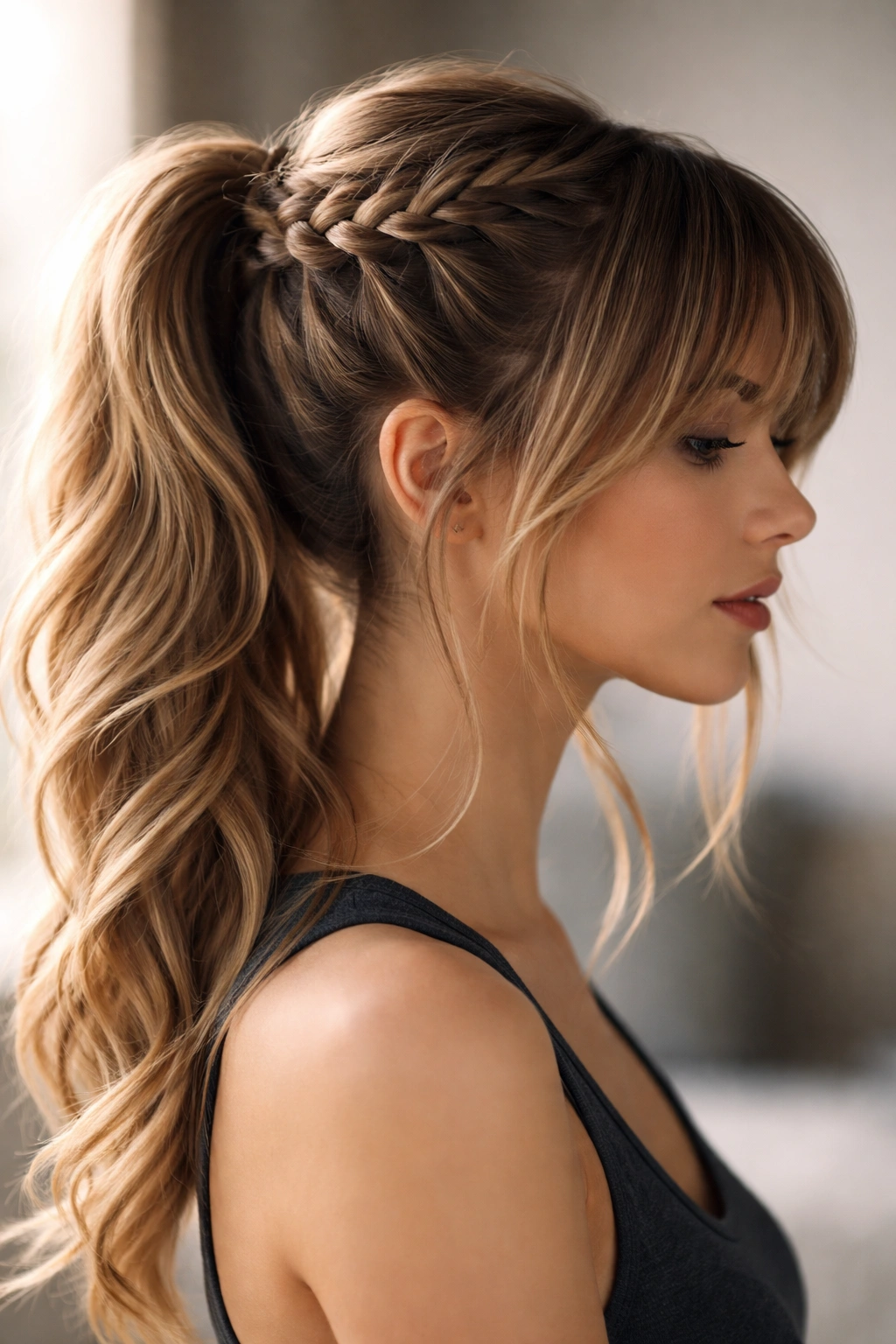
A waterfall braid uses a special technique where sections of hair are dropped and left loose as you braid, creating a cascading, flowing effect. When used with a ponytail and longer bangs, it creates romantic movement and visual interest. The dropped sections create an open, airy aesthetic that’s less structured than traditional braids but equally striking.
The Waterfall Effect
Waterfall braiding creates the illusion of hair flowing like water from a high point downward. The dropped strands add softness and movement, making this style feel less formal than tighter, more controlled braids. This technique works beautifully on wavy or curled hair, where the loose sections can catch light and show dimension.
The Waterfall Technique
- Begin your braid at the temple on one side of your head
- Start with a three-strand braid using hair from that area
- As you progress, instead of feeding new hair into the same three sections, drop the bottom strand and replace it with new hair from above
- This creates the “waterfall” effect where strands drop and cascade downward
- Continue this pattern across the back of your head toward the opposite ear
- Once you reach the ear, you can either secure just the braid or gather it with the rest of your hair
- Incorporate all hair (including the waterfall strands) into your ponytail
- Style longer bangs (at least chin-length) to fall naturally and frame the face with movement
- Lightly curl everything to enhance the cascading, flowing aesthetic
11. The Boxer Braid Ponytail With Blunt Bangs
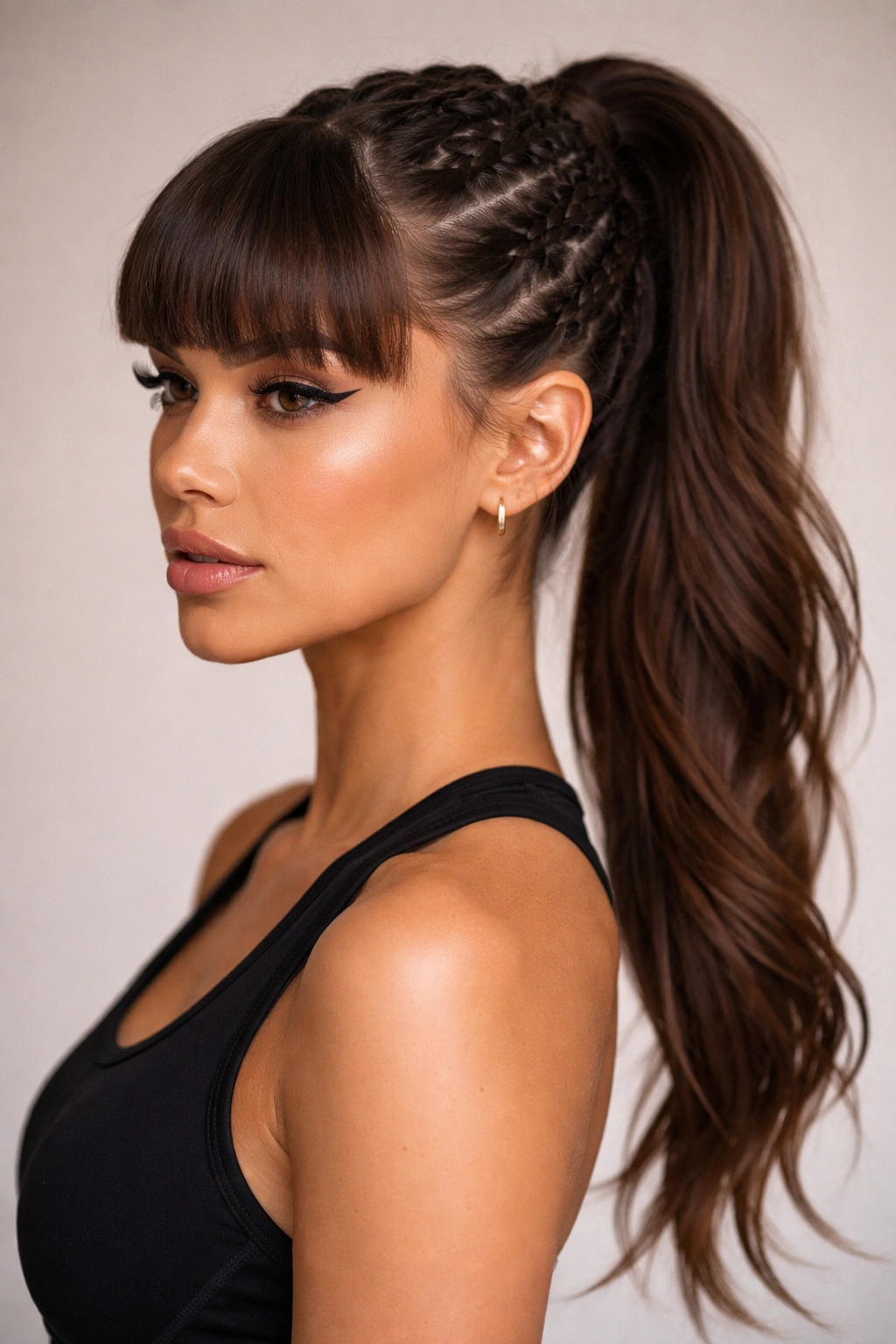
Boxer braids — two thick French braids that run parallel down the sides of the head — are an athletic, youthful style that feels modern and energetic. When fed into a ponytail and paired with blunt bangs, they create a look that’s equally at home at the gym or on the street. This style works best on thick, strong hair that can support the weight of two substantial braids.
The Athletic Appeal
Boxer braids gained popularity partly because they’re functional (they keep hair secure) and partly because they’re visually striking. The two braids create natural symmetry and a sporty vibe that feels current and youthful. This style is particularly flattering on people with oval or round face shapes, where the side framing is most flattering.
Creating Perfect Boxer Braids
- Part your hair down the center from forehead to nape
- On one side, create a French braid by starting at your hairline and working backward, feeding hair into the braid as you progress
- Keep this braid on top of your head as you travel toward the back
- Repeat the process on the opposite side, creating a mirror-image braid
- Once both braids reach the nape of your neck, gather them together with the remaining loose hair into a ponytail
- The ponytail can be positioned high or low depending on your preference
- Secure both braids and the ponytail with an elastic
- Tighten or loosen the braids based on your preference — athletic styles tend to be tighter, while casual versions can be looser
- Blunt bangs should create a sharp frame for this bold style
12. The Low Side Braid Into Side Ponytail With Wispy Bangs
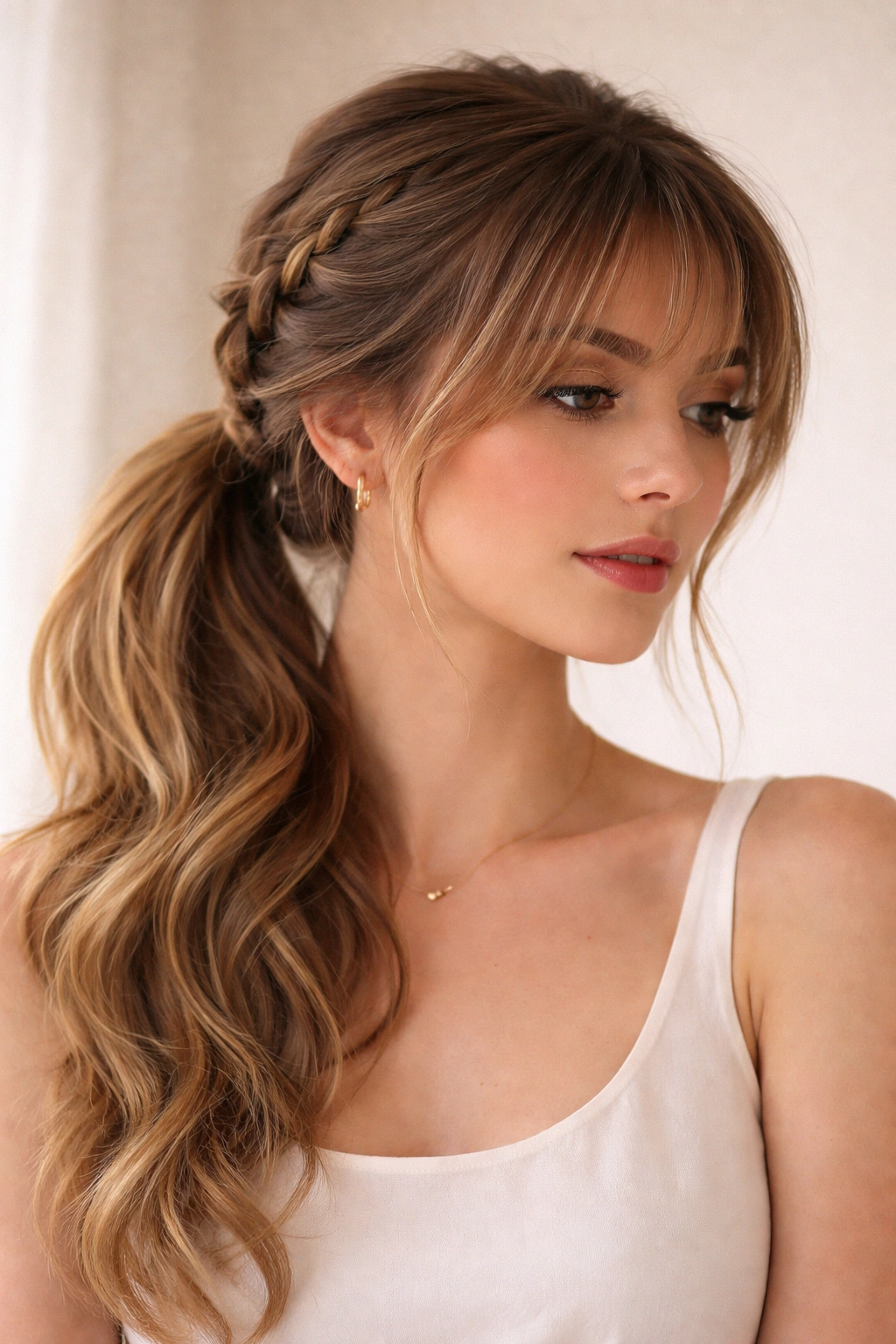
A braided ponytail positioned completely to one side of your head creates an asymmetrical, fashion-forward look that feels less formal than centered styles. A low side braid feeds into a side ponytail, while wispy bangs drift across the forehead, creating movement and softness. This style is particularly flattering on longer hair and anyone seeking something less conventional than traditional centered ponytails.
The Fashion-Forward Factor
Side ponytails have a way of immediately making a hairstyle feel more interesting and intentional than centered versions. Adding a braid elevates the style further, transforming it from casual to carefully styled. The asymmetry makes this feel current and creative, ideal for anyone wanting to stand out.
Executing the Side Braid Ponytail
- Begin your braid on one side of your head at the temple, using a Dutch or French braid technique
- Travel the braid diagonally across the back of your head toward the opposite side
- Angle your braid so it’s clearly traveling toward the side where you want your ponytail to sit
- As your braid approaches your target side (either the nape or further down depending on how low you want your ponytail), begin gathering the remaining hair
- Secure all braided hair and loose hair into a ponytail positioned to one side
- The side ponytail should sit at or below ear level, creating a dramatic off-center statement
- Leave some face-framing pieces loose on both sides if desired
- Wispy bangs should flow naturally, either parting down the center or drifting slightly to the side
- This style benefits from gentle waves or curls throughout, especially in the ponytail section, to enhance the relaxed, undone aesthetic
Final Thoughts
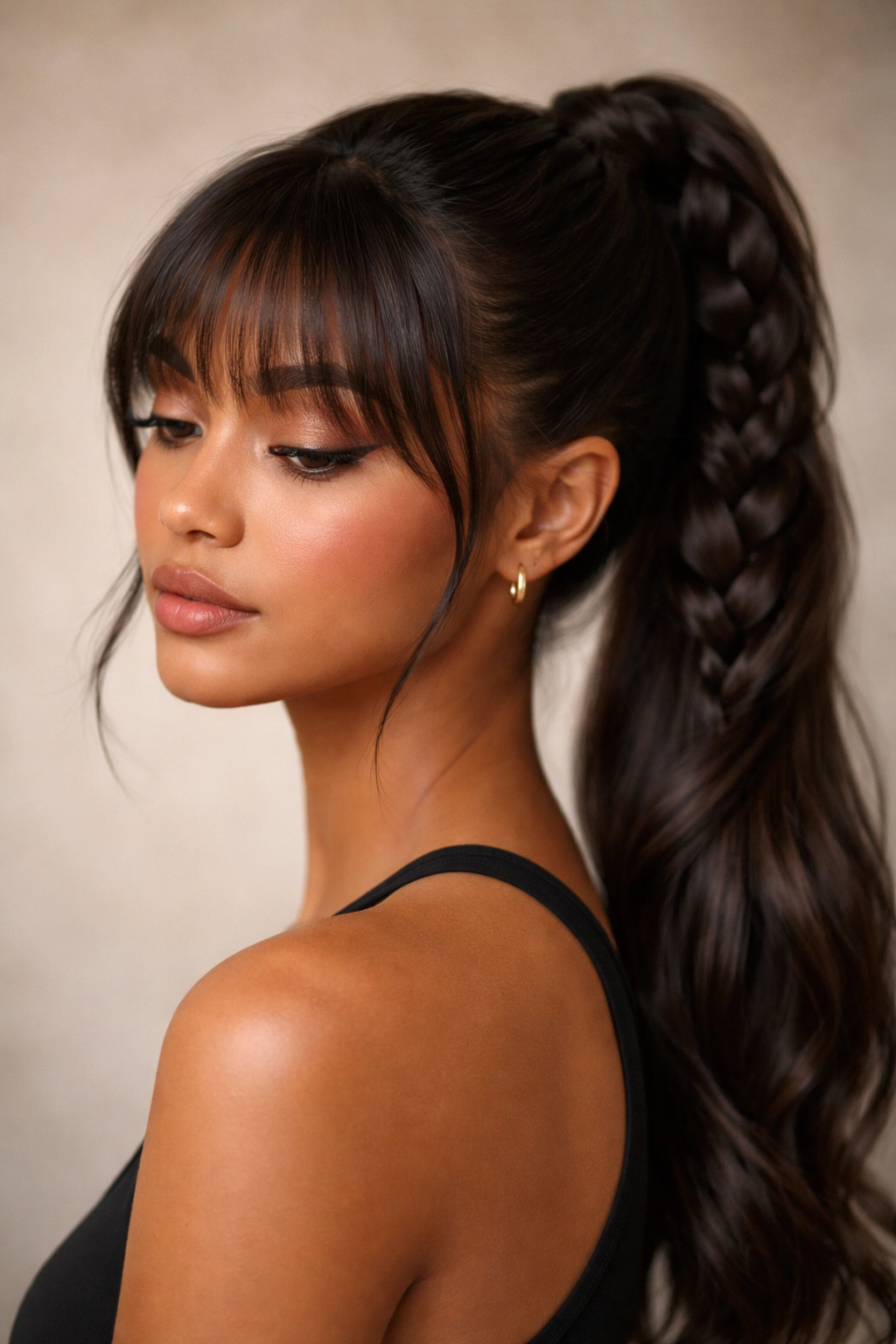
Braided ponytails with bangs offer an infinite spectrum of styling possibilities that range from athletic and casual to formal and romantic. The beauty of this hairstyle category is that your choice of braid pattern, bang style, and ponytail placement completely transforms the overall aesthetic, allowing you to express different facets of your personality. Whether you’re drawn to the precision of four-strand braids or the effortless feel of twisted hair, whether you prefer blunt statement-making bangs or soft, wispy framing, there’s a braided ponytail configuration that aligns with your style.
The techniques themselves become easier with practice, and once you’ve mastered a few core braiding methods — Dutch, French, fishtail, and simple twisted braids — you’ll be able to improvise and adapt endlessly. Don’t be discouraged if your first attempts feel clumsy or imperfect; even slightly messy braids read as intentional texture rather than mistakes, especially when you gently widen and loosen them after securing.
The most important takeaway is that braided ponytails with bangs are remarkably forgiving styles that work with most hair types and face shapes. You can wear them casually with minimal styling or elevate them into sophisticated special-occasion looks with the addition of curls, accessories, or strategic hair sections left loose. Experiment with different braid types, bang styles, and ponytail placements until you find the combinations that make you feel most like yourself. Your ideal braided ponytail is the one you’ll actually reach for again and again.