



Whether you’re looking for a protective style that keeps your hair healthy, a sleek look for the office, or an intricate design that turns heads, ponytails offer endless possibilities for Black women. The beauty of this hairstyle lies in its versatility—you can wear it bold and defined, soft and romantic, or sharp and sculpted depending on your mood, texture, and occasion. Black hair’s natural texture, curl pattern, and volume make ponytails particularly stunning because you can create dimension, texture contrast, and visual interest that other hair types often can’t achieve quite the same way. Whether you’re working with natural hair, relaxed hair, braids, or extensions, there’s a ponytail style that’ll work for you.
What makes ponytails especially practical is that they protect your ends from daily wear and tear while giving you endless styling flexibility. You can refresh the same base style multiple times with different accessories, edge control techniques, or hair pieces. The right ponytail can elevate your entire look—it’s that rare hairstyle that works for casual coffee runs, professional settings, special events, and gym sessions without modification. Best of all, once you master a few foundational techniques, you can mix and match elements to create entirely new styles that feel fresh and intentional.
This guide covers 15 ponytail styles specifically designed to celebrate and work beautifully with Black women’s hair texture, styling preferences, and the aesthetic choices that matter most. Each style includes exactly what makes it distinctive, who it works best for, and the practical tips you’ll need to execute it successfully.
1. High-Sleek Ponytail
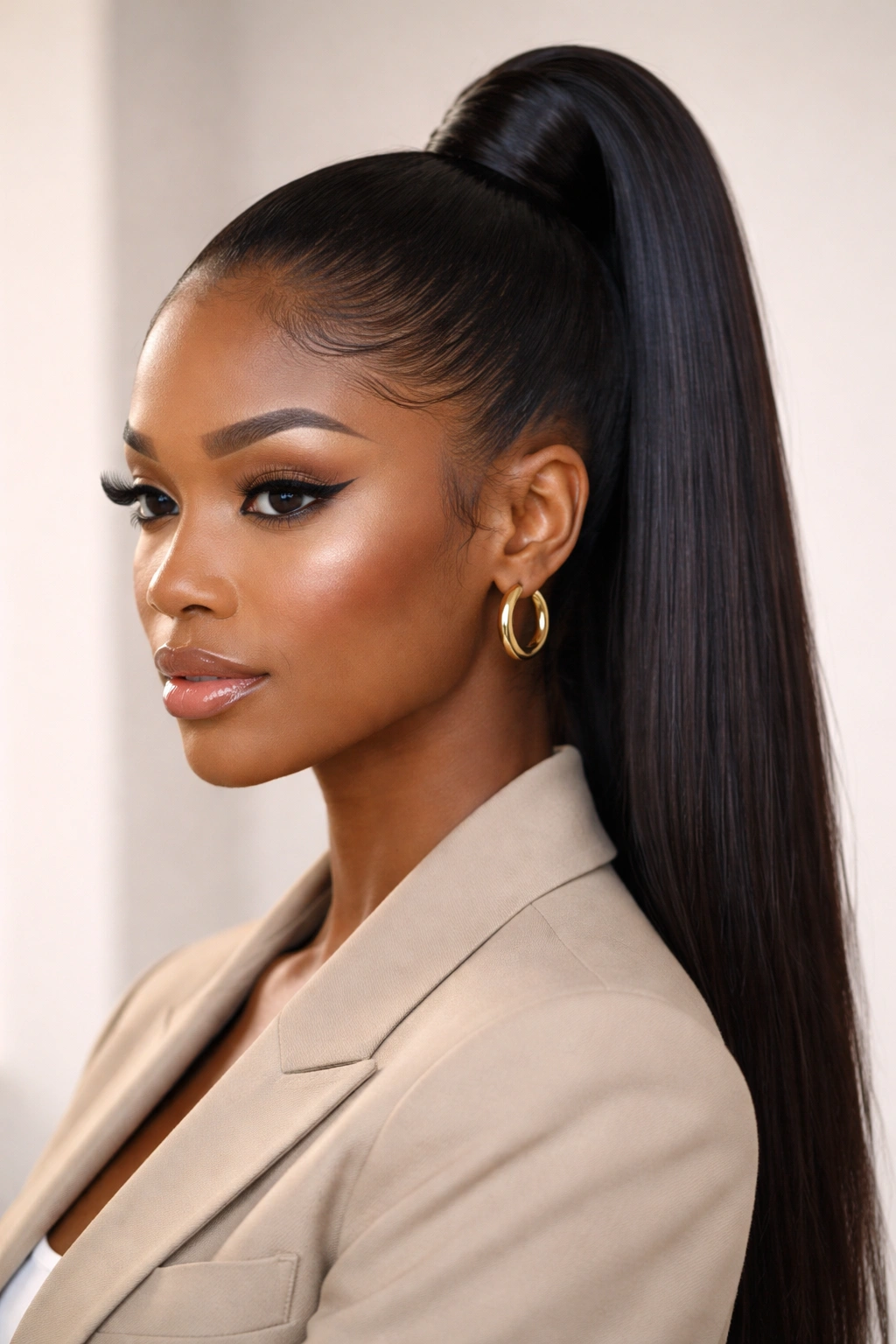
A high-sleek ponytail positioned at the crown sits elevated and polished—think sharp lines, smooth edges, and intentional styling from root to tip. This is the ponytail that commands a room because it reads polished, professional, and put-together without trying too hard. The height draws the eye upward and creates a lengthening effect on the face, which is why it works so beautifully for almost every face shape and hair type.
Why This Style Works for Professional and Casual Settings
The high-sleek is that rare hairstyle that works equally well in a boardroom and at brunch. It signals competence and intentionality—you chose this look, you executed it well, and you’re not afraid to be seen. The slickness requires precision, which automatically makes it feel elevated. Because the style pulls hair away from your face completely, it also shows off your features, skin, and any jewelry or accessories you’re wearing. It’s the hairstyle that says you have your life together, even if you’re actually throwing it together in 15 minutes.
Technique and Maintenance Essentials
- Use a firm-hold edge control product (not gel that flakes or dries white) to smooth flyaways and baby hairs along your hairline and part
- Apply edge control with a fine-tooth comb or an old toothbrush, smoothing in the direction of growth, not against it
- Secure the ponytail 2-3 inches away from your actual hairline to reduce stress on your edges—this is non-negotiable for long-term health
- Choose a seamless elastic band covered in fabric, or wrap a small section of your own hair around the base to hide the elastic
- Refresh the slickness every morning with a lightweight pomade and a light spritz of water
Pro tip: If you’re not blessed with naturally low-tension edges, position your ponytail slightly lower and use extra edge control—your hairline will thank you long-term.
2. Bubble Ponytail
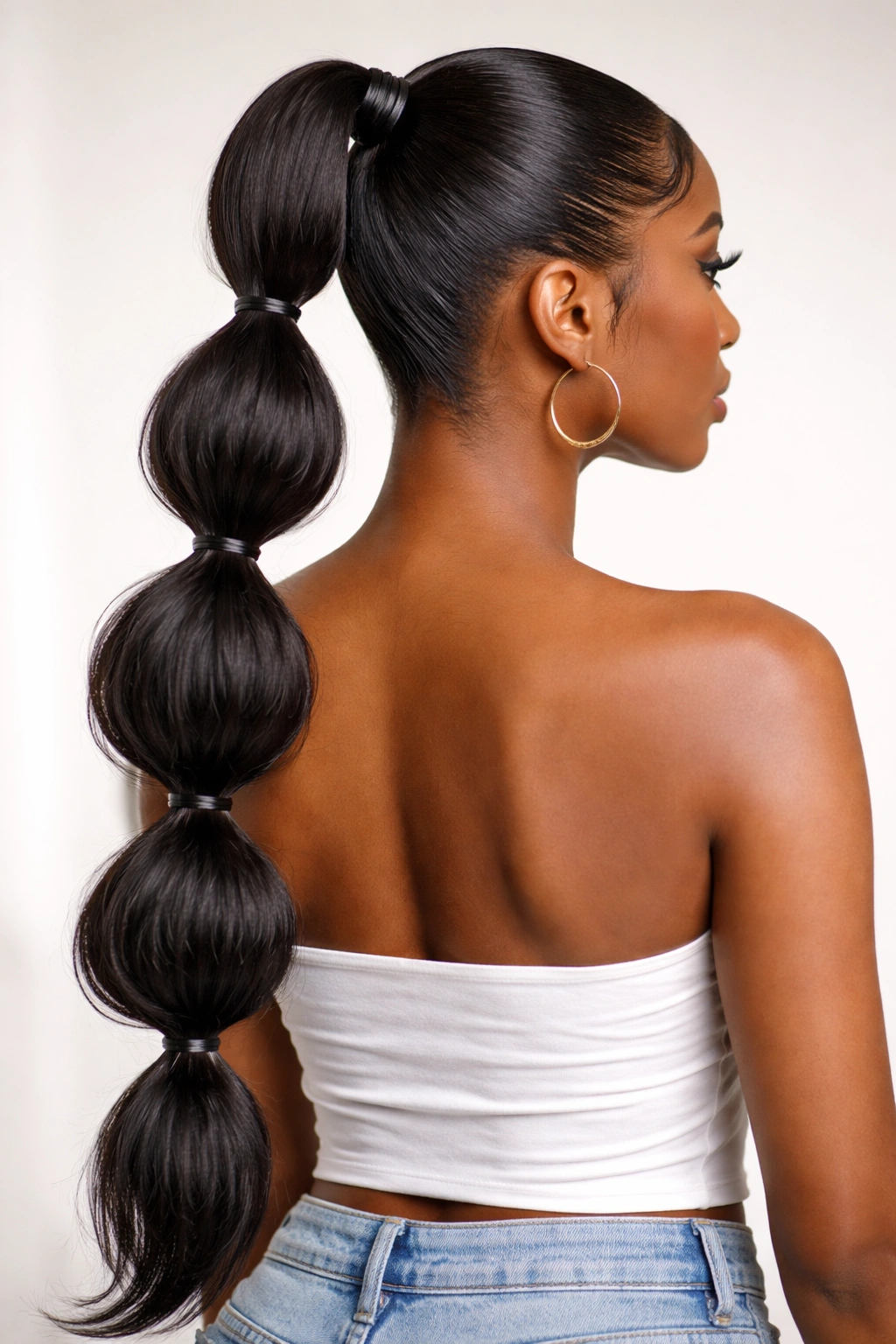
A bubble ponytail is essentially a high ponytail divided into 3-5 distinct “bubbles” by securing it with multiple elastic bands spaced down the length. Each bubble puffs out slightly, creating texture, dimension, and playful visual interest along the entire tail. The effect is fun, modern, and surprisingly versatile—it can look edgy paired with a leather jacket or sweet paired with a sundress and sandals.
What Makes This Style So Eye-Catching
Bubble ponytails work because they take volume and texture and turn it into intentional design. If you have thick hair or coily/curly natural hair, those bubbles showcase your hair’s density in a flattering way. The style breaks up the monotony of a single long ponytail and makes it feel more dynamic and thoughtful. Each bubble can be fluffed out or left sleek depending on your vibe—wear it as playful or as polished as you want. The style also photographs beautifully because the bubbles create visual rhythm and depth that reads well in photos and videos.
How to Perfect Your Bubble Sections
- Divide your ponytail into equal sections—three bubbles is beginner-friendly, five is more dramatic
- Use small, thin elastic bands (the clear ones or colored bands that match your hair) to section each bubble
- After securing each band, gently pull the hair between the band and the previous band to fluff out the bubble—don’t yank it violently, just coax it forward
- For a polished bubble, keep each section the same size and space the bands evenly down the tail
- For an edgier look, vary the bubble sizes or leave some sections sleeker than others
- If you have straight or relaxed hair, straighten the ponytail first, then create and fluff the bubbles
- For natural or textured hair, you can create bubbles with your natural curl pattern intact or straighten first for clean lines
Styling note: Bubble ponytails look best when worn high or at mid-crown height—low bubbles can read as droopy rather than intentional.
3. Knotless Braided Ponytail
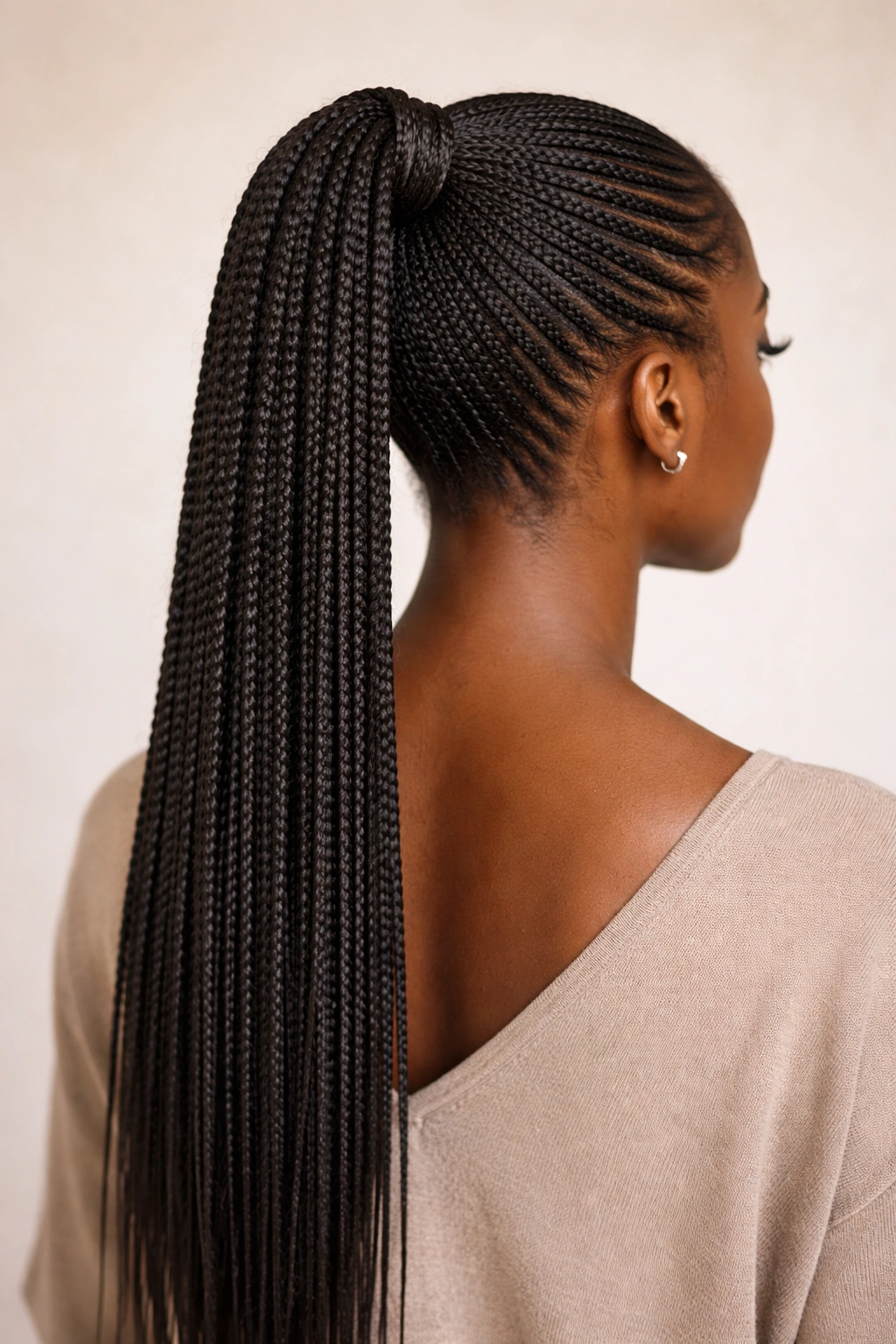
A knotless braided ponytail is a braided protective style where the braids are sewn, clipped, or twisted into a high or mid-level ponytail shape. “Knotless” means the braids themselves are built without knots at the base, which reduces tension and stress on your hairline and roots. This style combines the protective benefits of braids with the sleek, stylish appearance of a ponytail—it’s both practical for hair health and genuinely gorgeous to look at.
Why Knotless Braids Are Game-Changers for Hair Protection
Knotless braids distribute tension more evenly throughout each braid because there’s no tight knot anchoring everything at your scalp. This means less stress on individual strands, less breakage, and healthier hair over time. The braided ponytail version gives you the best of both worlds: your edges get a break from styling heat and tension, but you still get the polished, intentional look of a put-together ponytail. Unlike loose braids that move around, braids gathered into a ponytail stay in place, look intentional, and last longer without frizzing out. You can wear this style for 2-4 weeks depending on how well you maintain it, making it genuinely protective for hair growth.
Installation and Maintenance for Longevity
- Have knotless braids installed by someone experienced—the technique matters for reducing tension
- Braids should be snug enough to hold but not so tight you feel constant tension on your scalp
- After installation, wrap your ponytail with a silk or satin scarf before bed to reduce frizz and extend the life of the style
- Use a lightweight oil or leave-in spray on the braids daily to keep them moisturized and prevent dryness
- Gently retwist any loose braids every 1-2 weeks to keep the style looking fresh
- Avoid braiding your natural hair too tightly or too frequently—alternate between protective styles to give your edges recovery time
- Remove the style after 3-4 weeks maximum to prevent buildup and allow your scalp and edges to breathe
Important reminder: A protective style only protects your hair if it’s not causing tension. If your scalp hurts or you see redness after a few hours, the style is too tight and needs to be redone.
4. Twisted Ponytail
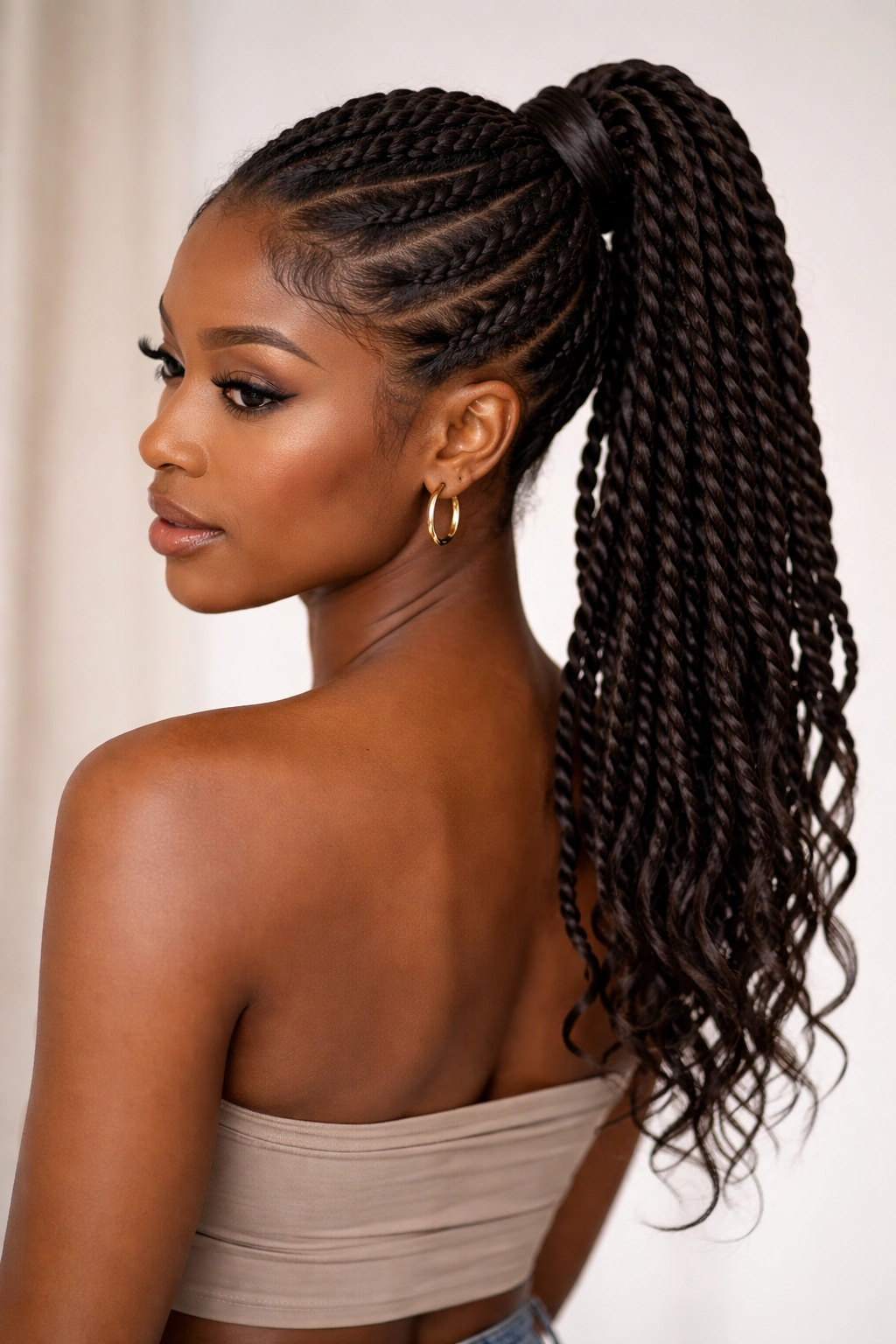
A twisted ponytail uses two-strand twists instead of braids as the base, with the twists gathered into a ponytail at the crown or sides. Two-strand twists are simpler to create than braids, give you gorgeous texture and definition, and look incredibly chic when gathered together. The twists can be as thin or as thick as you want, and you can create them with your natural hair or with extensions for added length and volume.
The Appeal of Twists Over Traditional Braids
Twists create a different texture than braids—they’re more fluid, slightly looser, and they showcase your curl pattern beautifully if you’re working with natural hair. If you have 4A-4C hair, twists allow your natural coils to shine through while still being contained and styled. Twists are also faster to install than intricate braids, which matters if you’re doing them on yourself or paying someone hourly. The visual effect is softer and more romantic than a sleek braided ponytail, but still completely polished and intentional. You can unravel the twists after a few days and create beautiful waves or curls, giving you two hairstyles from one protective style.
Creating and Styling Your Twist Ponytail
- Section the hair you want to twist into 4-8 sections, depending on the thickness you prefer
- Create two-strand twists by dividing each section in half and twisting the two strands around each other all the way to the ends
- For length, add extensions to one strand before twisting if you want longer, thicker twists
- Gather all the completed twists into a ponytail and secure with a fabric-covered elastic
- Smooth any flyaways with edge control around your part line and hairline
- Sleep with your twists wrapped in a silk or satin scarf to keep them fresh and prevent frizz
- After 5-7 days, carefully unravel the twists to reveal beautiful waves or soft curls underneath
- If you want to keep the twists longer, you can re-twist any sections that are getting loose every few days
Styling flexibility: The beauty of a twist ponytail is that you can wear it twisted, or take it down to reveal waves—you’re essentially getting two styles in one.
5. Natural Curly or Coily Ponytail

A natural curly ponytail celebrates your hair exactly as it grows from your head—coils, curls, shrinkage, texture, and all. Instead of straightening, relaxing, or smoothing your natural hair, this style gathers your curls into a ponytail that showcases the dimensional beauty of your natural texture. The effect is bold, authentic, and undeniably striking because you’re working with your hair’s natural structure rather than against it.
Why Natural Texture Ponytails Are Powerful
Wearing your natural texture in a ponytail is a statement of confidence and self-acceptance. The coils and curls create dimension and volume that other hairstyles can’t replicate—your hair literally reads bigger and more visually interesting because of its natural structure. Natural ponytails also require less heat damage and chemical processing, which means your hair stays healthier over time. The texture catches light differently, shows product shine beautifully, and photographs with genuine depth and character. For many Black women, a natural curly ponytail is the first time they’ve seen their authentic hair texture celebrated rather than treated as something to manage or control.
Caring for Natural Texture in a Ponytail
- Start with clean, moisturized hair—natural curls are thirsty and need hydration to look their best
- Use a leave-in conditioner or curl cream to define your curls before putting the hair up
- Gather the hair into a ponytail gently, using a scrunchy or clip rather than a tight elastic band
- Smooth your edges with water and a light edge control, not heavy gel
- Use a microfiber towel or t-shirt to dry your curls—regular towels cause frizz and disrupt the curl pattern
- Sleep with your curly ponytail wrapped loosely or in a bonnet to preserve the curl definition overnight
- Refresh curls between wash days with a curl spray or a mixture of water and leave-in conditioner
- Don’t fight the texture—embrace the shrinkage, the volume, and the way your hair naturally wants to move
Confidence note: Natural ponytails can look different depending on humidity, moisture levels, and how you slept. That’s not a flaw—that’s texture being alive and responsive. Embrace that variability.
6. Side Ponytail
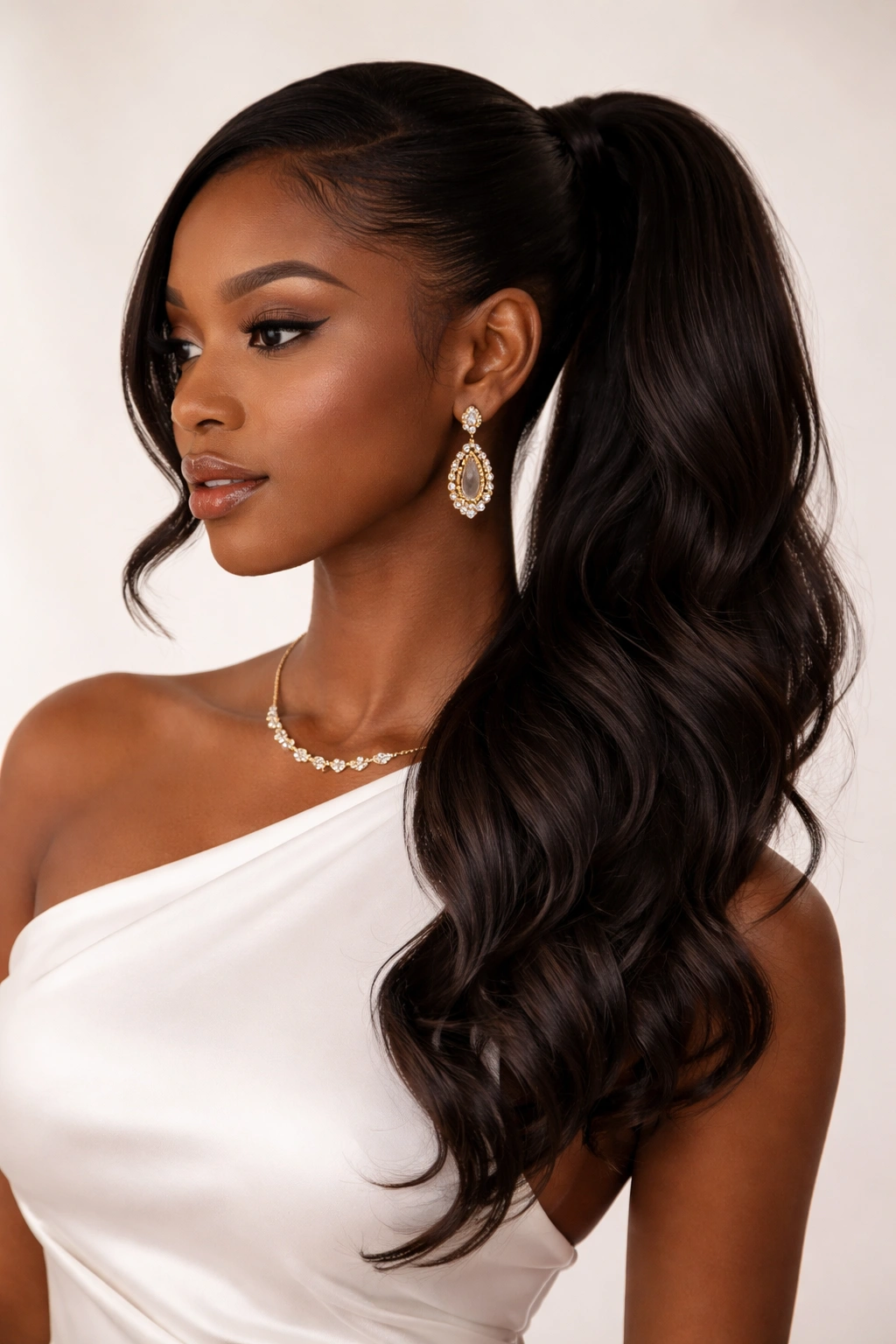
A side ponytail is gathered to one side of your head rather than centered at the crown or nape—it can be high on the side, mid-level, or very low depending on the look you’re going for. Side ponytails have a sophisticated, slightly asymmetrical vibe that feels effortlessly polished. This style works beautifully for both casual and formal occasions and offers a nice visual break from centered ponytails.
When and How Side Ponytails Shine
A high side ponytail works wonderfully for showing off earrings, necklines, and shoulder details. The asymmetry draws attention to whichever side you place it on, which is why it’s great for highlighting certain facial features or outfit details. Mid-level side ponytails feel relaxed and youthful while still being totally polished. Very low side ponytails (gathered at the nape but on one side) feel elegant and slightly romantic—they’re perfect for dinners out or evening events. Side ponytails also work beautifully with the natural texture and volume of Black hair because the side placement showcases your hair’s density in a flattering way.
Styling Tips for a Flattering Side Ponytail
- Determine which side you want the ponytail on—this might depend on which side of your face you prefer to show or which side your hair naturally parts
- Create a deep side part by running a fine-tooth comb from your temple back toward the crown on one side
- Smooth the larger section with edge control, creating a sleek base that flows toward the ponytail
- Gather the hair at your chosen side point, keeping it smooth and secure
- Let a few face-framing pieces fall forward naturally, or smooth everything back depending on your preference
- Use a fabric-covered elastic to secure the ponytail without snagging
- Smooth flyaways with a light pomade, not heavy gel
Pro styling move: A side ponytail looks even more polished when you add a decorative claw clip or jeweled elastic at the base—it draws attention to the style detail and adds intentional elegance.
7. Wrap-Around Ponytail
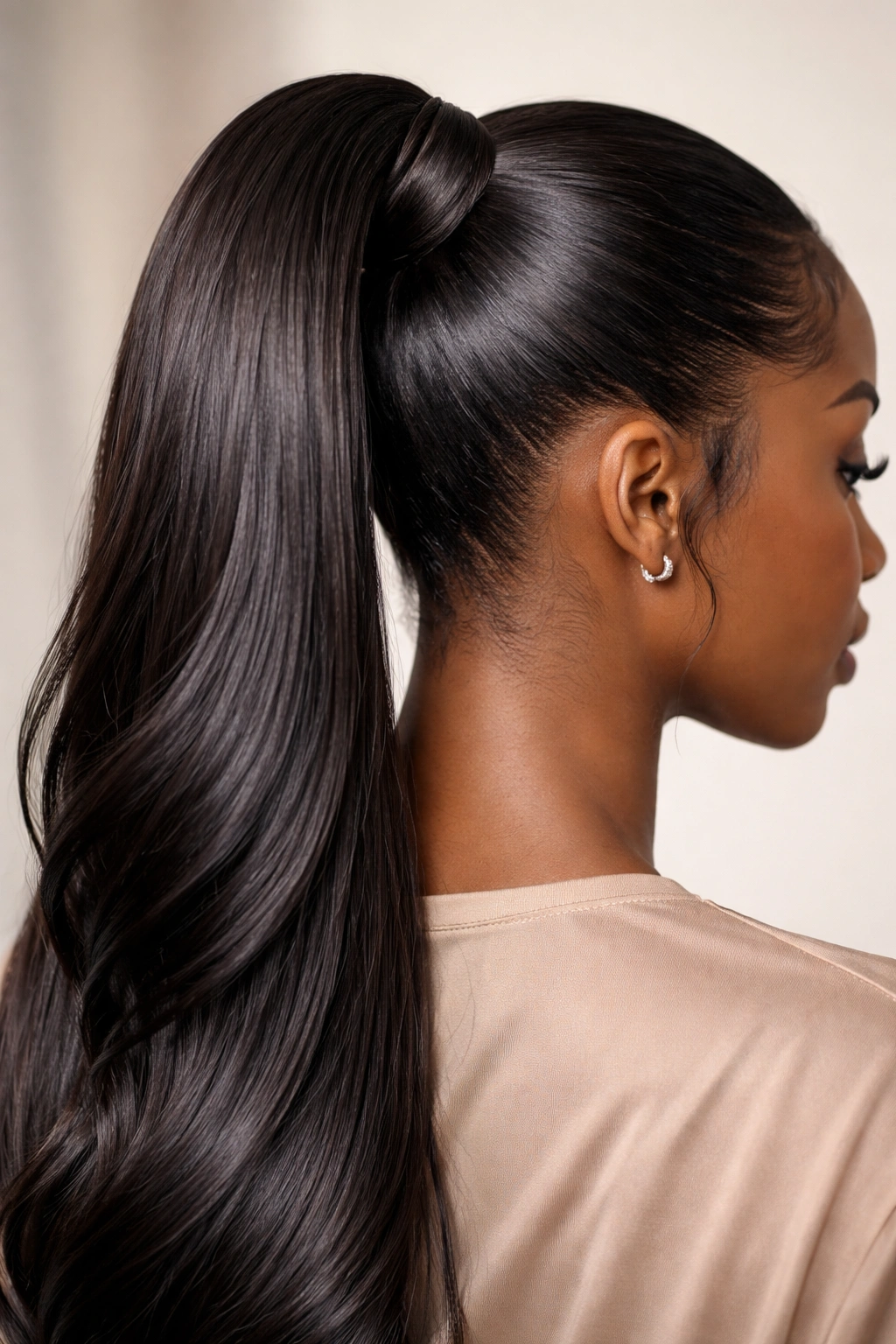
A wrap-around ponytail takes a standard high or mid-level ponytail and wraps a section of hair around the elastic at the base, creating the illusion of a sleek, seamless base rather than a visible elastic band. This technique makes even a simple ponytail look elevated and professionally executed. The wrap hides the mechanics of the style, which automatically makes it read more intentional and polished.
The Visual Impact of a Wrapped Base
A wrapped base completely changes how a ponytail looks. Instead of seeing an elastic band (which can look utilitarian and unfinished), the eye sees a smooth band of hair that looks intentional and designed. This small detail is what separates a casual thrown-together ponytail from one that looks like you actually styled it. The wrap-around technique also prevents your elastic from slipping down throughout the day, so your ponytail stays where you put it rather than gradually drooping. It’s the kind of styling detail that people notice subconsciously without being able to say exactly what makes the ponytail look so polished.
How to Execute a Perfect Wrap
- Create your base ponytail using a clear or colored elastic band, securing it at whatever height you prefer
- Take a thin section of hair from the ponytail (about 1 inch wide) and wrap it firmly around the elastic, covering it completely
- Secure the wrapped section underneath with a small bobby pin that matches your hair color
- If you want the wrap to be extra secure, apply a tiny dab of lightweight gel to the wrapped section before pinning
- Smooth any flyaways with edge control
- The wrap should look like one smooth, intentional band—not lumpy or obvious
Technique note: The thinner your wrap section, the neater and more finished it looks. Avoid making the wrap too thick or it can look bulky.
8. Slicked-Back Ponytail with Defined Edges
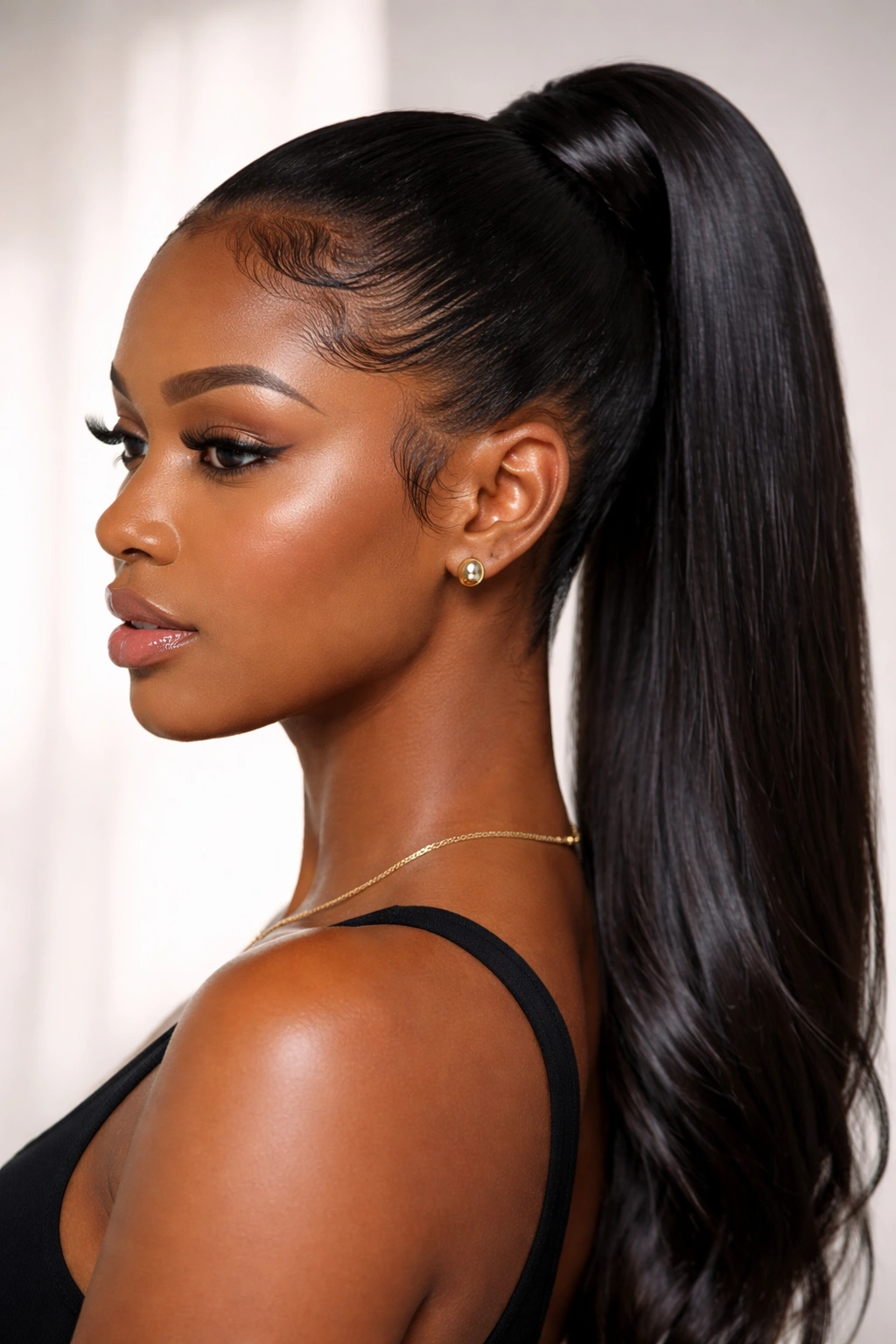
A slicked-back ponytail pulls all of your hair smoothly away from your face and secures it into a high ponytail with sharply defined, sculpted edges. This is the style that says you’re in control—everything is intentional, everything is smooth, and your edges are sharp. The slicked-back ponytail is particularly stunning on Black women because the contrast between the smooth crown and the voluminous ponytail creates beautiful visual definition.
Why Edges Matter in This Style
The edges (the baby hairs and smaller hairs along your hairline and temples) are what elevate a slicked-back ponytail from basic to exceptional. Smooth, defined edges signal that you took time with this style, that you care about detail, and that your hair is healthy enough to sculpt. Black women have been using edge control and edge styling to create sculptural, artistic hairlines for generations—it’s an art form. A slicked-back ponytail is the perfect showcase for this skill. Crisp edges transform a simple style into something bold and intentional.
Creating and Maintaining Sharp Edges
- Start with clean or refreshed hair—if you’re working with day-old hair, spray it lightly with water to reactivate any products
- Use a quality edge control product (not regular gel that flakes or dries chalky) that gives you hold without looking heavy
- Apply edge control with a fine-tooth comb or an old toothbrush, working in the direction your hair grows
- Smooth edges along your hairline, temples, and the part line, creating clean, intentional shapes
- Secure your ponytail and let the edge control dry completely (usually 5-10 minutes) before leaving the house
- Touch up your edges daily with a light hand—reapply edge control to any spots that have lost definition
- At night, wrap your hairline with a silk scarf to keep the edges smooth and prevent frizz
- Avoid pulling too tightly—sculpted edges with no tension on the edges is always better than tight, defined edges that are damaging your hairline
Edge care essential: Your edges are delicate. Over-manipulation, too-tight styles, and constant edge control application can cause thinning. Use strong edge control for special occasions, and lighter products for everyday styling.
9. Puffball Ponytail
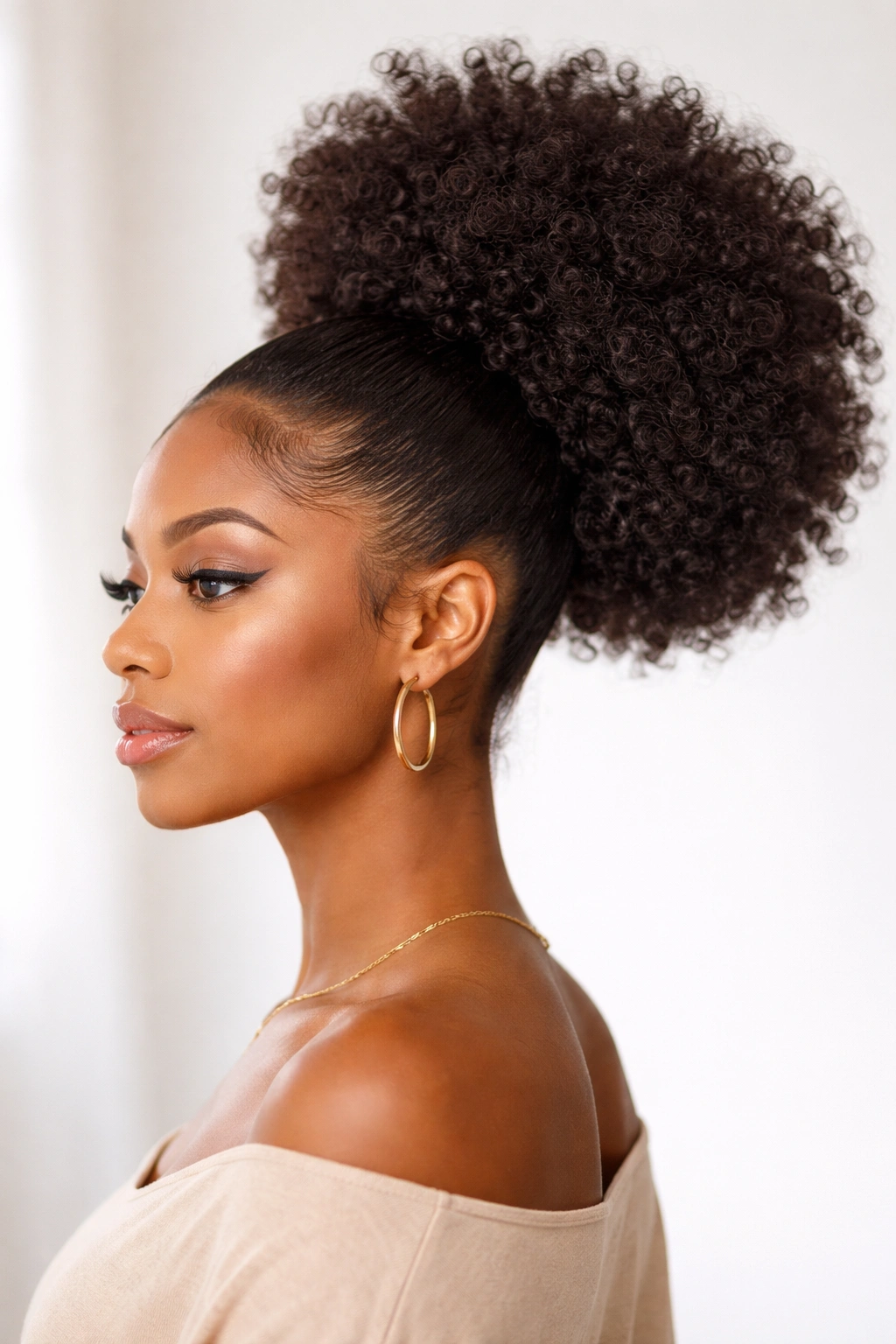
A puffball ponytail gathers a full, voluminous section of curly or coily hair into a high ponytail, letting it sit naturally in a big, rounded shape at the crown. Instead of stretching the ponytail out or braiding it smooth, you’re celebrating the volume and texture that comes naturally with Black hair. The effect is bold, youthful, and undeniably statement-making—it says you’re not apologizing for the size, texture, or presence of your hair.
The Confidence of Wearing Your Hair Big
A puff is one of the most authentic expressions of Black beauty because it celebrates the natural volume and texture of your hair exactly as it is. There’s power in taking up space and not trying to minimize or flatten your natural texture. A puffball ponytail reads young, energetic, and confident. It works beautifully for casual days, athletic activities, creative professions, and any time you want to lead with your actual hair rather than a styled, refined version of it. Puffs have become increasingly celebrated in workplaces and professional settings too—they’re no longer seen as unprofessional, but as a legitimate and beautiful styling choice.
Perfecting Your Puffball
- Use clean, moisturized natural hair or hair that’s been in a protective style and has fresh curl definition
- Apply a curl-defining cream or leave-in conditioner to add texture and hold without crunchiness
- Gather the hair into a high ponytail using a thick elastic band or a claw clip
- Don’t smooth the edges tightly—instead, use water and a light leave-in to define the natural texture at your hairline
- Allow the puff to sit naturally in its rounded shape without forcing it into a specific form
- If you want more definition, you can gently finger-coil sections of the puff, but avoid disrupting the natural texture
- Sleep with your puff wrapped loosely in a silk bonnet or scarf to preserve the curl definition
Texture celebration: The beauty of a puff is that it doesn’t need to be “perfect”—it’s meant to celebrate your natural texture, not control or minimize it.
10. Criss-Cross Ponytail
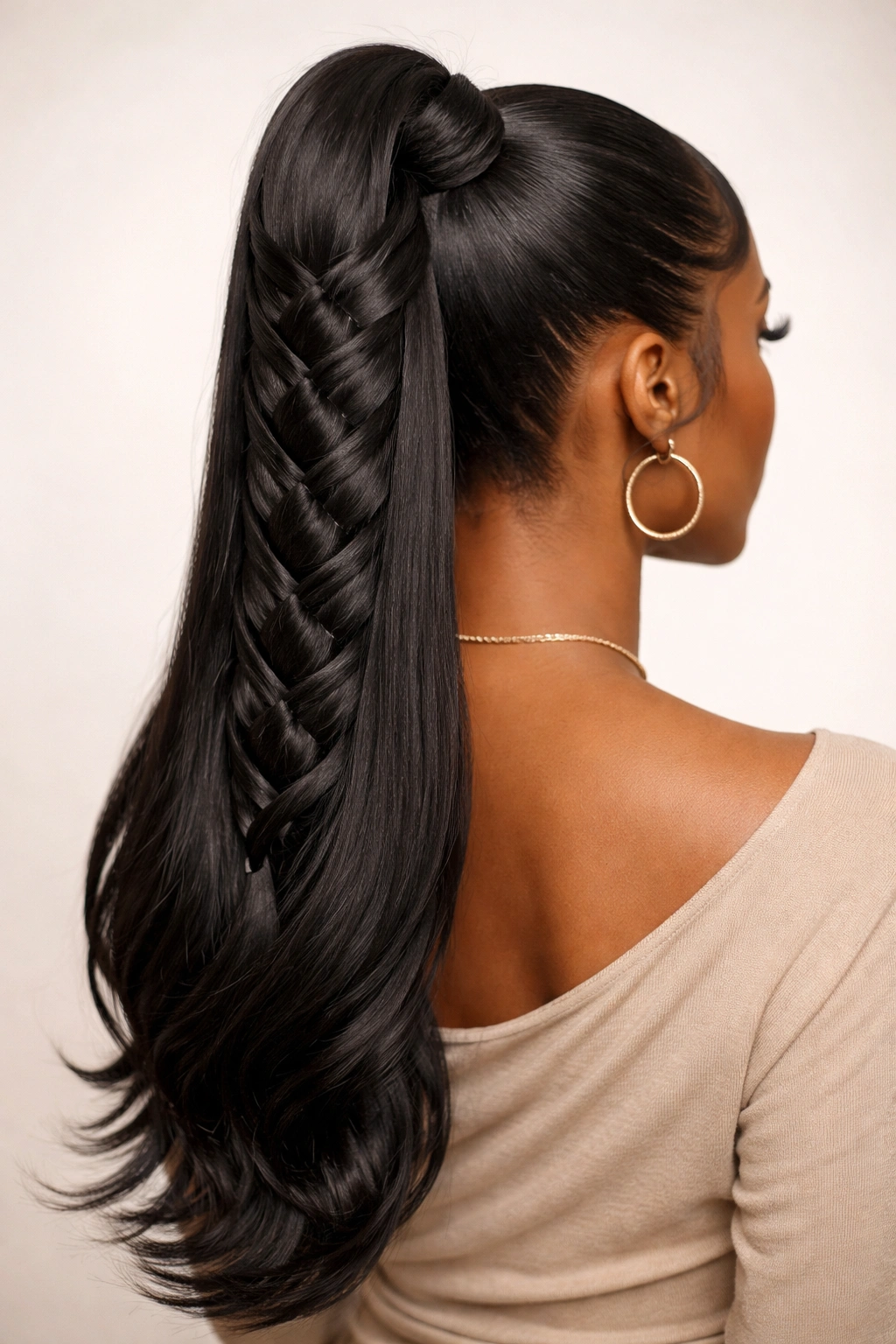
A criss-cross ponytail is made by creating a high ponytail, then taking sections from that ponytail and crossing them over each other in an X or lattice pattern down the length. The crossed sections can be thin and intricate or thicker and bolder depending on how much work you want to do. The effect is textured, intricate, and visually interesting—it takes a basic ponytail and elevates it into something that looks like you spent serious time on it.
Why This Style Commands Attention
Criss-cross details automatically make a hairstyle look more refined and intentional. The visual pattern draws the eye down the length of your ponytail and creates a sense of movement and texture. Because the style involves actively manipulating the hair rather than just securing it, it reads as special—appropriate for date nights, events, or any time you want your hair to be part of your look rather than just practical styling. The criss-cross pattern also adds structural interest without requiring braiding or twisting skills, so it’s accessible even if you’re new to complex ponytail techniques.
Creating Your Criss-Cross Pattern
- Start with a sleek, smooth high ponytail secured firmly at the crown
- Divide the ponytail into 4-6 sections depending on how intricate you want the criss-cross to be
- Starting at the top, take the section on the left and cross it over the section on the right, securing it with a small elastic band an inch or two down
- Take the next left section and cross it over the next right section, creating an X pattern
- Continue crossing sections down the length of the ponytail, always alternating which side goes over
- Keep the sections tight and even for a polished look, or let them be slightly looser for a more relaxed feel
- Secure each crossing point with a small elastic band the same color as your hair
Styling variation: You can leave the ends of the criss-cross loose and flowing, or gather everything back together at the bottom for a more contained look.
11. Double Ponytail
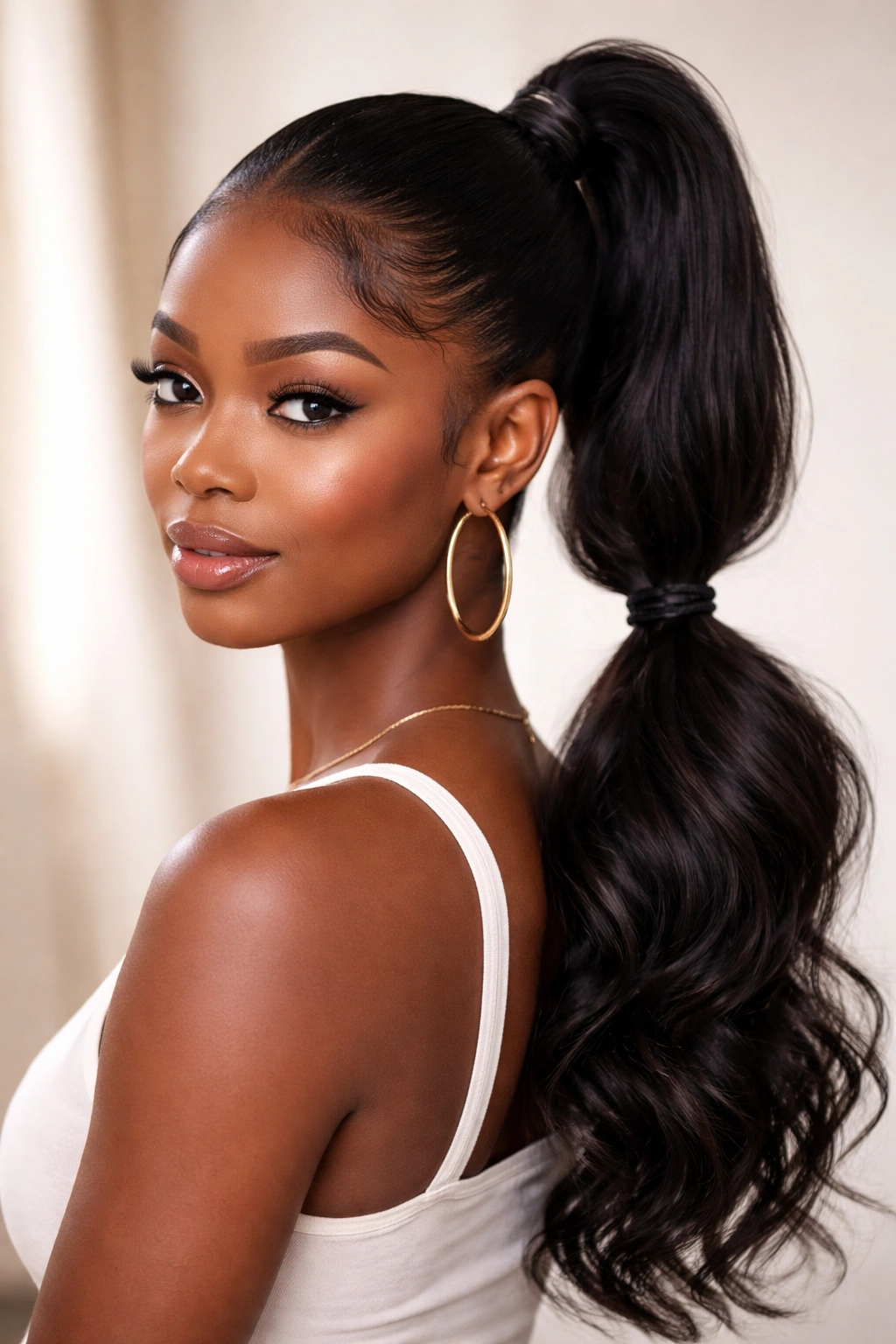
A double ponytail uses two separate ponytails instead of one—usually one high and one low, or two at different sides, both secured with separate elastics. The double ponytail is playful, youthful, and gives you the visual interest of two hairstyles. It can look fun and casual paired with athletic wear, or chic and intentional paired with a dress and jewelry.
The Playfulness and Versatility of Two Ponytails
Double ponytails instantly add visual interest and complexity to your styling without requiring advanced techniques. You can create symmetrical double ponytails (one on each side) for a balanced look, or stack one high ponytail directly above a lower one down the back for a more dramatic effect. Double ponytails also create more texture and volume because you’re not consolidating all your hair into a single base—each ponytail sits independently and takes up space. This style works beautifully for thick, voluminous hair and creates stunning visual dimension.
Executing a Double Ponytail Strategy
- For a stacked double ponytail (high and low down the back): create your first ponytail at the crown, secure it, then create a second ponytail just below it using the remaining hair
- For side-by-side ponytails: part your hair down the middle, create one ponytail on each side at your preferred height
- Each ponytail can be sleek, twisted, braided, or textured independently—you’re not limited to matching styles
- Use elastics that match your hair color so the focus is on the hairstyle, not the mechanics
- You can add different accessories to each ponytail, or keep it simple with matching elastics
- Smooth your edges with edge control to create a polished base for both ponytails
Styling freedom: Double ponytails give you permission to experiment—one could be sleek while the other is bubbly, or both could be different styles entirely.
12. Swooped Ponytail
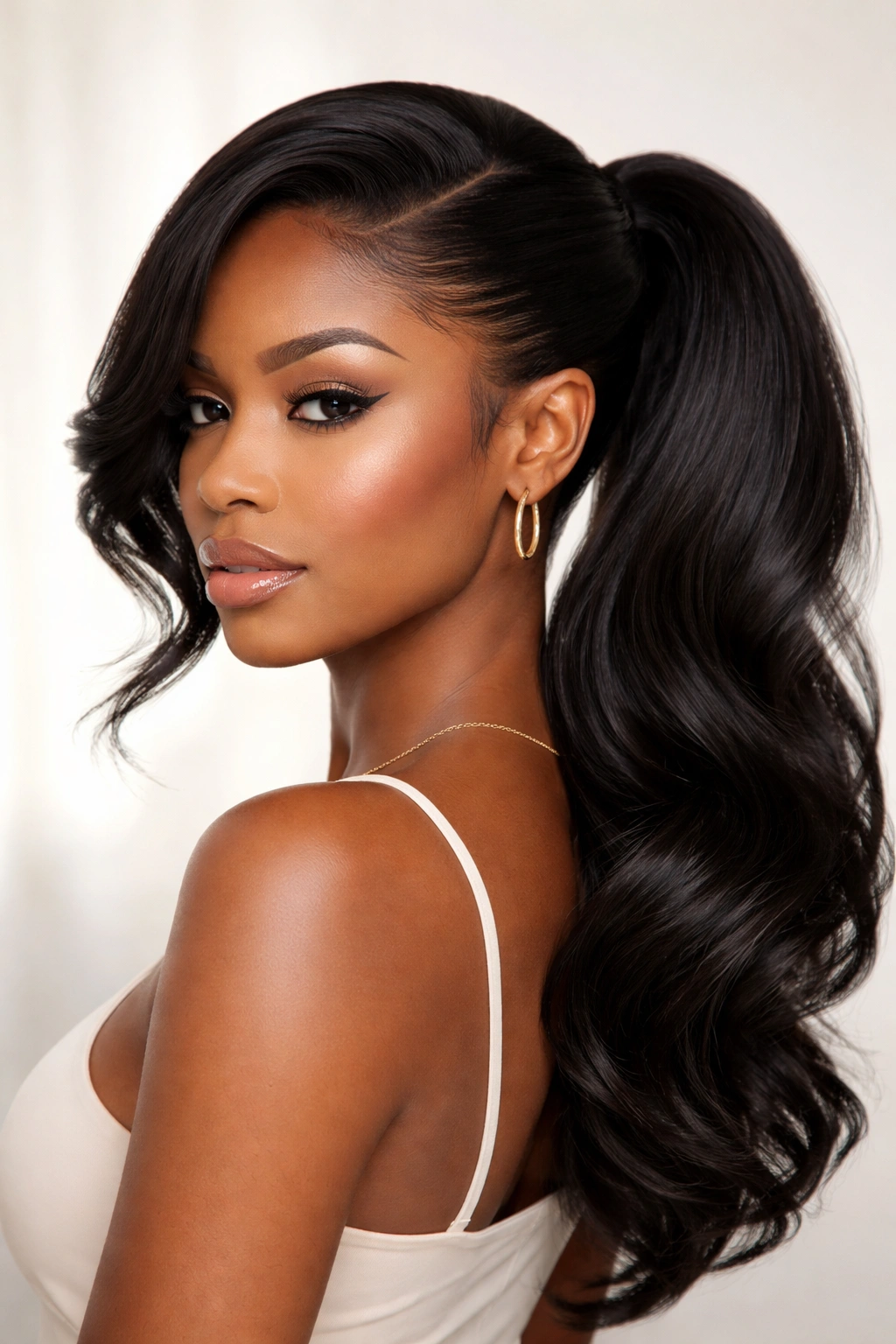
A swooped ponytail uses a swooped or curved side part and creates volume on one side of your head, with the hair gathered into a ponytail on the opposite side. The swooped side reads dramatic and chic, while the gathered ponytail keeps everything secure and polished. This style is sophisticated and works beautifully for professional settings, special events, or any time you want your styling to be noticed.
The Drama of a Swooped Foundation
A deep swooped part instantly elevates your entire look because it requires intention and creates visual movement. Instead of a center or side part, a swoop actually curves—it might start at your temple on one side and curve across the crown toward the opposite side. This curved part creates negative space on one side (showing off your scalp, revealing your face, or displaying jewelry) and positive volume on the other side. When you gather that volume into a ponytail, the contrast becomes even more dramatic. The swooped part is particularly stunning on Black women because the contrast between the sculpted, defined part line and the voluminous gathered hair creates real visual interest.
Creating a Defined Swooped Part
- Start with sleek, smooth hair—you can blow it dry or work with hair that’s been straightened
- Using a fine-tooth comb or rattail comb, create a curved part starting at one temple and moving toward the crown and beyond
- The curve can be subtle or very pronounced depending on the effect you want
- Smooth both sides of the part with edge control and a comb, creating clean, defined lines
- Gather the larger volume section into a ponytail on the opposite side from where the swoop begins
- Make sure the part line is completely dry and set before you consider the style complete
- You can add decorative elements along the part line—a thin braid, a colored edge control, or small hair clips
Dramatic potential: A swooped part with a low side ponytail is essentially evening-wear elegant, while a swooped part with a high ponytail is fun and youthful.
13. Braided Crown Ponytail
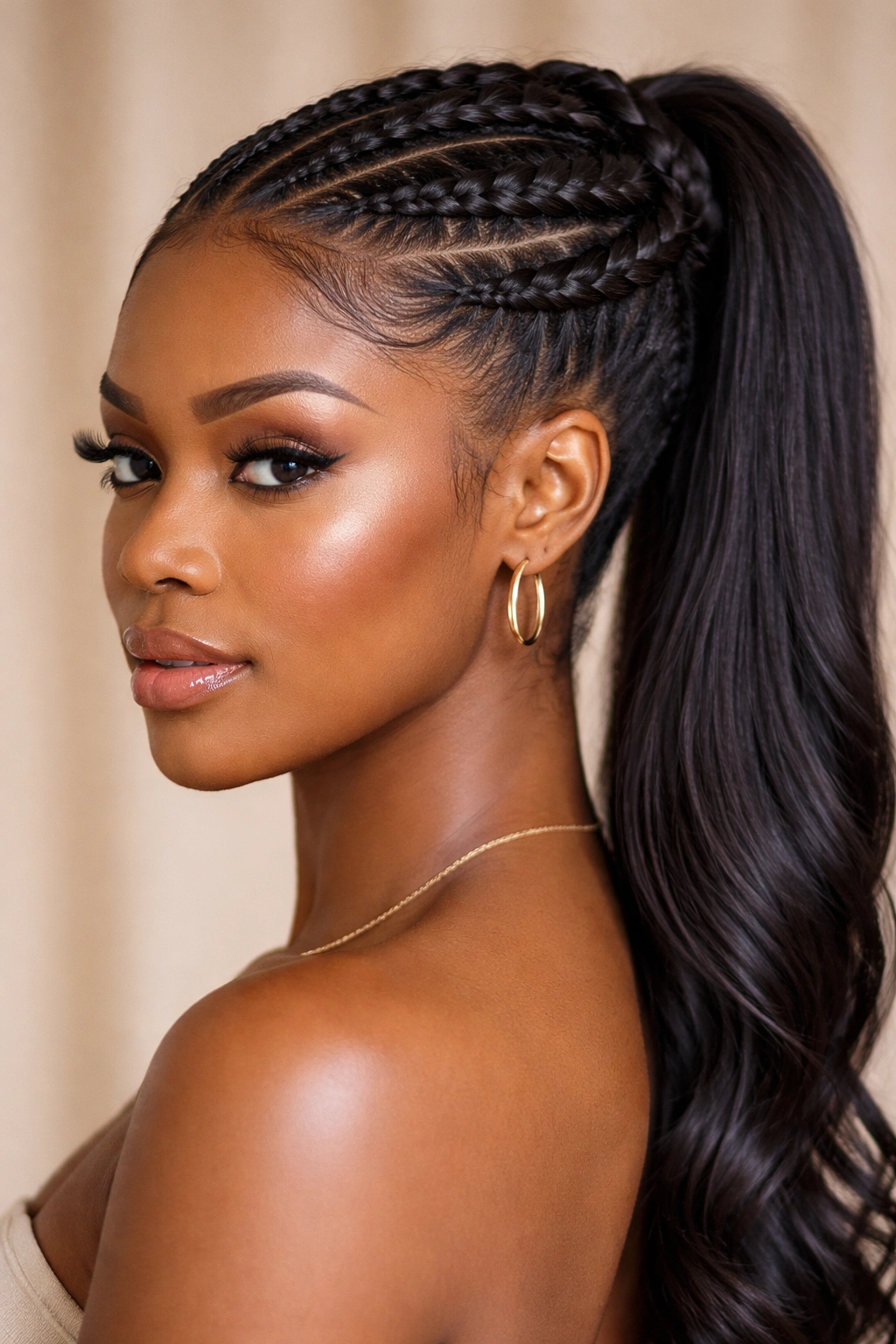
A braided crown ponytail incorporates one or more braids that wrap around the crown of your head, with the remaining hair gathered into a ponytail. This style combines the protective benefits and texture of braids with the polish of a gathered ponytail. The braids can be thin and delicate or thick and bold, and they create a crown-like effect that’s both beautiful and practical.
Why Crown Braids Add Elegance
A braid that frames the crown adds both visual interest and a sense of intentionality to your style. Crown braids are inherently romantic and special—they read as a hairstyle you created thoughtfully, not just something you threw together. The braids add texture and dimension above the ponytail, so the overall effect is more dynamic than a simple ponytail alone. This style works beautifully for special occasions, professional settings, or any time you want your hair to be part of your look. Crown braids also protect the hair along your hairline and part line from daily styling stress, making this a thoughtful protective styling choice.
Building Your Braided Crown
- Create a thin braid starting at one temple and braiding back and around the side of your head toward the opposite temple
- You can do a single braid across the crown, or create two braids that mirror each other
- Secure the braids with bobby pins that match your hair color
- Gather the remaining hair into a high ponytail, tucking the ends of the braids into the ponytail base
- Secure the ponytail with an elastic, then wrap a small section of hair around the base to hide the elastic
- Make sure the braids sit smoothly against your scalp and feel secure—bobby pins hidden under the wrapped section at the base of the ponytail will hold them in place
Variation option: Instead of one braid going all the way around, you could do a braid on just one side and let the other side sit loose—asymmetrical crown braids are stunning.
14. Goddess Ponytail
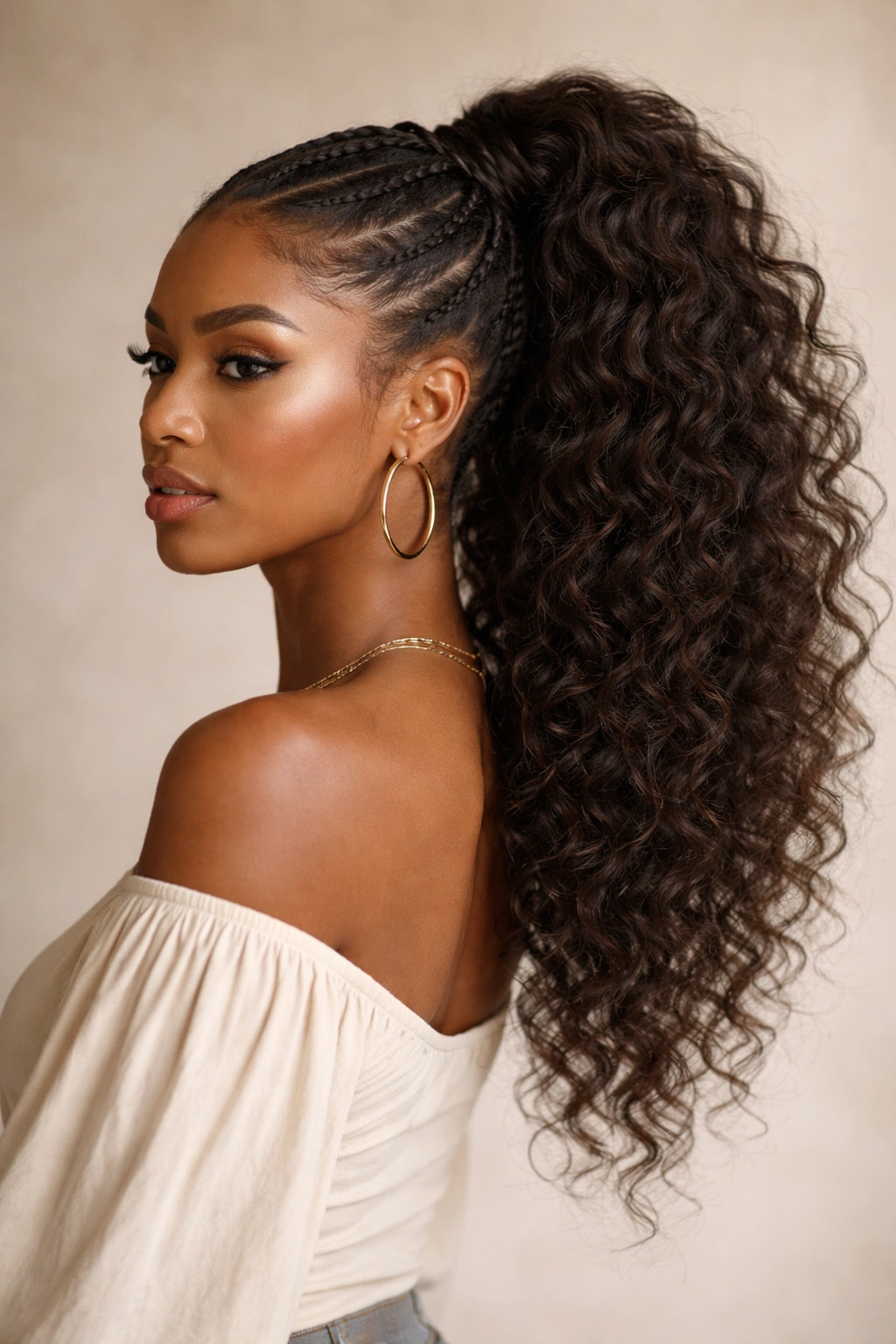
A goddess ponytail combines the volume and texture of a natural or textured ponytail with soft, intentional styling that looks effortlessly beautiful. Instead of stark sleekness or total wildness, a goddess ponytail is that sweet spot where your hair is gathered but still celebrates its natural texture and movement. It’s romantic, confident, and works for both casual and formal settings.
The Modern Beauty of Goddess Styling
Goddess styling is about celebrating natural texture while still looking intentional and polished. You’re not fighting your hair’s texture or trying to completely control it—instead, you’re working with it and styling in a way that feels collaborative rather than confrontational. A goddess ponytail reads sophisticated and modern because it rejects the idea that sleek is the only way to look polished. This style works beautifully for natural hair in any texture, from loose waves to tight coils, and it photographs beautifully because the texture actually reads in photos rather than being compressed flat.
Creating Goddess Texture and Movement
- Start with clean, moisturized hair with your natural curl or wave pattern intact
- Apply a curl-defining product or leave-in conditioner to enhance your texture without flattening it
- Gently gather the hair into a high or mid-level ponytail, being careful not to stretch or distort your curl pattern
- Don’t smooth edges aggressively—instead, use a light leave-in cream and water to define the texture around your hairline
- You can add soft layers of texture by gently finger-coiling some sections of the ponytail, but keep the overall effect natural
- Let some face-framing pieces fall forward for softness, or use a light edge control to define them intentionally
- Sleep with your goddess ponytail wrapped loosely in a silk bonnet or scarf
Styling philosophy: Goddess styling is about harmony with your hair’s natural tendencies, not control of them.
15. Edge-Control Sleek Ponytail
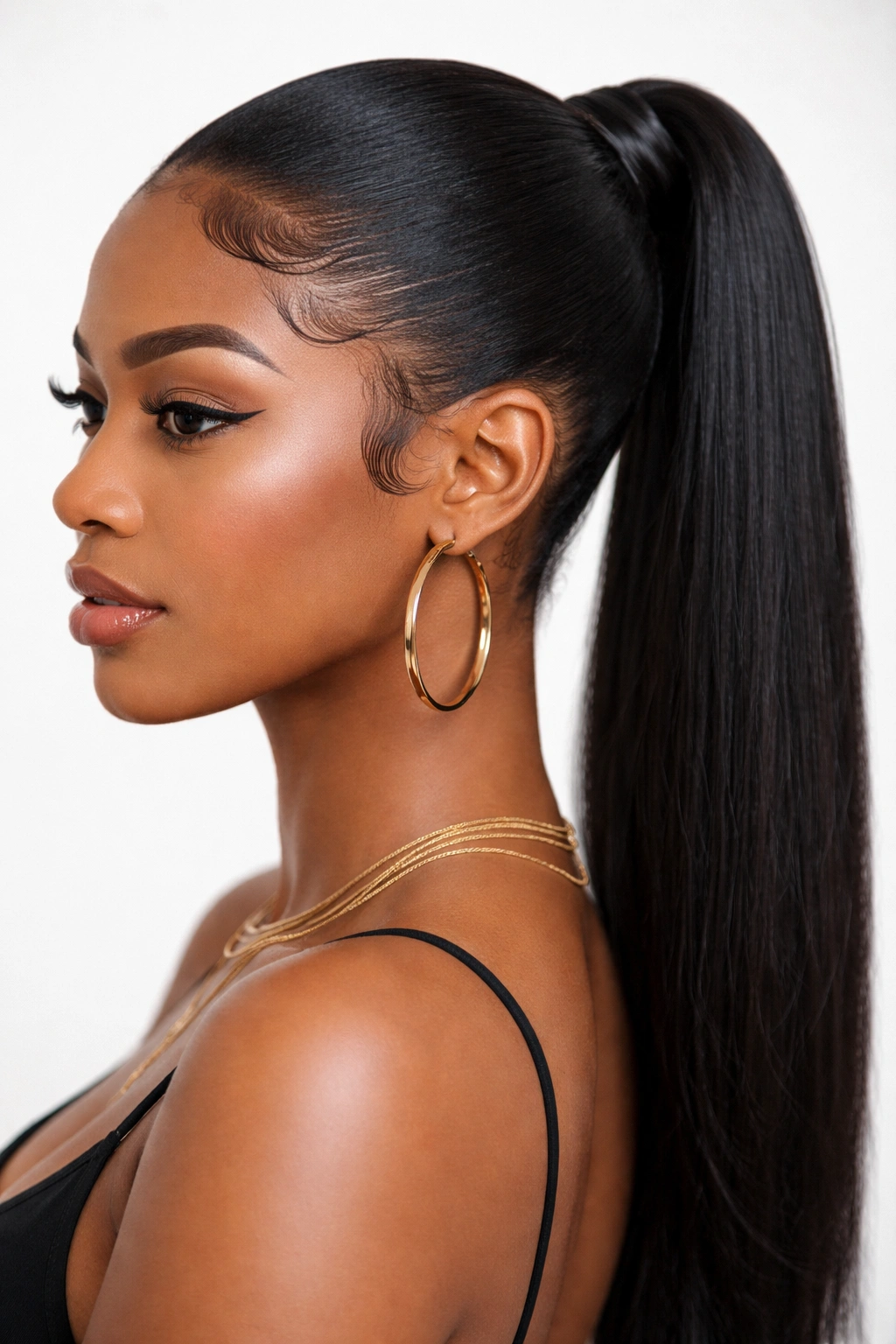
An edge-control sleek ponytail is the ultimate refined version of a basic ponytail—every hair is smooth and sculpted, including deliberate edge work that’s sharp and intentional. This is the style that shows off your edge-control skills and gives you maximum polish with minimal complexity. It’s appropriate for any occasion from casual to formal and instantly reads put-together.
The Art and Skill of Perfect Edge Work
A truly sleek ponytail isn’t just about securing your hair—it’s about the intentional sculpting of your edges and the absolute smoothness of your base. This requires good edge control product, technique, and time. The payoff is a hairstyle that looks professional, intentional, and undeniably polished. Black women have been mastering the art of edge control and edge sculpting for generations, and a truly sleek ponytail is a showcase for that skill. When your edges are sharp and your hair is smooth, you can wear this simple style to a board meeting, a date, or a special event and look absolutely intentional.
Mastering the Sleek Base
- Begin with clean or refreshed hair that you’ve smoothed with a blow dryer or flat iron
- Apply your edge control product of choice (find one that works with your hair type and holds without flaking)
- Use a fine-tooth comb to smooth your hair in sections, directing everything back toward your intended ponytail point
- Sculpt your edges deliberately—don’t just smooth them, create intentional shapes and lines that feel artistic
- Secure your ponytail with a fabric-covered elastic positioned to avoid tension on your hairline
- Wrap a small section of hair around the elastic to hide the mechanics of the style
- Touch up your edges throughout the day as needed with a lightweight pomade
- Sleep with your edges wrapped in a silk scarf to maintain the sculpted effect
Professional polish: A sleek ponytail with sharp edges is the hairstyle equivalent of perfect winged eyeliner—it’s simple, but it requires skill and intention.
Final Takeaway
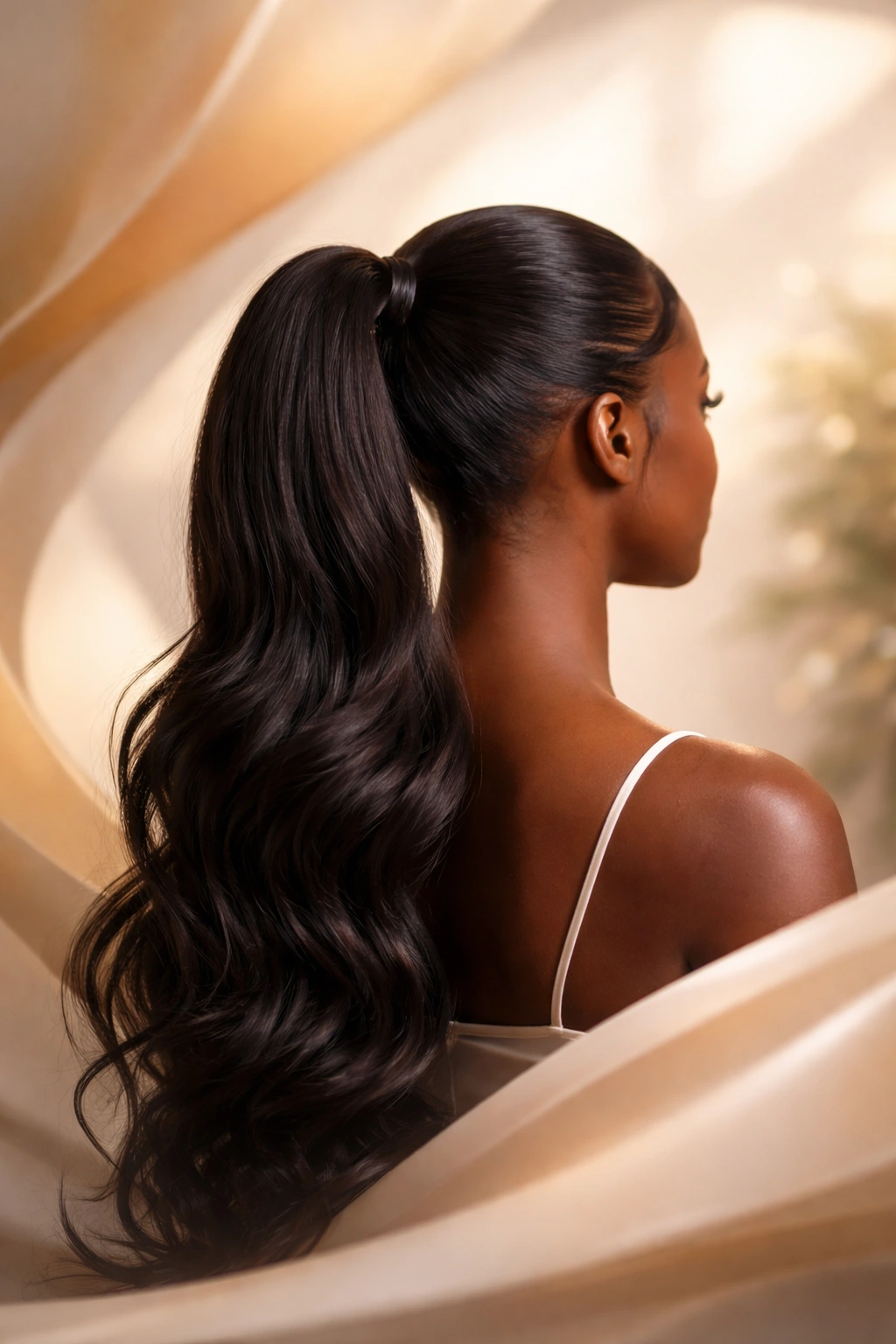
The 15 ponytail styles above aren’t just variations on a basic theme—they’re distinct expressions of your personal style, your hair’s unique texture, and your creativity. Whether you’re choosing a protective style that’ll keep your hair healthy for weeks, or grabbing something quick for a busy morning, there’s a ponytail option that works for you. What makes ponytails so perfect for Black women is that our hair’s natural texture, volume, and versatility make every one of these styles look stunning. You can wear a sleek high ponytail to a professional meeting and a goddess ponytail to brunch and feel equally confident both times.
The best ponytail you can wear is the one that makes you feel like yourself. Maybe that’s sharp and sculpted, or maybe that’s soft and textured. Maybe it’s protective and low-maintenance, or maybe it’s intricate and intentional. Your hair is an extension of your personality—let your ponytail reflect exactly that. Try a few of these styles, play with the techniques, add your own twists, and build a rotation that keeps your hair healthy while keeping you feeling powerful and beautiful.
