



Double ponytails strike that perfect balance between playful and polished—they work for everyday wear, athletic pursuits, and styled-up occasions when you want a look that’s both practical and visually striking. For Black women with textured hair, the versatility of double ponytails goes even deeper: these styles work beautifully with natural hair in all its forms, whether you’re rocking coily coils, wavy patterns, or relaxed textures. The key is understanding how to shape, secure, and accessorize double ponytails in ways that celebrate the richness of textured hair rather than fight against it.
What makes double ponytails so appealing is the sheer range of styling possibilities. You can go sleek and controlled, voluminous and bouncy, intricate with braiding details, or enhanced with accessories that add dimension. The placement matters too—high ponytails create an energetic, youthful vibe, while lower placements feel more sophisticated and polished. And because you’re dividing your hair into two sections instead of one, you actually gain more styling flexibility and can create looks that feel completely different from each other while still being cohesive.
The styles that follow aren’t just generic double ponytail ideas borrowed from mainstream sources. Each one has been tailored specifically for textured hair, with practical details about securing, maintaining the shape, and keeping your hair healthy while wearing these styles. Whether you’re looking for something you can throw together in five minutes or a more intricate style that turns heads, you’ll find exactly what you need here.
1. High Double Buns with Smooth Edges
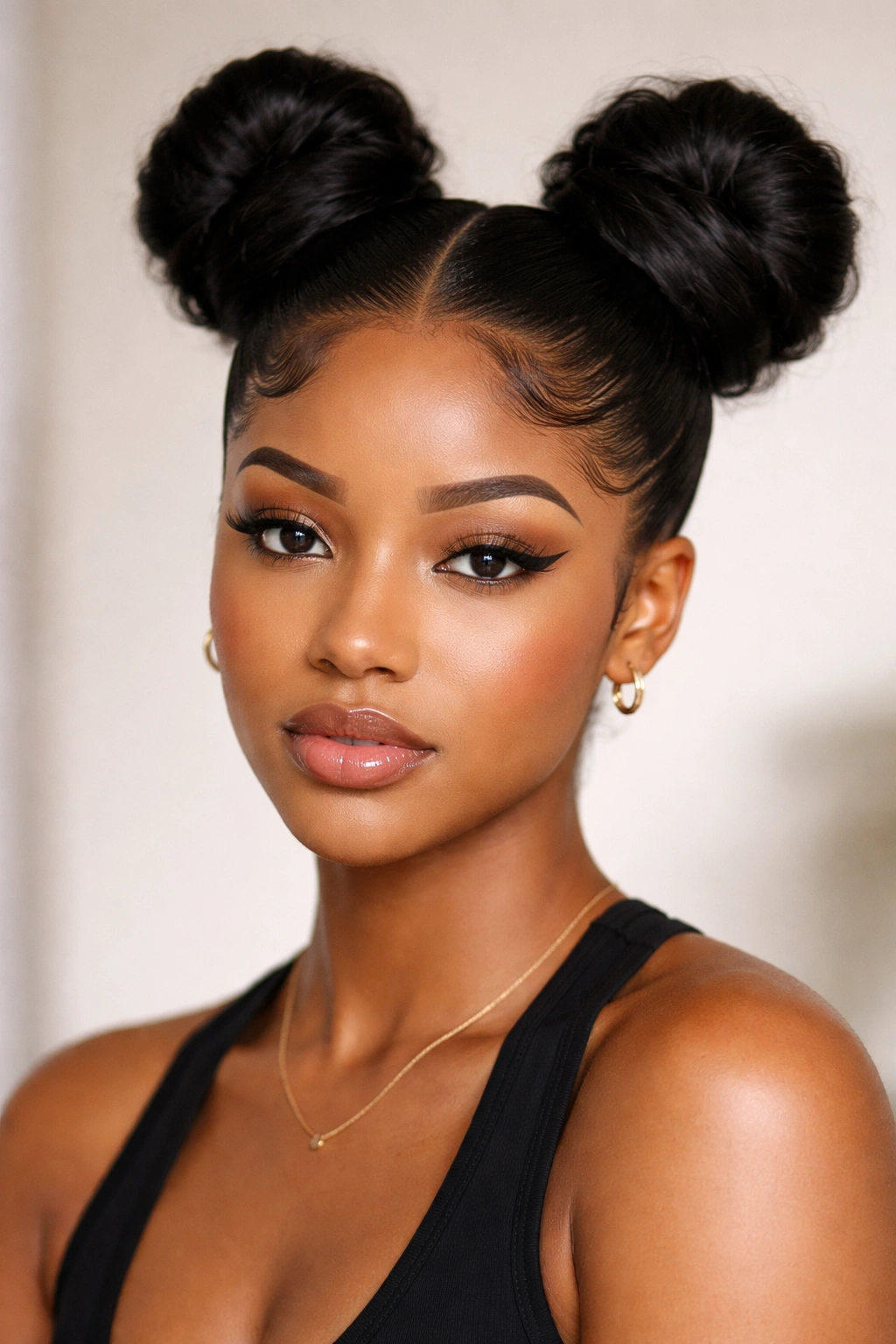
This is the modern update to the classic double bun—two compact, perfectly rounded bundles positioned high on your head, each one finished with a smooth, refined perimeter. What sets this version apart is the emphasis on clean edges and intentional shaping, which gives it polish whether you’re heading to the gym or out for a night with friends. The elevated placement creates immediate lift and visual interest while keeping all your hair secured away from your face.
Why This Style Works for Textured Hair
High double buns on Black women create the kind of height and dimension that showcases the natural volume of textured hair. Rather than flattening your crown, this style amplifies it—your natural texture becomes part of the aesthetic. The rounded shape of buns works especially well with coily and curly patterns because those patterns naturally create that fullness and definition the style requires. You’re not fighting your hair’s natural movement; you’re directing it into a polished form.
How to Create Clean, Defined Edges
Start with a clean part: Use a fine-tooth comb or a rat-tail comb to create two distinct sections, parting your hair down the middle from your hairline all the way to your nape. Consider parting slightly off-center if you prefer asymmetry. Each section will become one bun.
Smooth with the right products: Apply a smoothing cream, edge control gel, or lightweight styler to your hairline and the perimeter of each bun section. The smoothing power comes from product layering and technique, not from damaging your hair with excessive heat or tension.
Twist into shape: Gather each section high on your head, twist it tightly (but not uncomfortably—you shouldn’t feel tension pulling on your scalp), and wrap it around its base to form a compact bun. Secure with bobby pins inserted horizontally across the bun’s base for maximum hold.
Smooth the edges with a brush method: Use a soft boar-bristle brush or a toothbrush with a tiny bit of edge control to smooth each bun’s perimeter. Brush in the direction you want the hair to lay—usually smoothly back toward the center of the bun. Finish with a light hairspray to hold the style.
Styling Timeline
This style takes about 10-15 minutes once you’ve mastered the technique. You can wear it for 3-5 days before needing to refresh, depending on your sleep patterns and activity level. Sleep on a silk pillowcase or bonnet to preserve the buns overnight without flattening them completely.
Pro tip: Use spiral bobby pins rather than standard ones—they grip textured hair far more securely and you’ll need fewer of them to keep each bun in place throughout the day.
2. Side-Swept Double Ponytails with Braided Accents
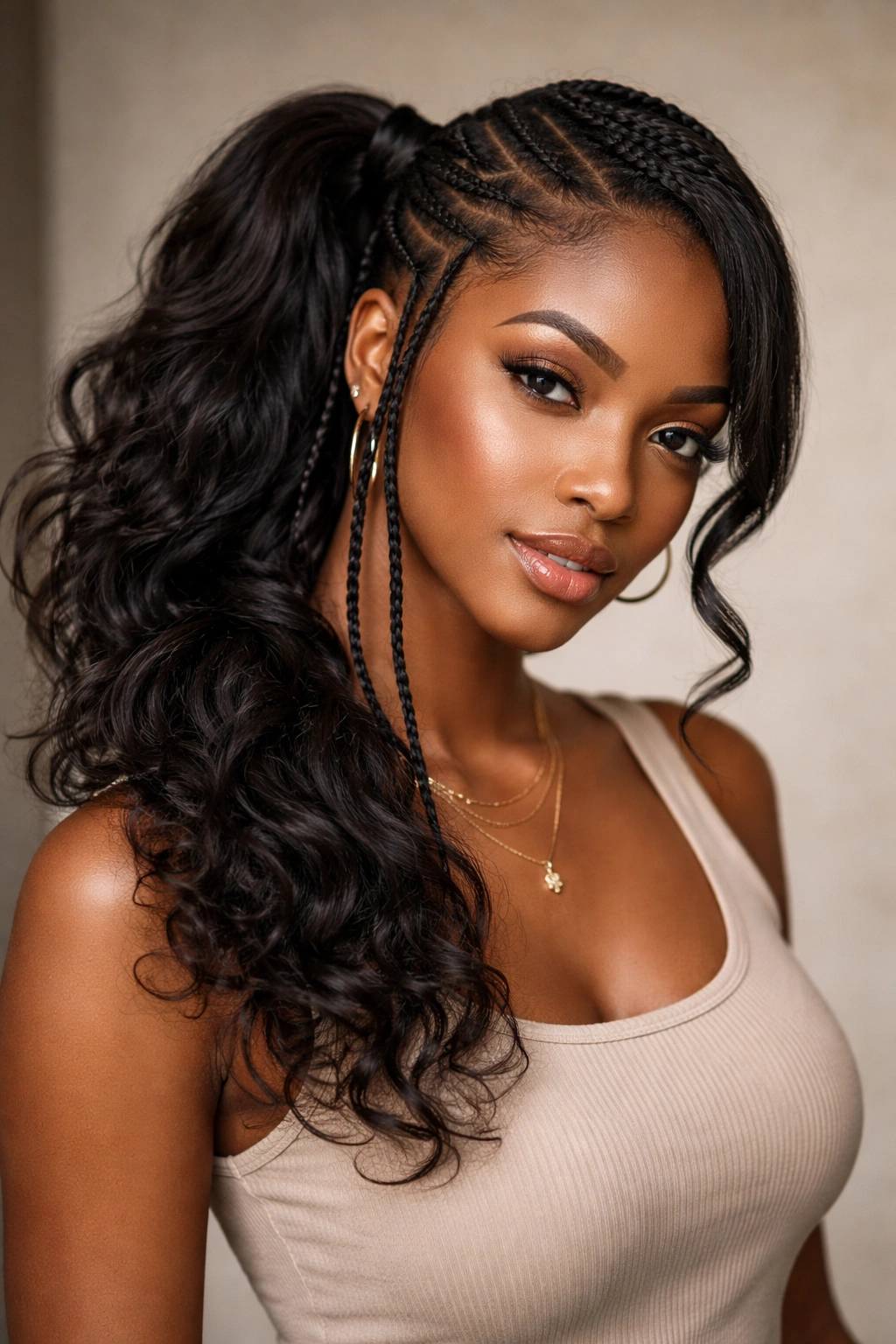
This style combines two ponytails positioned asymmetrically—one gathered high on one side and the other lower on the opposite side—with braided sections that weave between them or frame the face. The asymmetry makes the style feel contemporary and intentional rather than accidental, and the braided accents add texture and visual interest without requiring a completely intricate style.
The Asymmetrical Positioning That Works
Instead of placing both ponytails at equal heights, position one significantly higher (at your crown) and one lower (at the nape). This creates a diagonal line that’s visually dynamic. The higher ponytail becomes a statement element, while the lower one offers balance. On Black women with textured hair, this positioning showcases different aspects of your hair’s natural pattern—the crown gets that lifted, dimensional look, while the lower section shows off curl definition and movement.
Incorporating Braids for Added Dimension
Before you gather your ponytails, identify 2-3 small sections around your face or along your temple that you’ll braid first. Box braids, cornrows, or simple three-strand braids all work beautifully. These braids become framing elements—they can sweep across your forehead before being incorporated into your ponytails, or they can be positioned to create dimension between the two ponytails. The braids also serve a practical purpose: they help anchor the style and add visual weight to areas that might otherwise feel sparse.
Finishing Details That Elevate
The real polish comes in the details. After gathering each ponytail, wrap a small section of hair (or a coordinating ribbon, yarn, or fabric strip) around its base to hide the elastic. For textured hair, this wrapping technique actually strengthens the hold by creating another securing layer. Consider curling or coiling the ponytail ends with a curling iron or by twisting small sections and allowing them to cool—this adds texture and prevents the ponytails from looking flat.
Maintenance and Touch-Up Strategy
This style holds well for 4-5 days, though the braids may loosen slightly after day two. Refresh the braids by unraveling them gently and re-braiding over the same sections. You can sleep on this style by wrapping the braids and ponytails loosely in a silk wrap or sleeping on a silk pillowcase to minimize frizz and maintain the braid pattern.
3. Layered Double Ponytails with Textured Ends
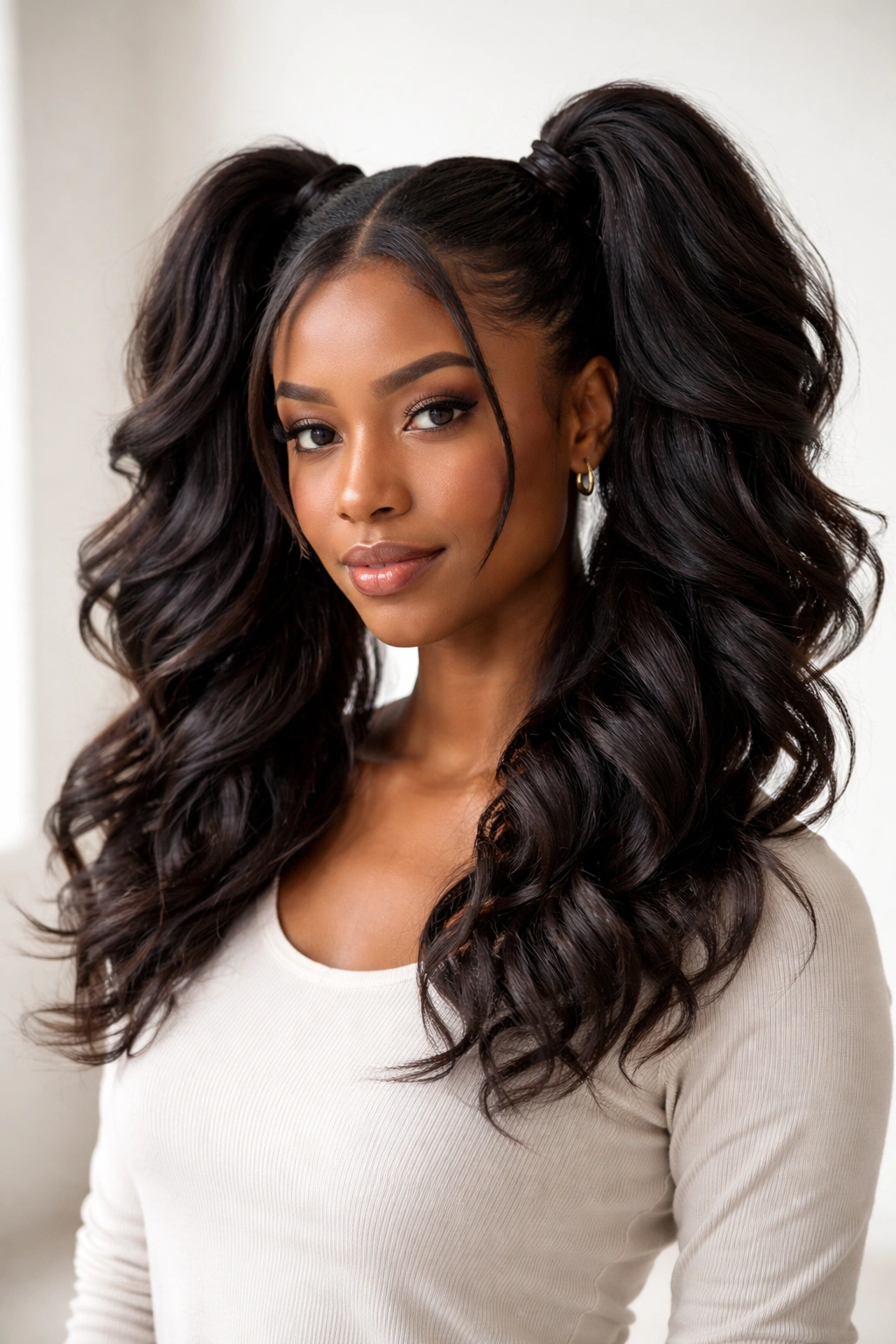
Layering within each ponytail creates the illusion of more volume and adds movement to your style—instead of gathering all your hair into one dense section, you create two to three subtle horizontal layers, each secured separately, then style the ends to create texture and definition. The result is a double ponytail that feels airy, dimensional, and far more interesting than a single-layer version.
Understanding the Layering Technique
Begin by dividing each ponytail section into two or three subsections based on hair length and texture. If you’re working with textured hair, you might create one layer at the crown, another at mid-length, and a final layer at the ends. Secure the first (highest) layer loosely, then add hair from below it, securing a second layer, and repeat if you’re adding a third layer. Each layer should sit slightly lower than the one above it. This technique takes practice, but once you understand the mechanics, it becomes second nature.
Why Layering Works with Textured Hair
Textured hair naturally wants to move and expand. By creating layers, you’re giving that natural texture space to breathe and display itself. Instead of fighting the volume with tension, you’re incorporating it into the style design. Layered ponytails also feel less heavy on your scalp because the weight is distributed across multiple securing points rather than concentrated in one spot—this means less tension on your hairline and healthier hair in the long run.
Styling the Ends for Maximum Impact
Once your layers are secured, focus on the ponytail ends. If your hair is naturally curly or coily, you might simply flip your head upside down and let gravity enhance the curl pattern, then flip back and separate the curls with your fingers. If your hair is wavy, you can enhance that pattern with a curling cream and a diffuser attachment on your blow dryer. For a sleeker look, straighten the ends with a flat iron and then twirl small sections into spirals before they cool—these cooled spirals create texture without requiring you to damage your hair with heat.
How Long This Style Lasts
Layered ponytails typically last 4-6 days depending on how much you move around and sleep. The beauty is that the style only gets better as it sits—the layers become more defined, the texture settles into place, and any small imperfections actually contribute to the lived-in, intentional aesthetic. After day three, simply refresh by unraveling each layer and re-securing them with the hair in its current state.
4. Double Ponytails with Cornrow Details
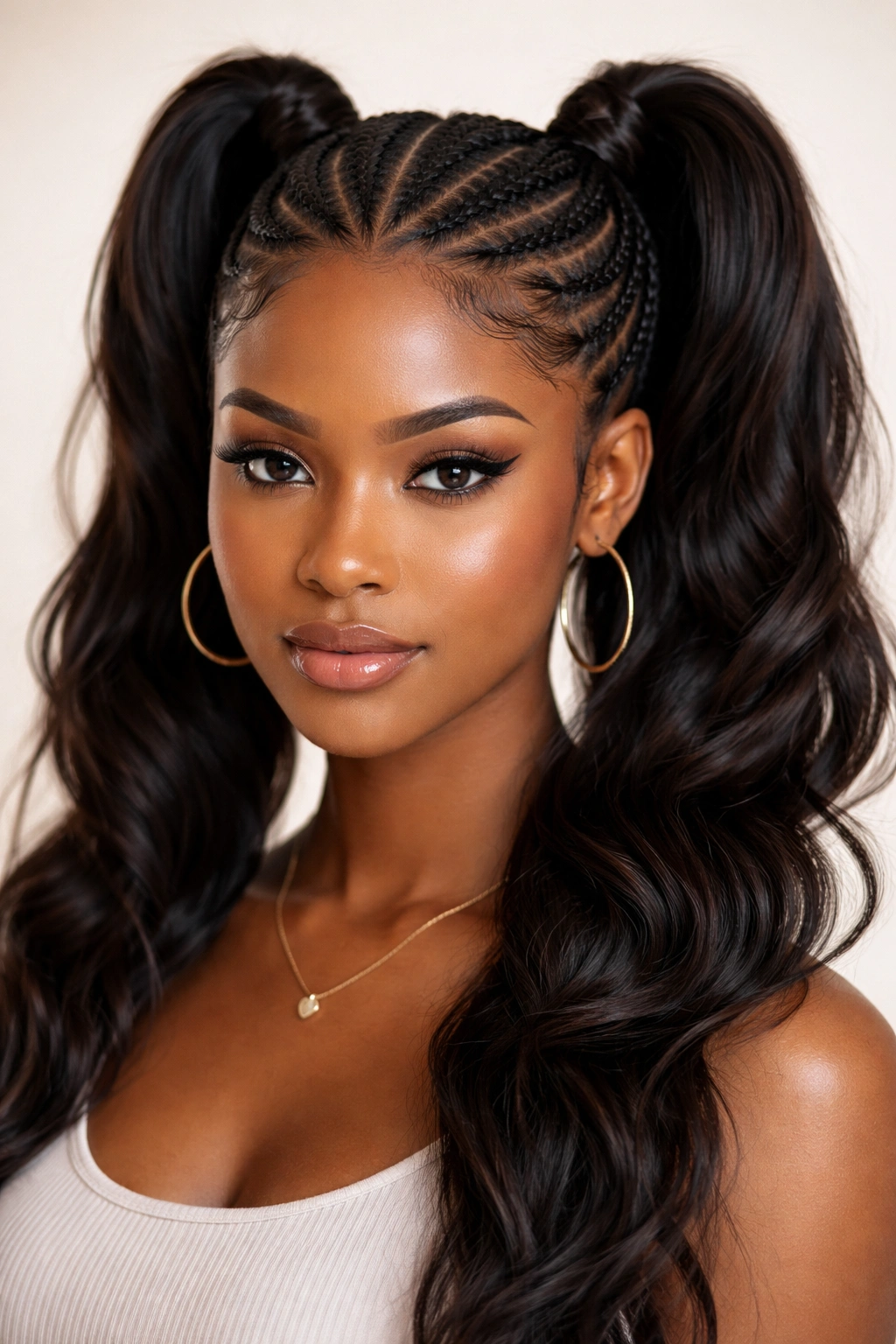
This style incorporates cornrows as a foundational element—two or more cornrows run through your hair and lead directly into your ponytails, creating structure and visual interest throughout the entire style. The cornrows can run parallel to each other, converge toward a central point, or create a more complex geometric pattern depending on your skill level and the look you want to achieve.
Planning Your Cornrow Pattern
Start by deciding your cornrow direction and number. A simple approach uses two symmetrical cornrows (one on each side of your head) that lead upward toward your crown, where they feed into two ponytails positioned side by side. A more intricate approach might use four to six cornrows that create a more complex pattern—some running front to back, others running side to side, all converging toward your two ponytail gathering points. Sketch your pattern lightly on paper first if you’re designing something new; this makes the execution much smoother.
The Practical Benefits of Cornrow Integration
Cornrows do more than look stunning—they distribute tension across a wider area of your scalp rather than concentrating it at a single gathering point, which significantly reduces stress on your hairline and makes the style more comfortable to wear. The cornrows also act as built-in anchors for your ponytails, making them far more secure and less likely to slip or loosen throughout the day. For protective styling, cornrows are a win on both the aesthetic and practical fronts.
Styling the Ponytails After Cornrows
Where cornrows feed into ponytails, you have freedom. You can keep the ponytail ends straight and sleek for a very controlled, high-fashion aesthetic. You can curl them for contrast—tight cornrows meeting voluminous, bouncy curls creates beautiful textural interplay. You can twist the ponytail ends around themselves to create a wrapped or coiled effect. The cornrows establish the structure; the ponytails are where you express your personal style.
Maintenance for Cornrowed Ponytails
This style is genuinely protective if done correctly—it keeps your hair secured in a way that minimizes daily manipulation. Expect to wear it for 7-10 days comfortably, though by day five or six the ponytails may feel looser and benefit from a light refresh. To refresh, you can partially undo just the ponytails and retighten them without touching the cornrows. Sleep on a silk bonnet to preserve the cornrow edges and minimize frizz in the ponytails.
5. Bubble Ponytails with Double Positioning
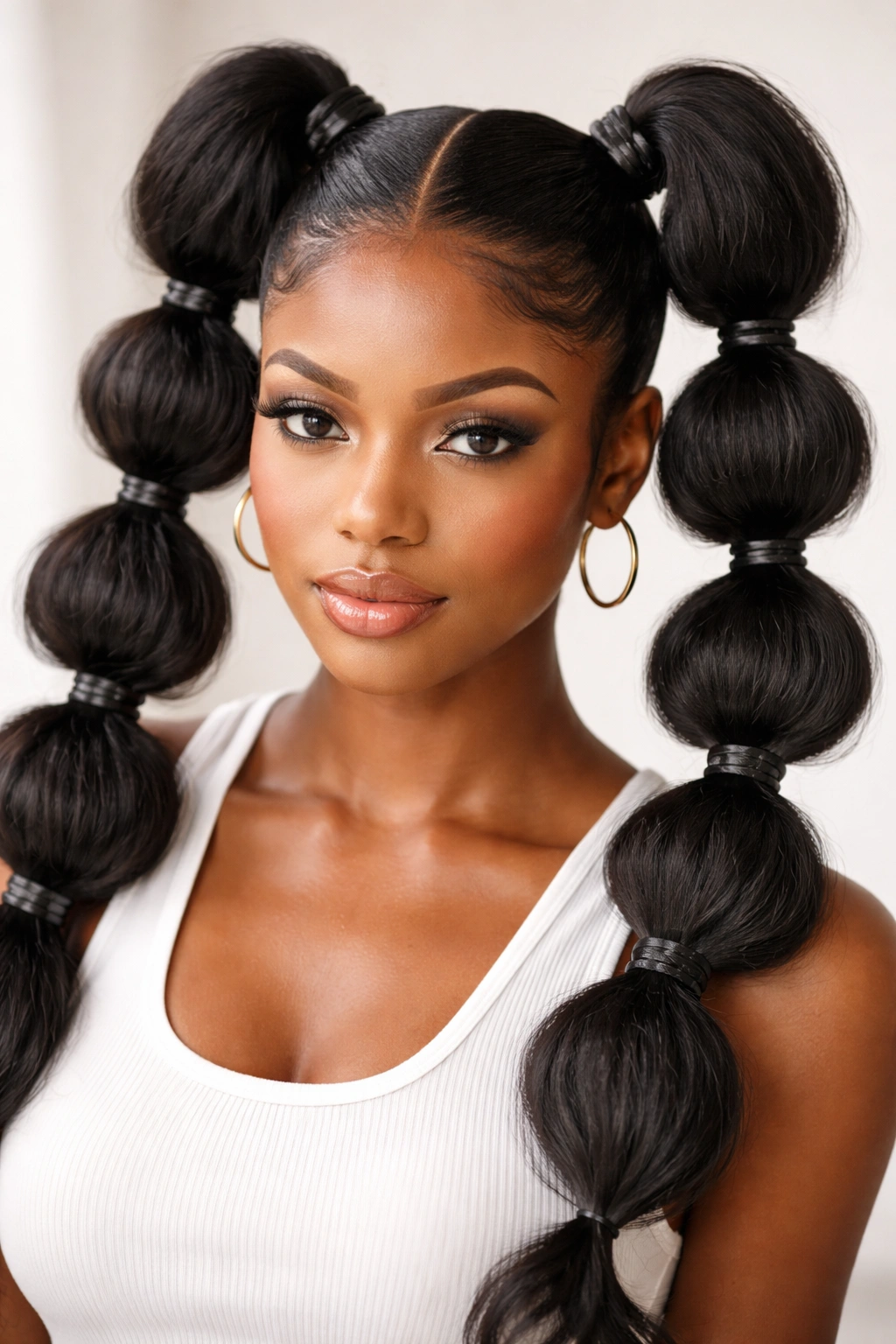
The bubble ponytail has become iconic—a single ponytail with multiple elastic bands spaced along its length, creating rounded sections that puff out between each band. When you create this style as double ponytails, you get two independent bubble sections that can be positioned anywhere on your head, allowing for maximum creativity and visual impact.
Constructing the Perfect Bubble Shape
Gather your first ponytail and secure it with a elastic band (silk or fabric-covered elastics minimize breakage on textured hair). Now comes the technique: take a small section of hair from the outside of the ponytail and wrap it over the elastic band, creating a small loop that conceals it. Slide this loop down slightly to create the first “bubble.” Place a second elastic band about 2-3 inches below the first, and repeat the wrapping and looping technique. Continue this process down the length of each ponytail, creating evenly-sized bubbles. For textured hair, the bubbles naturally achieve excellent fullness and shape because of your hair’s natural volume and movement.
Playing with Bubble Sizes and Spacing
Bubble size changes the whole feeling of the style. Large, generously spaced bubbles feel playful and youthful—perfect for athletic or casual wear. Tightly spaced smaller bubbles feel more refined and controlled, working beautifully for professional settings or styled occasions. You can even create varying bubble sizes on each ponytail for an intentionally asymmetrical look. With textured hair, you have the advantage of seeing exactly where your curl patterns create natural separation points, which helps you choose the most flattering bubble placement.
Enhancing Bubbles with Texture and Dimension
For textured hair, the bubble technique naturally shows off your curl pattern beautifully. Each bubble becomes a canvas for curl definition. You might enhance this by applying a curl-defining cream or gel to each bubble section before creating it, allowing your coils or curls to pop visually. Alternatively, you can create contrast by keeping one ponytail’s bubbles sleek and smooth while the other’s remain full and textured—this asymmetry looks intentional and fashion-forward.
Durability and Refresh Timing
Bubble ponytails hold their shape for about 4-5 days with minimal effort. The multiple elastic bands actually strengthen the overall hold, making this a surprisingly durable style. If bubbles start to flatten after day three, simply flip your head upside down, shake gently, and flip back—gravity and movement will restore the bubble fullness. You can sleep on this style if you’re careful; use a silk bonnet or pillowcase to minimize flattening, and you’ll wake up to a nearly perfect style.
Pro tip: Use small fabric-covered elastic bands in colors that coordinate with your outfit or with your hair color—this adds an intentional design element rather than looking like something you did out of necessity.
6. Twisted Double Ponytails with Spiraled Ends
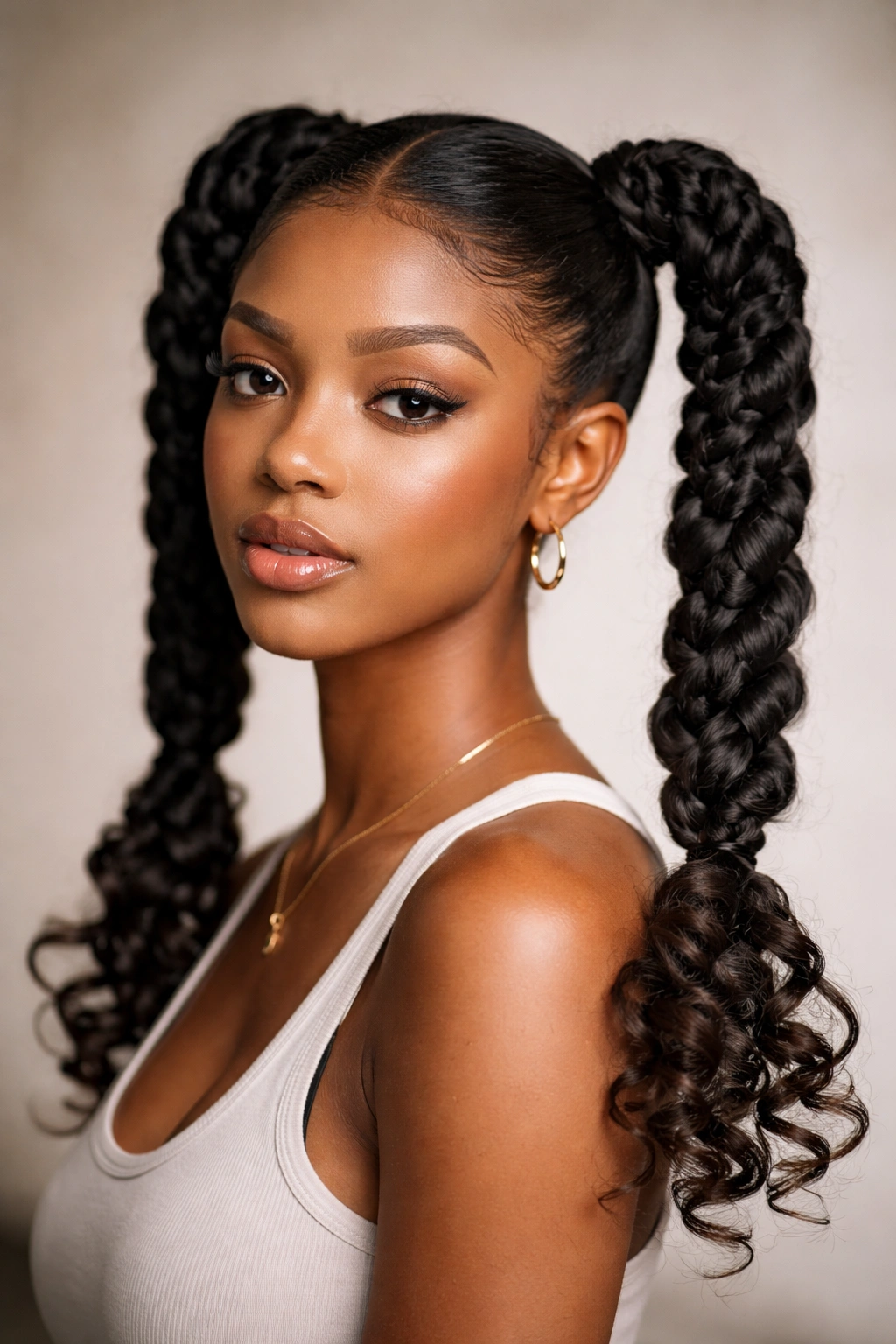
Twisting is a fundamental textured hair technique, and when you incorporate it into double ponytails, you create a style that feels both intricate and deeply connected to Black hair culture. Each ponytail begins with twisted sections that wrap around each other or spiral outward, then the ends continue the twisted or spiraled pattern for a cohesive, intentional look.
The Mechanics of Twisted Ponytails
To create a twisted ponytail, divide your ponytail section into two subsections. Twist each subsection tightly, then wrap the two twisted sections around each other, allowing them to naturally spiral together. Secure this twisted-and-wrapped section with bobby pins and an elastic band. The visual result is a ponytail that looks intricate and dimensional without requiring hours of braiding. For textured hair, twisting actually enhances curl definition—the twisting motion encourages coils to coil further and more visibly.
Creating Continuity from Root to End
Rather than stopping the twisted pattern at the elastic band, continue it through your ponytail ends. If you’ve started with two-strand twists in your ponytail sections, keep twisting the ponytail ends themselves. You can twist to the very ends of your hair, then wrap the twisted end around itself to create a coiled knot at the bottom. Alternatively, you can twist halfway down and allow the lower section of each ponytail to coil naturally, creating a gradient from twisted structure to loose, voluminous texture.
Styling Options for Twisted Ends
For the ponytail ends, you have clear choices. Tight, controlled twists throughout create a sleek, refined aesthetic that works beautifully in professional settings or for special occasions. Loosely twisted ponytails that transition to coily, bouncy ends feel playful and youthful—perfect for casual wear or athletic activity. You might also try one tight and one loose ponytail for asymmetrical interest, or alternate twisted and untwisted sections for a visually complex, patterned effect.
Longevity and Refreshing Twisted Styles
Twisted ponytails hold their shape exceptionally well for 5-7 days. Because the twisting creates its own securing structure (the tension of the twist itself holds the shape), you don’t rely entirely on product or elastics. This means the style actually holds better and puts less tension on your scalp compared to some other ponytail variations. If twists loosen slightly after day four or five, you can re-twist just the loosened sections without undoing the entire style—a quick 10-minute refresh keeps the style looking fresh for several more days.
7. Sleek High Double Ponytails with Sculptural Lines
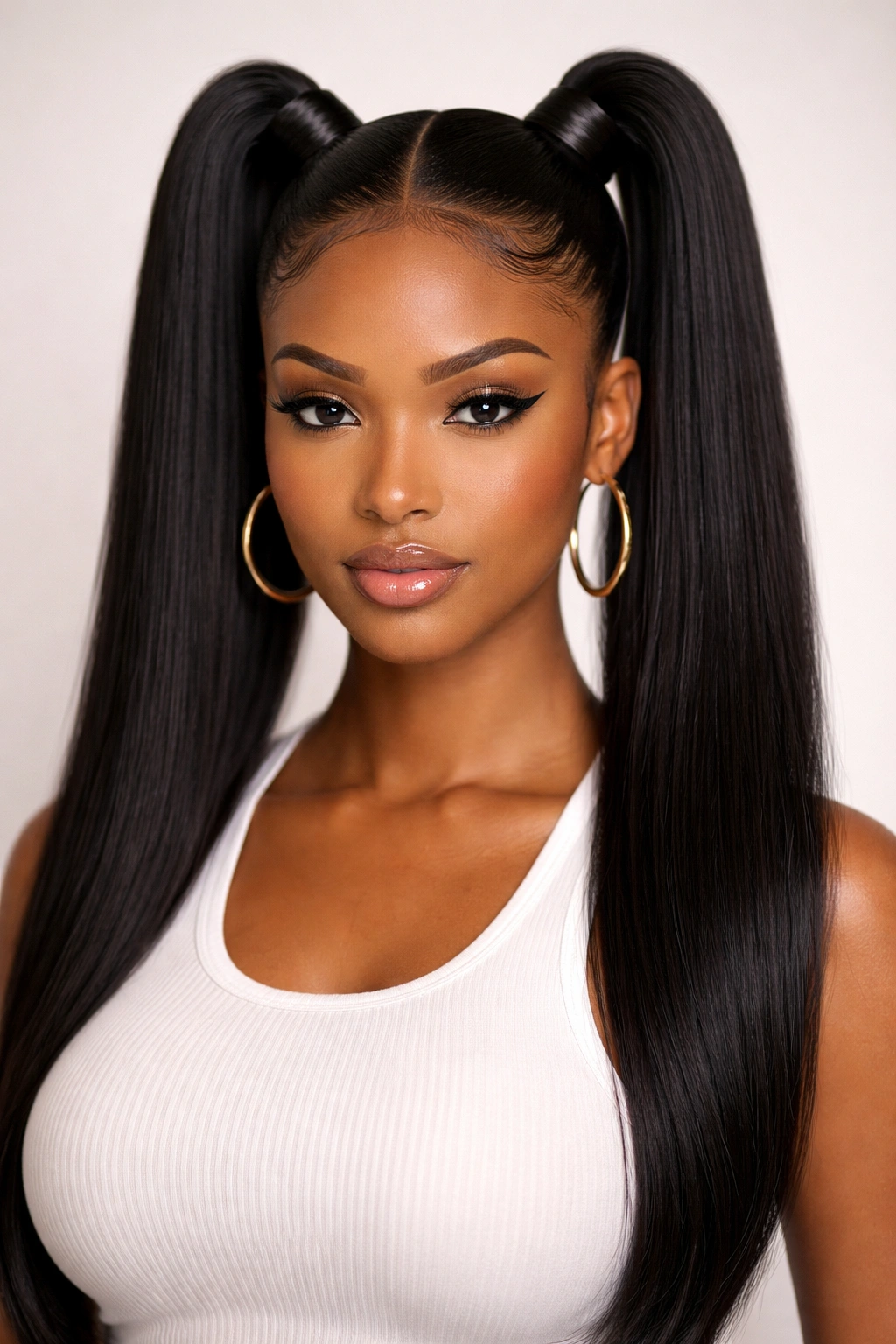
For moments when you want maximum polish—a professional presentation, a special event, a day when you want to feel powerful and put-together—sleek high double ponytails deliver. This style emphasizes smooth, controlled edges, geometric precision, and the kind of intentionality that reads as high-fashion. Everything is tight, clean, and sculpted, which on Black women with textured hair creates a striking contrast between the sleekness of the style and the beautiful richness of the hair itself.
Achieving True Sleekness on Textured Hair
True sleekness on textured hair requires the right approach. Start with damp or wet hair, and apply a smoothing gel or edge control cream that’s heavy enough to control texture but not so heavy that it flakes or leaves white residue. Work the product through your hair section by section using a fine-tooth comb or detangling brush, combing toward your scalp in the direction you want your hair to lay. For textured hair, sleekness comes from product + technique + patience, not from heat or damaging methods.
The Power of Sculptural Gathering
Position your two ponytails as high as physically possible—at your very crown if you have the hair density, or just slightly lower if your hair is finer. Use a tiny, discreet elastic band (black for dark hair, clear for lighter shades) and gather with absolute precision—no stray hairs, no bumps, no asymmetry. Wrap a thin section of hair around the elastic base to conceal it completely. The result should look like your ponytails are emerging directly from your scalp, creating maximum height and creating the impression of more hair density.
Creating Geometric Precision
Sleek ponytails benefit from deliberate shaping. Rather than simply banding your hair and leaving it loose, consider creating a very slight twist in each ponytail before securing it, or smoothing each ponytail downward so they lie perfectly straight and parallel to each other. You might even position them so they’re perfectly vertical, or angle them slightly forward or backward for intentional asymmetry.
Styling the Ponytail Ends
With sleek ponytails, the ends deserve equal attention to the gathering. You might keep them completely straight for a stark, minimalist look. You might curl them dramatically for contrast—the juxtaposition of tight sleekness at the crown with bouncy curls at the ends is visually stunning. You might wrap each ponytail end around itself and pin it into a coil. The key is intentionality—nothing about this style should feel accidental.
How Long Sleekness Holds
This style is durable and lasts 5-7 days with good care. The tension and the product hold both contribute to longevity. However, sleekness does diminish over time—by day three or four, tiny hairs at your hairline will have begun to escape, your edges won’t look quite as controlled, and your ponytails may look slightly fuller and less geometric. This is normal and not a failure of the style. Many people actually prefer the slightly softened version, which feels less severe than the first-day version.
8. Double Pouf Ponytails with Stacked Volume
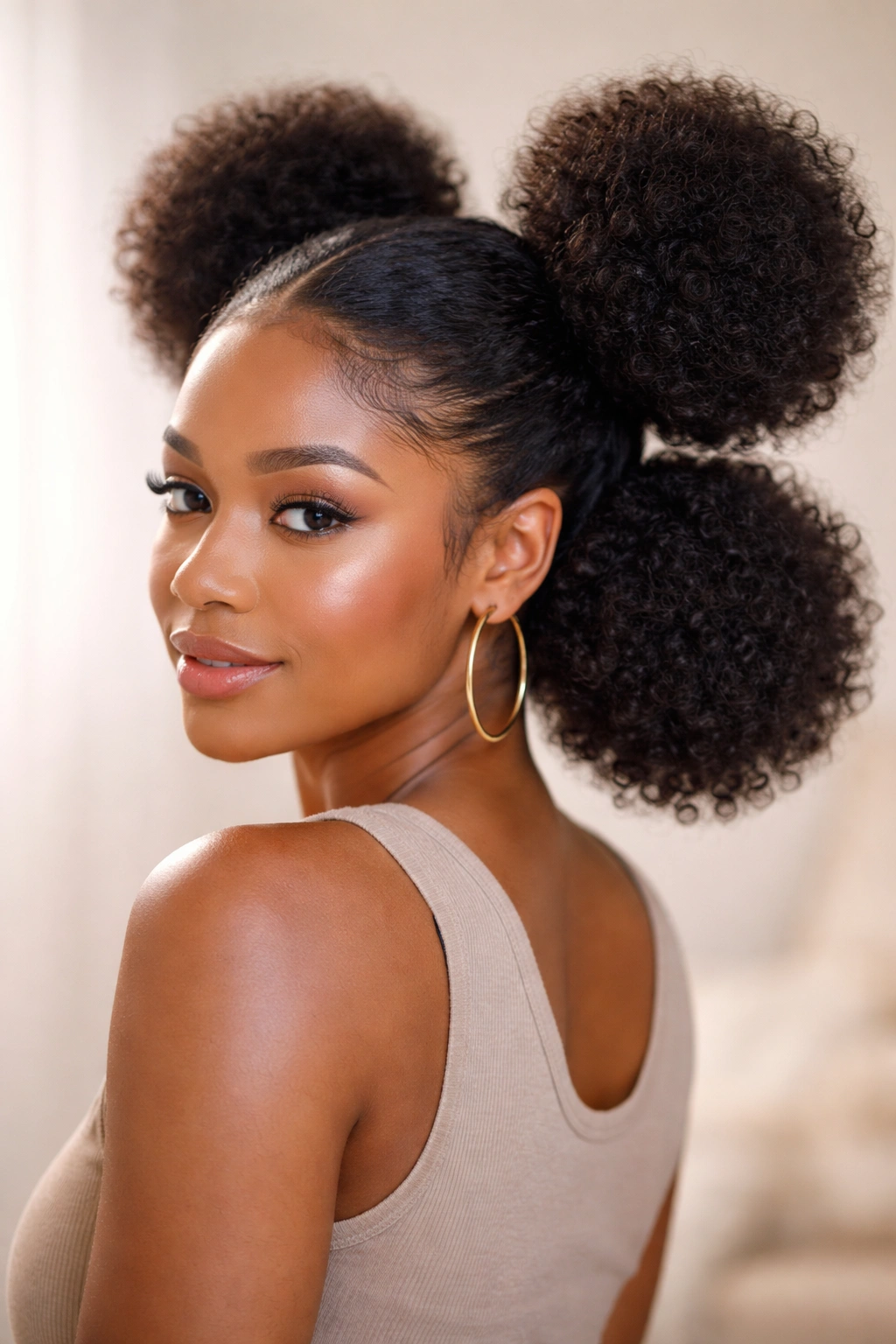
A pouf is a rounded section of voluminous hair gathered at a single point, and when you create two of them side by side or at different heights, you get a style that’s feminine, approachable, and celebrates the natural volume that textured hair provides. Poufs are less structured than buns—they maintain a soft, rounded shape but with movement and dimension rather than a tight knot.
Building Your Pouf Foundation
To create a pouf, gather your hair into a ponytail at your desired height, but don’t fully secure it yet. Instead, wrap a hair donut (a round fabric ring) or a fabric-covered elastic band around your gathered section loosely. Now gently pull sections of hair outward from the gathered center, creating a rounded halo of volume around your base. This isn’t a tight bun; the hair is loosely distributed around your gathering point. Once you’ve shaped your pouf to your liking, secure it with bobby pins inserted under and around the pouf structure. Add a second elastic band at the base of your ponytail to hold everything firmly in place.
The Visual Power of Double Poufs on Textured Hair
Where a double bun might feel retro or casual, double poufs feel contemporary and fashion-forward. This is partly because poufs maintain visible texture and movement—your curls and coils remain visible and defined, rather than being tightened and compressed into a solid shape. On Black women with textured hair, this visibility of natural pattern is stunningly beautiful. Your natural texture becomes the whole aesthetic, rather than something to be controlled or minimized.
Positioning for Maximum Impact
You can position your two poufs at equal heights (creating a balanced, symmetrical look), at different heights (for asymmetrical interest), or even off to the sides (a more playful, fashion-forward approach). Each positioning changes the overall feel. High poufs feel energetic and youthful. Lower poufs feel more sophisticated. Asymmetrical poufs feel intentionally styled and creative.
Complementary Styling Details
Poufs look beautiful on their own, but they also pair beautifully with other elements. You might incorporate small braids between the two poufs, or add a middle part and braid sections from it. You might add decorative hair clips or pins to the poufs themselves, or weave ribbons through them. Because poufs maintain volume and movement, they can handle additional embellishment without feeling overdone.
Maintenance and How Long They Hold
Poufs typically last 4-6 days depending on how much you move and whether you sleep on them carefully. The beauty of poufs is that they can actually improve as they sit—by day three, your curls and coils have settled into place and look even more defined and beautiful. Sleep on a silk bonnet to preserve the pouf shape, and you’ll wake up to a style that looks nearly as good as it did when you created it.
9. Double Ponytails with Curled and Coiled Ends
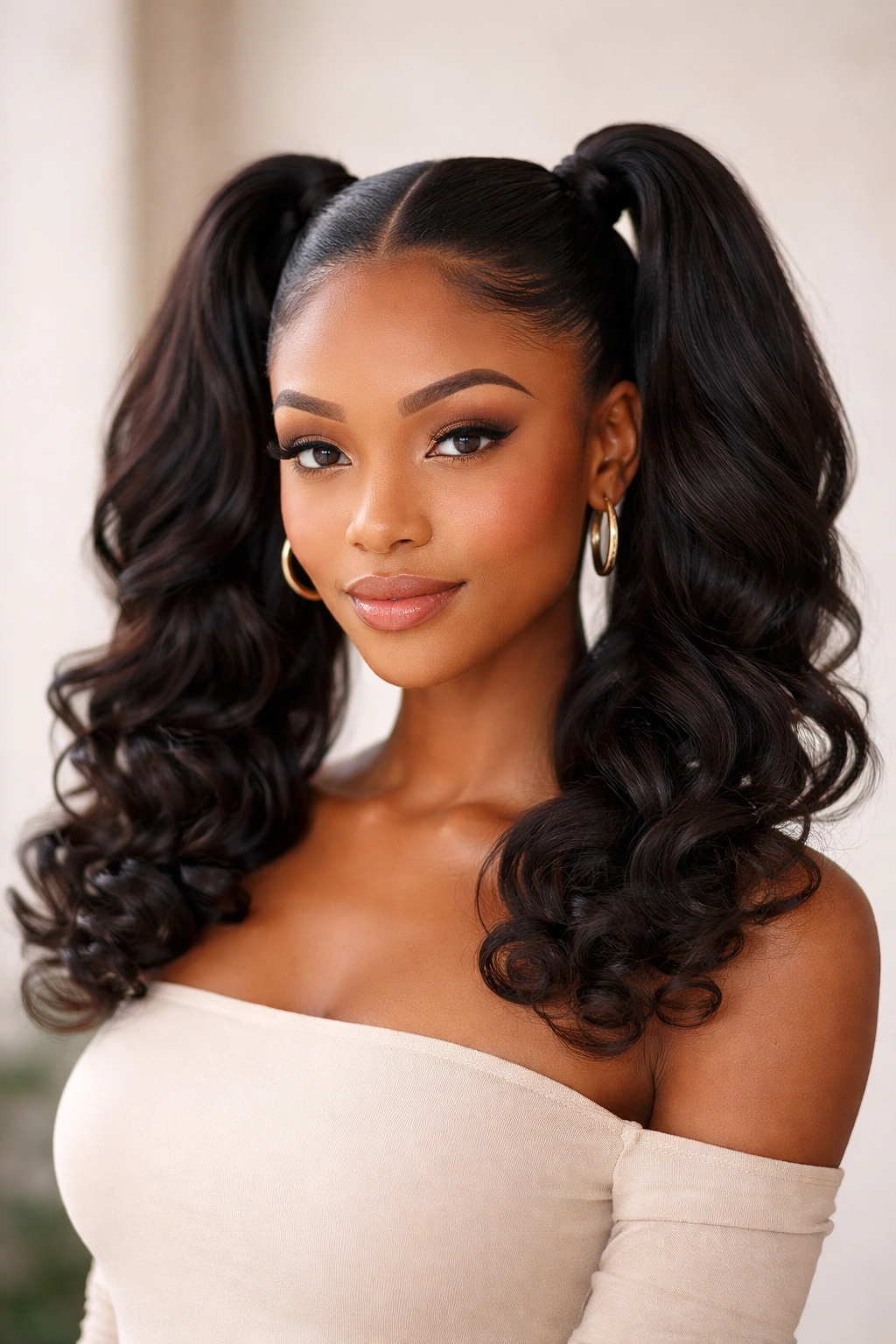
Sometimes the most beautiful style is one that starts simple and ends stunning—smooth gathered ponytails that transition into gorgeously textured, curled, or coiled ends. This style celebrates the full range of your hair’s potential: control and precision at the gathering, and unrestricted natural texture throughout the ponytail length.
Creating the Base Ponytails
Begin with two clean, detangled sections of hair. Smooth each section with a lightweight gel or mousse and gather them into two ponytails at your chosen height. For this style specifically, you want the gathering to be neat and the ponytails themselves to be smooth for the first few inches below the elastic. This creates a clear visual transition from controlled to textured.
Techniques for Curling Textured Ponytail Ends
Once your ponytails are gathered, you have several options for enhancing their texture. If your hair is naturally curly or coily, you might simply apply a curl-enhancing cream to the ponytail length and allow your natural pattern to define itself—sometimes no additional styling is needed. If you want more dramatic curl, you can use a curling iron to curl sections of each ponytail, creating defined ringlets or waves. For a bouncy texture, try twirling small sections of your ponytail around a curling iron without tightening—this creates loose waves rather than tight curls.
Creating Visual Contrast and Impact
The power of this style comes from the contrast between the sleek gathering and the textured ponytail ends. To maximize this, consider making your gathered sections as smooth and controlled as possible, then letting your ponytail ends be as voluminous and textured as possible. Apply smoothing product to the gathered sections and curl-enhancing product to the ends—two different products with different purposes create a more dramatic result.
Styling with Curling Tools
When using a curling iron on textured hair, start with damp or wet hair that’s been treated with a heat protectant product. Work in small sections, curling methodically. Different size curling irons create different results: a smaller barrel creates tighter, springier curls; a larger barrel creates loose, wavy curls. Experiment to find what you prefer. Allow curls to cool completely before running your fingers through them—cooling sets the curl shape, and touching warm curls collapses the structure.
How This Style Photographs and Moves
Curled and coiled ponytail ends catch light beautifully and move dynamically throughout your day—this style is incredibly photogenic. When you move your head, the curled ends bounce and flow in a way that sleek ponytails don’t. This makes the style particularly great for social events, active days, or any situation where your hair will be visible and part of your overall presence.
Durability Without a Ton of Maintenance
Despite the texture at the ends, this style holds well for 4-5 days. The smooth gathered sections don’t loosen easily, and the curled ends naturally tighten as they cool. By day three or four, your curls may have relaxed somewhat and feel less bouncy, but they’ll still look beautiful—they’ll simply read as waves rather than tight curls. This is actually fine; the style evolves rather than falls apart.
10. Feed-In Braided Double Ponytails with Extensions
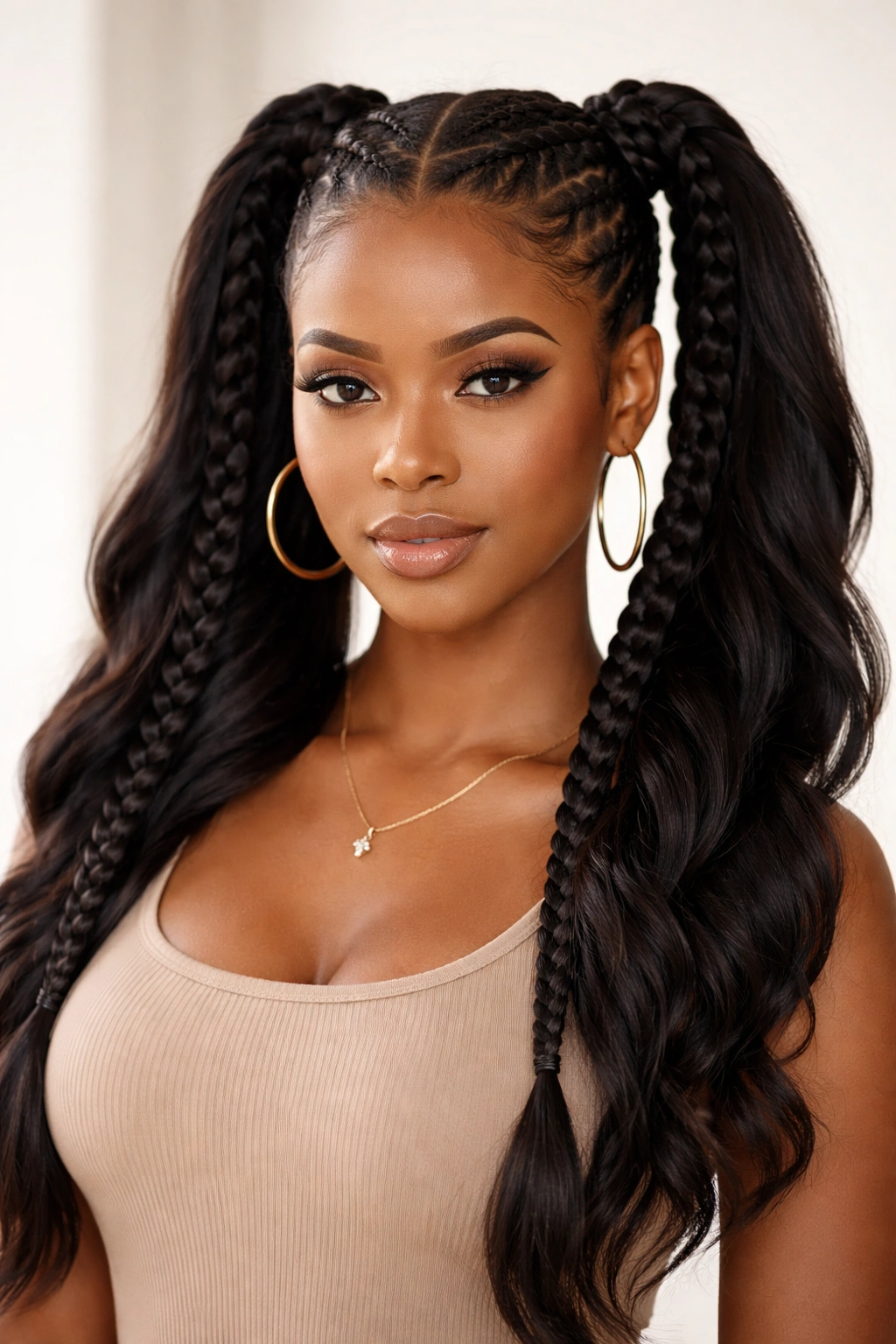
Feed-in braids integrate hair extensions seamlessly by feeding small amounts of extension hair into your braids as you work, creating a braided style that appears thicker and fuller than your natural hair alone. When you use this technique for double ponytails, you create voluminous, textured ponytails that look like pure natural hair while being stronger and more durable than standard ponytails.
Understanding Feed-In Braiding
Feed-in braiding starts with a section of your natural hair, and as you braid, you gradually add extension hair into your braid pattern. You’re weaving the extension hair in bit by bit rather than adding a large chunk all at once. This creates a seamless transition where the extension becomes indistinguishable from your natural hair. For double ponytails, you might create feed-in braids that form the ponytail bases, then release the extensions into loose, flowing ponytail ends, or continue the braid pattern all the way through your ponytail length.
Choosing the Right Extensions
For feed-in braided ponytails, you want extension hair that matches your natural texture as closely as possible. Human hair extensions create the most seamless blend with textured hair; synthetic extensions are more affordable but create a visible contrast in texture and movement. Choose extensions in a color that matches your hair perfectly, or choose a complementary shade if you’re intentionally creating highlight or dimension. Most people use 1-2 packs of extension hair per ponytail for adequate fullness.
The Technical Execution
Create your center part (if you’re doing symmetrical ponytails) or your desired parting pattern. Section off your first ponytail area. Begin a three-strand braid at your hairline or temple, feeding in extension hair gradually as you work toward your desired ponytail gathering point. The feeding-in should be smooth and gradual—you’re not clumping extension hair into your braid, but rather threading it in strand by strand so it integrates naturally. Once you’ve braided to your gathering point, secure your feed-in braid with an elastic band, then decide whether to continue the braid pattern through your ponytail or release the extension hair into a loose, flowing section.
Styling the Ponytail Ends
With extensions added, your ponytail ends have incredible volume and can be styled boldly. You might curl extensions and natural hair together for a completely textured ponytail, or style the extension-heavy sections differently from your natural hair sections. You might twist the ponytails, coil them, or let them flow loosely. The extensions give you options that might not exist with your natural hair alone.
How Long Feed-In Braided Ponytails Last
This is a protective style that lasts 2-4 weeks depending on how carefully you maintain it. The feed-in braids are quite secure, and extensions actually strengthen the hold by adding weight and stability. To extend the wear time, you can refresh your edges and rebraid slightly loosened areas after the first 7-10 days. Sleep on a silk bonnet to preserve braids and minimize frizz. When you’re ready to take the style down, do so gently—unravel braids slowly and remove extensions carefully to avoid pulling out natural hair.
11. Double Low Ponytails with Textured Undercuts
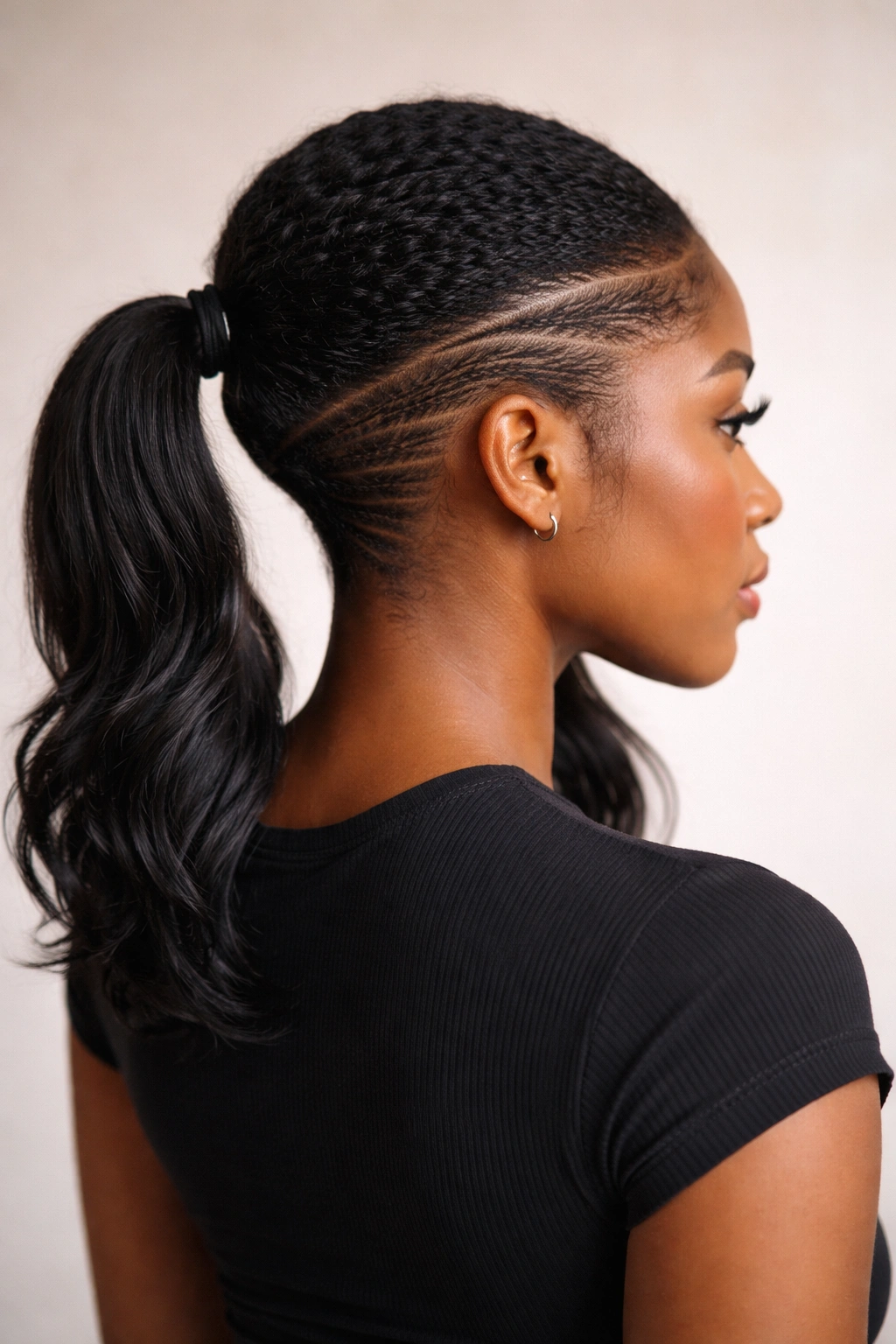
A textured undercut—where a small section of hair is cut significantly shorter than the rest—creates visual interest and movement when incorporated into a ponytail style. Double low ponytails with textured undercuts offer an edgy, fashion-forward aesthetic that works beautifully on Black women and celebrates geometric styling choices.
Understanding the Undercut Element
An undercut isn’t a style you create temporarily; it’s a cut that’s part of your permanent hair structure. Textured undercuts are typically sections around your temple, underside, or side that are cut very short (often a quarter-inch to an inch of length) while the rest of your hair maintains longer length. When you wear double low ponytails over an undercut, the contrast creates visual interest and movement. You might not even realize you have undercut sections until you move your head and the longer hair shifts, revealing the shaped short sections beneath.
Gathering Ponytails When You Have an Undercut
With undercut sections in place, your ponytail gathering is more dynamic. You might gather your ponytails low and loose, allowing longer hair to flow while the undercut sections create texture and dimension visible from the sides or when you move. Alternatively, you might deliberately position your ponytails to emphasize the undercut—gathering tightly so the longer hair sits above the cut sections, creating a stark, intentional contrast. Both approaches work; it’s about what aesthetic you prefer.
Creating Visual Movement and Dimension
The textured undercut sections naturally move differently from your longer hair because they have less weight and more freedom. This means your style has built-in movement and dimension—it’s not static. When you turn your head, the undercut sections shift and show differently. When you move your ponytails, they swing with different momentum than the longer hair. This dynamism is what makes the style feel modern and intentional.
Styling Choices with Double Low Ponytails
You might keep your gathered ponytails sleek and smooth, allowing the undercut sections to create all the visual interest. You might curl your ponytail ends bouncy and voluminous, creating contrast with the sharp, controlled undercut. You might twist your ponytails, braid them, or keep them completely straight. The undercut works beautifully with virtually any styling approach because it contributes its own dimensional element.
Maintenance Considerations for Undercuts
Textured undercuts require touch-up cuts every 4-6 weeks to maintain their sharp definition. The short sections grow out quickly and will look fuzzy and unkempt if not maintained. Between salon visits, you can trim your own undercut sections carefully using sharp clippers or scissors, though many people prefer leaving this to a professional. Even with maintenance required, the style is worth it for the geometric sophistication it adds to any ponytail style.
12. Double Ponytails with Decorative Hair Jewelry and Accents
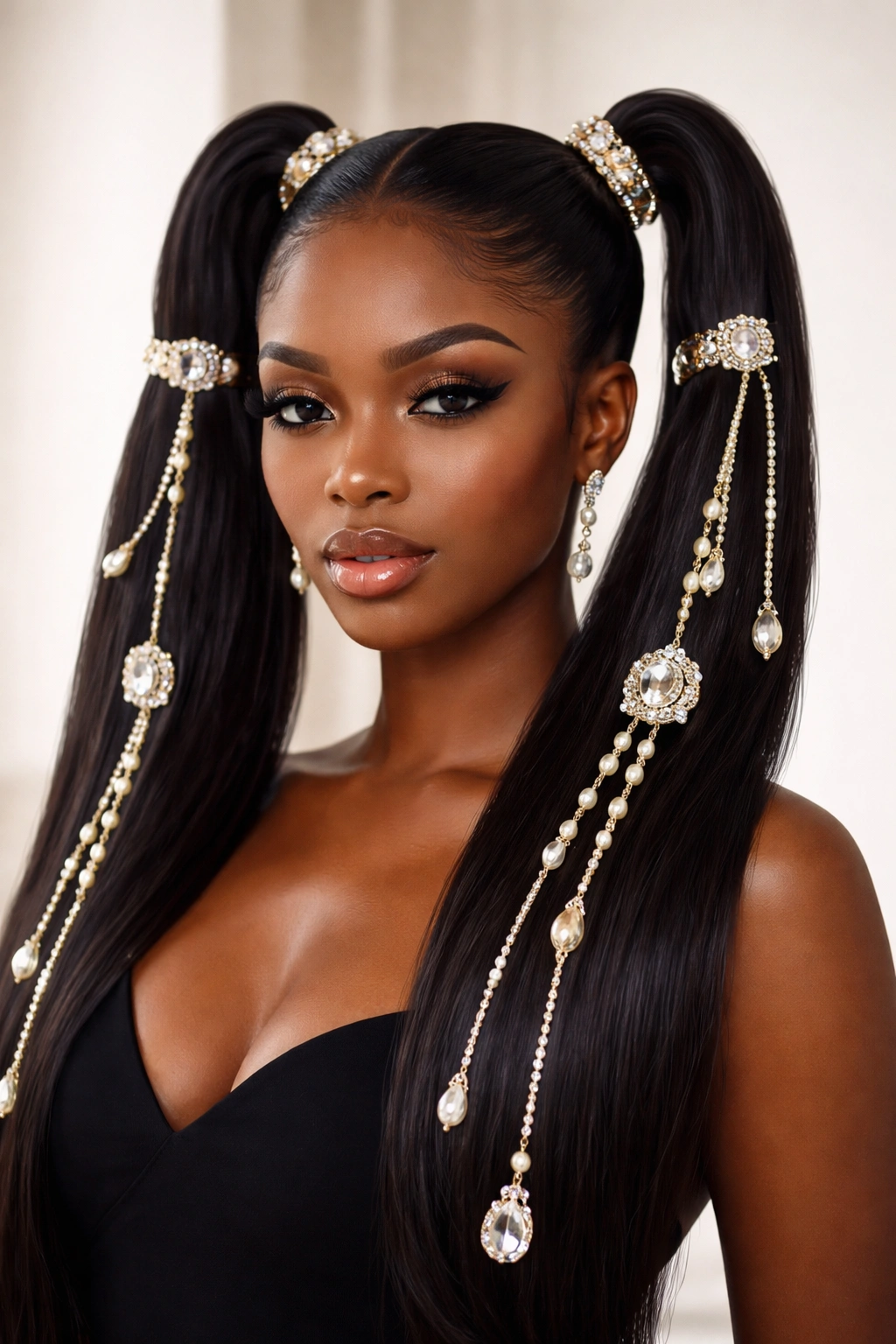
The final style showcases how accessorizing and embellishing your double ponytails elevates them from everyday to special-occasion-worthy. This approach uses decorative elements—hair jewelry, cuffs, clips, beads, metallic accents—intentionally positioned throughout your ponytails to create a styled, intentional aesthetic.
Choosing the Right Accessories
Hair jewelry comes in countless styles, and your choice should reflect your personal aesthetic and the occasion. Metallic cuffs look polished and professional. Colorful beads or decorative clips look playful and youthful. Delicate chains woven through ponytails read as high-fashion. Fabric ribbons add a softer, romantic element. The key is choosing jewelry that’s heavy enough to not slip through textured hair and secure enough that you’re not constantly adjusting it.
Strategic Placement for Maximum Impact
Rather than covering your entire ponytail with jewelry, consider strategic placement that emphasizes your style’s best features. You might place a single cuff at the elastic base of each ponytail for minimalist elegance. You might cluster several different-sized clips or cuffs along the length of each ponytail in an intentional pattern. You might weave a thin chain through both ponytails as a unifying element. You might add a single statement piece at the tip of each ponytail.
Incorporating Beads and Wraps
Beads and wraps are easy to add and create immediate visual impact. You can slide beads onto your ponytails and secure them with thread, creating permanent adornment. You can wrap decorative cord, yarn, or ribbon around sections of your ponytail, creating bands of color or pattern. You can use hair cuffs, which slide on and off, allowing you to change your style’s look without committing permanently.
Coordinating Accessories with Your Look
The most polished approach to accessorizing ponytails is coordinating your hair jewelry with your outfit, makeup, or overall aesthetic. If you’re wearing gold jewelry on your body, use gold-toned hair cuffs and clips. If you’re wearing jewel tones in your outfit, echo those colors in your hair accessories. This coordination creates a cohesive, intentionally styled appearance that reads as put-together and thoughtful.
Removing and Maintaining Hair Jewelry
Most slide-on hair jewelry can be easily removed by sliding it off the ponytail end, allowing you to change your style whenever you want. Jewelry that’s been permanently attached (like beads secured with thread) should be carefully removed using tiny scissors to cut the securing thread. Most hair jewelry can be reused indefinitely, though you should clean it occasionally to remove product buildup. Thread-on beads might need replacing after several uses, but they’re inexpensive and easy to replace.
Final Thoughts
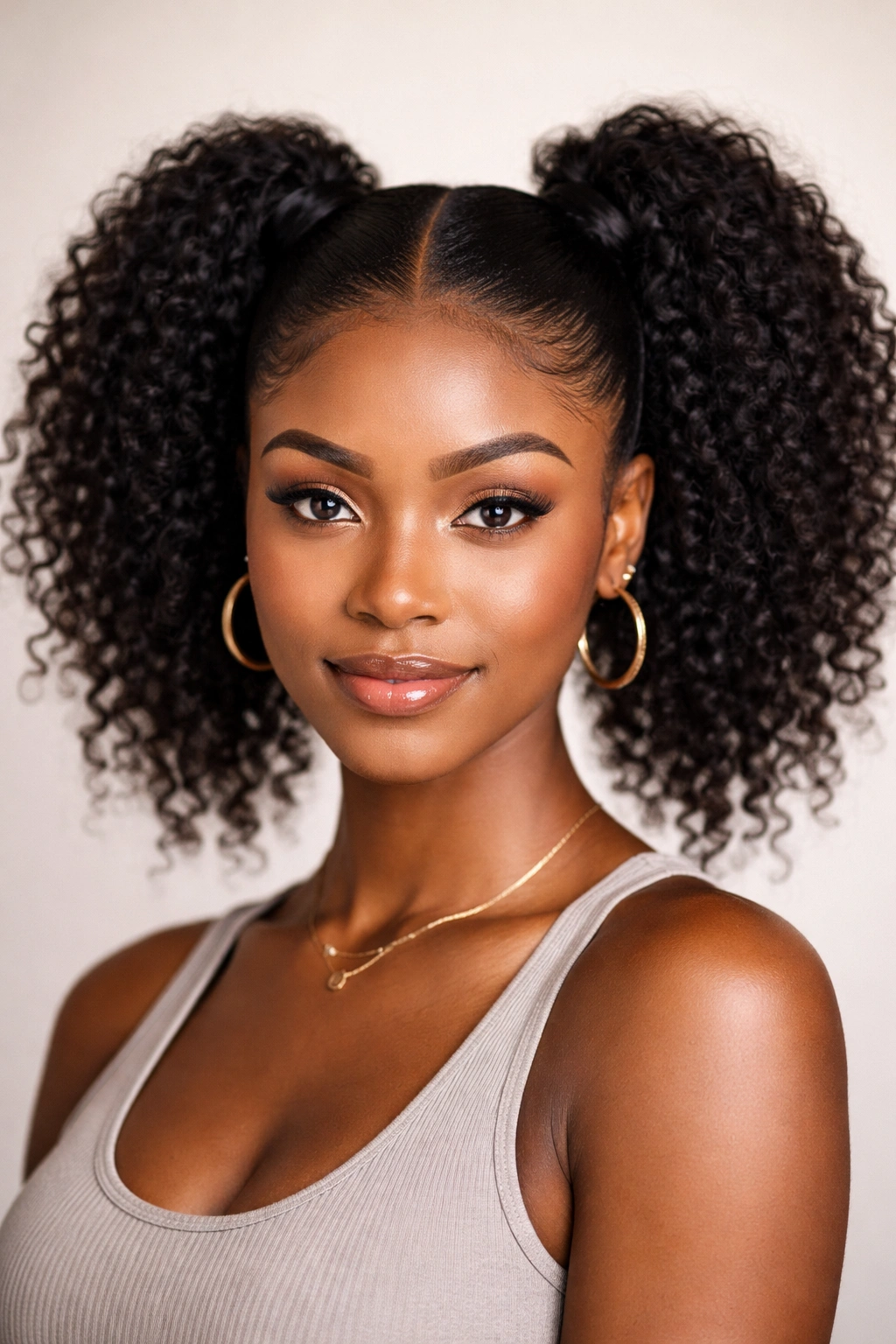
Double ponytails offer an incredible range of styling possibilities specifically because they divide your hair into two sections instead of one. You gain the flexibility to create looks ranging from sleek and controlled to voluminous and textured, and everything in between. For Black women, these styles celebrate the richness of textured hair, whether you’re emphasizing natural coils and curls, incorporating braiding techniques, or playing with geometric precision and movement.
What makes these styles particularly powerful is their versatility across contexts. You can wear a style to the gym, to work, to a special event, or for everyday wear—often with just minor adjustments to accessories or the way you finish the ponytail ends. This means you can invest the time and effort to master these techniques once and enjoy the benefits for months and years of repeated wear, watching your styling skills deepen and your sense of what works for your unique hair continue to evolve.
The best style is always the one that makes you feel most like yourself—the one that celebrates your hair’s natural beauty while allowing you to express your creativity and personal aesthetic. Whether you choose one of these styles exactly as described or adapt them to suit your hair’s unique texture, density, and length, the goal is creating something you love wearing and something that honors your hair’s genuine nature.
