

Bandanas and afro hair were genuinely made for each other. Whether you’re protecting your curls while they set, managing a wash-and-go day, or just wanting a polished look in five minutes flat, a bandana transforms both your hair and your entire outfit. The beauty of styling with bandanas is that they work with your natural texture, not against it — your curls stay moisturized, your edges look intentional, and you go from bedhead to camera-ready without heat, chemicals, or thirty minutes in front of the mirror.
The challenge isn’t finding a way to use a bandana with your afro. The challenge is choosing which way, because there are genuinely dozens of styles that all deliver completely different vibes. A bandana wrapped one way gives you effortless chic; twisted differently, it’s more polished and put-together. Tied another way, it reads playful and bold. The same piece of fabric becomes an entirely different accessory depending on how you work it.
What makes bandana styling so valuable for people with textured hair is the speed factor combined with the hair health factor. You’re not rushing to style wet hair before it dries into a shape you didn’t choose. You’re not subjecting your curls to tension and heat. You’re giving yourself a legitimate, professional-looking option that takes minutes and actually protects your curls while you’re wearing it. That combination — fast, protective, and genuinely stylish — is why bandanas deserve serious rotation in your regular hairstyle lineup.
The styles below range from loose and bohemian to structured and polished, and each one works differently depending on your curl pattern, hair density, and personal aesthetic. Pick the ones that match your vibe and your schedule.
1. The Classic Head Wrap
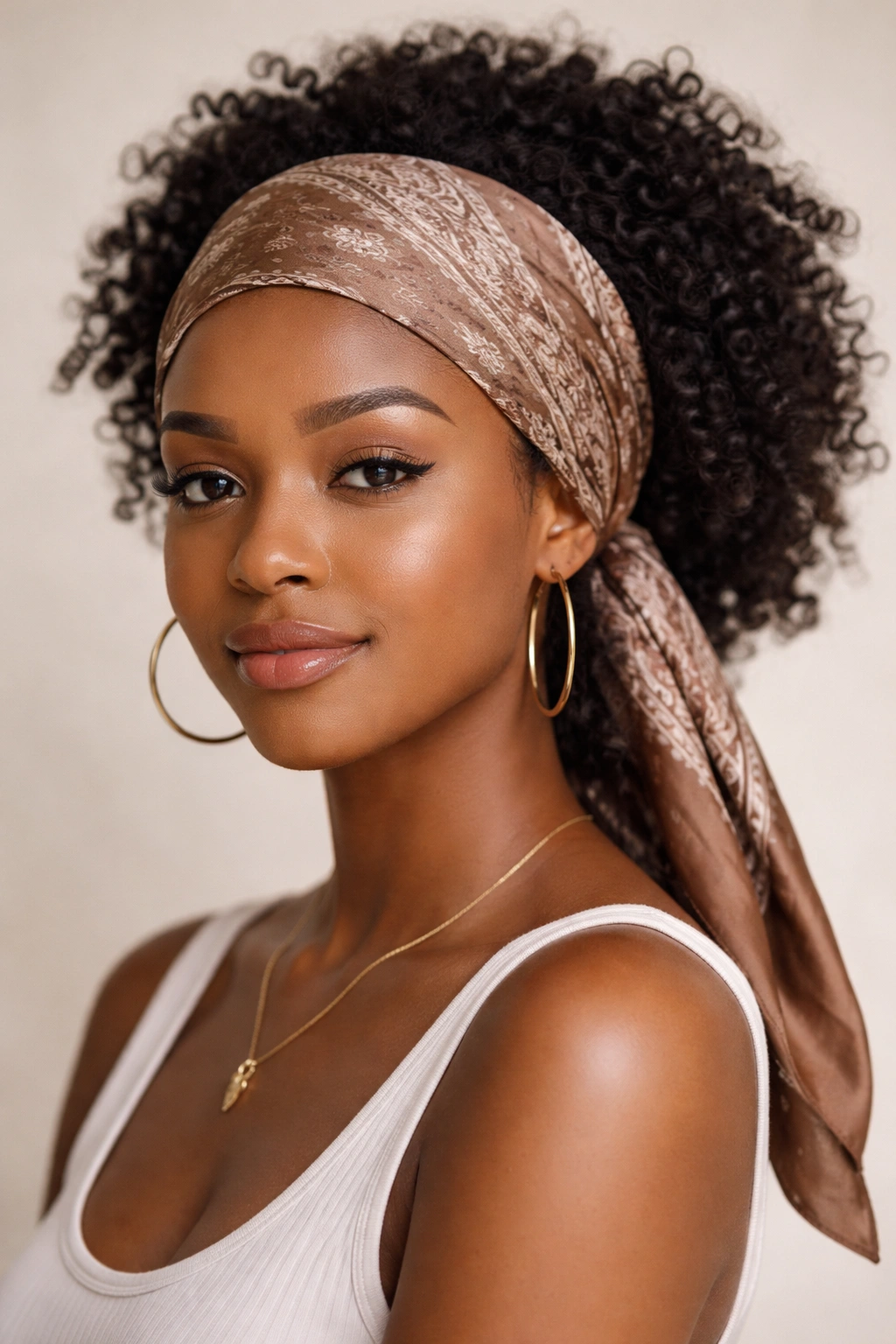
This is the foundational bandana style, and it’s essential to master because once you nail it, you can modify it in countless directions. The classic wrap starts with your bandana folded into a triangle, positioned at your hairline with the long tail draped down your back. You bring one end across the side of your head and tuck it behind your ear, then do the same with the other end, creating a smooth, wrapped appearance that holds everything in place without flattening your curls underneath.
Why This Style Works So Well
The classic wrap distributes the fabric evenly across your scalp, so there’s no single point of pressure damaging your curl pattern. Your hair stays loose and protected at the same time — the bandana shields your edges and keeps flyaways in check without requiring you to compress your curls into submission with products or tension. It’s genuinely protective styling, which matters if you’re transitioning, recovering from heat damage, or just trying to extend the life of your current style.
How to Master the Look
- Start with a large square bandana and fold it into a triangle by bringing two opposite corners together
- Position the long fold at your hairline, letting it sit just above your eyebrows, and drape the point down your back
- Take the two loose ends and bring them around to the back of your head, crossing them gently and bringing them forward to tie at the nape of your neck
- Tuck any loose ends under the wrap for a finished edge, and adjust so the fabric sits smoothly against your hairline without pulling
- The result should feel secure but never tight — you should be able to slip a finger under the wrap at any point and feel no tension on your scalp
Pro tip: Use a silk or satin bandana rather than cotton when you’re wrapping directly against damp hair. Cotton absorbs moisture and can roughen your curl cuticles; silk and satin allow your hair to slide smoothly without friction as it dries, which means better-defined curls by morning and zero frizz.
2. The Turban-Styled Topknot
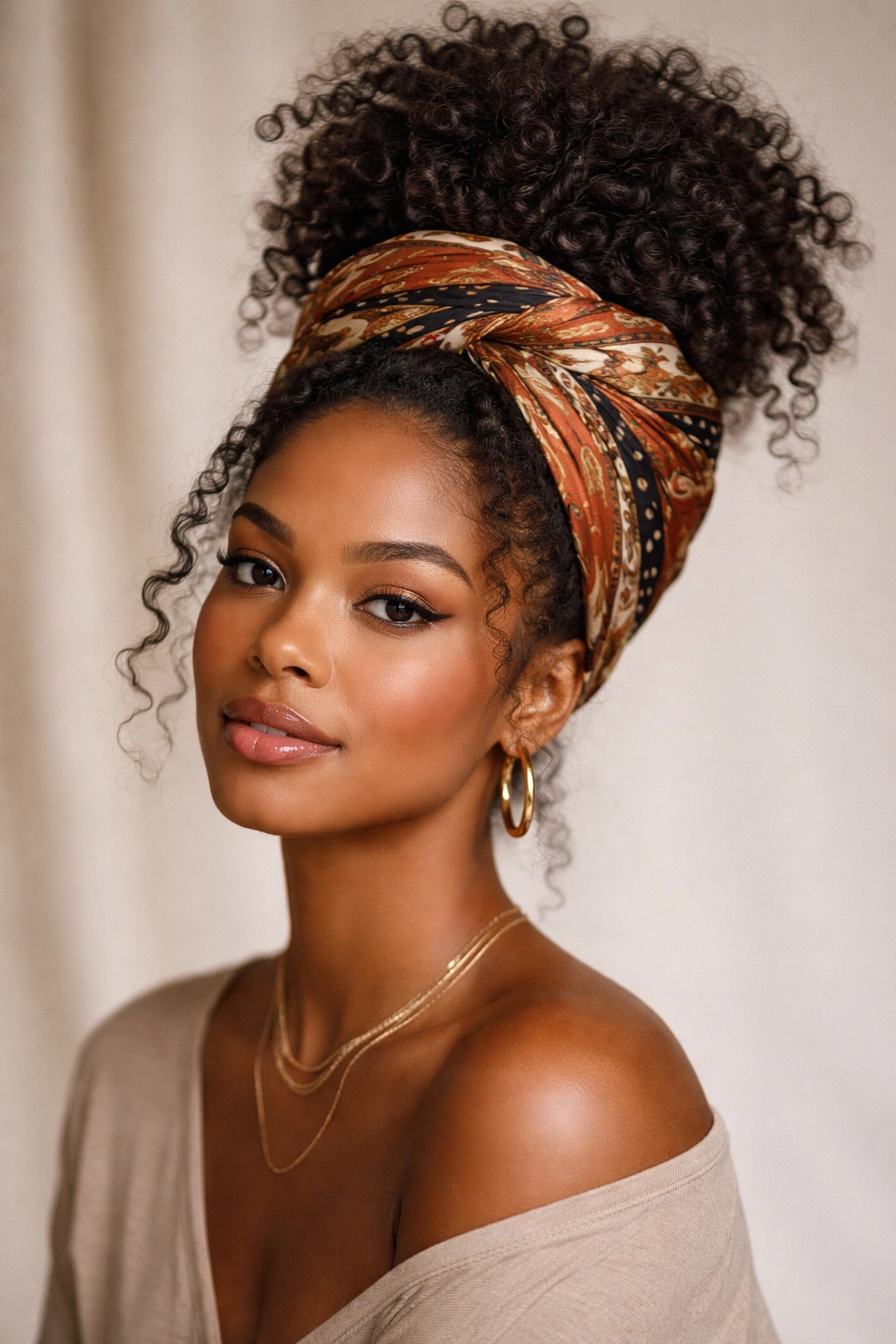
This style elevates a regular bandana into something that reads more formal and polished. Instead of wrapping the bandana flat against your head, you’re gathering your hair up into a loose topknot first, then wrapping the bandana around the base and over the top of the knot in a way that looks deliberately styled. It’s perfect for days when you want your hair up and off your shoulders but still want to protect your curls and keep them moisturized.
Why This Works for Textured Hair
A turban-styled wrap protects the vulnerable crown area of your curls while your hair is piled loosely on top of your head. Unlike tight buns or ponytails that stress the root and shaft, this style keeps tension completely off your hair structure. Your curls sit in their most natural position — relaxed and unstressed — while the bandana handles all the styling work. When you unwrap it the next day, your curls are bouncy, defined, and actually more moisturized than they’d be without any protection.
Steps to Create This Look
- Flip your head upside down and gather your hair loosely at the crown, securing it with a soft hair tie or clip
- Flip back up and smooth any flyaways around your face with your fingers or a small amount of styling cream
- Take a large square bandana and fold it into a triangle, then wrap it around the base of your topknot, tying it under the knot at the nape
- Bring the remaining fabric up and over the top of the knot, securing it with another tie or tucking the ends into the base wrap
- Adjust so the bandana sits smoothly and the wrapped knot looks intentional, not accidentally messy
Worth knowing: This style works especially well on wash-and-go days when your curls are already defined and you just need to protect them. You can also sleep in this style, and your curls will actually be more defined when you take it down because your hair dried in a gathered position that encouraged curl pattern definition.
3. The Side-Swept Bandana Tie
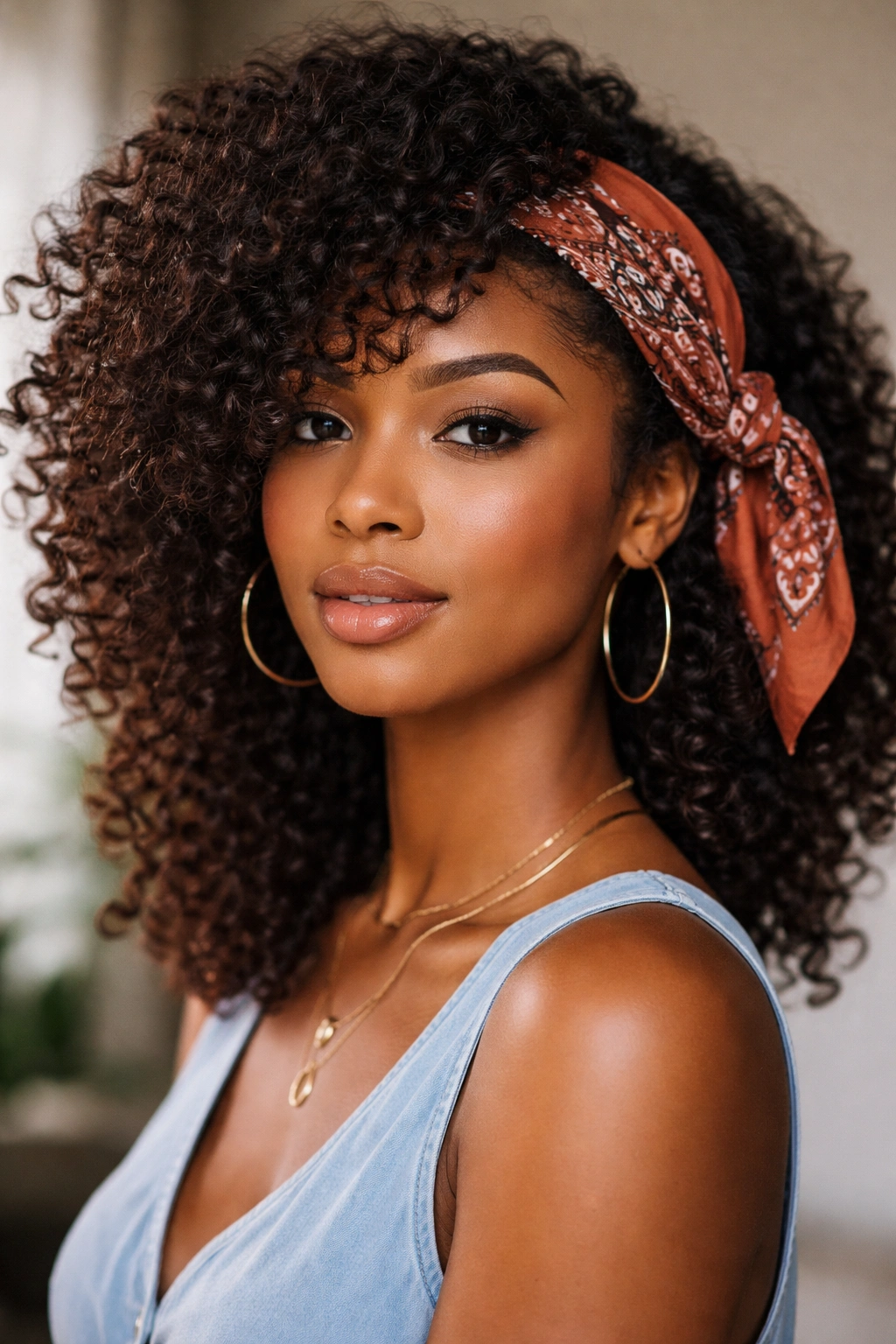
This style is for days when you want your curls completely down and visible but you’re managing flyaways, shorter pieces around your face, or just want a polished edge. You’re not wrapping your entire head — you’re tying a bandana loosely at one side, creating a swept, asymmetrical look that instantly makes a casual afro feel intentional and styled. It’s the easiest style on this list and genuinely takes ninety seconds.
What Makes This Look So Effortless
The side-swept tie works because it controls the front portions of your hair — the pieces most likely to look chaotic on a quick day — while leaving the rest of your curl pattern completely visible and free. You’re not flattening, compressing, or rearranging your curls; you’re simply anchoring the specific pieces that need it. This means your curls maintain their definition and bounce while your overall appearance looks polished and put-together. It’s the styling equivalent of a really good pair of sunglasses — minimal effort, maximum impact.
How to Tie It
- Fold your bandana into a long rectangle by bringing two opposite sides together, then folding it in half lengthwise
- Gather a section of hair loosely from one side of your head, starting near your temple and sweeping it back toward the opposite ear
- Wrap the bandana loosely around this section, tying it at the back of your head or tucking it into the wrapped section so the knot is hidden
- Let the rest of your curls fall freely, and adjust the bandana so it sits at the perfect casual angle — not too tight, just anchoring enough to define the look
- You can flip the tie to the other side the next day for a completely different vibe
Quick fact: This style is especially useful if you’re dealing with two-texture hair — looser curls on one side and tighter coils on the other. The side-swept tie naturally emphasizes whichever side you choose and balances the overall appearance of your curl pattern.
4. The Halo Bandana Crown
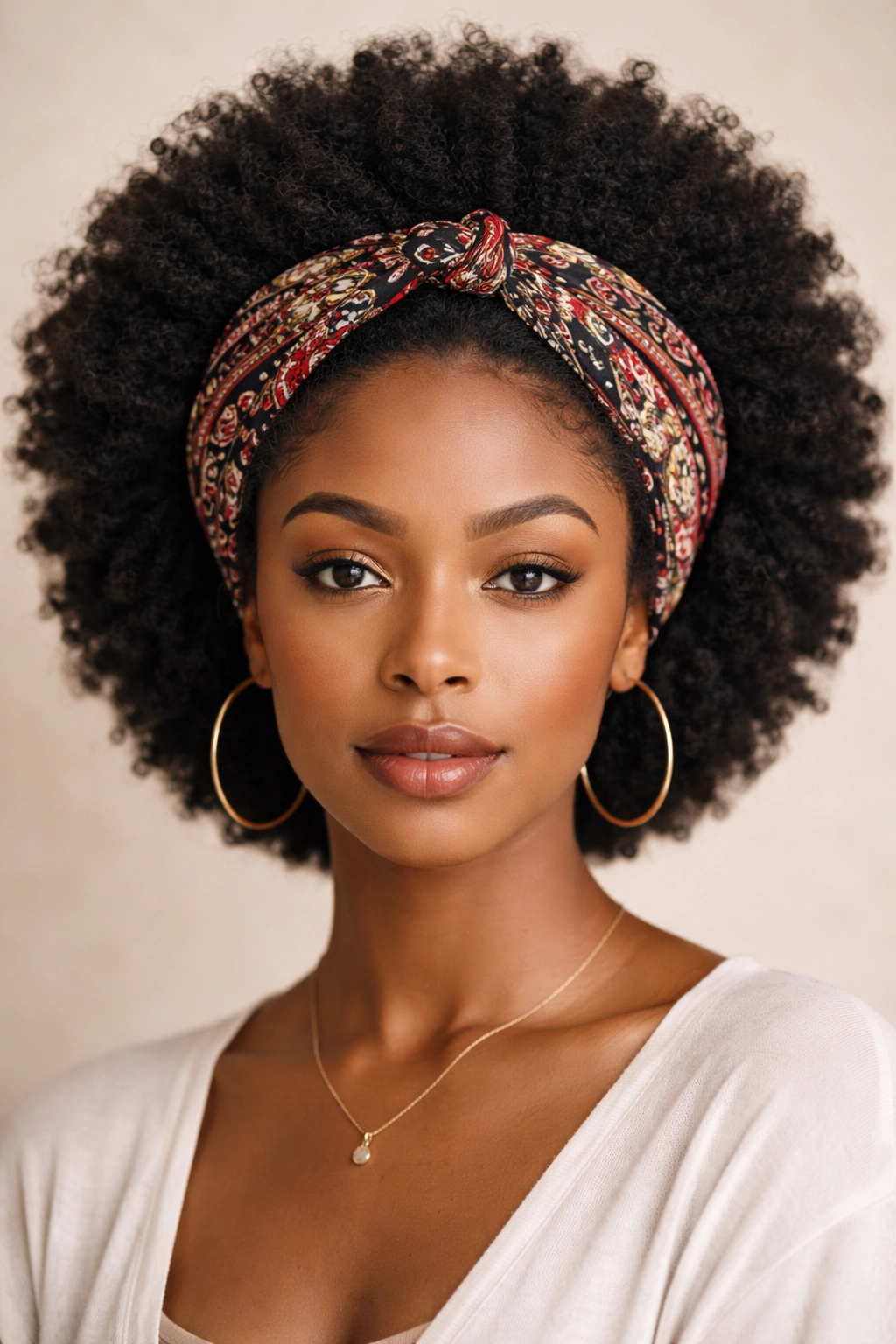
This is the most formal and polished bandana style, perfect for events, professional settings, or days when you want your afro to look intentionally styled rather than casual. Instead of wrapping the bandana around your head the traditional way, you’re creating a deliberate crown effect by positioning the bandana so it frames your face and sits like a headpiece. Your full natural hair is visible and on display, but the bandana adds structure and elegance.
Why This Creates Such a Striking Look
A halo crown works because it respects your natural texture while adding clear intentionality to your style. You’re not hiding your curls or compressing them — you’re framing them. The bandana becomes a deliberate accessory rather than a functional necessity, which changes how the entire look reads. Paired with the right color or pattern, a halo crown makes your afro look like a carefully curated presentation rather than a quick styling solution, even though it takes about three minutes to create.
Creating the Halo Effect
- Choose a bandana with a pattern or color that complements your skin tone and intention for the day
- Fold it into a long rectangle and position it at your hairline, centered over your forehead
- Bring both ends around to the back of your head, positioning them so they sit at the crown area rather than at the nape
- Tie them loosely at the back, tucking the ends under the wrapped section so the knot isn’t visible
- Arrange any front sections of hair so they frame your face, and adjust the bandana so it sits smoothly without slipping
- The result should look like a deliberate crown or headpiece that complements your curls, not a functional wrap
Pro tip: Use a stiffer bandana fabric (100% cotton prints or a cotton-linen blend) for the halo crown rather than soft, drapey materials. The structure helps the bandana maintain its position as a crown accent throughout the day without slipping toward your ears or the nape of your neck.
5. The Two-Toned Front Wrap
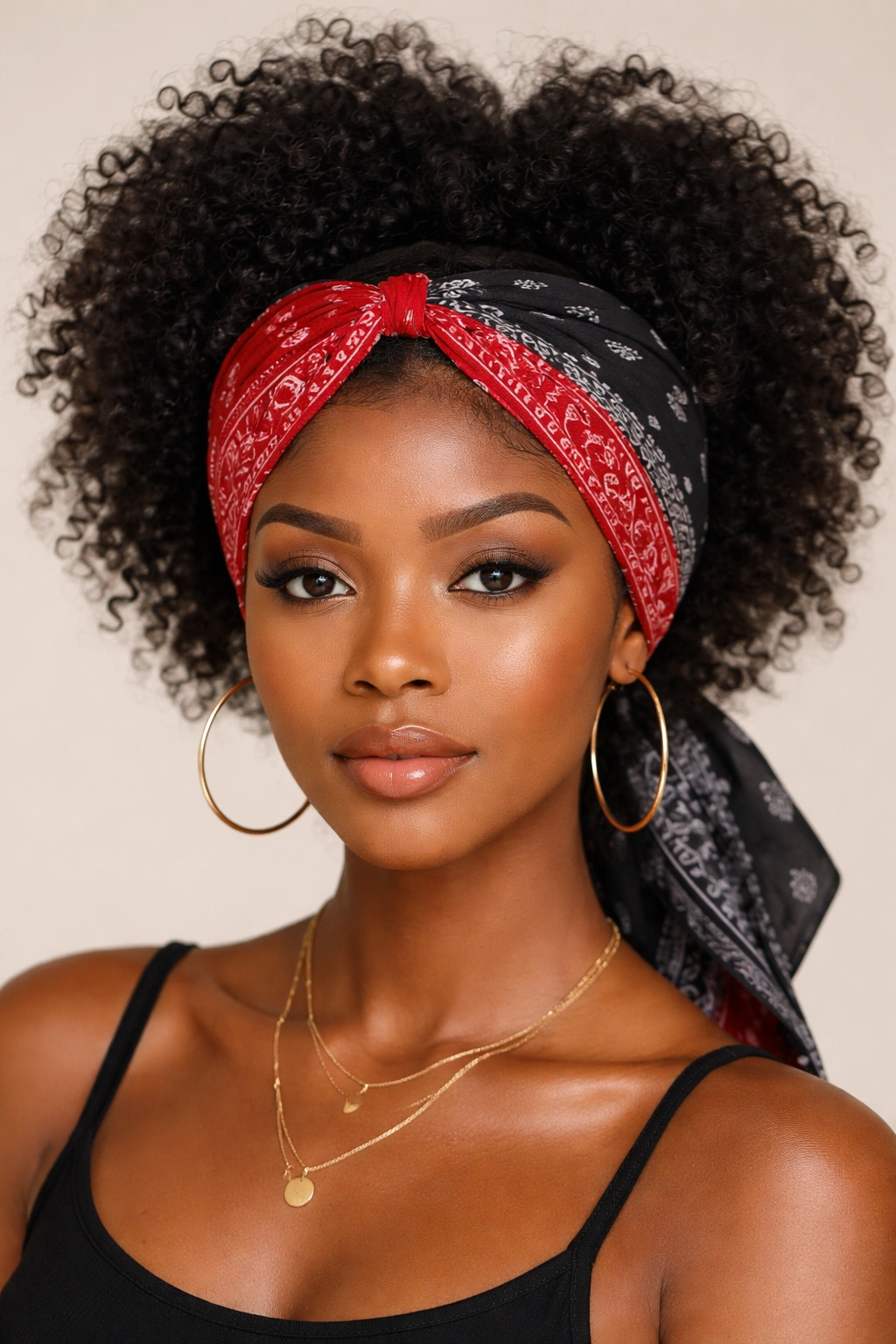
This style combines protection with visible styling by wrapping one bandana around the back and sides of your head while tying a second, coordinating bandana at the front hairline. The two-bandana approach gives you maximum security and protection while creating a visually interesting, intentional look. It’s more labor-intensive than single-bandana styles, but the result is so polished it’s worth the extra thirty seconds.
How This Protects and Flatters Your Edges
Your edges and hairline are the most delicate parts of your natural hair, and they’re usually the first area to show damage from tension, friction, or drying out. By wrapping two bandanas strategically, you’re protecting your edges with direct fabric contact while also creating a styled frame for your face. The front bandana sits at your hairline specifically to protect these vulnerable sections, while the back wrap holds everything in place and protects your crown curls. It’s functional and gorgeous simultaneously.
Step-by-Step for the Two-Tone Wrap
- Fold your first bandana into a triangle and wrap it around the back and sides of your head (using the same technique as the classic wrap), securing it at the nape or tucking the ends
- Fold your second bandana (in a coordinating color or pattern) into a long rectangle
- Position this second bandana at your hairline, centering it over your forehead, and bring the ends around to tie at the back of your head over the first bandana
- Make sure both bandanas sit smoothly without bunching or shifting, and adjust the positioning of your front hairline so it looks intentional
- The two bandanas create a framing effect that looks completely styled, not like you’re protecting your hair
Insider note: Color coordination matters more with two-bandana styles than single wraps. Choose bandanas that either match exactly or create a deliberate contrast — mismatched colors that don’t intentionally complement each other can look accidental rather than styled.
6. The High Side-Wrap Ponytail
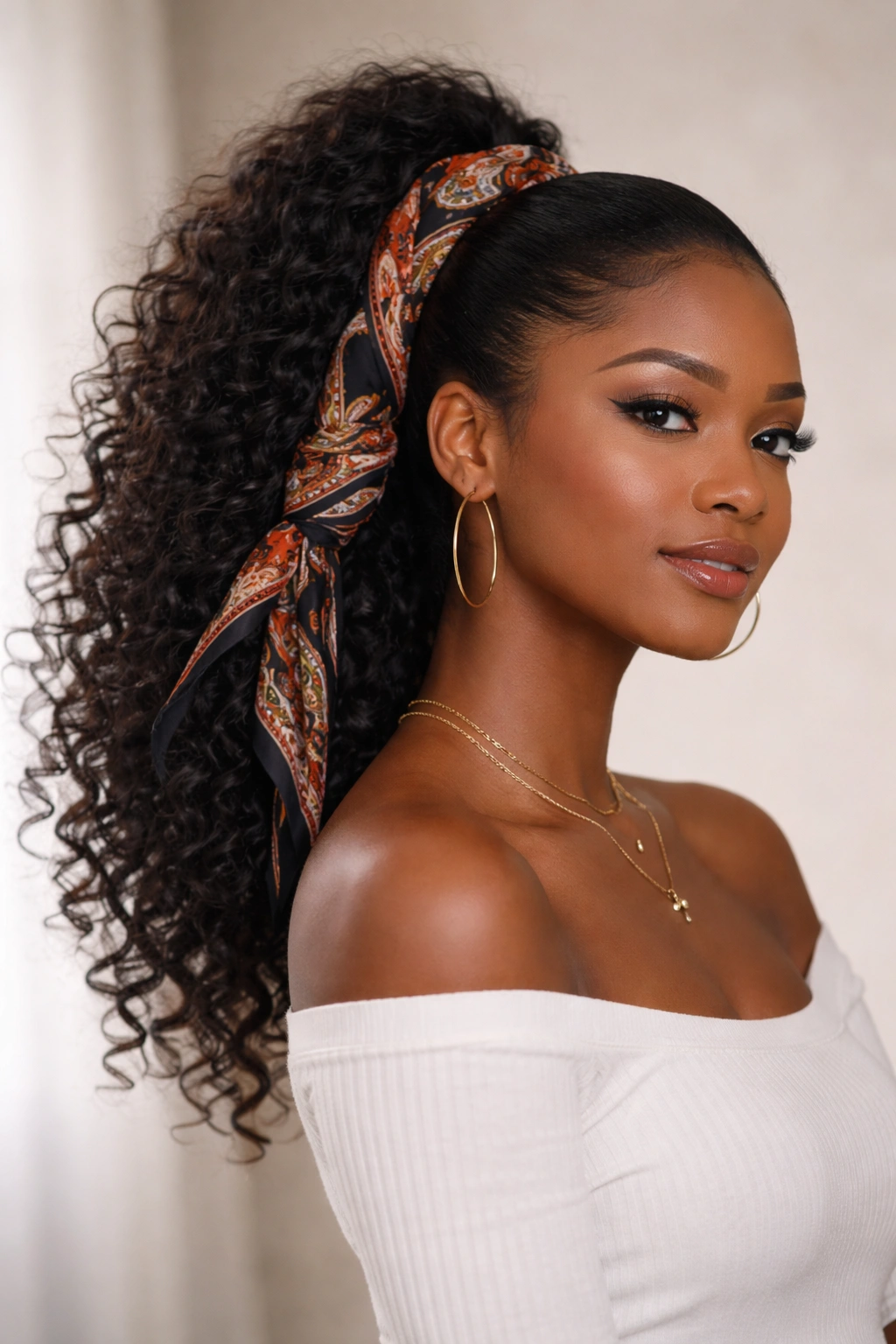
This is the perfect hybrid style for days when you want your curls visibly on display but also want your hair completely secured and off your shoulders. You’re creating a high ponytail (not tight, just gathered) and then wrapping a bandana around the base and through the ponytail itself, creating a styled accessory that’s also functionally holding everything in place. It’s energetic and fun without being overly casual.
What Makes This Style So Versatile
The high side-wrap works with almost any curl density and pattern because you’re gathering hair loosely, not requiring your curls to hold tension in a traditional ponytail knot. The bandana does all the structural work, which means you can use this style on days when your curls feel fragile or less defined. It also works on both freshly washed days (when your curls are puffy and beautiful) and second-day hair (when you’re maintaining a style). The versatility combined with the speed makes this a genuinely valuable rotation style.
How to Create the Look
- Gather your hair loosely into a high ponytail, positioning it slightly off-center toward one side if you want the asymmetrical effect
- Don’t worry about making the ponytail perfectly smooth — loose and slightly textured actually looks more intentional
- Secure the ponytail with a soft hair tie, then take a folded bandana and wrap it around the base of the ponytail, covering the hair tie completely
- Tie the bandana at the base, or continue wrapping it through the ponytail and tying it at the end for extra security
- Arrange your curls so they fan out from the ponytail, and make sure the bandana sits smoothly without twisting
Worth knowing: This style is perfect for active days — running errands, exercise, or any time you need your hair completely secured but still want to feel like you’re wearing a styled look rather than a utilitarian updo.
7. The Bandana Scarf Tail
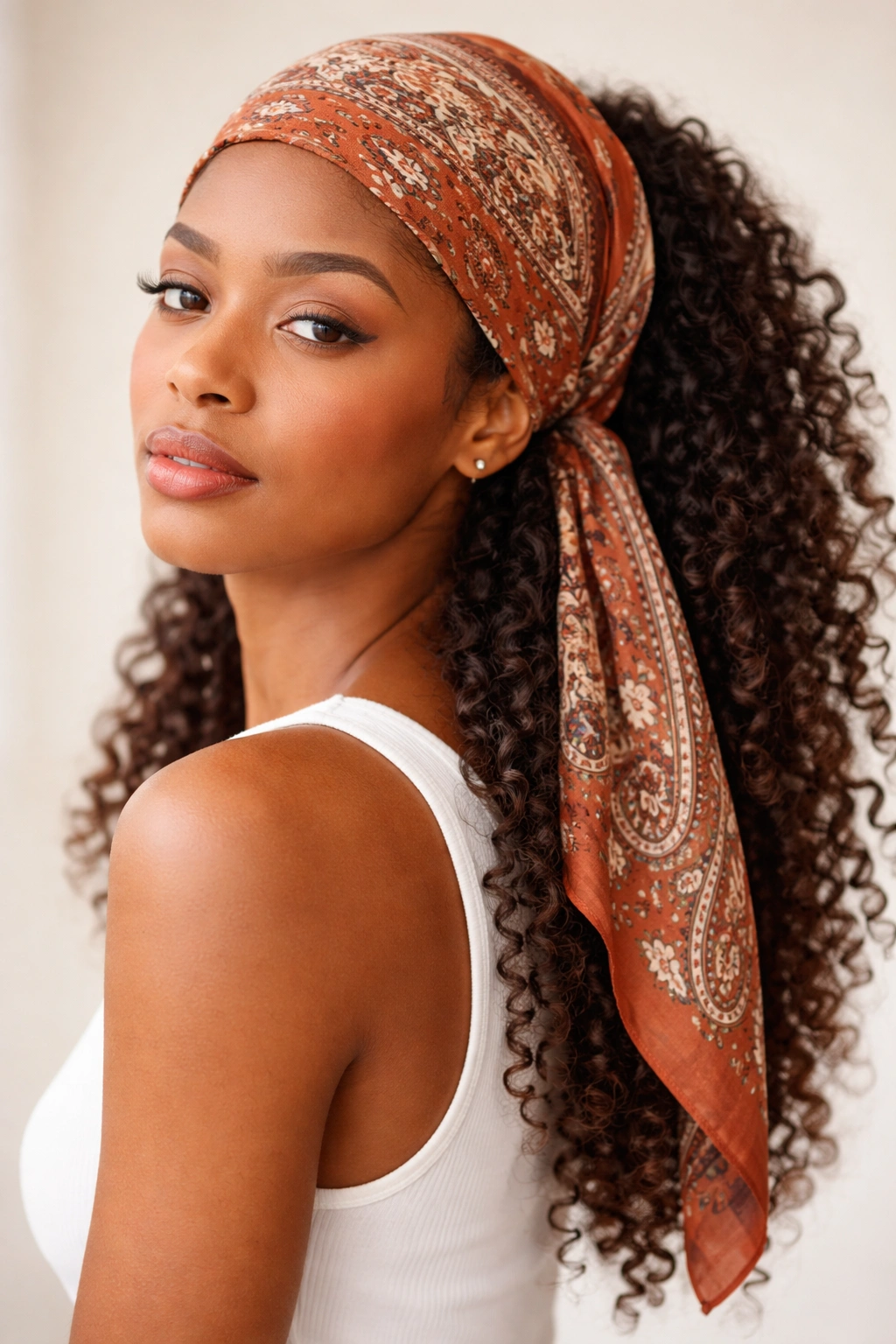
This style splits the difference between wrapped and loose by using a bandana as a scarf accessory that you drape over half your head and let flow down your back. Your curls remain fully visible and loose, but you’ve anchored the back section with the bandana tail, creating a look that’s bohemian, relaxed, and surprisingly polished. It’s ideal for days when you want your afro to take center stage but you need a light styling element to pull the whole look together.
Why This Works for Casual-Polished Days
The bandana scarf tail approach respects your natural curl pattern completely while adding a styling element that prevents the overall look from reading as “just rolled out of bed.” You’re not compressing curls, creating tension, or requiring any restyling products — you’re simply draping fabric in a way that adds intentional visual interest. It works equally well over a fresh wash-and-go and over second-day hair, which is genuinely rare in bandana styling.
Creating the Scarf Tail Effect
- Fold your bandana into a long rectangle by bringing two opposite sides together and folding lengthwise again
- Position it at the crown of your head, centering it slightly toward the back, and secure it with a small clip or by tucking it into your curls
- Let the rest of the bandana drape down your back, positioning it so it falls slightly to one side and creates an asymmetrical flow
- Arrange your front and side curls so they frame your face and the bandana tail is visible but not dominant
- The overall effect should look like you’ve casually draped a scarf, not that you’ve carefully constructed an elaborate style
Pro tip: Lightweight bandana fabrics work best for the scarf tail because they drape naturally without adding bulk at your crown. A silk or satin bandana will flow beautifully; a heavy cotton or linen version will sit too stiffly and look less effortless.
8. The Double Knot Bandana Updo
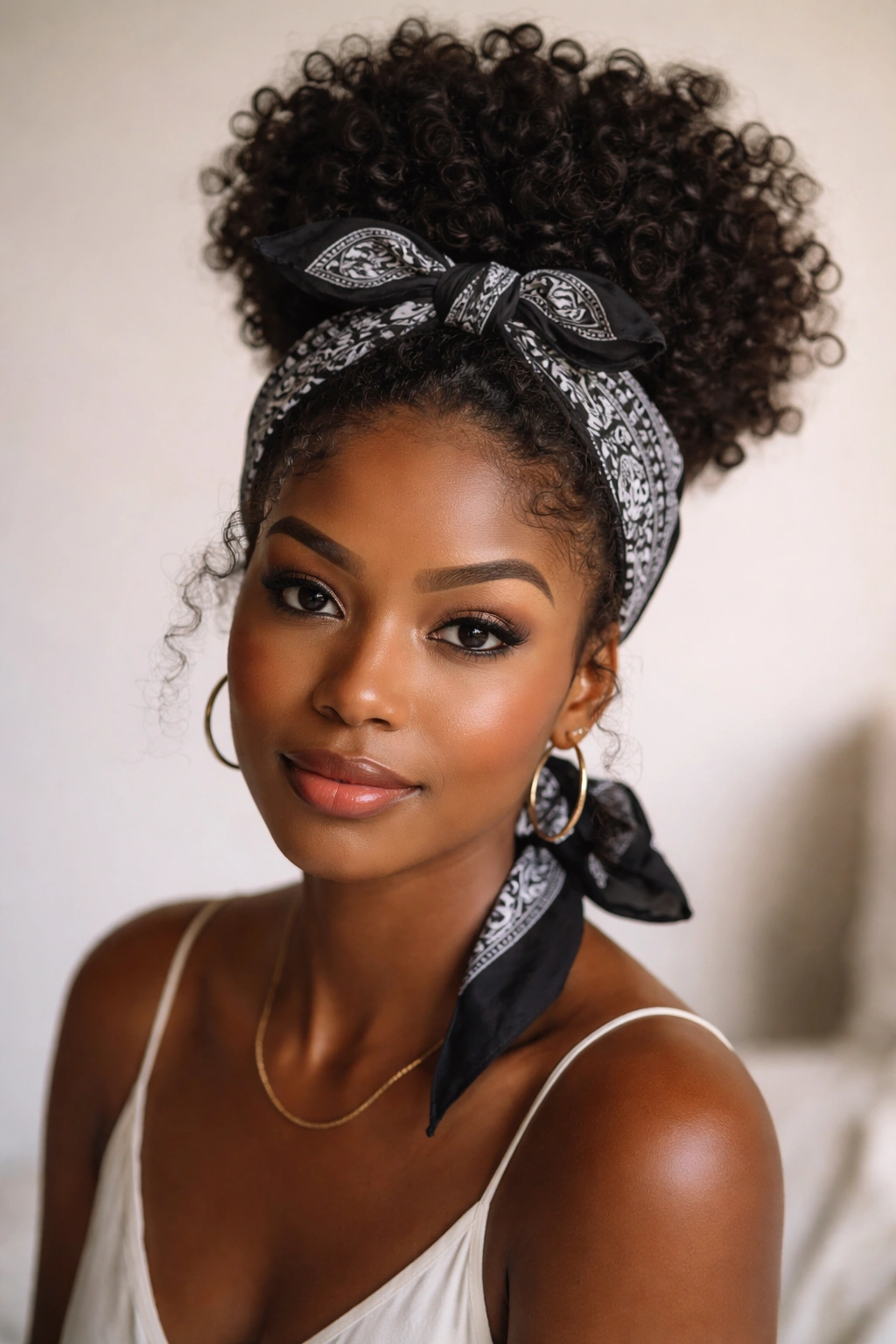
This is the most structured and secure bandana style, perfect for days when you need your hair completely out of your way but still want a finished, polished look. You’re using two separate knots — one at the crown and one at the base — to secure both your hair and the bandana itself, creating an updo that’s genuinely stable even with very full, dense curls. It’s the style to choose on humid days, active days, or any time you need zero hair movement.
Why Double-Knot Structure Matters for Textured Hair
A single knot sometimes struggles to keep very dense, full curls secured, especially if your hair is still somewhat damp or if you’re dealing with humidity. By creating two separate anchor points — one at the crown and one at the base — you’re distributing the hold across multiple sections of your hair structure, which means nothing is bearing all the tension alone. The style actually becomes more protective because no single section is compressed or stressed. This double-anchor approach is specifically valuable for thick, coily textures.
Steps for the Double-Knot Updo
- Gather your hair loosely at the crown, securing it with a soft clip or tie to hold it temporarily in place
- Take a large bandana and fold it into a triangle, positioning it at the base of your gathered hair at the nape of your neck
- Bring the ends of the bandana up and around the outside of your gathered curls, tying them at the crown (first knot)
- Now take a second bandana (same color or a coordinating pattern) and fold it into a triangle, positioning it at the crown
- Wrap this second bandana down and around the first bandana and your curls, tying it at the base (second knot)
- The result is an updo completely secured by two bandana ties with your curls flowing between them
Quick fact: This style can actually be worn down the next day by simply removing one bandana and retying the other in a different position, which gives you two completely different looks from one night of protective styling.
Final Thoughts
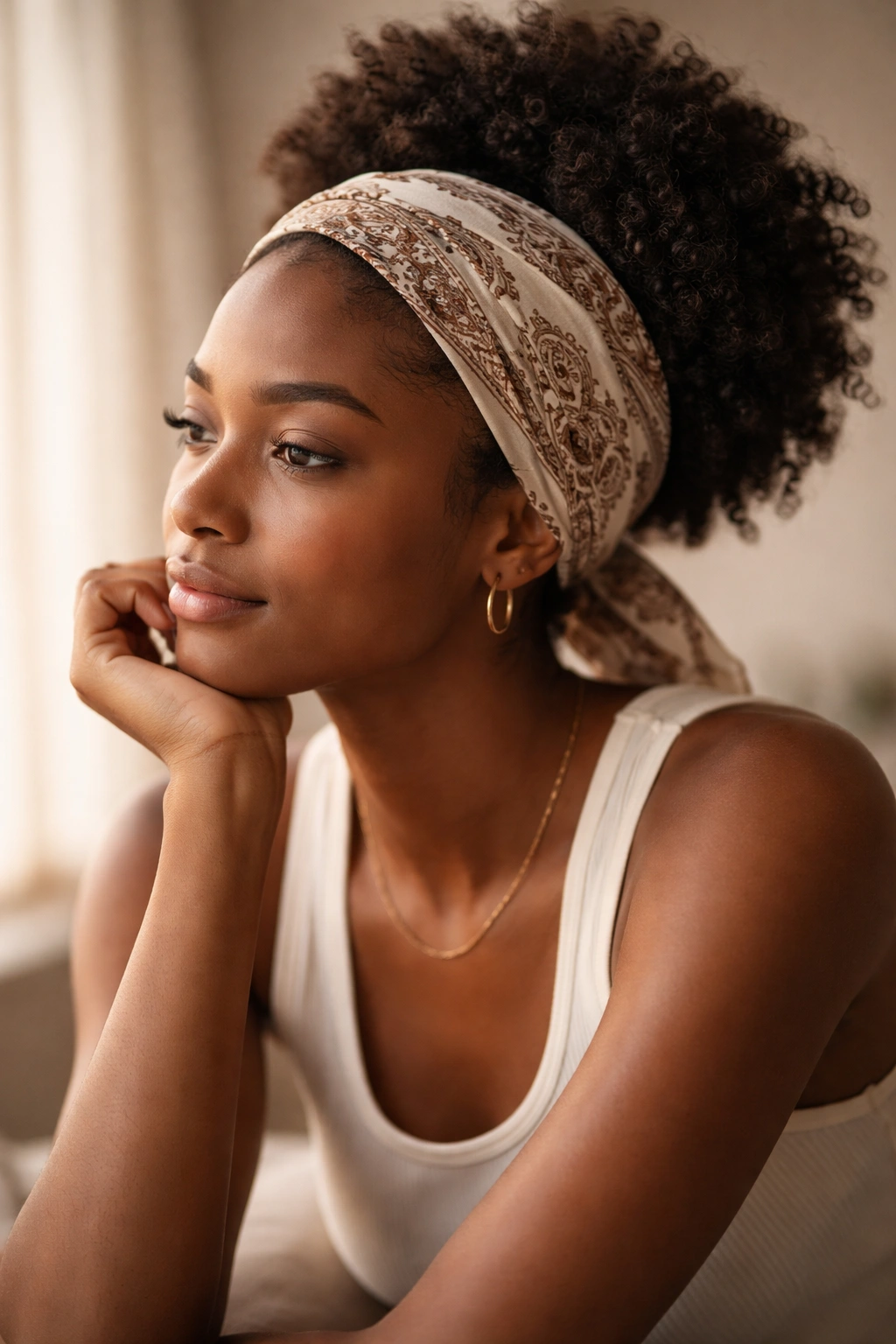
The right bandana style transforms quick hair days from feeling like you’re making the best of a bad situation into actually enjoying a protective, intentional, gorgeous look. The difference between “I had to throw a bandana on” and “I’m wearing a bandana style I love” is just knowing which wrap, tie, or drape works with your specific curl pattern and your lifestyle that day.
Start with whichever style in this list speaks to you first — maybe it’s the simplicity of the side-swept tie, or maybe it’s the polish of the halo crown. Master that one completely, then branch into the others. You’ll quickly find that you have a rotating repertoire of styles that covers every situation: working from home days, professional settings, active days, events, and lazy mornings. That’s the real power of bandana styling — it’s not just functional, it’s actually preferred once you develop a few go-to techniques that feel effortless to you.