



Space buns have evolved from a novelty Y2K trend into a legitimate style statement for textured hair. When done right on natural Afro hair, they’re not just playful — they’re bold, sculptural, and surprisingly versatile. The key to pulling off space buns with an Afro is understanding how volume, height, and texture placement work together to create impact. Unlike sleek straight hair where buns read as small and neat, Afro space buns command attention because your natural texture adds dimension, movement, and presence. Whether you’re going for editorial high fashion, everyday cool, or something completely experimental, space buns on Afro hair are a statement that says you’re confident enough to take up space.
What makes space bun styling so exciting for Afro hair is the endless possibility for variation. Your curl pattern, coil texture, and hair density become assets rather than obstacles. You can play with symmetry and asymmetry, stack buns at different heights, weave braids through them, or use geometric shapes to create something nobody else will think of. The beauty is that space buns work on all Afro hair types — whether you have tight coils, loose waves, or anything in between. They also work across protective styling philosophies, can be worn on stretched or unstretched hair, and honestly look fresher the second and third day after styling, when your texture has really settled in.
1. Classic High-Rise Space Buns
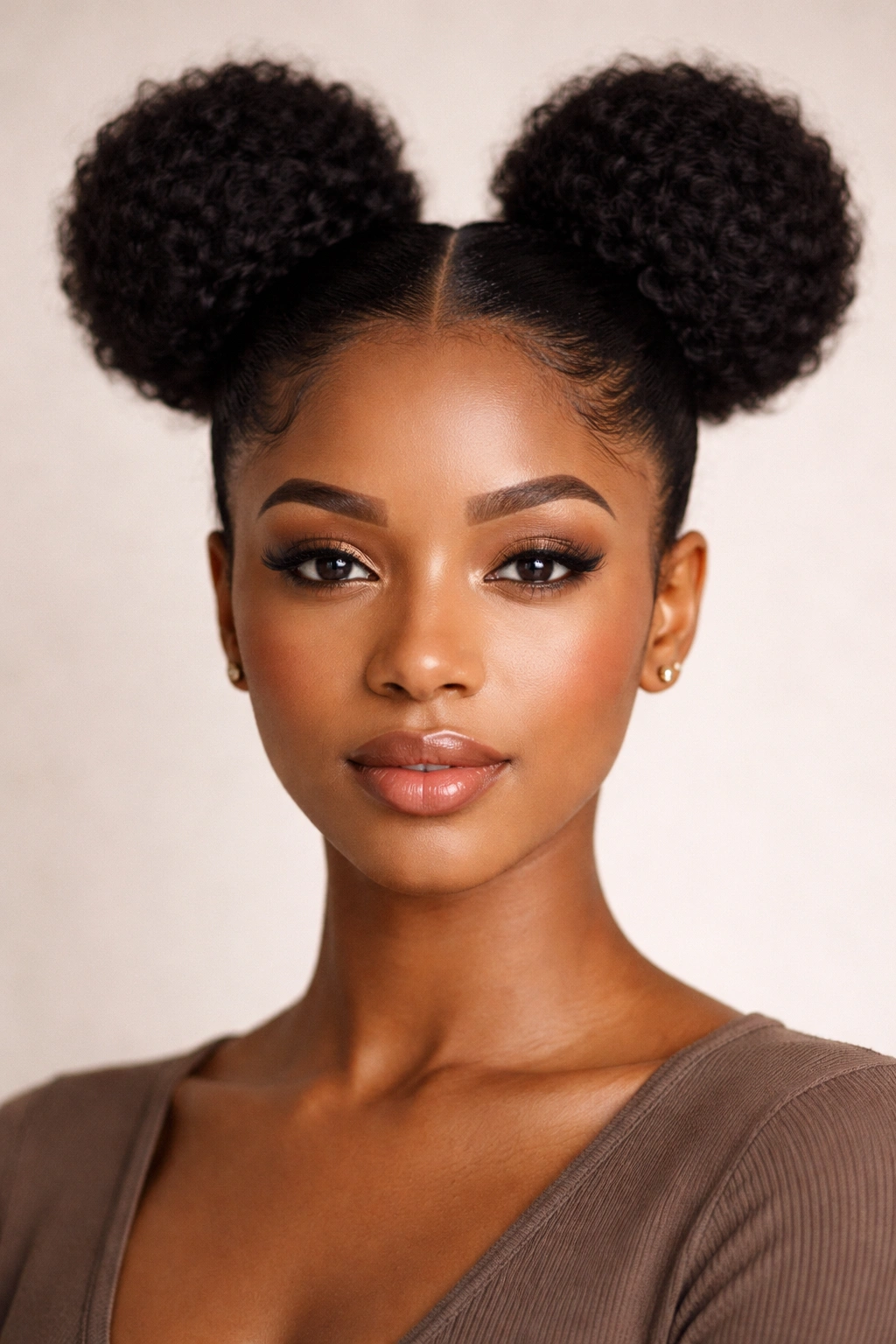
The classic high-rise space bun is the foundation style — think two perfectly positioned orbs sitting high on top of your head, commanding immediate attention. This version reads as editorial and intentional rather than childish when executed on Afro hair, because your natural texture gives the buns weight, sophistication, and sculptural presence. The placement is everything: these buns should sit at the crown, separated by a clean part down the middle of your head, positioned high enough that they’re the first thing people see when they look at you head-on.
How to Build the Architecture
Start with moisturized, detangled hair — whether stretched on braids the night before or styled with a blow dryer is your call. Create a precise middle part from your forehead straight back to your nape using a rat-tail comb. This part is your guide for symmetry. Divide the hair into two equal sections and secure each one into a high ponytail at the crown using a smooth elastic band. The ponytails should sit directly above your ears, near the very top of your head. Once the ponytails are secure, gently separate each section into two sub-sections, twist each sub-section, and wrap it around the base of the ponytail to form a tight bun. Use bobby pins to secure the twisted sections, and smooth the outer edges with gel and a toothbrush for definition. The finished buns should be full, round, and intentional — not sparse or limp.
Making Them Last Through the Day
High-rise buns stay fresh longest when your hair is slightly less freshly washed. Second-day hair, or hair that’s been moisturized and set overnight in braids, holds texture and grip better. Use a lightweight, flexible hold gel rather than a heavy pomade, which can make hair feel greasy and cause it to slip out of the bun structure. Mist the finished style with a light-hold hairspray to lock in the shape without flattening your curl pattern. If you notice slippage throughout the day, use bobby pins to create an X-pattern across the back of each bun, anchoring the twisted sections securely to the ponytail base.
A pro tip many stylists miss: tuck the ends of your twisted sections underneath the bun and pin them in place rather than wrapping them around the surface. This creates a cleaner silhouette and prevents loose strands from fraying out as the day goes on. The buns should look intentional and polished, not like they’re about to unravel.
2. Side-Swept Space Buns
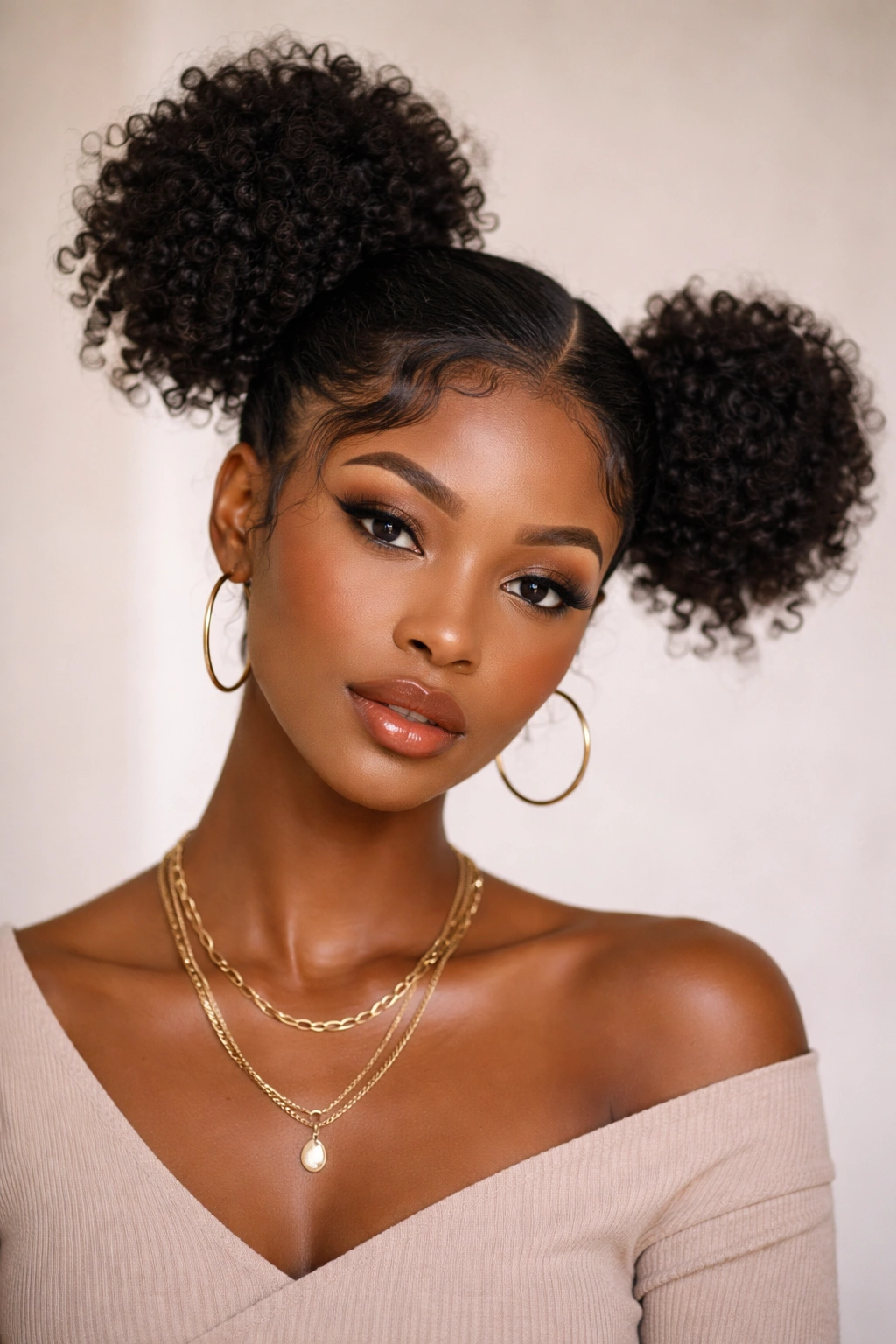
If perfect symmetry feels too buttoned-up, side-swept space buns give you asymmetrical boldness. One bun sits high on one side of your head while the other bun floats lower on the opposite side, creating a diagonal line that’s visually dynamic and modern. This style works beautifully on Afro hair because the natural volume and texture of each bun catches light from different angles, creating depth and movement. The asymmetry reads as intentional rather than accidental, especially when you balance the visual weight with careful placement.
Positioning and Balance
Start with a deep side part that skews at least two-thirds to one side. Section the smaller side (about one-third of your hair) and create a high ponytail near the very top of that side of your head. Section the larger side (about two-thirds of your hair) and create a lower ponytail positioned slightly toward the back and lower than the first one — aim for somewhere between mid-crown and mid-head height. The height differential is what creates the signature side-swept look. Twist each ponytail section into a bun and secure with pins. The visual trick is that this asymmetrical positioning actually balances better than it looks — your face shape and the way your head sits on your shoulders makes the diagonal feel right, not lopsided.
Styling Variations Within the Side-Sweep
You can manipulate how bold or subtle the asymmetry reads by adjusting the height difference and the bun sizes. For maximum drama, make the top bun extra full and voluminous while keeping the lower bun tighter and more compact. For a softer approach, keep both buns similarly sized but just play with the positioning. Some people add texture by loosening the twists slightly before pinning, letting the buns sit fluffier. Others smooth them down with gel for a sleeker, more architectural look. The side-swept bun also pairs beautifully with edge styling — lay down your baby hairs on the asymmetrical side with gel for an intentional polished finish that grounds the playfulness of the space buns themselves.
Worth knowing: This style photographs exceptionally well because the asymmetry creates visual interest from every angle. If you’re planning to take photos or attend an event, side-swept space buns are your move — they never look boring or static in pictures.
3. Triple Bun Formation
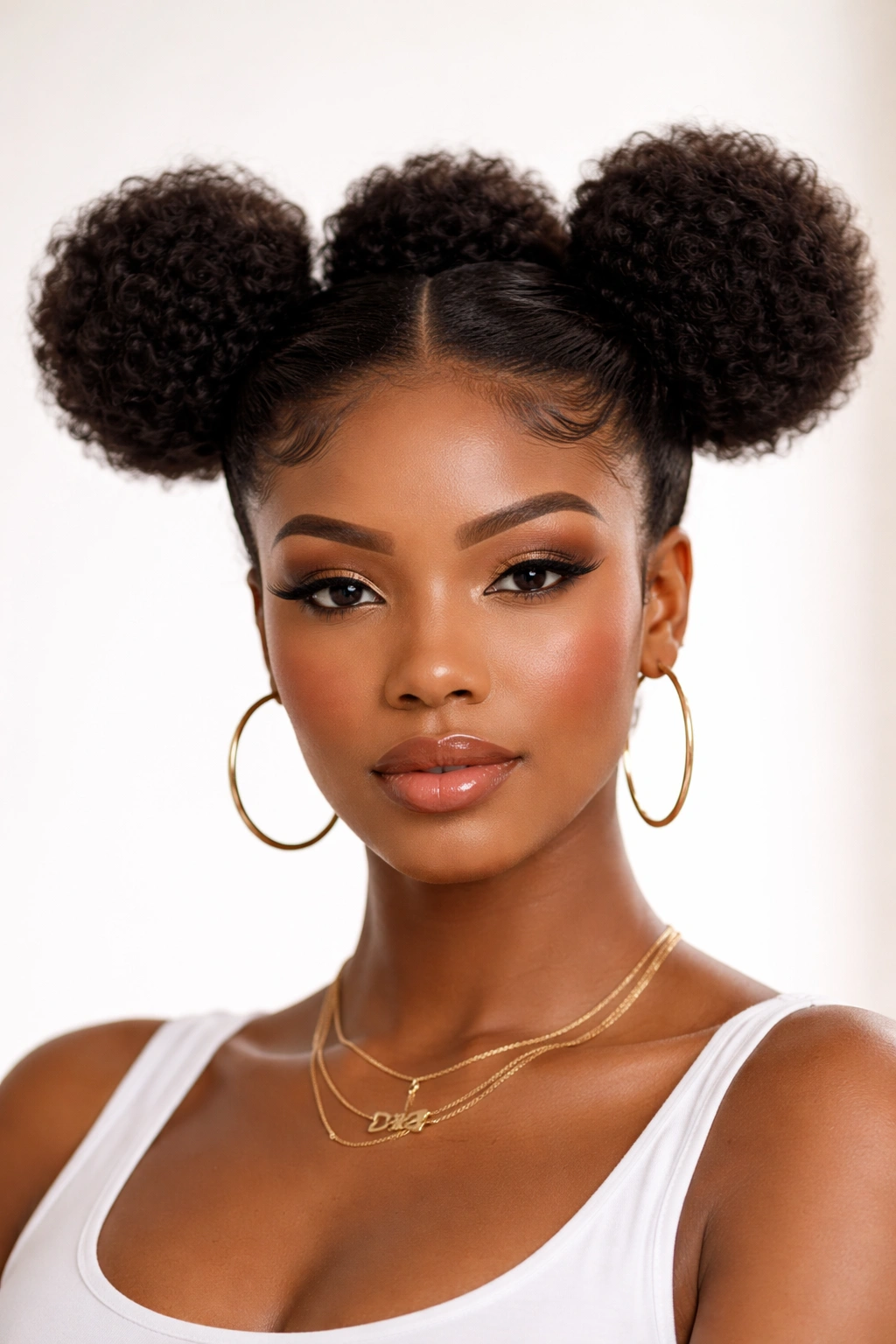
For the bold statement that says “I’m not thinking small,” a triple bun formation spreads three buns across your head instead of two. This can mean three buns in a horizontal line across your crown, three buns in a triangle formation, or three buns arranged however your vision dictates. On Afro hair, multiple buns create an almost architectural quality — the repeated rounded shapes play against your natural texture and create a silhouette that’s impossible to ignore. It’s the style for someone who wants space buns to be the clear focal point of their entire look.
The Three-in-a-Line Approach
Divide your hair into three sections of roughly equal size. Create a thin vertical section at the very center of your head from front hairline to nape — this becomes your middle bun. Divide the left side in half again to create your left-side bun, and the right side in half to create your right-side bun. Create three high ponytails using this division, twisting each into a bun and securing with bobby pins. The three buns should form an almost perfect horizontal line across the top of your head when viewed from behind. This arrangement is great because it distributes the visual weight evenly and feels balanced, even though there’s a lot going on stylistically.
The Triangle or Custom Arrangement
If a straight line feels too predictable, arrange your three buns in a triangle — two high buns in the back, one lower bun in the front at the center of your head, or vice versa. You could also create an asymmetrical triple arrangement with buns at different heights and slightly different positions. The point is that three buns give you real creative freedom. This style works best when you have thick, voluminous Afro hair that can support three separate sections without looking thin or strained. If your hair is finer, make sure your three buns are appropriately sized — smaller buns on less hair look intentional, while oversized buns on thin hair just look like you’re trying too hard.
Insider note: Triple buns photograph incredibly well for social media and look especially striking in profile or three-quarter view shots. The repetition of shapes creates a visual rhythm that’s inherently pleasing to the eye.
4. Stacked Layered Space Buns
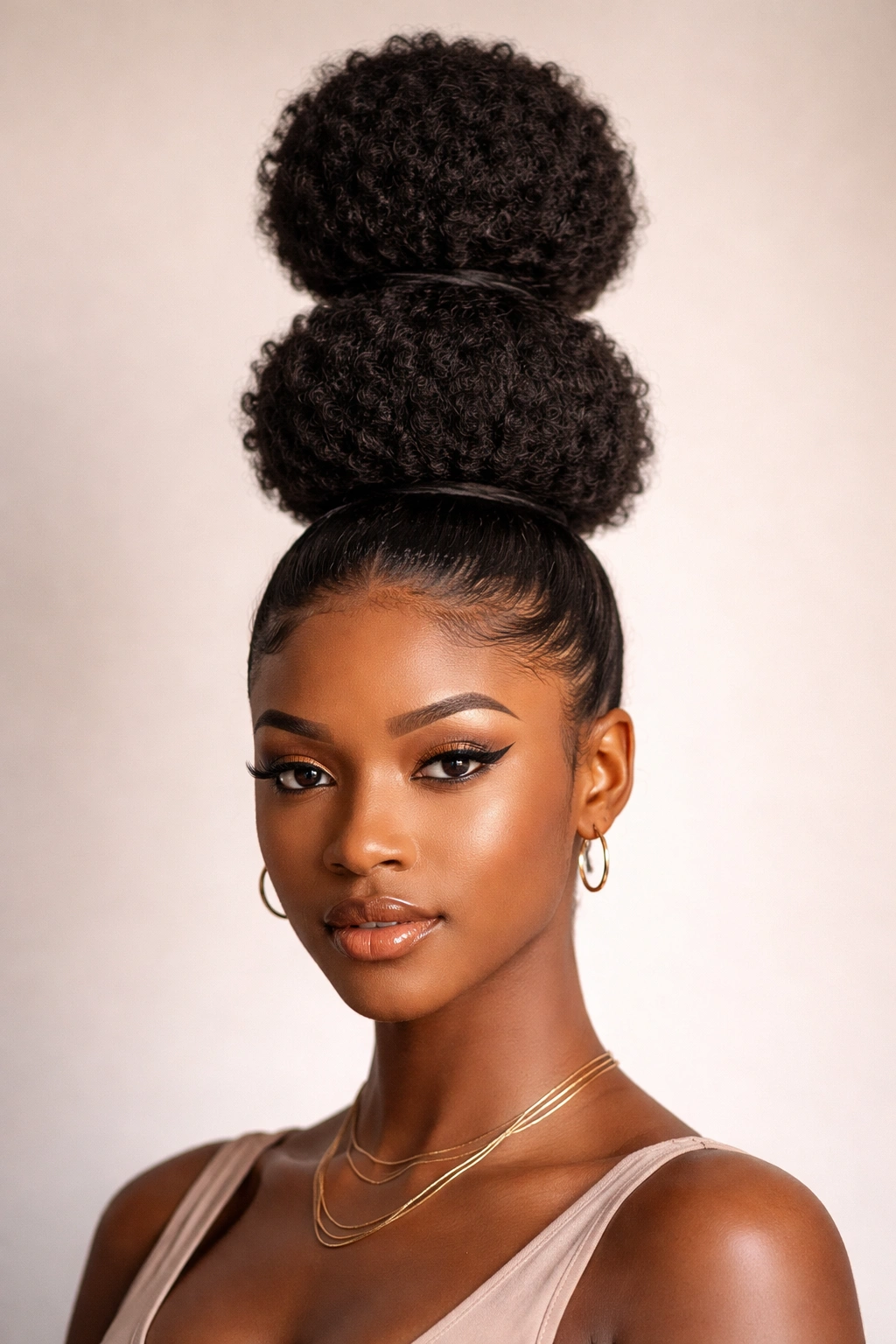
For maximum texture and dimension, stack your buns vertically instead of horizontally. This means creating a bun at the crown, then creating another bun directly below it (but using a different section of hair), then optionally a third bun below that. Stacked buns play with the height and depth of your silhouette in a completely different way than traditional space buns. They’re especially striking because the repeated bun shapes create an almost sculptural tower of texture, and on Afro hair, the natural curl and coil pattern adds visual complexity that makes this style look like serious artistry.
Creating Clean Separation Between Layers
The key to stacked buns is creating clean horizontal divisions in your hair so each layer reads distinctly. Start at the crown and create your first bun using the top section of your hair. Use a rat-tail comb and create a clean horizontal line where the crown bun ends. This line should be precise — use a fine-toothed comb and flatten the hair below it so it doesn’t blend with the upper section. Create a second ponytail using the hair immediately below the first horizontal line, and form it into a bun positioned directly beneath the first one. If you want a third layer, repeat this process. The visual separation between layers is what makes stacked buns work — if the sections blur together, the effect gets lost.
Sizing and Proportion
Stacked buns work best when each bun is roughly the same size, or when you intentionally graduate them (smallest at top, largest at bottom, or vice versa). If you have three buns and the middle one is suddenly huge while the top and bottom are small, the proportions feel off. Aim for visual harmony either through consistency or through intentional graduation. This style requires enough hair density to create three separate, visible bun sections without making your head feel oddly top-heavy. If you have medium to thick Afro hair, stacked buns are completely achievable and absolutely stunning.
Pro tip: Use a light pomade or flexible-hold gel between each bun layer and smooth the transitional section with a fine-tooth comb. This keeps the layers visually distinct while ensuring the buns themselves stay secure and don’t slip downward throughout the day.
5. Half-Up Space Buns
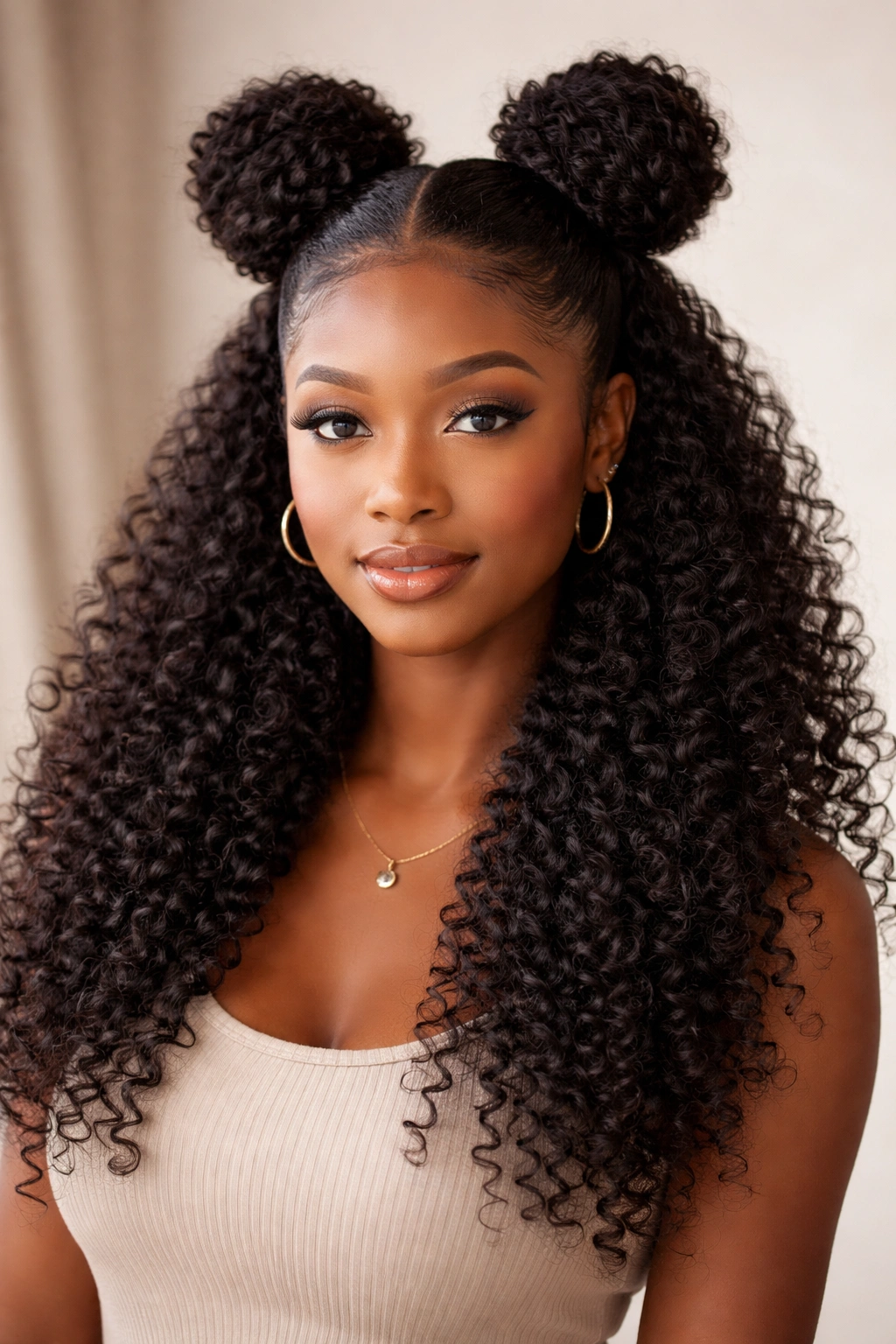
Sometimes bold doesn’t mean all-the-way — half-up space buns take the drama of space buns and blend them with the practicality of wearing your hair down. You create two space buns using only the top or upper-middle section of your hair, while the rest of your hair flows free below them. This style is perfect for days when you want the statement of space buns but also want the freedom and flow of having hair down. On Afro hair, half-up space buns are especially gorgeous because your coils and curls add movement and texture that contrasts beautifully with the structured buns themselves.
Execution and Proportion
Decide how much hair to incorporate into your buns — roughly 40-50% of your total hair is the sweet spot. Create a horizontal section from ear to ear across the back of your crown, leaving the bottom half of your hair free. Divide the top section into two equal parts with a middle part, create two ponytails, and twist each into a bun. The result is space buns sitting at the crown while your Afro flows freely below. The proportion matters: your buns should look full and intentional, not skimpy or overwhelmed by the larger mass of hair below them. Aim for buns that are roughly the circumference of a golf ball or slightly larger.
Balancing the Upper and Lower Sections
The key to making half-up space buns work is ensuring both the buns and the loose hair below look intentional and balanced. Your loose hair should ideally have the same level of styling attention as your buns — if the buns are sleek and the loose hair is undefined, the overall look feels disjointed. Consider moisturizing and defining your loose curls, or adding some subtle edge control around your hairline so the whole look feels cohesive. Some people add a small decorative element like a clip or a cuff to the lower section to echo the visual interest of the buns above.
This style also transitions beautifully from day to night. You can start your day with half-up space buns and then, if you want to shift the vibe, release the buns and let your whole Afro flow free — suddenly you have a completely different hairstyle without needing to restyle from scratch.
6. Geometric Sculptural Buns
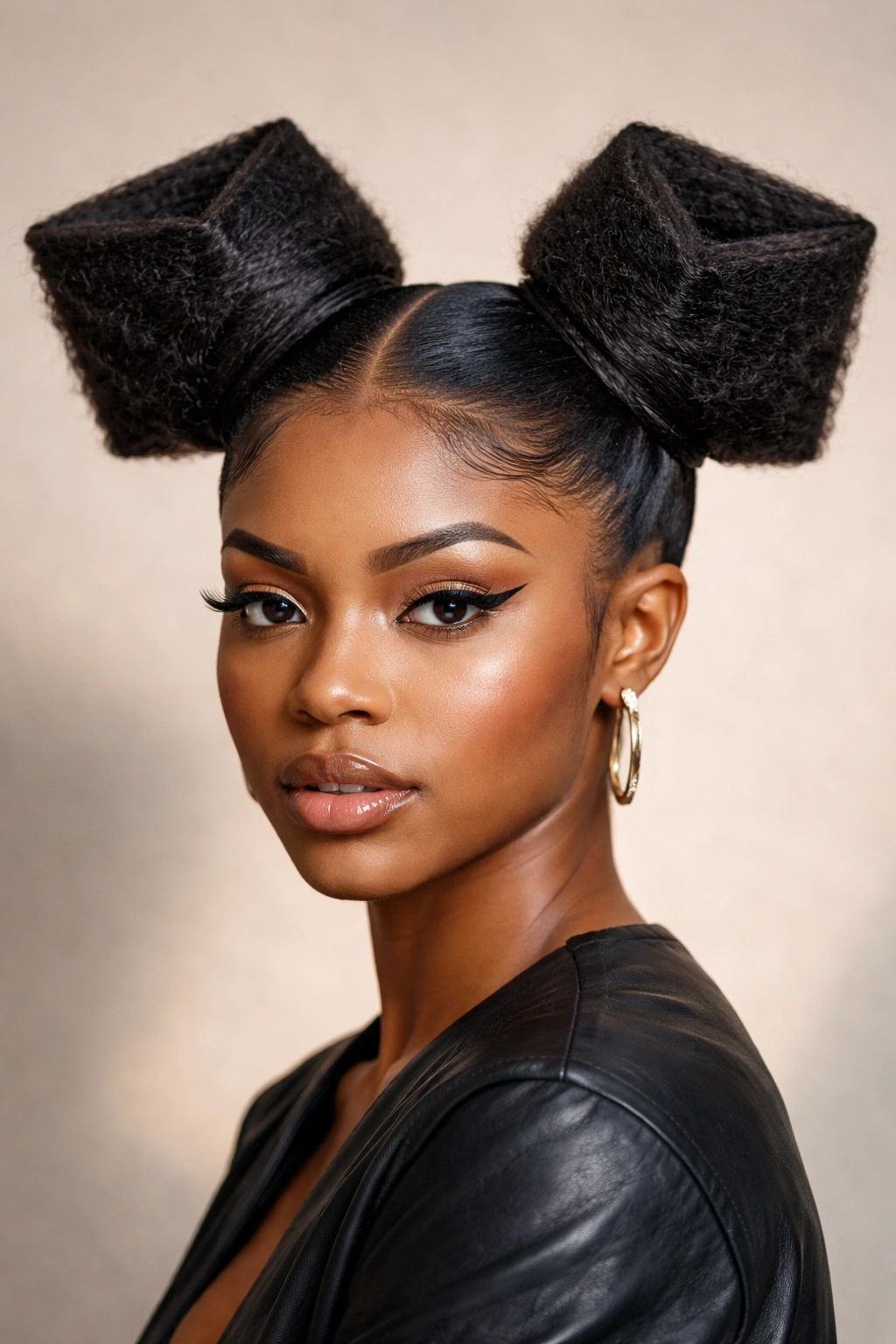
For the truly experimental, geometric sculptural buns push space buns into art territory. Instead of round, organic bun shapes, you create buns that echo geometric forms — squares, elongated rectangles, diamond shapes, or even angular spirals. This is where styling becomes sculpture, and on Afro hair, the texture itself adds dimension and visual interest to geometric forms. Geometric buns work best on hair that’s been stretched or smoothed (often on blow-dried Afro or on fresh braids-out hair), so the geometric shape reads cleanly without getting lost in curl pattern.
Creating Defined Angular Shapes
To create a geometric shape, you need to control how your hair sits within the bun structure. After forming a ponytail, instead of twisting and wrapping, try a different approach: divide the ponytail into sections and wrap those sections around the base in a way that creates angles or defined edges. You can also create rectangular buns by not twisting at all — instead, flatten the ponytail and fold it into a rectangular shape, pinning the edges to maintain that form. For a diamond shape, create a ponytail, flatten it, and fold it into a diamond configuration. The texture of your Afro actually helps these geometric shapes hold because your natural hair has grip and doesn’t slide as easily as straighter hair types.
Adding Visual Complexity
Make geometric buns even more striking by adding contrast through texture manipulation, accessories, or hair color. You could create geometric buns and then tease certain sections within the bun to add dimension, or you could add subtle highlights or bold hair chalk that shows in certain sections. Metallic cuffs or geometric hair rings placed at strategic points on the bun structure can emphasize the geometric theme. This is a style for someone who loves fashion-forward thinking and doesn’t mind putting in extra effort to achieve something unexpected.
Worth knowing: This style is bold, artistic, and absolutely not for every context — it’s perfect for events, special occasions, creative environments, or days when you want to make a statement and have fun with your presentation.
7. Braided Base Space Buns
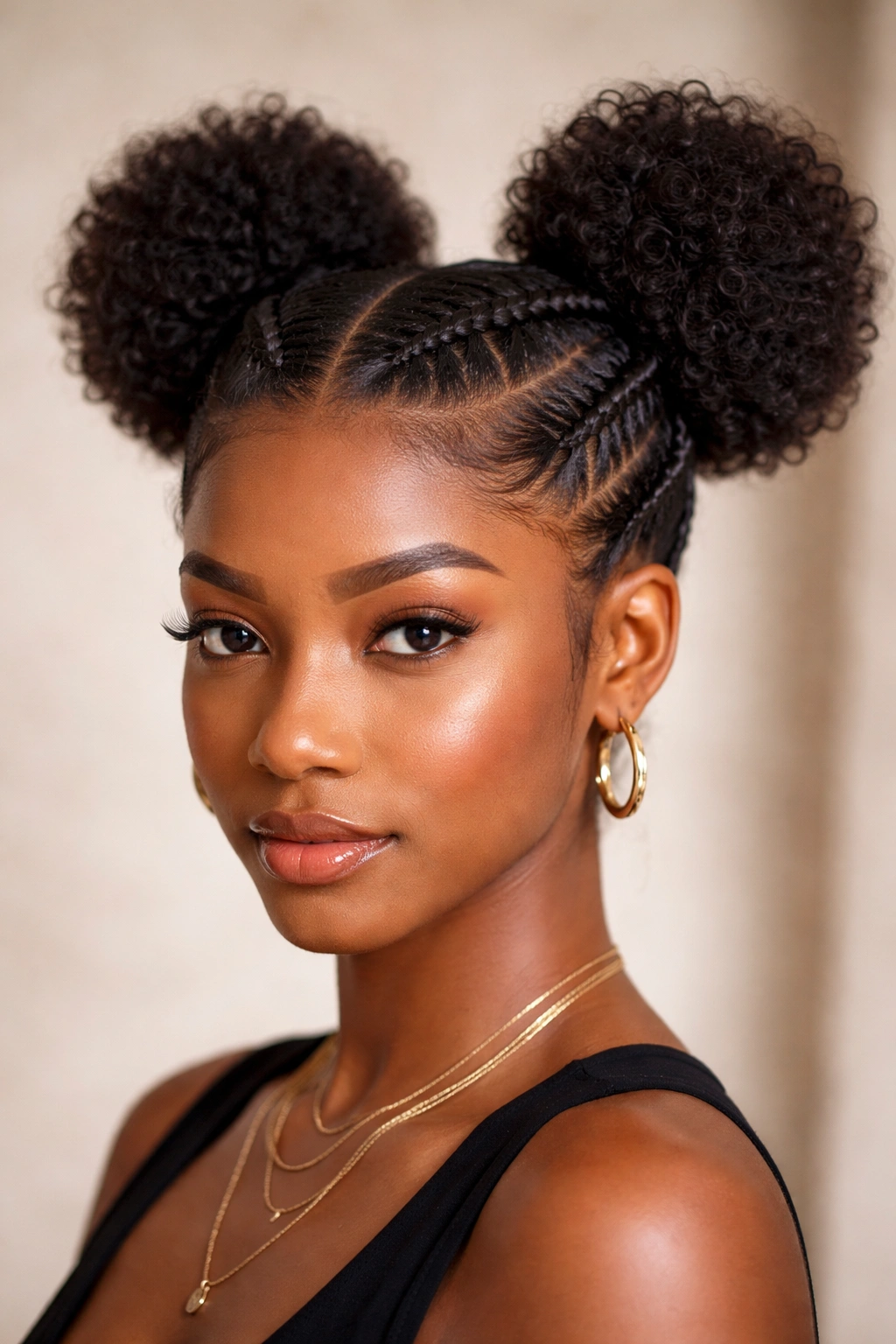
For a style that combines protective styling elements with space bun drama, braided base space buns start with cornrows or smaller braids that feed into space buns. The braids act as the foundation and anchor point, making the buns more secure while adding a layer of visual complexity. On Afro hair, braids as a base create definition, texture contrast, and a more intentional, editorial aesthetic. The combination of structured braids flowing into playful space buns is the sweet spot between wearable and creative.
Building the Braid-to-Bun Structure
Start by creating two cornrows or Dutch braids that run from your hairline or crown toward the back/sides of your head, following the path where your ponytails will sit. You can do two vertical braids down the center and sides, or angled braids, or even one braid that spirals around to one side. Once your braids are complete, gather the loose hair at the end of each braid and add any additional loose hair from that side to create a fuller ponytail. Twist that combined section into a bun and secure with bobby pins. The braids become part of the bun structure, adding texture and holding power. The result is a style that’s both intricate and bold — the braids show your styling skill while the space buns read as playful and intentional.
Variations and Complexity Options
You can add as much or as little braid detail as you want. Simple two-braid foundations are striking and don’t require advanced braiding skill. More complex versions might include multiple braids feeding into each bun, or geometric braid patterns across the crown before the buns begin. You could braid in a contrasting color (using hair extensions or temporary color) to add visual interest. You could also braid the bun sections themselves — after creating a ponytail, instead of twisting it into a bun, braid it and then coil the braid into a bun shape. The braid-to-bun style is genuinely customizable based on your skill level and how much time you want to invest.
The beauty of braided base space buns is that they actually hold better throughout the day and night than smooth space buns, because the braids provide internal structure. This makes them an excellent option for all-day wear or even sleeping in (though you’d want to protect them with a silk or satin bonnet).
Final Thoughts
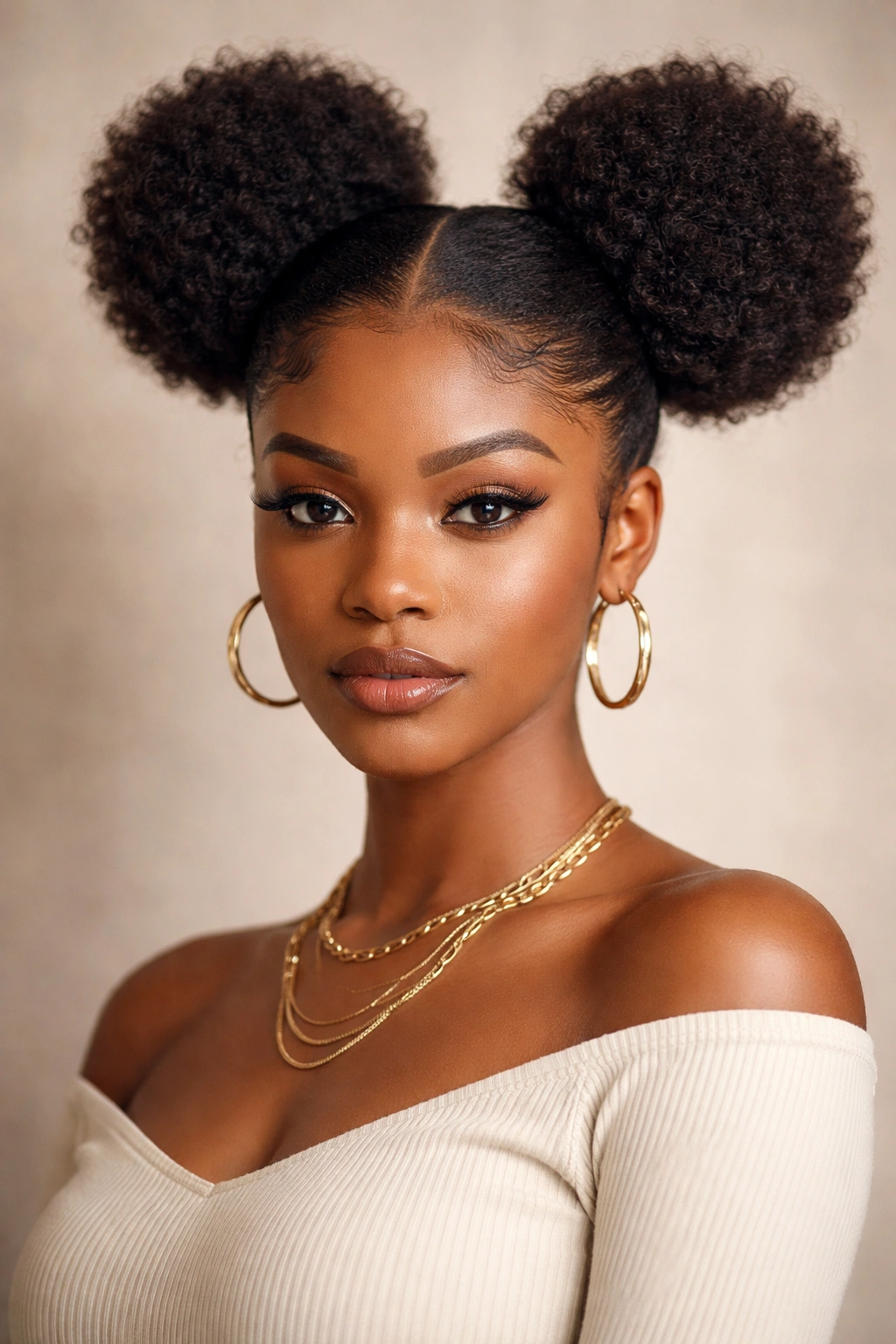
Space buns on Afro hair are a complete mood — they’re bold, they’re sculptural, and they’re undeniably you. The seven styles here are your starting points, but honestly, once you understand the fundamentals, you can create infinite variations. Mix symmetry with asymmetry. Play with heights and proportions. Add braids, accessories, textures, or color. The point of space buns on natural Afro hair is that they celebrate volume, they take up space unapologetically, and they announce that you’re comfortable standing out.
The key to making any space bun style work is understanding your hair’s density and texture, and choosing a placement and size that feels balanced on your unique head shape and hair volume. A style that looks perfect on someone else might need tweaking to read exactly right on you — and that’s not a failure, that’s customization. Start with the classic high-rise buns to master the basics, then branch out into asymmetrical, triple, stacked, or geometric versions as you get more confident. Each style teaches you something about proportion, balance, and how your hair responds to different handling.
The most important thing? Commit to whatever style you choose. Space buns demand confidence. Wear them like you meant to, because you did. They look best when you own them completely.
