



A high ponytail is one of those deceptively simple hairstyles that somehow works for almost every situation. Whether you’re heading to the gym, running errands, sitting in back-to-back meetings, or meeting friends for coffee, a high ponytail can look polished, practical, and intentional all at once. The beauty of this style is that it has massive range — you can make it sleek and minimal one day, textured and voluminous the next, then add braids or accessories for something completely different.
The challenge isn’t whether a high ponytail can work for you. The real question is which version fits your hair type, your personal style, and what you’re actually trying to achieve on any given day. Some versions are perfect for keeping hair completely off your face during an intense workout. Others strike that sweet spot between looking put-together and feeling effortless, which is exactly what everyday wear demands. And some variations add enough texture, detail, or personality that people genuinely compliment your hair without realizing you threw it together in under five minutes.
What makes a high ponytail truly wearable every single day isn’t complicated — it’s about choosing a style that suits your hair’s natural texture, holding up well through movement and time, and honestly, making you feel confident when you catch your reflection. A poorly executed high ponytail can feel too severe, too slippery, or just plain uncomfortable. But nail the right version for your specific hair type and lifestyle, and you’ve got a go-to that solves the “I don’t have time but I need to look intentional” problem on repeat.
Here are twelve distinct high ponytail styles, each with its own character, difficulty level, and best use case. Whether your hair is fine and straight, thick and curly, or anywhere in between, there’s something here that’ll become your new everyday default.
1. Sleek High Ponytail with Center Part
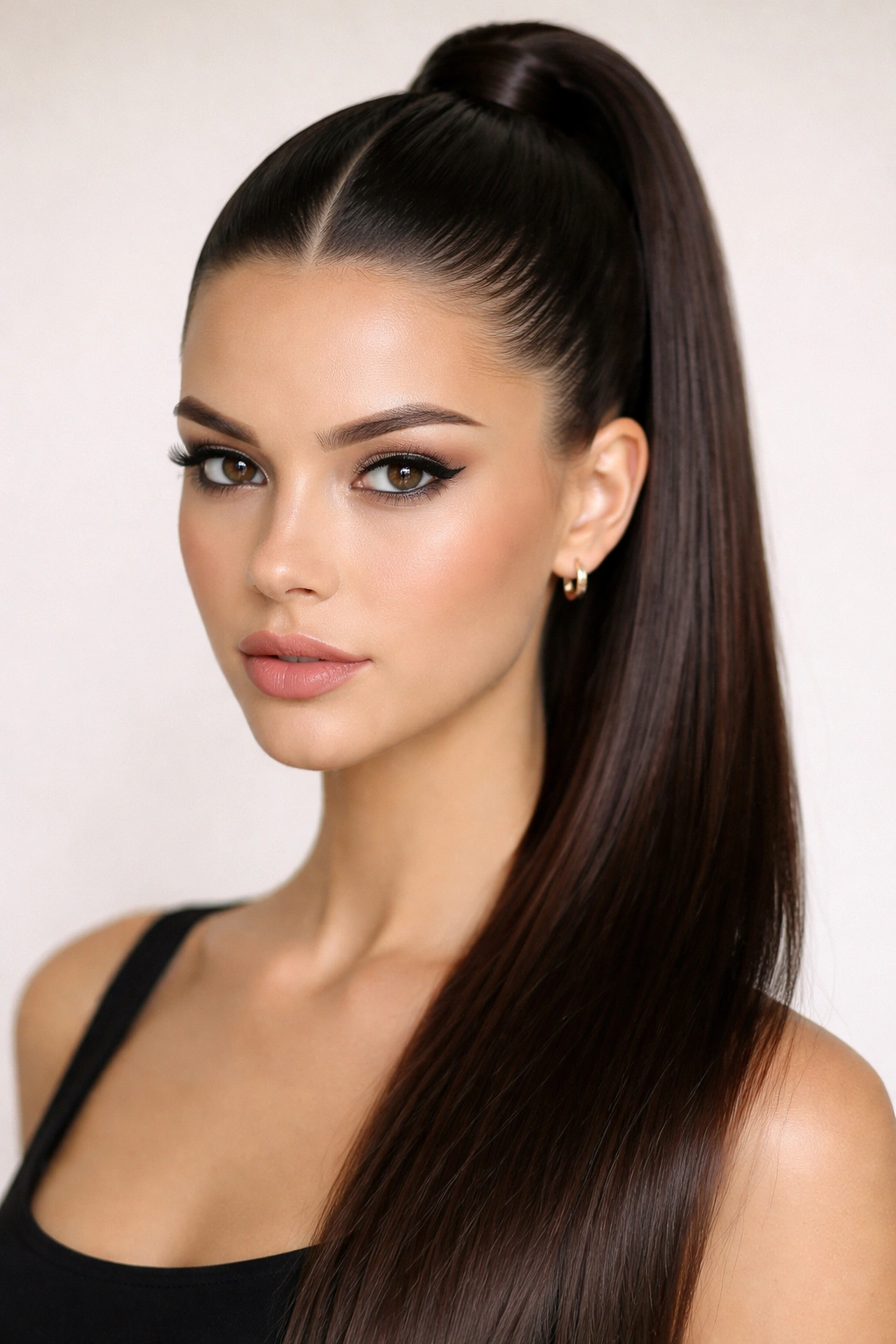
This is the minimalist’s high ponytail — clean lines, sharp center part, and absolutely zero texture. It’s the hairstyle equivalent of a perfectly tailored blazer. To achieve this look, start with hair that’s been straightened or smoothed, and create a precise center part using a fine-tooth comb or the pointed end of a rattail comb. Brush the hair straight back toward the crown with a stiff paddle brush or slicker brush, pulling everything into a super tight grip at the base.
Why It Works for Everyday Wear
The sleek high ponytail is practically bulletproof for someone who wants their hair completely out of the way. No flyaways, no pieces escaping, just a clean, polished silhouette that photographs well and actually stays put through a full day. It reads as intentional even though it’s genuinely one of the fastest styles to execute — three minutes, maximum, once you’ve gotten your hair smooth.
How to Perfect the Execution
- Use a smoothing serum or anti-frizz cream on damp hair before blow-drying completely straight — this is crucial for sleekness
- Brush the hair back firmly and use a fine elastic (matching your hair color, not a chunky hair tie) positioned right at your natural crown point
- Once the ponytail is secured, smooth any pieces around your face with a fine-tooth comb and a tiny bit of edge control cream
- For extra hold that lasts all day, finish with a light hairspray that doesn’t create shine or stiffness
Pro tip: The secret to a truly sleek ponytail isn’t just about the style itself — it’s about the prep work. Even five minutes of smoothing serum and proper blow-drying transforms how polished this style looks compared to just pulling your hair back wet or damp.
2. Voluminous High Ponytail with Teasing
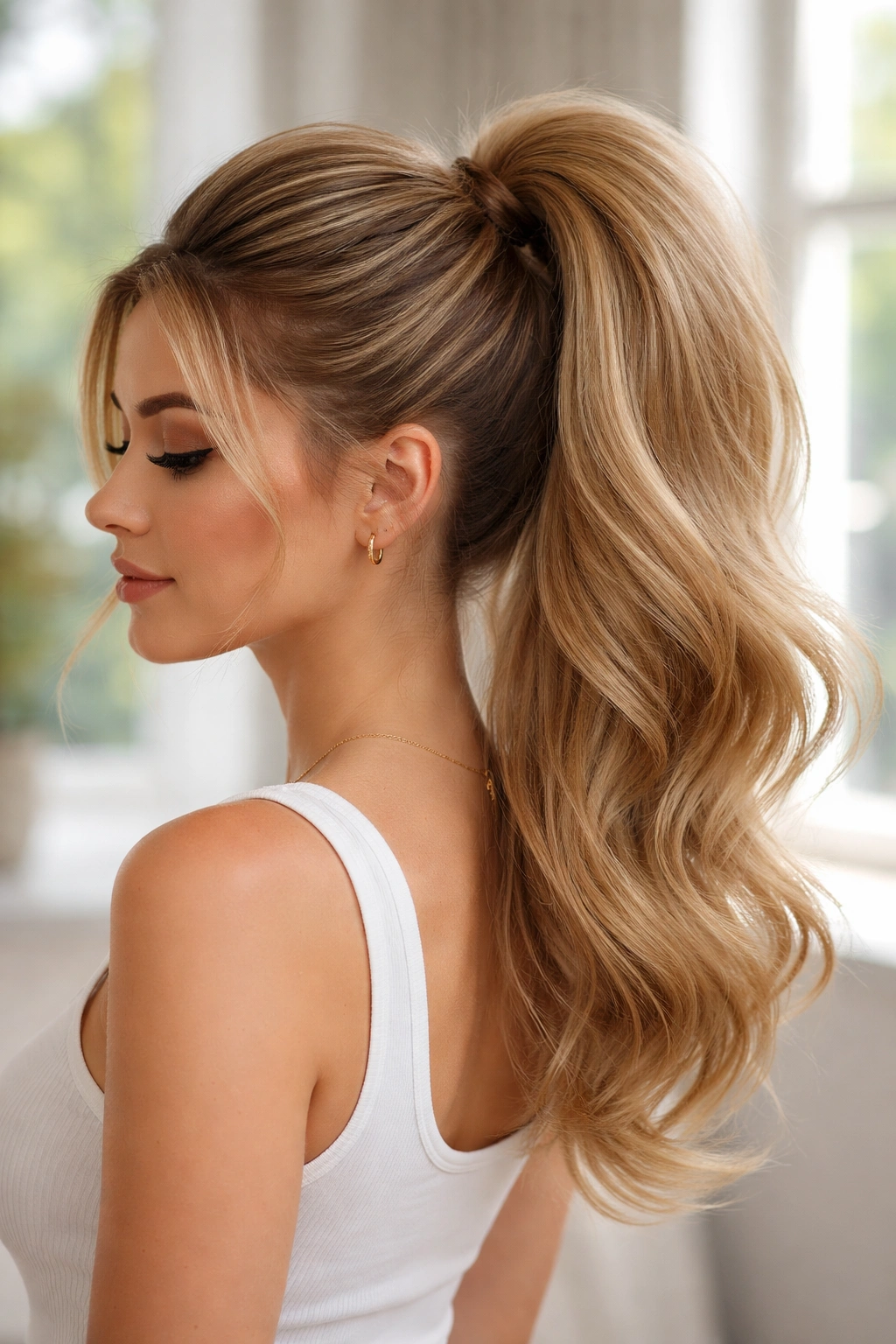
If sleek isn’t your vibe, go the opposite direction entirely. A voluminous high ponytail trades precision for drama, and it honestly looks incredible for everyday wear if you do it right. The key is teasing at the crown before you gather everything into a ponytail — this creates height that’s genuinely structured, not just an illusion. Start by blow-drying your hair with some texture already in it, maybe with a curling iron or by blow-drying with your head flipped upside down.
Section off the top third of your hair at the crown and tease it gently but thoroughly using a fine-tooth teasing brush. The goal is to backcomb just enough to create a cushion of texture that holds everything up, not to create a birds-nest situation. Smooth the surface layer with your comb so it looks polished, then gather all your hair into the ponytail at a high point on your crown.
What Makes This Version Different
Volume at the crown changes the entire silhouette of a high ponytail. Instead of looking sleek and severe, the teased version has softness and dimension. It actually photographs better in natural light, it feels more effortless even though you’ve put work into it, and it tends to look fuller and thicker than a standard ponytail — which is honestly why many people prefer this version.
Getting the Volume Right
- Tease only the crown area, not every section of your hair, or the ponytail becomes unwieldy
- Use a flexible hold spray before you tease so the texture grips and stays put rather than falling flat
- Once you’ve gathered the ponytail, gently pull a few face-framing pieces or strands forward for a softer, less strict look
- The teased section should feel solid and supportive but not scratchy or uncomfortable — you’re creating structure, not damage
This version looks particularly amazing on finer hair types because the teasing actually makes it appear thicker and fuller than it naturally is, without needing to damage your hair or use extensions.
3. Braided High Ponytail
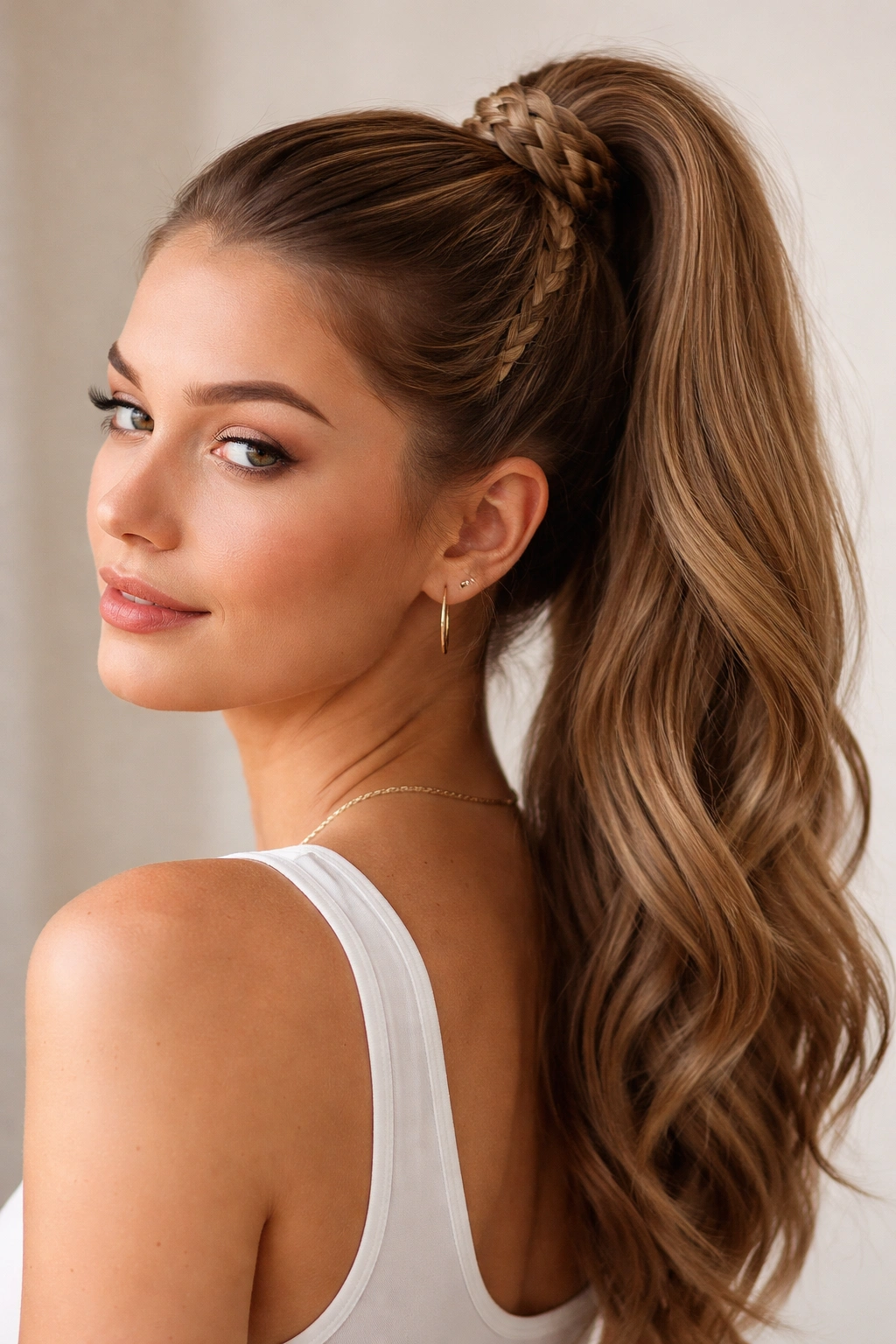
Adding a braid into your high ponytail instantly transforms it from a utilitarian style into something that looks like you spent actual time on your hair, even if you genuinely didn’t. The easiest version is a simple three-strand braid that captures just the front sections of your hair, then flows into the ponytail. Start by creating your high ponytail as normal, then separate out two thin sections from the sides of your face.
Take these two sections and braid them together (or separately and intertwine them), then wrap the braid around the base of your ponytail and secure it with bobby pins in a matching hair color. This creates a detailed, intentional-looking hairstyle that’s still incredibly quick to execute.
Why Braids Elevate Everyday Ponytails
A braid around the base of a ponytail does something almost magical — it makes the whole style look more finished and polished while also covering up the elastic, which instantly makes it look more refined. It’s also an incredible solution if you’re dealing with a day when your hair feels slippery or just won’t stay put in a tight ponytail, because the braid adds grip and texture that keeps everything secure.
Braid Placement Options
- Wrap one larger braid around the base of the ponytail for maximum visual impact
- Create two thinner braids on either side of your face and wrap them both around the elastic for a Celtic-inspired look
- Start with a Dutch braid (braided under instead of over) at the front and incorporate it into your ponytail for a unique blend
- Use a fishtail braid instead of a basic three-strand for a lighter, more delicate appearance
The beauty of a braided ponytail is that it works whether your hair is stick-straight or naturally wavy, and it’s legitimately impressive looking while remaining genuinely simple to execute.
4. High Ponytail with Face-Framing Pieces
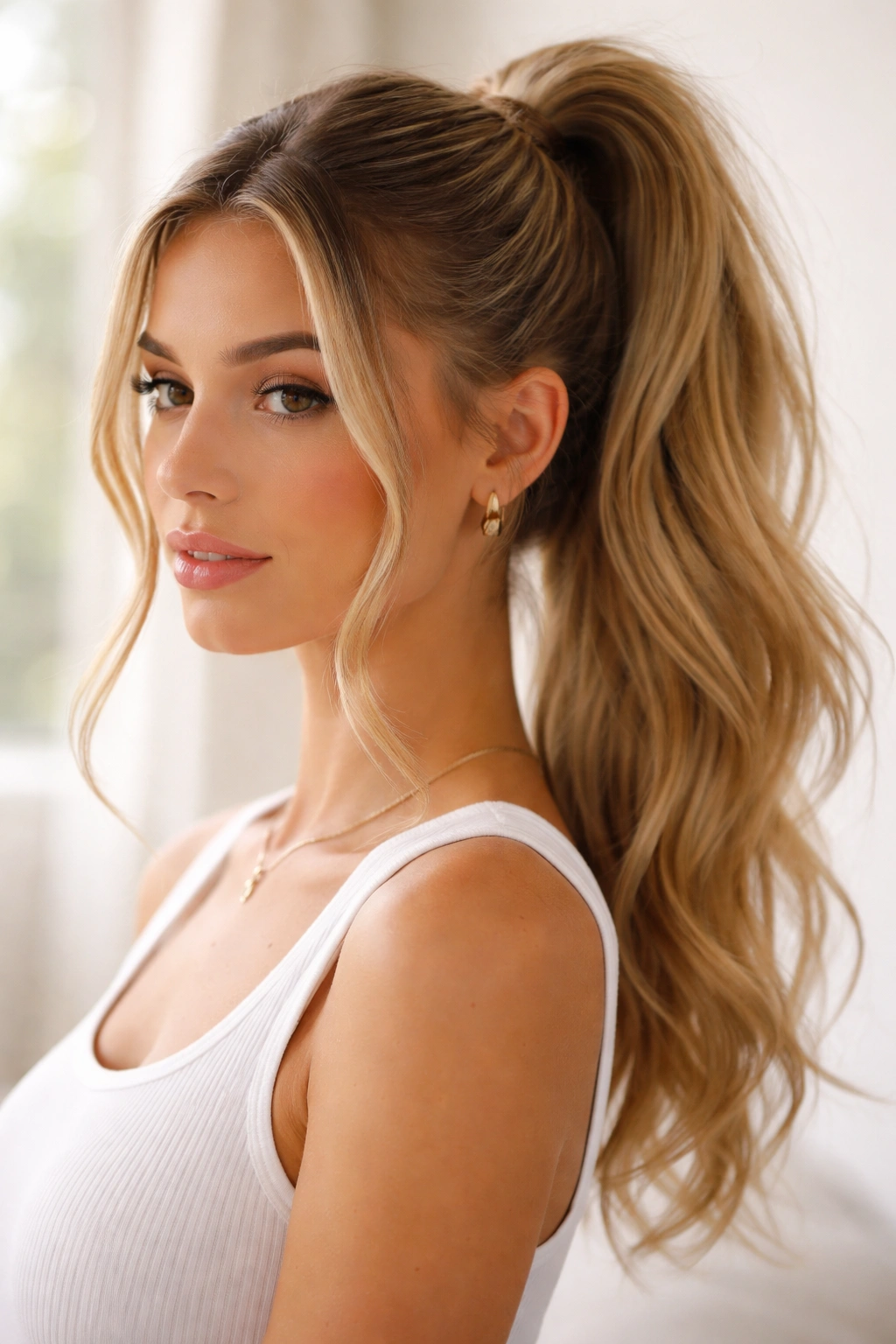
Sometimes pulling your hair completely back feels too severe, or you want the security of a ponytail but also want some softness around your face. This is where face-framing pieces come in. Create your high ponytail as normal, but before you secure it, separate out two thin sections from near your temples. Leave these sections out entirely, then gather everything else into your ponytail.
Curl the loose face-framing pieces with a curling iron to add dimension, or leave them straight if that’s more your style. This creates an instant softening effect that takes the severity out of a pulled-back style while still getting your hair completely off your neck if you need that.
The Psychology of Face-Framing Pieces
There’s actually something really smart about this style beyond just aesthetics. Face-framing pieces soften your face shape, bring attention to your eyes and cheekbones rather than your hairline, and create a sense of intentionality — like you didn’t just throw your hair up, you styled it deliberately. It’s a tiny detail that changes the entire vibe from “I needed to get this off my face” to “I chose to wear my hair this way.”
Customizing to Your Face Shape
- If you have a rounder face, curl the pieces away from your face and toward your ears to lengthen the appearance
- For a more angular face, curl pieces toward your face for softness that balances your features
- Keep the pieces relatively thin (about an inch of hair on each side) so they don’t undermine the pulled-back effect
- The pieces should hit somewhere between your cheekbone and your jaw for maximum face-framing impact
This version is probably the most flattering high ponytail style because it combines practicality with actual visual enhancement.
5. Twisted High Ponytail
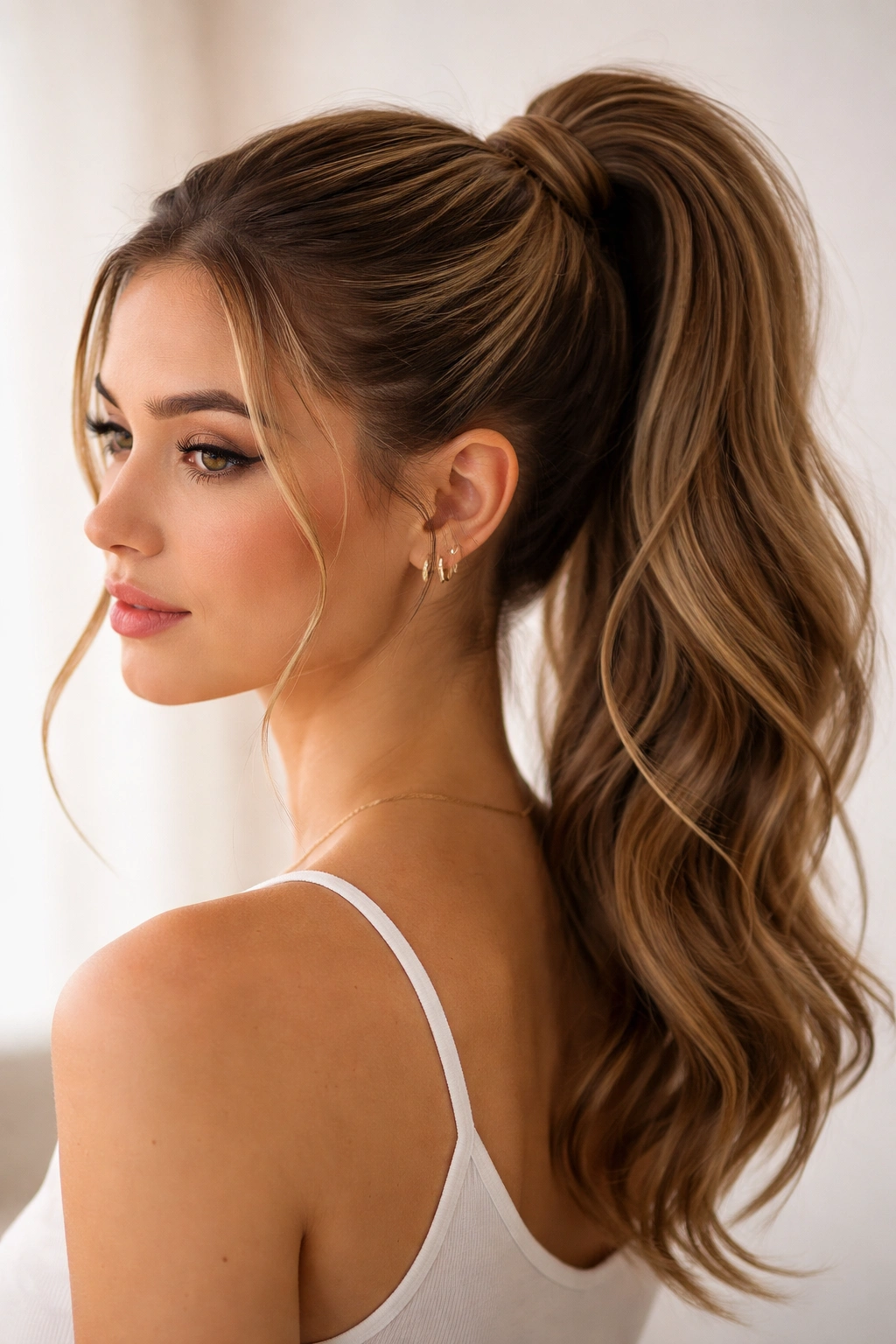
If you like the idea of a braided ponytail but you find actual braiding tedious or you struggle with the technique, a twisted version is your answer. Instead of braiding, you simply take two sections of hair, twist them around each other, and secure the twist around your ponytail base. Twists are honestly easier to execute than braids, they look intricate and intentional, and they work beautifully on both straight and textured hair.
To create this, gather your high ponytail first, then take two thin sections from the front sections of your hair. Twist these sections around each other (or twist each section individually, creating rope texture) and wrap them around the base of your ponytail. Secure with bobby pins and you’re done.
Twist Variations for Different Effects
A basic twist works well on straight hair, but you can also create double twists by taking more sections and twisting them around each other, or create a spiral twist by twisting your hair around itself multiple times. The beauty of twists is that they look polished and detailed but they’re genuinely forgiving — slight imperfections read as intentional and artistic rather than sloppy.
When Twists Shine
- On thick, heavy hair that holds texture well — twists create beautiful definition and hold structure
- On curly or textured hair where natural texture adds to the twist dimension — you don’t need straight hair for this to look amazing
- When you’re in a hurry but want something that looks detailed — twists are faster than braids but look equally intentional
- For a softer, more romantic vibe compared to the structured feel of a braid
A twisted ponytail looks especially good in formal or professional settings because it reads as elegant without looking overdone.
6. High Ponytail with Textured Waves
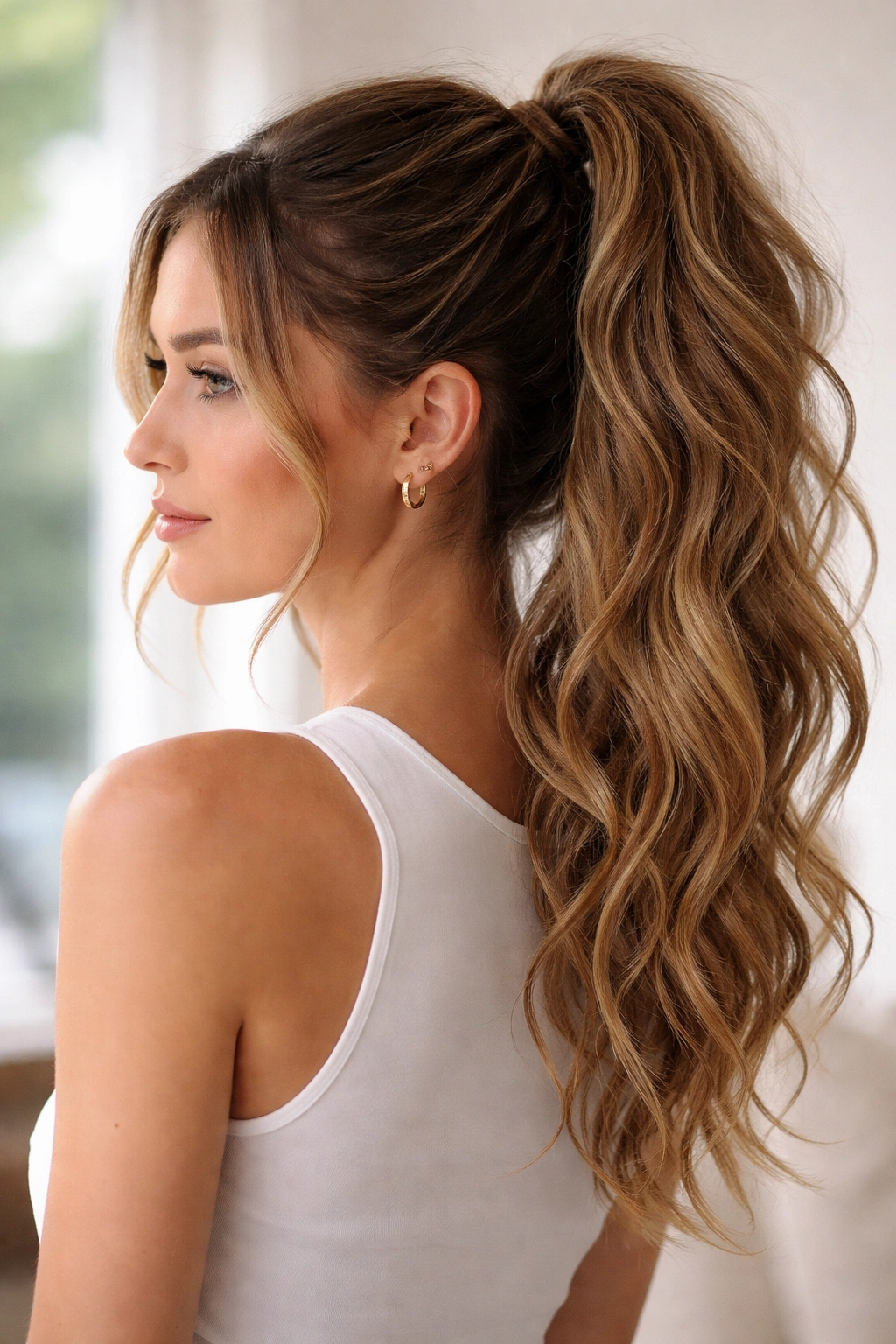
This version starts with waves or curls already worked into your hair before you create the ponytail. Instead of smooth, straight hair, you’re working with volume and movement. You can create waves with a curling iron, a waving tool, braids left in overnight, or just the natural texture of your hair if you have naturally wavy or curly hair.
Once your waves are set, gather everything into a high ponytail. The result is a ponytail that has movement and dimension even after it’s pulled up, which completely changes the feeling from structured to effortless. This version reads as more casual and approachable than a sleek ponytail, even though the execution is similar.
Why Textured Ponytails Look So Effortlessly Cool
When your ponytail has waves or curls in it, the entire style reads as “I woke up like this,” which is honestly the holy grail of everyday styling. It looks intentional enough for professional settings but relaxed enough that it doesn’t feel overdone. The texture also makes your hair appear fuller and thicker, and it disguises the fact that your ponytail might be slightly messy or have some flyaways — texture covers a multitude of styling sins.
Creating Different Wave Patterns
- Beach waves: Use a curling iron loosely, alternating direction for natural-looking waves
- Defined waves: Braid damp hair and leave braids in for a few hours, then unravel for structured waves
- Spiral waves: Use a curling iron to curl sections away from your face, creating uniform waves
- Ombré texture: Curl or wave only the bottom half of your hair for a hybrid look that’s textured at the ends
This style works on virtually every hair type and texture, and it’s particularly fantastic if your hair has a mind of its own anyway — the waves actually help disguise the rebelliousness rather than fighting against it.
7. Bubble Ponytail High Style
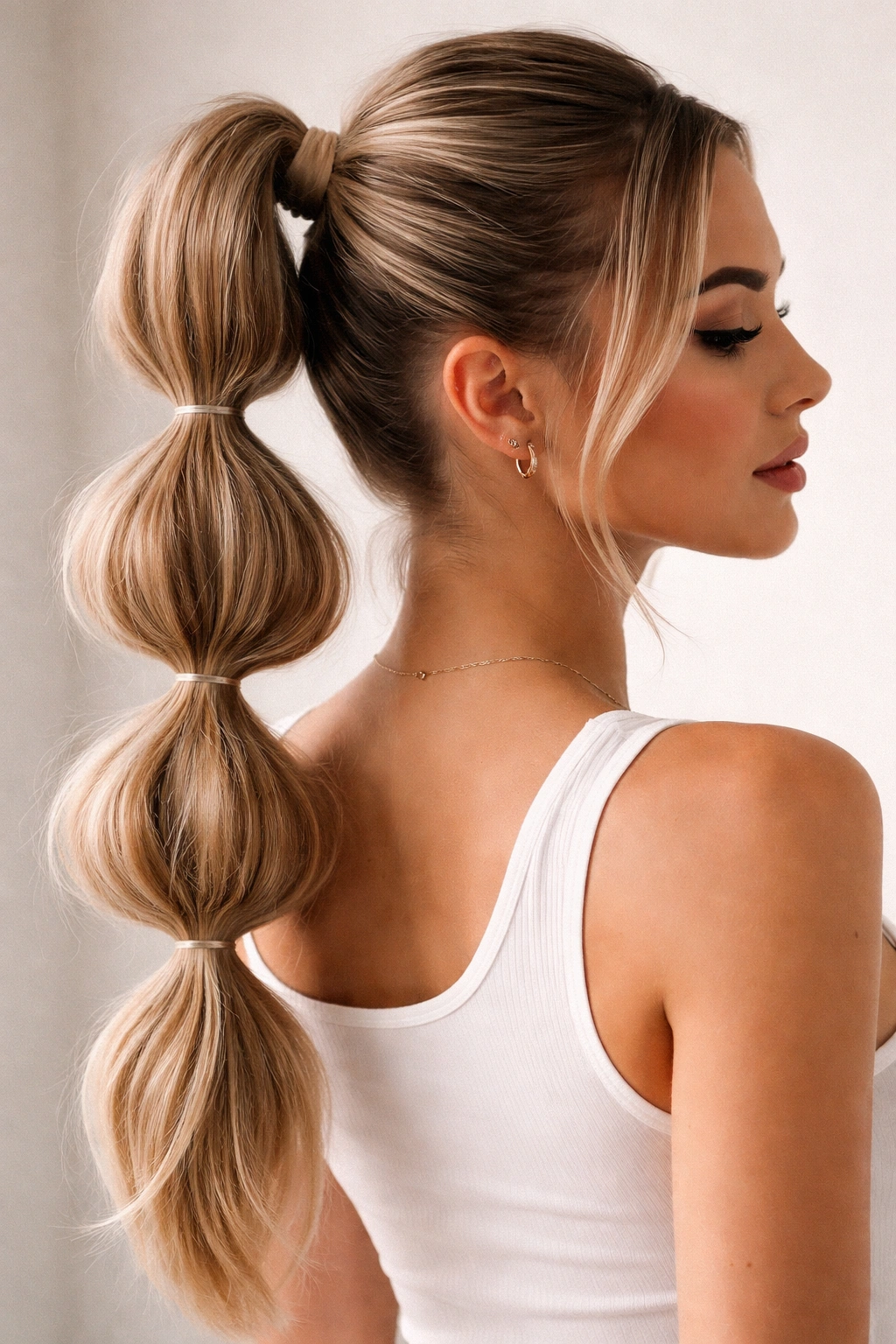
A bubble ponytail is exactly what it sounds like — multiple hair ties spaced down the length of your ponytail, creating bulbous sections that look dimensional and playful. You create this by making a standard high ponytail, then securing additional hair ties every two to three inches down the length. Between each tie, you gently pull and tease the hair to create that bubble effect.
This style absolutely works as an everyday look, especially if you want something that’s clearly intentional and unique without requiring complicated braiding or teasing skills. It’s also incredibly practical because the multiple ties provide extra security, so your ponytail won’t slip or fall flat even if you’re moving around a lot.
The Technical Execution
- Create your base high ponytail with an elastic that matches your hair color
- Working from the elastic down, secure additional elastics about two to three inches apart
- Gently pull each section between the elastics upward and outward to create the bubble shape
- You can leave the sections smooth or tease them slightly for more dramatic bubbles
- If your hair is fine or slippery, use smaller elastics closer together for better structure
When Bubble Ponytails Work Best
- On younger people or in more casual, playful settings — this style reads fun and youthful
- When you want maximum security and your hair tie won’t budge despite movement
- On thick, healthy hair that has enough weight to create defined bubbles
- For events where you want something obviously styled and intentional
This style is having a moment, and for good reason — it genuinely looks cool while being straightforward to execute once you’ve done it a couple of times.
8. Slicked-Back High Ponytail
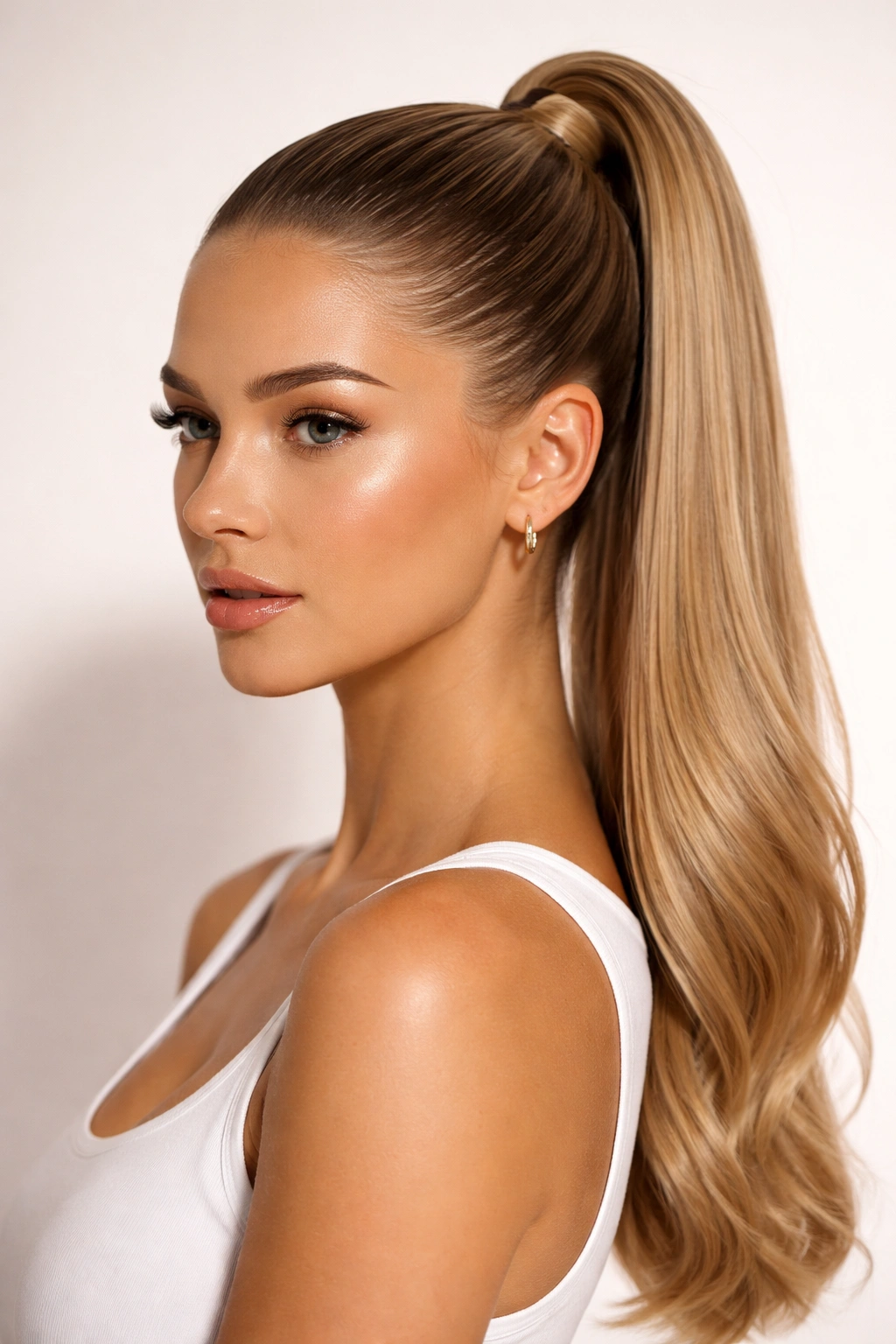
Similar to the sleek ponytail but even more dramatic, a slicked-back ponytail uses gel, mousse, or strong-hold edge control to smooth every single piece of hair completely flat against your head before gathering it into a ponytail. This creates an almost sculptural effect where your hair is so smooth and tight that your face shape is completely revealed.
This version isn’t for everyone — it’s quite severe — but it’s genuinely stunning on the right face shape and in the right context. It’s particularly flattering if you have great cheekbones, strong eyebrows, or a defined jawline, because you’re literally putting all the focus on your facial features. It also works beautifully in professional settings, athletic contexts, or anywhere you want hair to be completely out of the way.
Creating Maximum Slickness
- Use a wet brush or slicker brush with a strong-hold gel or mousse to brush hair straight back
- Apply the product while hair is damp, then blow-dry while brushing continuously for maximum smoothness
- Use an edge control cream or gel on your hairline for a finished, polished look
- Consider using an extra-tight elastic or even a hair stick at the crown for security
Face Shapes That Shine With Slicked-Back Ponytails
- Oval faces that can carry any style with confidence
- Heart-shaped faces where pulling hair back reveals a balanced jawline
- Square faces with strong jaws that this style emphasizes beautifully
- Athletic builds and specific professional contexts where this aesthetic aligns with the environment
This version feels risky if you’re not sure it works for you, so test it out at home before committing to it in public. When it clicks with your features and style, though, it’s absolutely stunning.
9. High Ponytail with Accessories
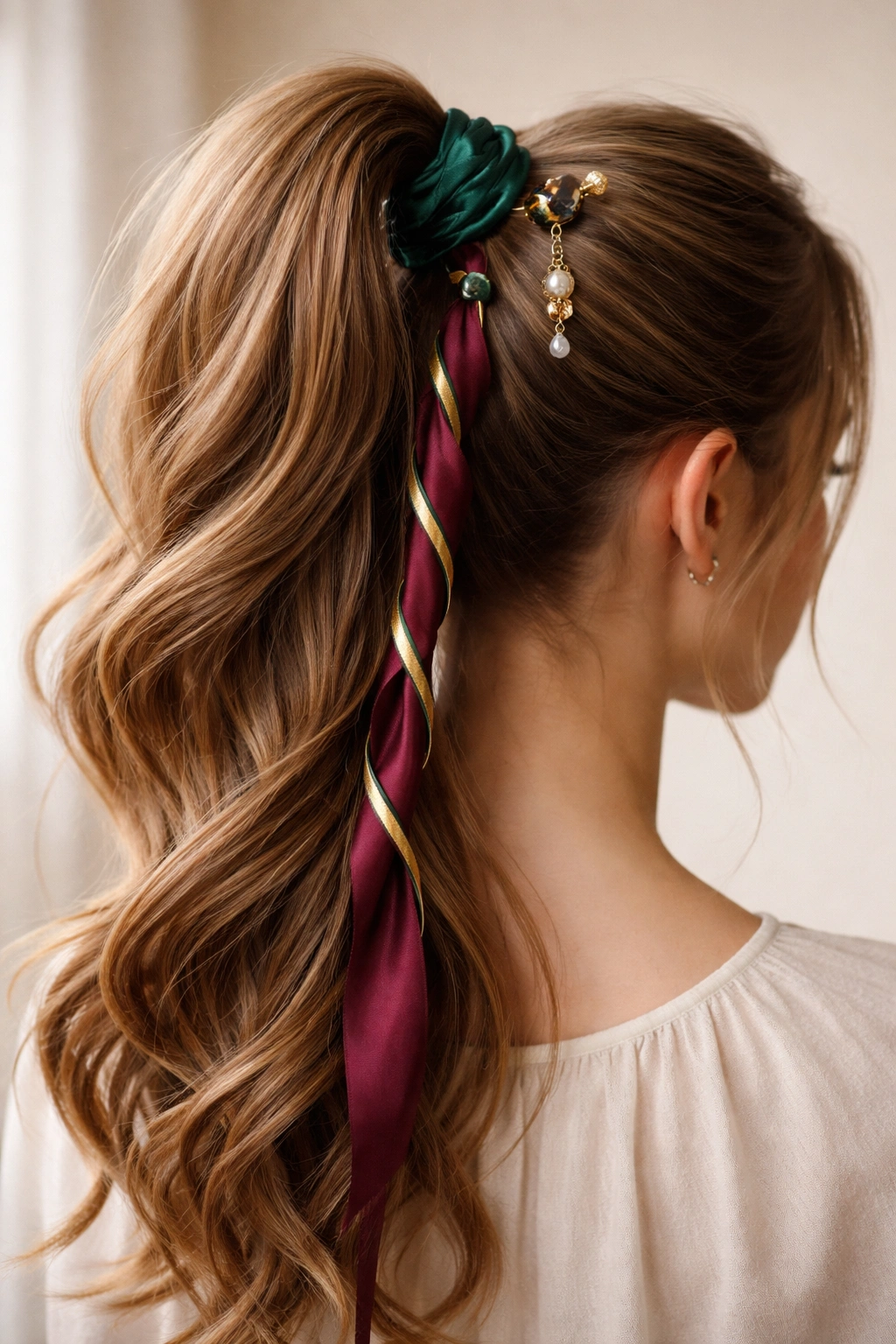
This is where you get to have fun and inject personality into a basic high ponytail style. Any high ponytail becomes elevated when you add the right accessory — whether that’s a decorative hair stick, a silk scrunchie in a fun color or pattern, a claw clip, decorative bobby pins, or ribbons woven through the base.
The genius of styling a ponytail with accessories is that you can change the entire vibe by switching out just one element. The same basic ponytail becomes playful with a fun scrunchie, elevated with a delicate hair stick, sporty with a metallic claw clip, or romantic with ribbons. This makes it an incredibly versatile everyday style because you can match the accessory to your mood or outfit.
Accessory Choices for Different Vibes
- Silk scrunchies in jewel tones or patterns for a put-together, luxe feel
- Metallic claw clips for a modern, contemporary edge
- Decorative hair sticks for an elegant, intentional aesthetic
- Ribbons woven through the ponytail base for feminine, romantic energy
- Leather or fabric cuffs worn around the elastic for a bohemian touch
- Minimalist metal rings or hoops around the base for a sleek, architectural feel
Why This Works as Everyday Styling
The beauty of an accessorized ponytail is that the base style can be incredibly simple — straight, smooth, basic — but the accessory makes it look thoughtful and intentional. It’s also a way to express personality and style without committing to a complex hairstyle, which is exactly what everyday wear demands. You get high-impact styling with minimal effort.
Most of these accessories are also genuinely practical — a good scrunchie distributes pressure across your hair rather than concentrating it in one spot, and decorative clips and sticks actually help hold the ponytail in place rather than just looking pretty.
10. Messy High Ponytail with Texture
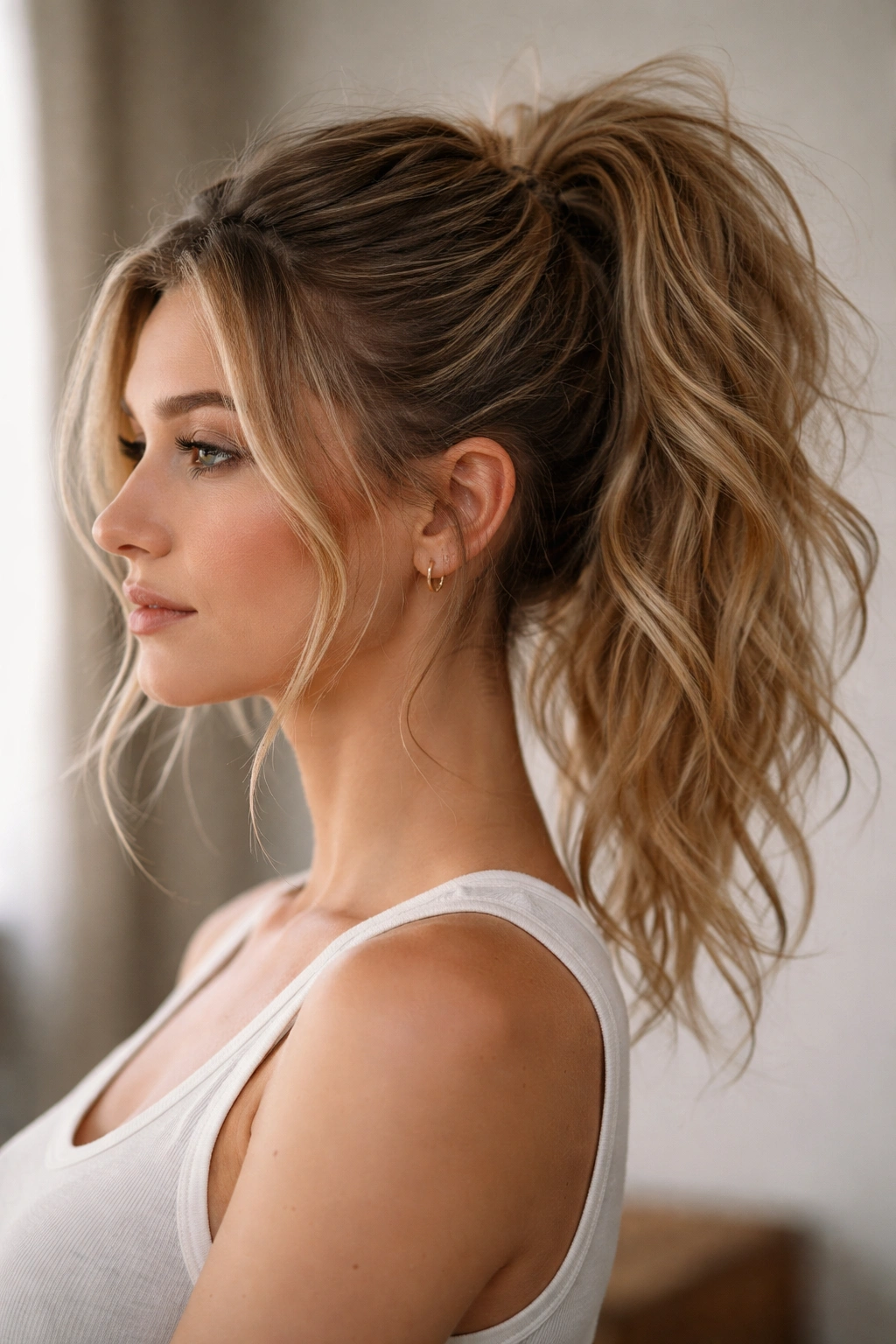
This version embraces the slightly undone, authentically imperfect aesthetic. Instead of aiming for sleekness or precision, you’re going for the just-right amount of messiness that looks intentional rather than sloppy. Start by creating waves or curls in your hair, then gather it into a high ponytail but deliberately leave some pieces loose around your face and a few pieces escaping from the base.
Don’t worry about smoothing everything down — let some flyaways and pieces stick out. The result is a ponytail that’s obviously styled (you can tell effort was involved) but also looks effortless and genuinely wearable. This is probably the most forgiving high ponytail version because perfection isn’t the goal.
The Art of Intentional Messiness
- Start with textured waves or curls, not straight hair — texture is the key to looking intentionally undone
- Tease the crown slightly for volume and dimension
- Loose a couple of thin pieces in the front and at the sides
- Allow some small pieces to escape from the base of the ponytail
- Use a flexible hold spray that keeps everything moveable rather than rock-solid
- Gently rustle the ponytail with your fingers after securing it for that just-done-this-second feel
Who This Style Works For
- People with naturally wavy or curly hair who aren’t interested in fighting their texture
- Anyone who wants the security and practicality of a ponytail but doesn’t like the severity of a pulled-back style
- Professional settings where “polished but approachable” is the goal
- Literally any casual context where you want your hair up but don’t want it to look like you tried too hard
The messy ponytail is the version most people actually gravitate toward in real life because it splits the difference between practical and pretty, which is exactly what makes it so wearable every single day.
11. Half-Up High Ponytail Hybrid
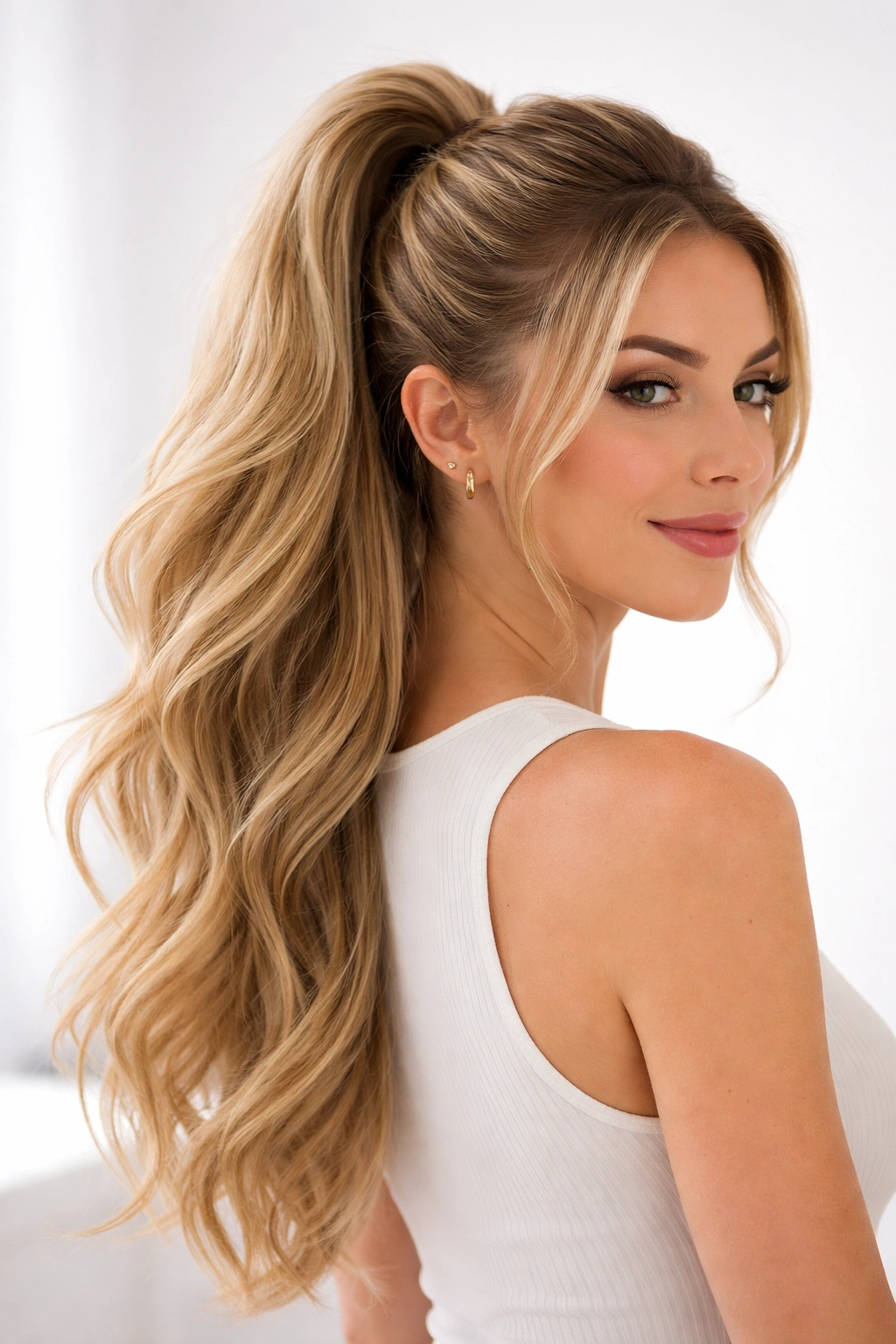
This style is technically not a full ponytail — it’s more of a half-up situation gathered at the crown of your head. You’re taking the top half of your hair and securing it into a ponytail at a high point on your head, while leaving the bottom half down and loose. This creates a style that has some of the practicality of a pulled-back look while maintaining the freedom and length of wearing your hair down.
It’s an underrated everyday style because it genuinely solves the problem of hair getting in your face without the commitment of a full ponytail. It works beautifully if you have medium to long hair, and it’s particularly stunning on people with thick hair or people who have layers that create movement and dimension.
The Half-Up Ponytail Advantage
This style prevents hair from falling in your face during activities or work without overheating your entire head — your neck and shoulders stay cool because you’ve only put the top layer up. It also allows you to let your hair down quickly if you need to, without having to redo everything, since only the top section has been styled.
Variations and Customizations
- Leave the half-up section smooth and sleek while the bottom half has waves
- Tease the crown for added volume in the half-up section
- Add a braid to the half-up section for detail and interest
- Use a decorative hair clip or claw at the crown instead of an elastic for a different aesthetic
- Leave very thin face-framing pieces out of the half-up section for softness
This style is perfect for everyday wear because it’s genuinely practical and it actually looks better when it’s slightly imperfect or undone — trying too hard with a half-up style reads as forced, so the casually styled version is almost always the most flattering.
12. High Ponytail with Layered Sections
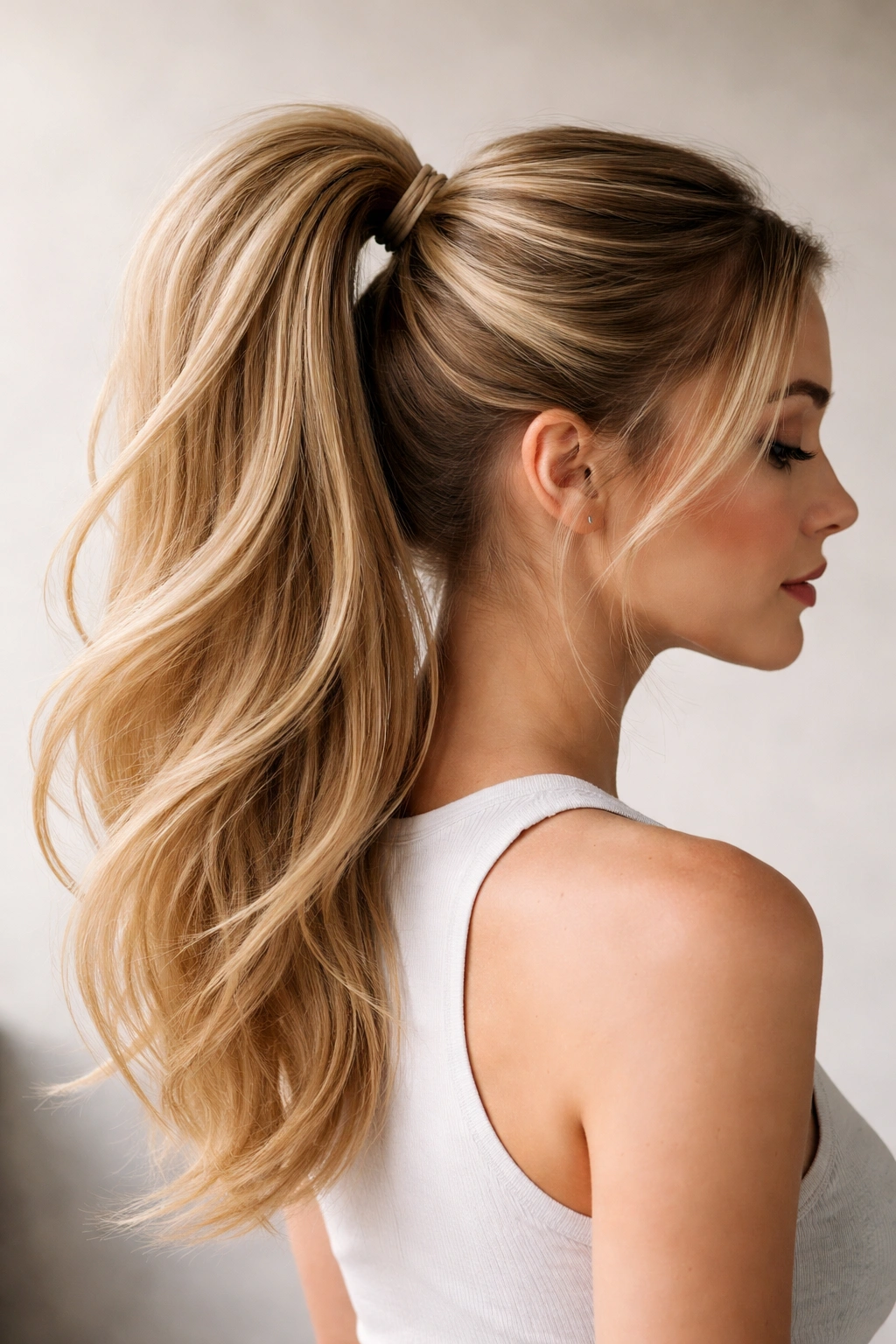
This final version adds sophistication by creating distinct layers or sections within the ponytail itself, which adds visual interest and dimension. To create this look, divide your high ponytail into three or four horizontal sections, then gently backcomb or tease just the underside of each section. Smooth the top, but leave the texture underneath.
The result is a ponytail that appears fuller and more dimensional than a standard smooth version, and the layers catch light differently, which creates visual depth. This version is particularly stunning in photography and it looks incredible for professional or formal settings while still being wearable as an everyday style.
Creating Dimension Through Layers
- Divide your ponytail into distinct sections using horizontal partings
- Tease only the underside of each section so the top stays smooth
- Leave the teased layers slightly textured rather than perfectly smooth
- The layers should be visible enough that someone looking at your ponytail can see the dimension
- This technique works especially well on thicker hair with more volume to work with
Why Layered Ponytails Work
Layered texturing creates the optical illusion of much fuller, thicker hair than you might actually have. It’s also a technique that’s much more forgiving than trying to create a perfectly smooth, sleek ponytail, so if you struggle with hair that won’t cooperate, this version hides those imperfections beautifully while actually making them work in your favor.
This style absolutely works as an everyday look, especially if you want something that photographs well and looks intentionally styled without requiring complicated techniques.
Final Thoughts
A high ponytail doesn’t have to be boring or utilitarian, even though it can certainly be both of those things when you need it to be. The reality is that you have genuine options here — from sleek and minimal to textured and playful, from simple and quick to detailed and intricate. The key to finding your everyday high ponytail is honestly just testing a few versions and noticing which one makes you feel confident, which one actually stays put throughout your day, and which one you find yourself reaching for again and again.
The other thing worth mentioning is that your everyday ponytail doesn’t need to be the same every single day. You can do a sleek version on days when you want to feel polished, a textured version when you want to feel effortless, a braided version when you want something that looks more intentional. Having two or three go-to high ponytail styles in your rotation actually makes getting ready faster because you already know exactly what you’re doing, and the small variations keep the style from feeling stale or tired.
Start with whichever version appeals to you most, test it a few times, and notice what adjustments make it work better with your hair type and your daily life. The best hairstyle is always the one that actually works with your hair, not against it, and that fits realistically into how you actually live. Master one version, then branch out to the others once you’ve got your foundation solid.
