

Triangle parts change the whole mood of box braids. The diagonal sections break up the grid, and when you add curly ends, the style stops looking stiff and starts moving.
That movement matters. Box braids can feel heavy fast, and curly ends soften the last few inches so the hair swings instead of hanging like rope. If you’ve ever left a chair with neat braids that still felt a little too serious, this version fixes that in a way square parts never quite do.
The parting shape is doing more work than people give it credit for. Triangle sections make the scalp pattern look less predictable, and the curls at the ends keep the style from reading as too sharp or too boxed-in. Get the braid size wrong, though, and the whole thing can tip into bulky territory. Get the curl pattern wrong, and the ends disappear before you’ve even had time to enjoy them.
Some of the looks below are sleek. Some are soft. A few are a little louder on purpose. The sweet spot is the one that fits your hair density, your daily routine, and how much time you’re willing to spend refreshing the ends.
1. Classic Waist-Length Triangle-Part Box Braids With Spiral Ends
Waist-length braids are the easiest place to start if you want the triangle parting to show up clearly without turning the style into a whole production. The length gives the curls room to breathe, and the braid itself stays neat enough that the triangle pattern reads from a few feet away.
Why this one works
The longer length gives you a nice balance: enough braid to feel substantial, enough curl to keep the ends from dragging the whole look down. Spiral ends are especially good here because they hold their shape better than looser waves, which matters when the braids land near the waist and brush against coats, bags, and chair backs.
- Best braid size: medium, about the width of a pinky finger.
- Best curl type: medium spiral curls, not tiny ringlets that can frizz fast.
- Best finish: a light mousse set on the ends, then wrapped at night with a satin scarf.
- Best vibe: polished, clean, and easy to dress up.
My opinion: if you only try one triangle-part box braid style with curly ends, start here. It’s the one that makes the parting look intentional instead of experimental.
2. Shoulder-Length Triangle-Part Bob With Soft Curly Tips
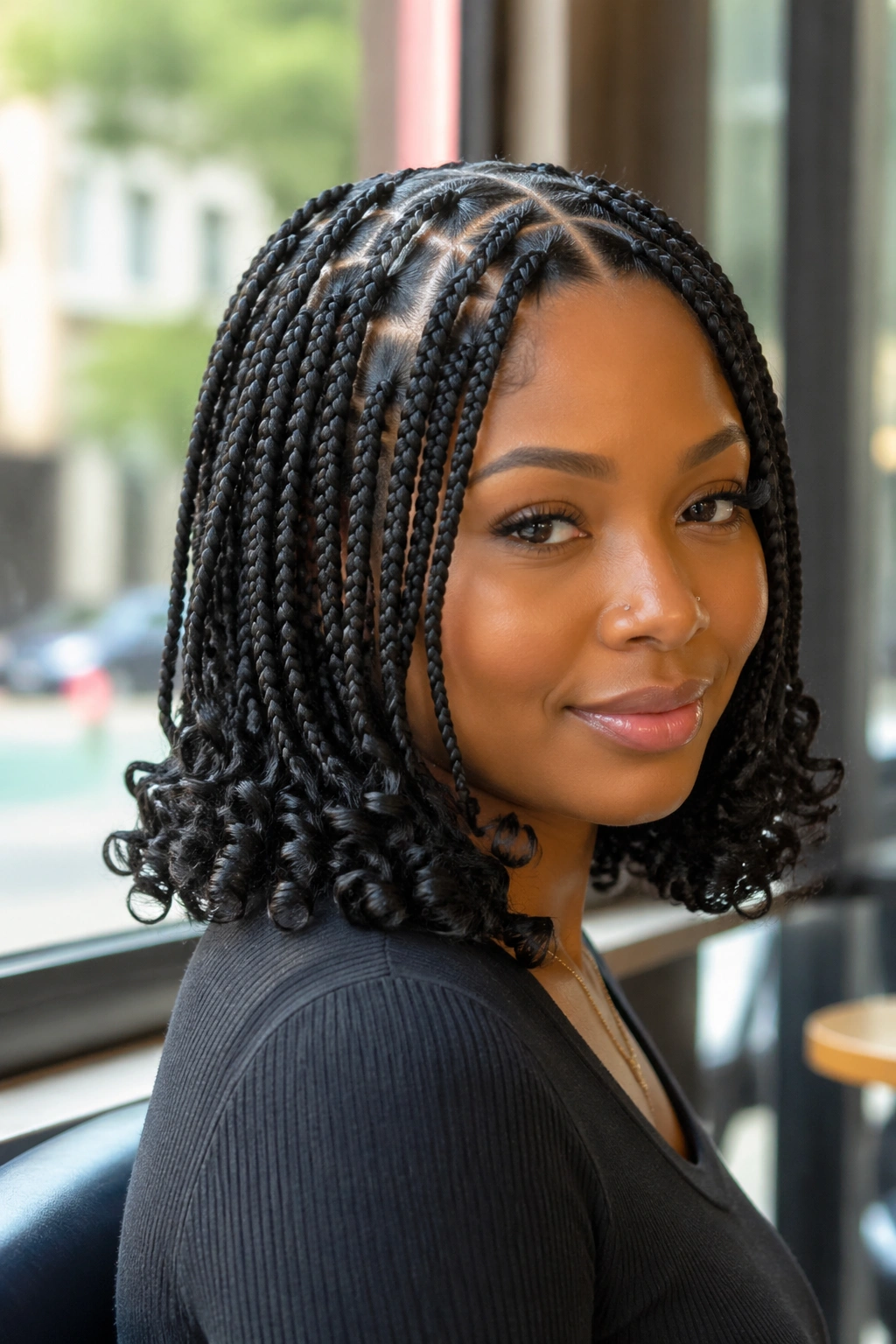
Shoulder-length braids are blunt in the best way. They don’t swing around as much as longer braids, so the triangle parting stays visible every time you turn your head, and the soft curly tips keep the cut from feeling boxy or heavy.
This is the version I’d point to for anyone who wants box braids that feel light on the neck. The ends sit right at the shoulders or just above them, which means less tangling, less pulling, and fewer moments where the braids get trapped under straps. The curls at the tips give the bob a little bounce, almost like the braid finished with a quiet flick instead of a hard stop.
It also grows out well. That matters more than people admit. Shorter braids with curly ends often keep their shape longer because the weight pulling on the roots is lower, and that makes the triangle pattern stay cleaner for longer too.
If you like neat edges, easy washing, and a style that doesn’t take over your whole back, this one makes a lot of sense.
3. Jumbo Triangle-Part Box Braids With Bouncy Ends
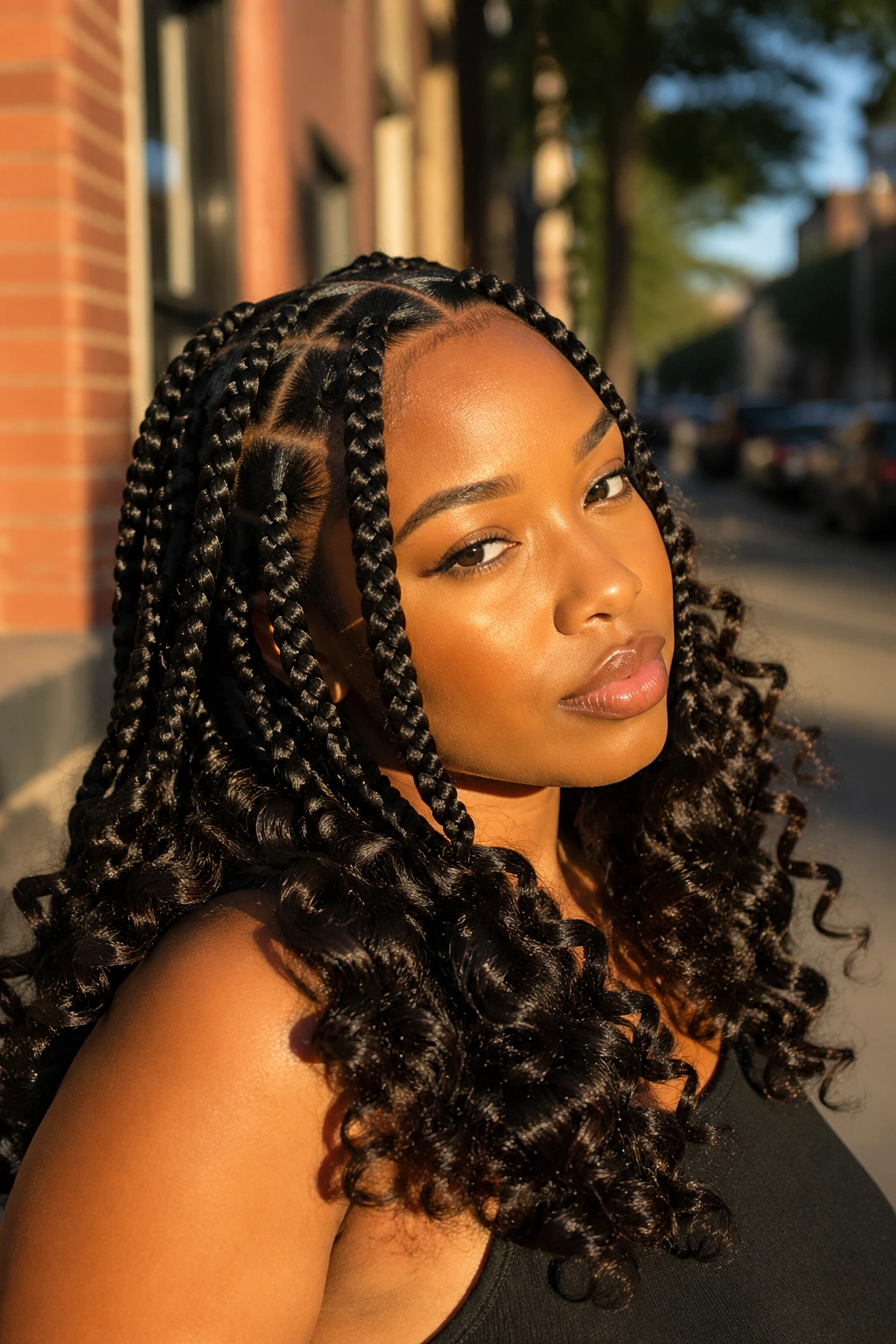
Big braids are not shy. They show the triangle parts more boldly because each section has room to breathe, and the curly ends keep the whole look from becoming too blunt or heavy. That contrast is the fun part.
What makes it different
With jumbo braids, the parting is part of the design, not just the setup. You can see each triangle clearly, especially if the braids are installed with clean spacing and the edges are kept tidy. The curly ends should be full, not wispy. Think soft bounce at the bottom, not tiny frizz.
A few things matter here:
- Use larger triangular sections so the braid pattern stays balanced.
- Keep the braid length around chest to mid-back unless you want real weight.
- Choose a curl pattern that holds—big rod curls or chunky spiral ends work better than tiny curls.
- Don’t overload the ends with too much product. That makes them droop.
Jumbo triangle-part box braids with curly ends are for someone who wants the parting to be seen, not hidden. Loud hair. In a good way.
4. Knotless Triangle-Part Box Braids With Loose Ringlets
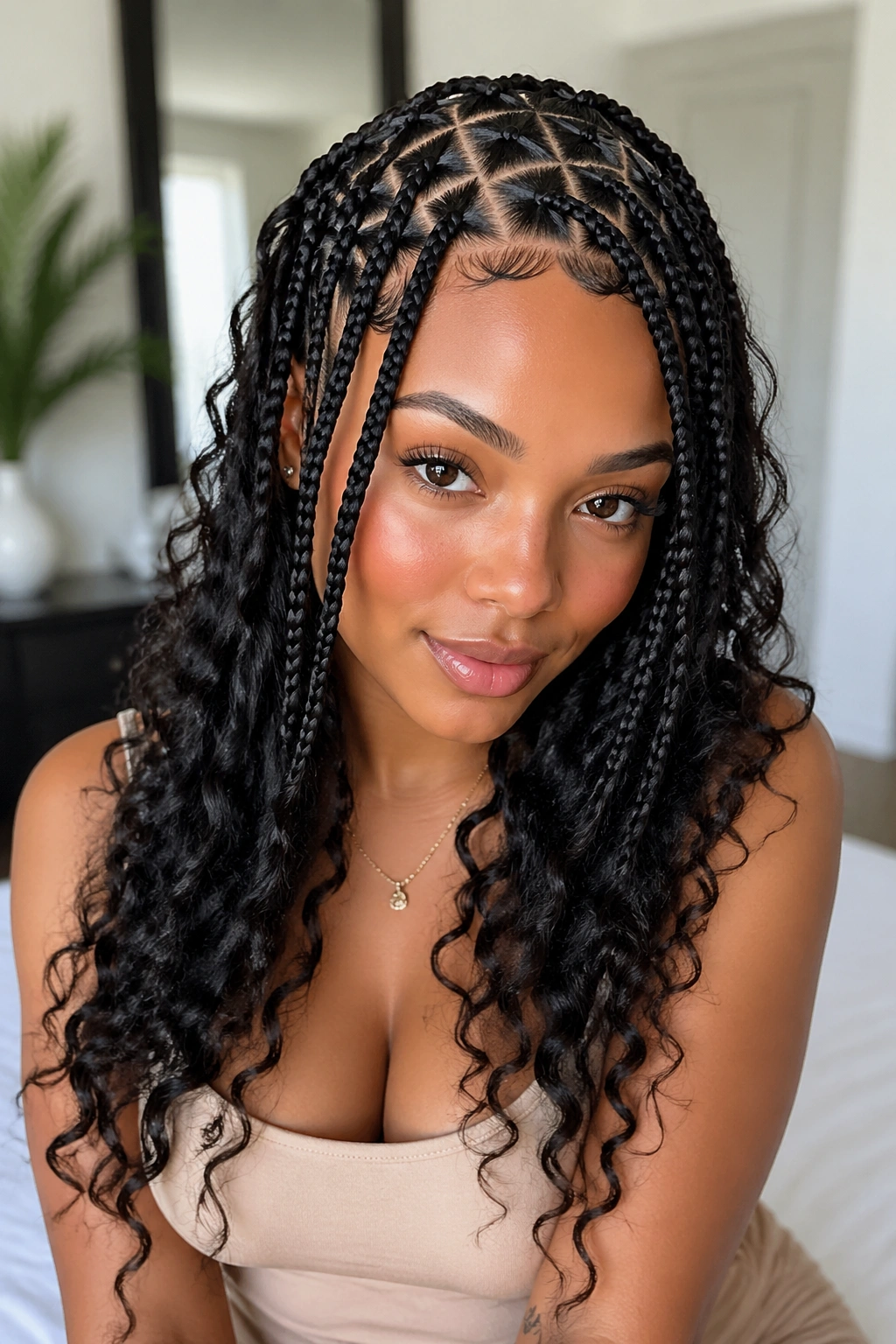
Knotless installation changes the whole feel at the root. The braid starts more gently, so the scalp gets less tugging, and triangle parting looks smoother because there’s no bulky knot sitting at the base of each section.
Why do loose ringlets work here? Because the root is already soft and flat, so the curly ends can take the spotlight. Tight curls would fight the relaxed base. Loose ringlets, though, feel easy. They move when you walk, and they keep the style from looking too stiff or too formal.
You can tell when this combination is done well. The braid should lie flat against the scalp at the start, then grow a little fuller through the length before finishing in soft curls. There should be a clean line between braid and curl, not a messy blend where the shape gets lost.
This is the one I’d choose if your edges are touchy or if you just hate the feeling of heavy roots. Clean, comfortable, and a little softer than the usual braid look.
5. Small Triangle-Part Braids With Tight Wand Curls
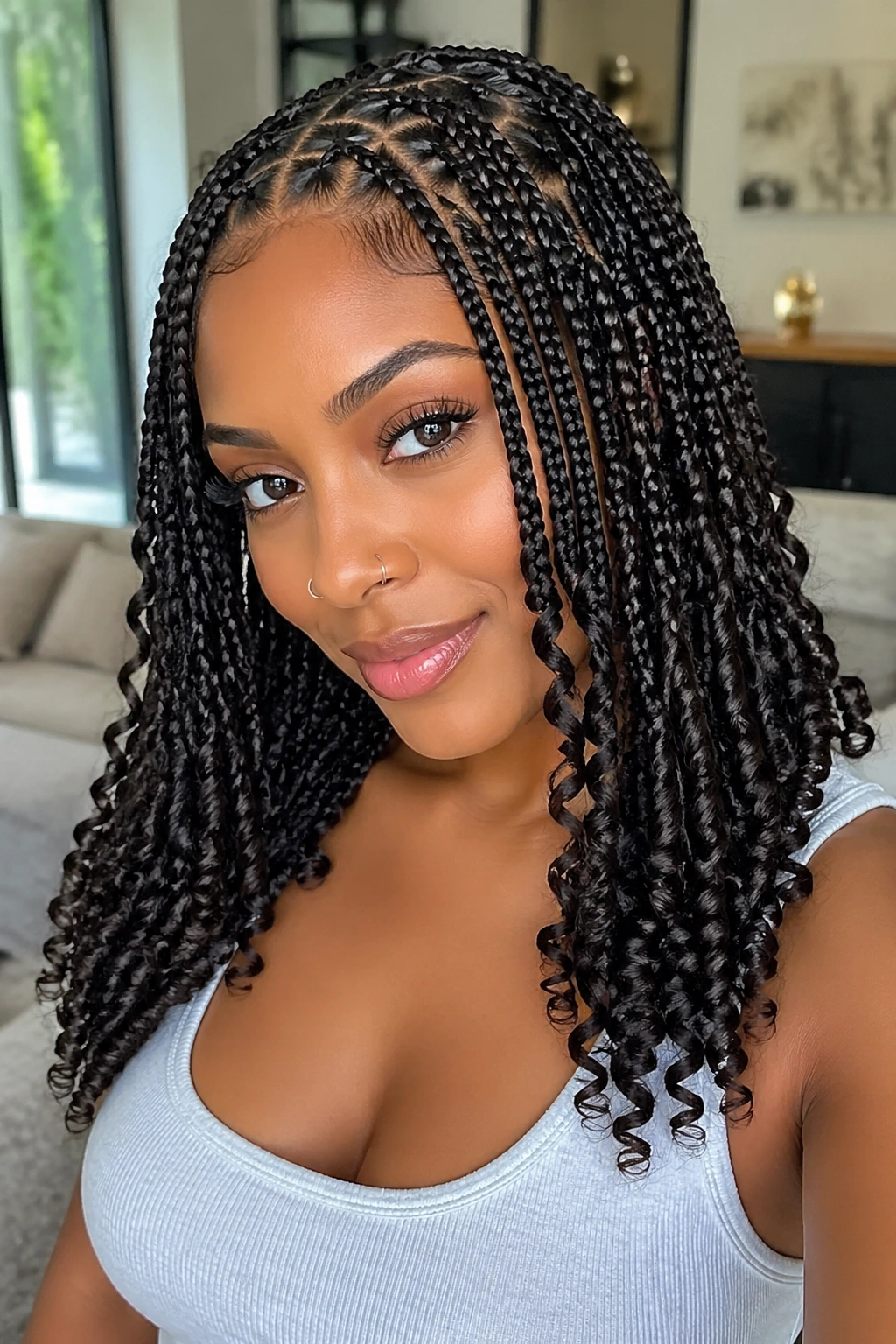
Small triangle-part braids are the detail lover’s version. The parting lines create a sharp pattern across the scalp, and the smaller braid size makes the curls at the ends feel more delicate and controlled.
The thing about this style is patience. It takes longer to install, and it takes longer to finish the ends properly. Worth it, though. Tight wand curls or small rod curls keep their shape well, especially on shorter ends that might otherwise puff out too fast. The whole head ends up looking neat from root to tip.
How to keep it from looking fussy
Tiny braids can turn overly busy if the curls are too wide or too loose. Keep the end curl size smaller than you think you need. It should look intentional, almost tailored, with the braid pattern doing the main visual work and the curls acting like a soft finish.
This is not the style for someone who wants the quickest salon chair time. It’s for someone who likes precision. Clean triangle parts. Thin braids. Tight curls that hold their shape.
6. Triangle-Part Boho Braids With Face-Framing Pieces
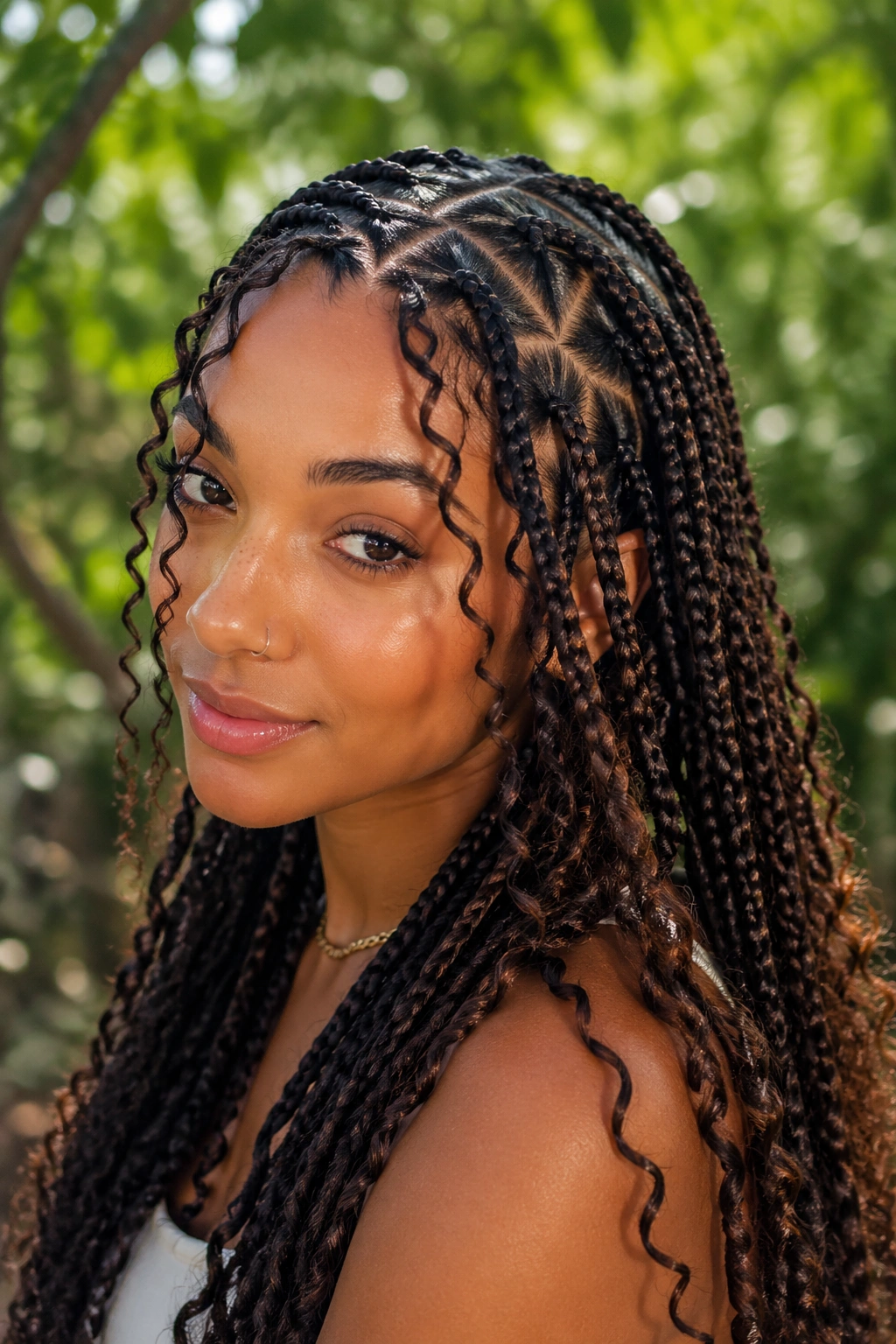
Boho braids and triangle parts get along better than you’d expect. The triangle sections give the scalp pattern structure, and the loose face-framing pieces stop the look from getting too rigid. The curly ends help bridge those two moods.
The best version keeps the leave-out pieces light and intentional. You don’t need a lot. A few loose curls near the temples and around the cheekbones are enough to soften the front of the style. If you use too many, the braid pattern starts to disappear, and that defeats the whole point of triangle parting.
This style shines when the curls and the braids share the same finish level. A little gloss on the braid lengths, a little softness on the ends, and the face-framing bits should look like they belong there, not like they were added as a rescue plan.
It’s a good pick if you like texture. Not perfect lines. Texture. Movement. A little softness around the face.
7. Layered Triangle-Part Braids With Shorter Front Pieces
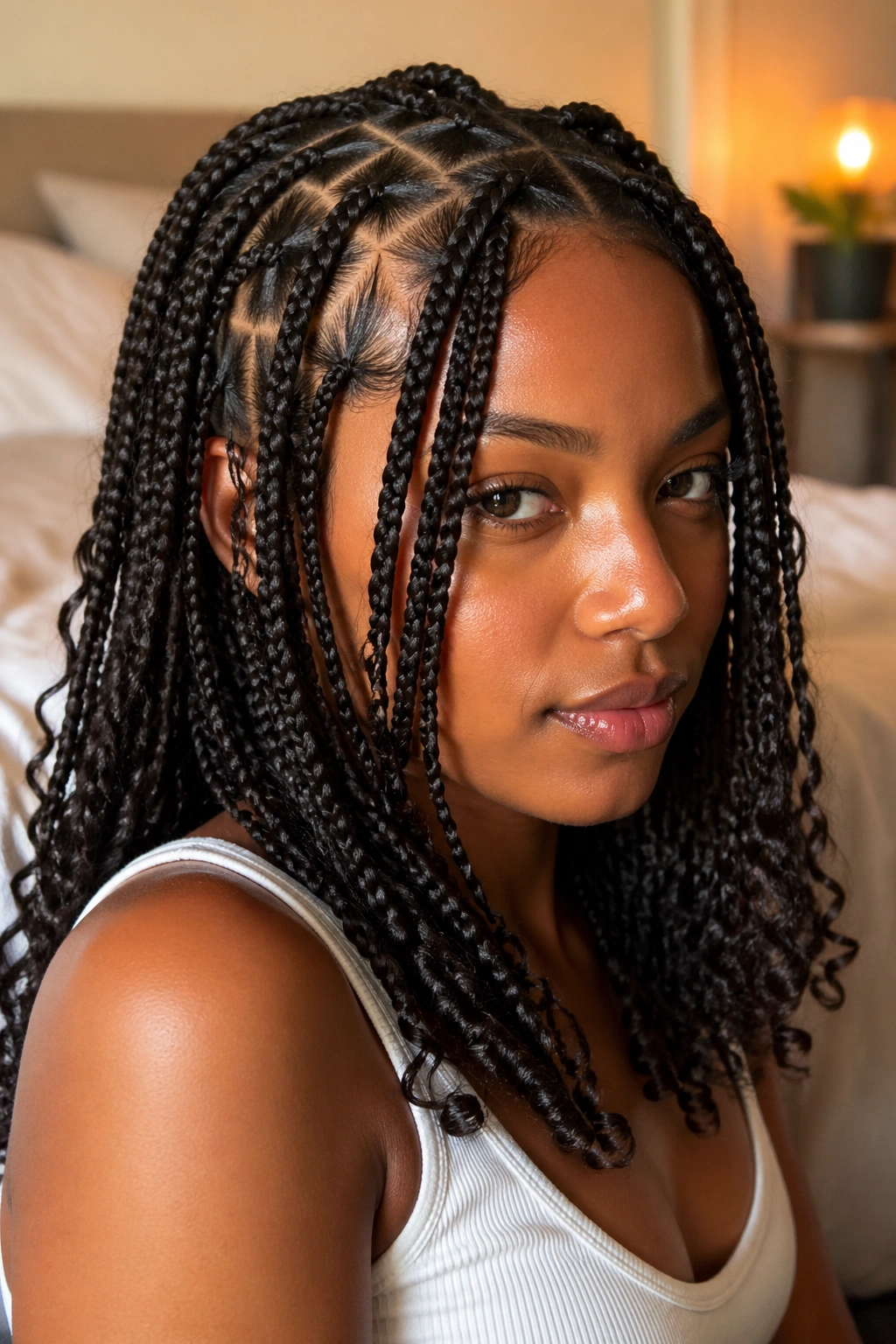
Layering changes the silhouette in a way people notice right away, even if they can’t explain why. Shorter braids around the front of the face let the triangle parts show off more clearly near the hairline, and the longer pieces in the back make the curls at the ends feel more dramatic.
The shape matters here
A braid that lands at chin length in front and mid-back in back gives the whole style a curve instead of a flat line. That curve is what makes the curls at the bottom feel deliberate. The ends don’t just hang there; they finish the shape.
Ask for the front braids to be trimmed or installed about 1 to 2 inches shorter than the back pieces. That small difference changes everything. Too much layering can make the style look choppy. Too little, and you lose the shape that makes this version stand out.
This one is good if you like your braids to frame your face a little. It’s neat, but not severe.
8. Blonde Ombré Triangle-Part Braids With Honey Curly Ends
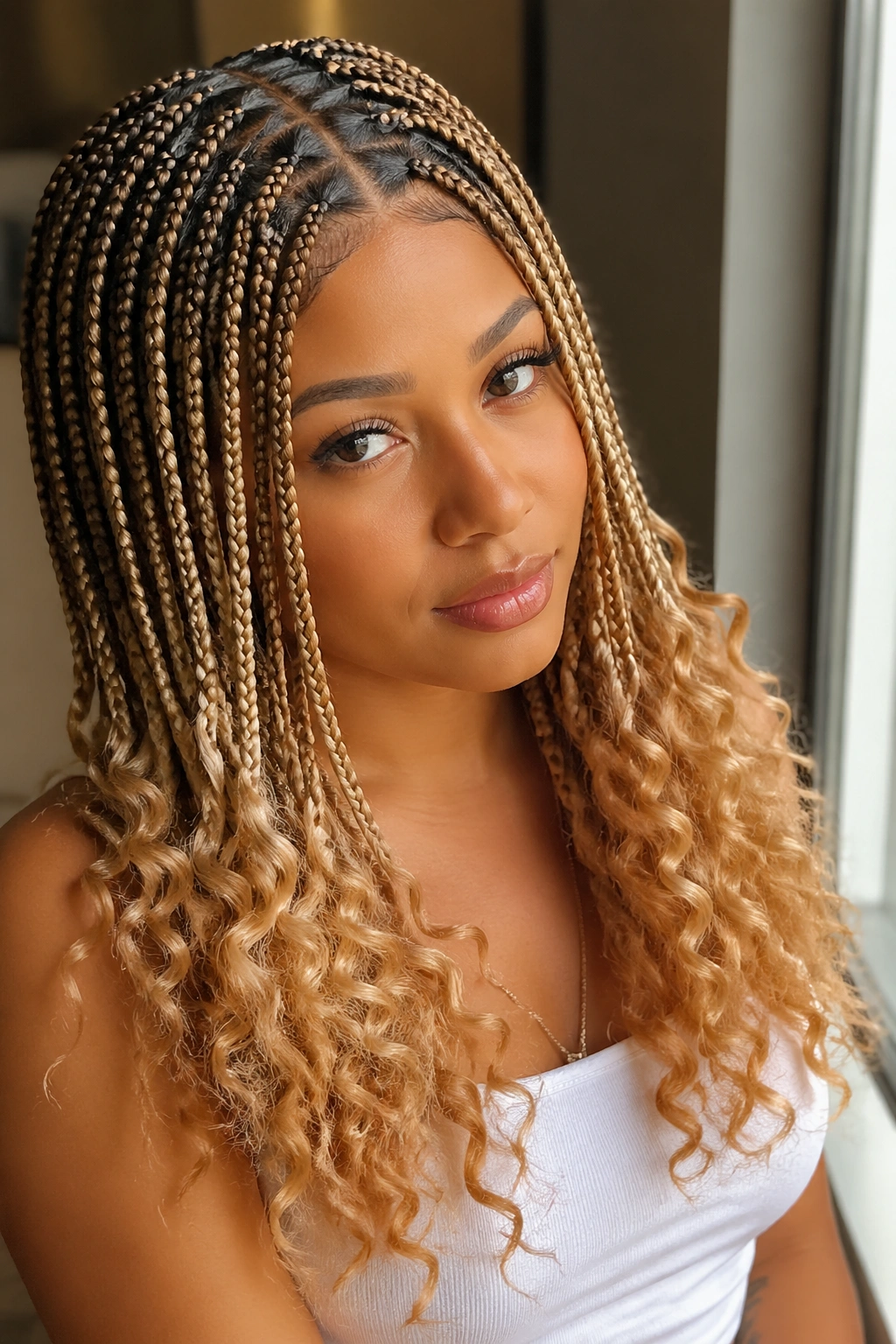
Blonde ombré braids show off triangle parts in a way darker colors sometimes don’t. The lighter ends catch the eye first, so the triangle pattern becomes a frame for the color rather than the only thing people notice.
Honey tones work especially well when the curls are placed at the ends. The lighter color gives the curls a soft glow, and the movement makes the gradient look more natural. You can go from deep roots to warm blonde mid-lengths, then finish with bright honey curls that feel airy instead of harsh.
A lot of ombré braids fail because the color jump is too sharp. Don’t do that here. A gradual shift looks better, and the curly ends need enough color variation to show texture. If everything is one flat blonde, the curls can disappear in photos and in person.
This version is for someone who wants the triangle parting, but also wants the color to do some talking. It’s not subtle. That’s the point.
9. Burgundy Triangle-Part Box Braids With Glossy Curls
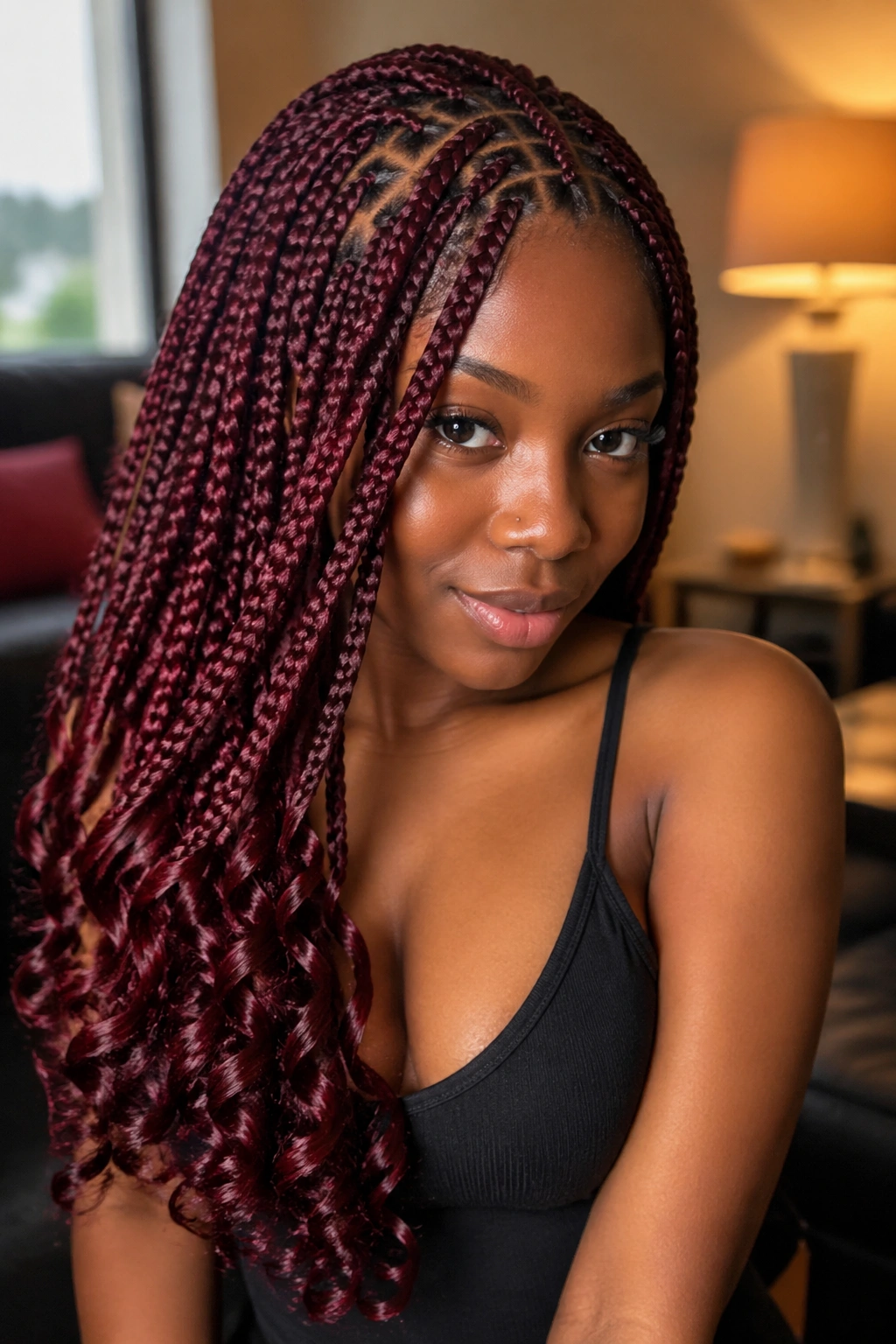
Burgundy does something nice to triangle-part box braids: it makes the sections look richer without needing extra accessories. The color has enough depth to feel bold, but it still looks controlled, which suits the angled triangle parts really well.
Glossy curls at the ends make this style read cleaner than matte curls would. The shine helps the curl pattern stand out against the braid length, especially when the light hits the ends and the color shifts from deep wine to a softer red-violet edge. It’s one of those shades that looks expensive without trying to look expensive. If that makes sense. It does to me.
This style works well with medium or long lengths because the color needs space to show the shift from braid to curl. On a very short cut, the burgundy can look a little abrupt. On longer braids, it breathes.
If you like rich color and don’t want the style to rely on beads or cuffs, burgundy is a sharp choice.
10. Triangle-Part Braids With Gold Cuffs and Curved Ends
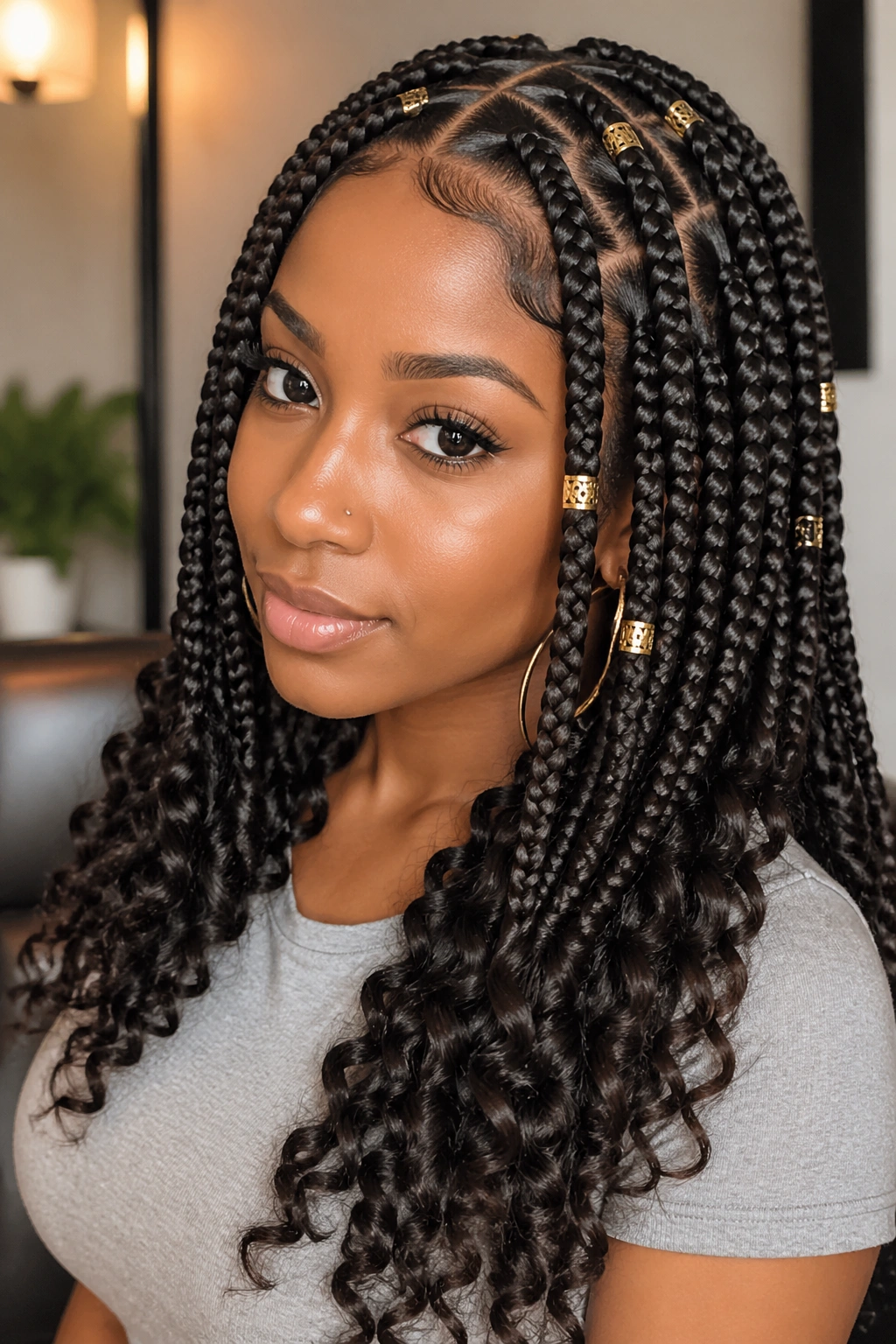
Gold cuffs can make triangle-part braids look more finished, but they need restraint. One or two cuffs placed near the mid-length or just above the curled ends is enough. Stack too many, and the braid starts looking weighed down.
Where the cuffs belong
Put the cuffs after the curls are set. That way you don’t snag the end shape while styling. A cuff near the last third of the braid can draw the eye downward toward the curl, which is exactly what you want when the ends are part of the design.
Curved ends work better than tight coils here. The curve echoes the metal shape without competing with it. If you’ve got straight, stiff ends and a lot of cuff shine, the whole look can feel boxy. Soft curves break that up.
This is a dress-up style without being precious. Good for dinners, events, or any day when you want the braids to look a little styled without spending an hour on them.
11. Half-Up Triangle-Part Box Braids With Curly Ponytail Ends
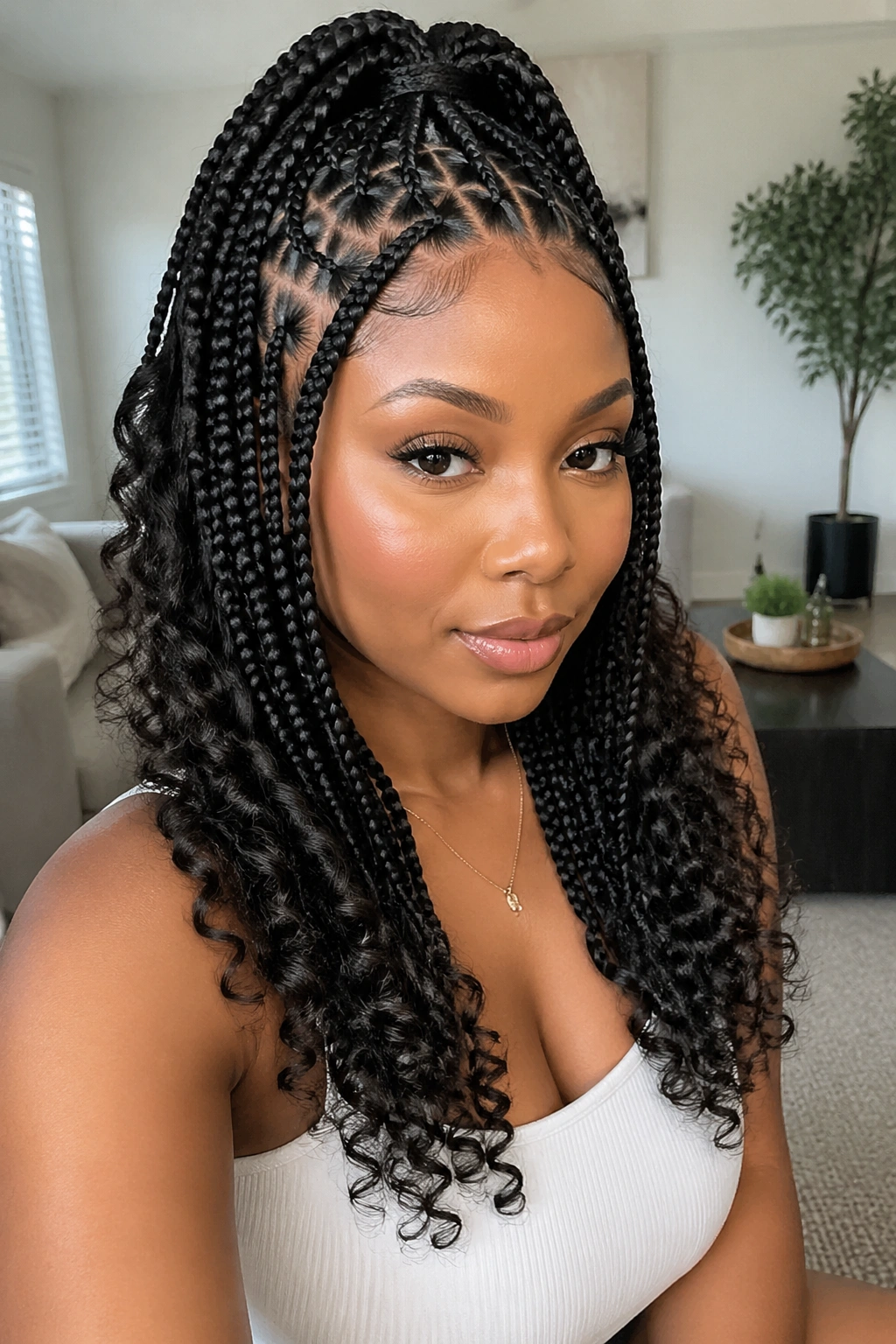
Half-up styles are useful because they keep the face open while still showing off the braid pattern. Triangle parts remain visible around the front and sides, and the curly ends get their own moment once the braids are gathered at the crown.
The ponytail section should sit high enough to create lift, but not so high that it pulls on the roots. That’s the mistake people make. A half-up braid style only looks good when the base stays flat and the top knot or tie doesn’t yank the hairline backward. Use a snag-free band, and don’t pull the front too tight.
The curls at the back matter here because they create movement when the rest of the braids are pinned up. If the ends are too straight, the style feels unfinished. If they’re too frizzy, the ponytail gets messy fast. A soft curl pattern lands in the middle.
It’s one of the easiest triangle-part braid looks to wear if you like having hair off your face.
12. Side-Swept Triangle-Part Box Braids With Curtain Pieces
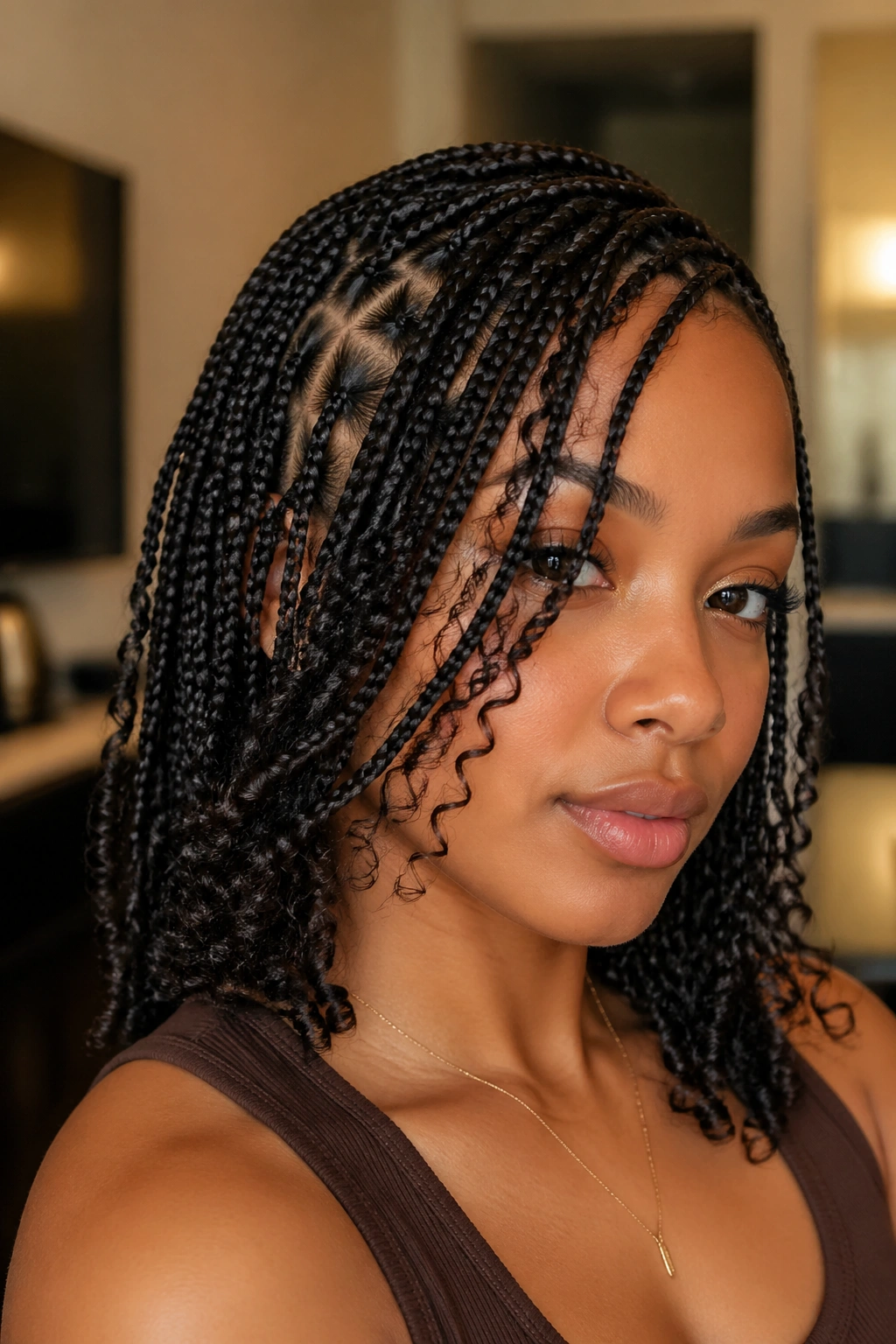
A deep side sweep changes the mood fast. Suddenly the triangle parts aren’t just a scalp detail; they become part of a shape that moves across the face and down one side of the head.
The best curtain pieces are braids that sit a little shorter near the front, then blend into longer lengths at the cheek and collarbone. That asymmetry lets the curly ends show at different heights, which keeps the style from feeling flat. The whole thing looks a little softer, a little more deliberate.
You do need to be careful with balance. If the side sweep is too heavy, the braids can tug toward one ear all day. If it’s too light, it loses the point. A well-placed side part and a few pinned-back front pieces usually solve that.
This style is for someone who likes the triangle parting but wants the finish to feel less centered and more face-framing. It’s flattering in a way that’s hard to fake.
13. Medium-Length Triangle-Part Braids for Everyday Wear
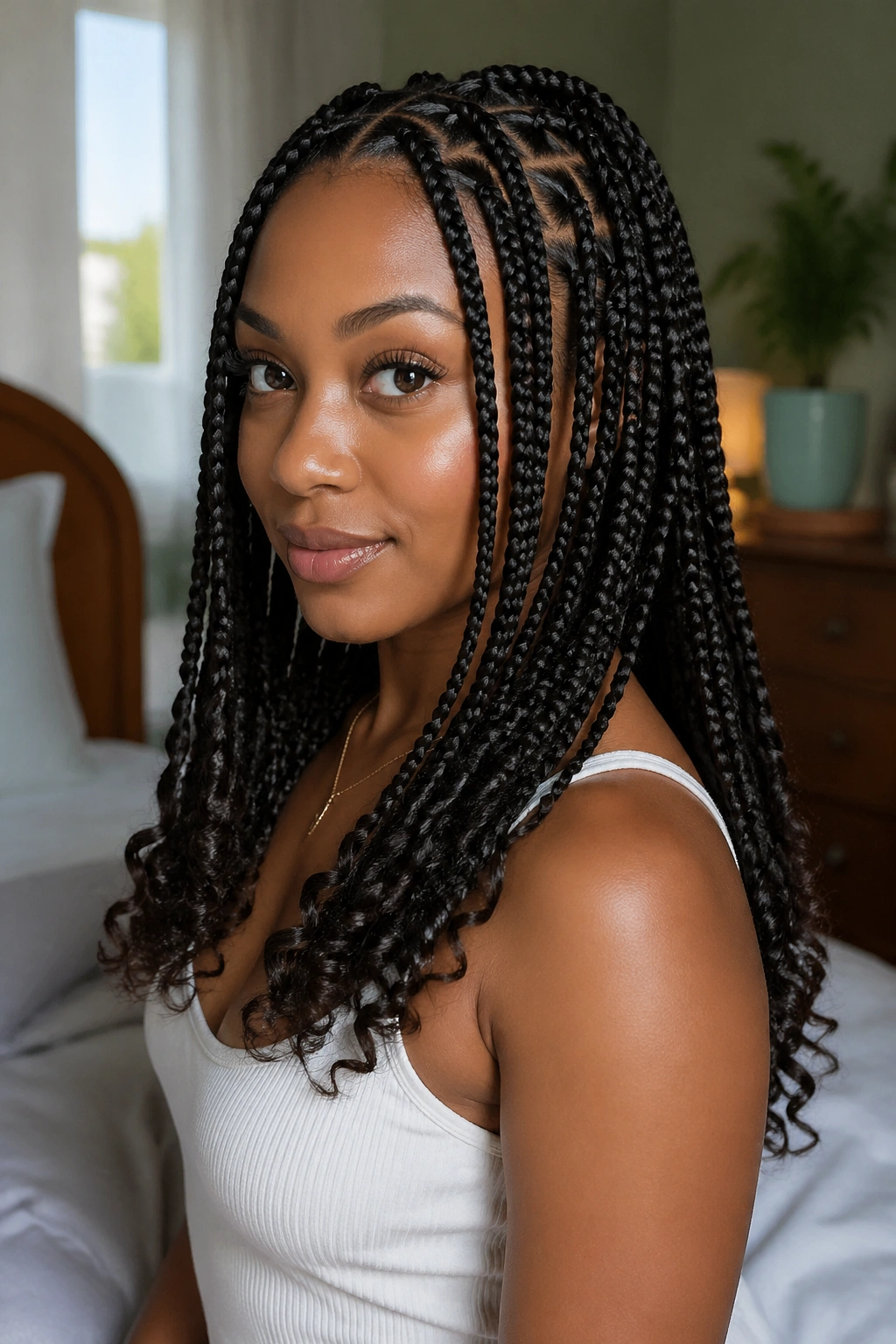
Medium-length triangle-part braids are the workhorse version. They sit somewhere around the chest or upper back, which makes them easy to wash, easy to sleep in, and easy to pin up without wrestling a lot of extra length.
The curly ends are what keep this length from feeling plain. Without them, medium braids can read a little safe. With them, there’s enough softness at the bottom to make the style feel finished. You get the structure of the triangle parting and the movement of the curl in one neat package.
This is probably the most practical choice if you wear braids for weeks at a time. They don’t whip around as much as long braids, and they don’t crowd the neck the way very short, thick braids sometimes do. The curls need a quick refresh now and then, but that’s true of almost every braid style with a soft finish.
If you want one look that works with errands, work, and going out without a full restyle, start here.
14. Extra-Long Triangle-Part Braids With Feathered Ends
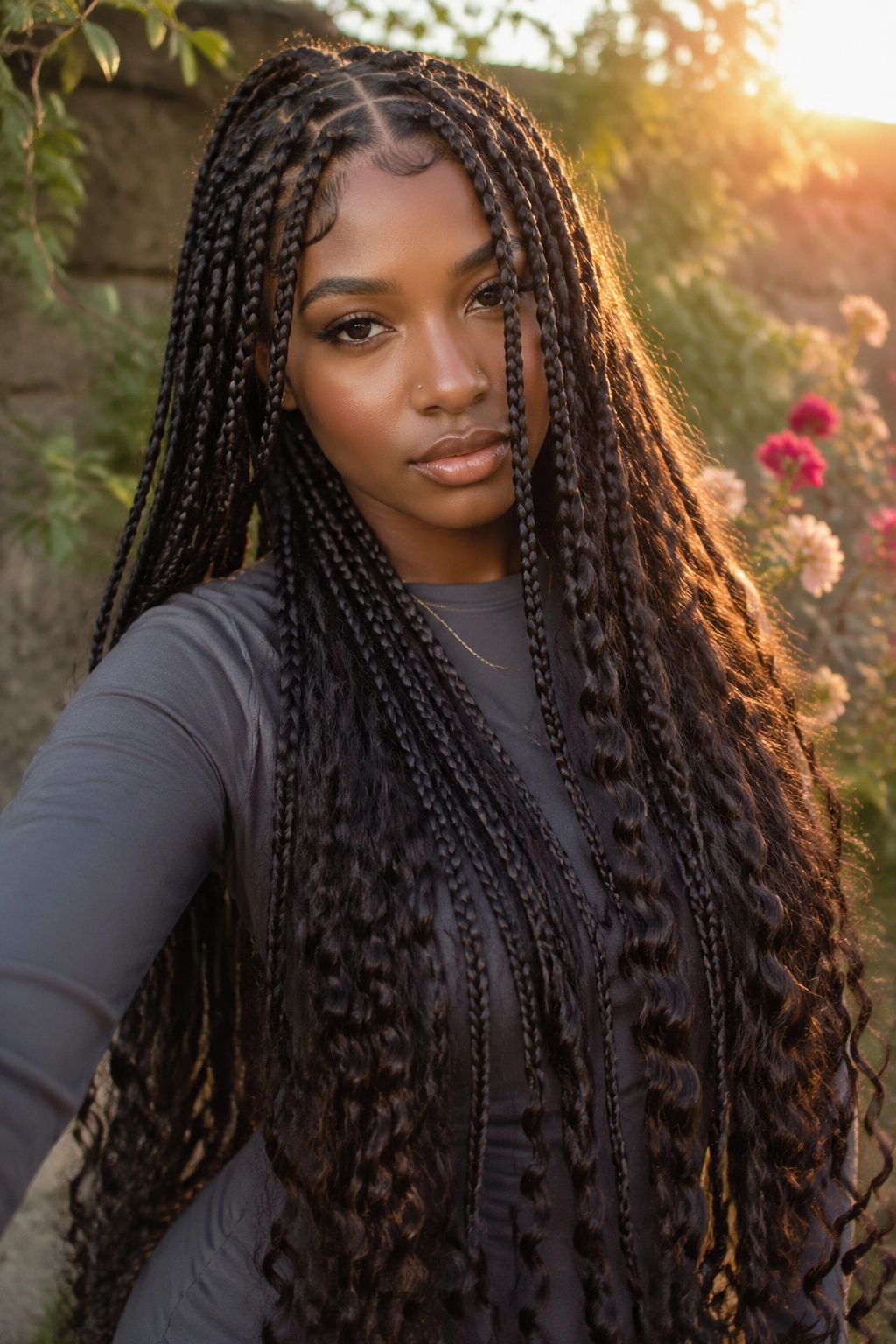
Extra-long braids can be gorgeous, but they come with weight. Triangle parts help because the angled sections make the scalp pattern feel more interesting, and feathered ends keep the bottom from looking like one heavy block.
What to watch for
The longer the braid, the more the hair wants to pull downward. That’s why the feathering matters. A soft curl or a brushed-out spiral at the ends takes some of the visual heaviness away. The braids still look long and dramatic, but they don’t feel as severe.
Keep the extensions light. That part isn’t glamorous, but it matters. If the braid is too thick from root to tip, the weight adds up fast, and the triangle parting loses the clean, airy look that makes it work. Light hair at the ends also keeps the curls from collapsing under their own weight.
This style is for someone who likes length first and convenience second. Nothing wrong with that. Just know what you’re signing up for.
15. Triangle-Part Box Braids on a Tapered Cut
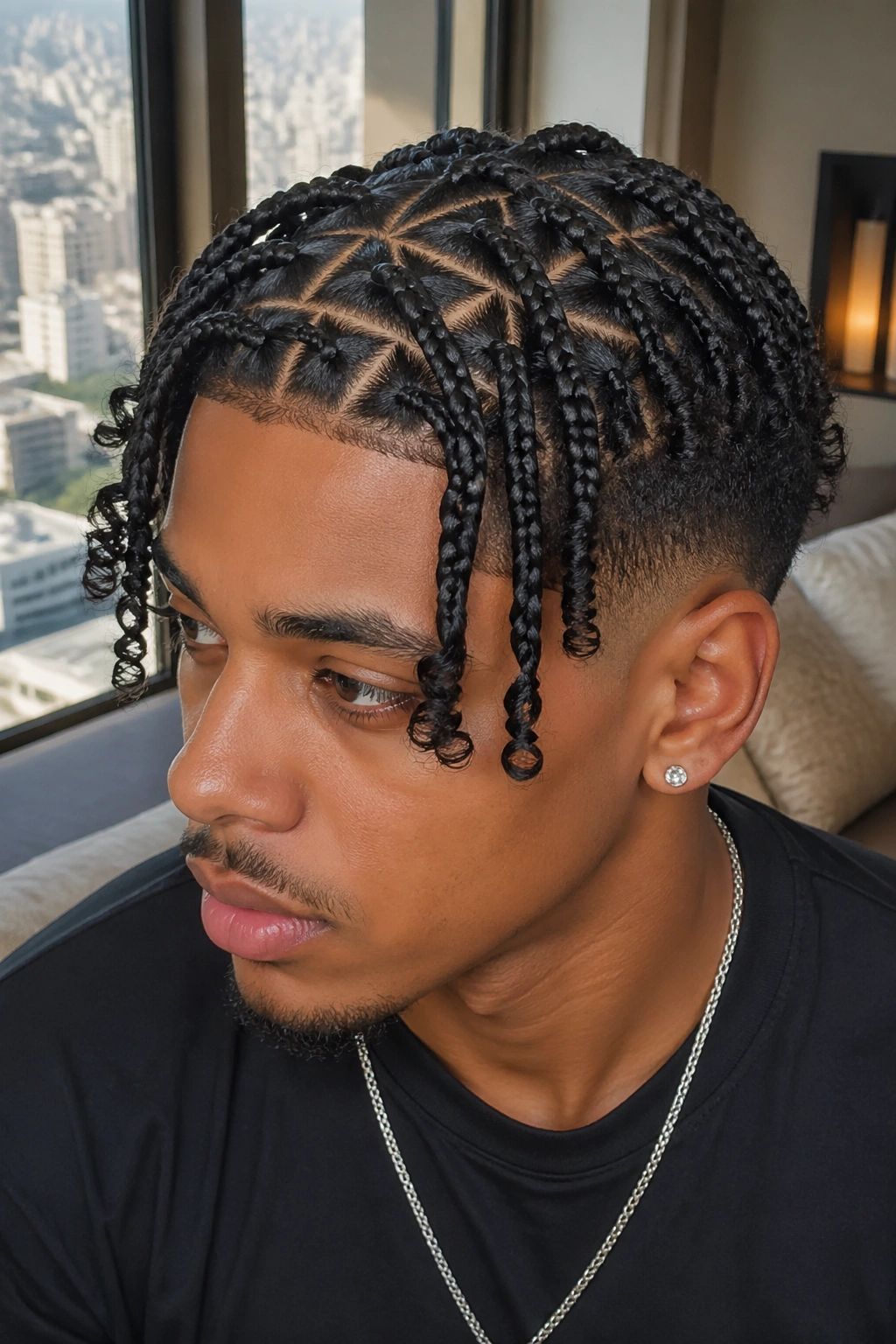
A tapered cut gives triangle-part braids a cool shape because the hair already has a natural shift in density. The sides stay neat, the top has room for the parting to show, and the curly ends keep the top-heavy silhouette from feeling harsh.
What I like here is the contrast. The style is tight and clean at the sides, then fuller at the crown, then soft again at the ends. That rhythm looks intentional. It’s a good way to keep the braids from overwhelming the face or neck.
You do need a careful installer for this. The triangle parts on top should line up with the shape of the cut so the braid pattern doesn’t fight the haircut. If the parting is too broad or too heavy near the sides, the shape gets bulky fast.
This is one of the sharper, more modern-looking triangle-part braid options. Clean edges. Soft ends. Not much fluff.
16. Triangle-Part Braids With Crimped Curly Ends
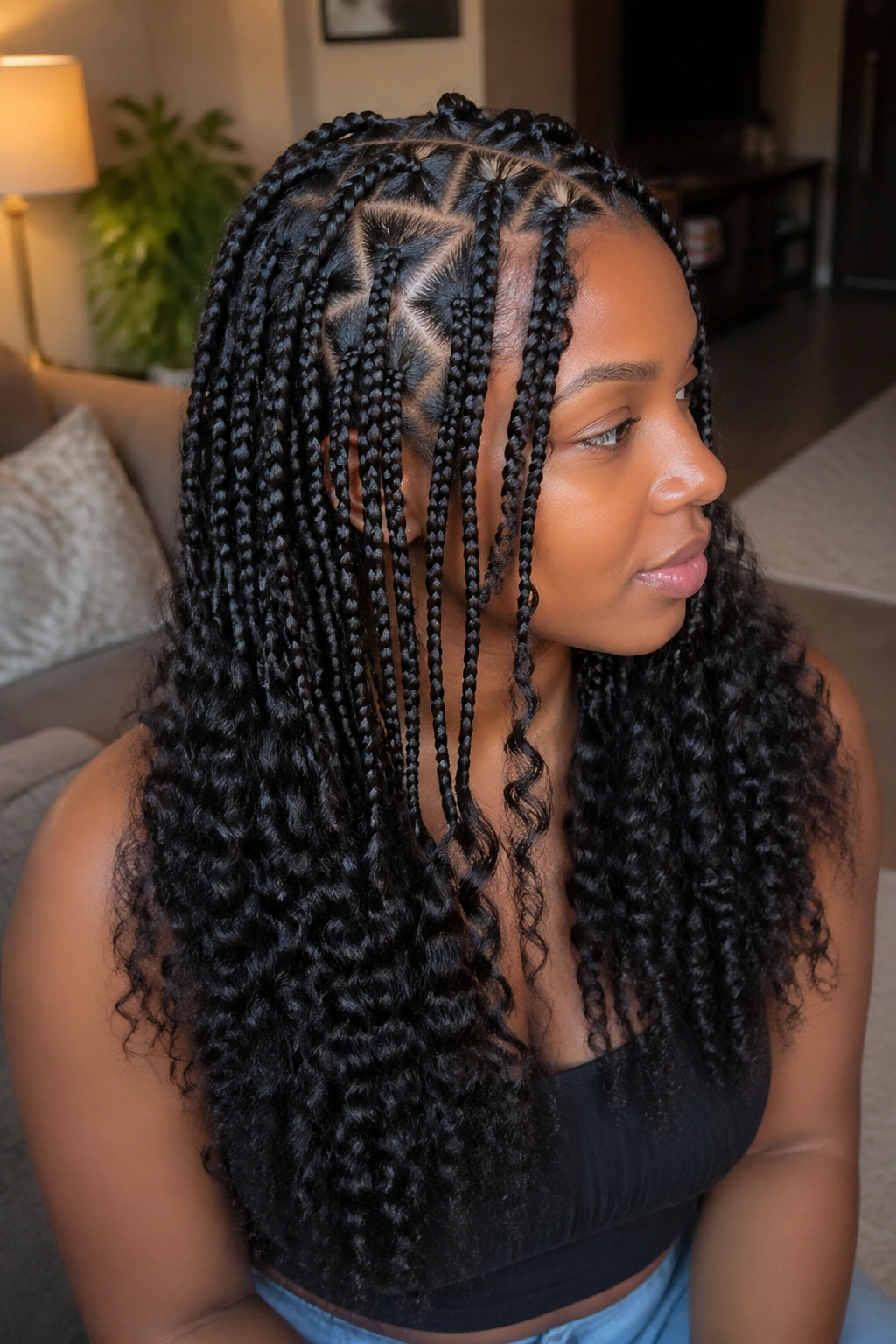
Crimped ends have a different energy from spiral curls. They feel textured instead of romantic, which makes the whole style look a little more playful and a little less polished. That can be a good thing.
The triangle parts give you structure. The crimped ends bring the movement. Put those together and the style reads as intentional without getting too neat. I like this one when the braids themselves are simple and the ends are doing the talking.
How to keep the texture from going flat
The ends need enough hold to keep the crimp pattern visible, but not so much product that they go stiff. Use a light mousse or setting foam and let the curls set fully before you touch them. If you sleep on them too soon, they lose their shape and start bending in strange places.
This style isn’t for someone who wants a smooth, glossy finish. It’s for someone who likes texture with a little edge.
17. Triangle-Part Braids With a Deep Side Part and Curl Flip
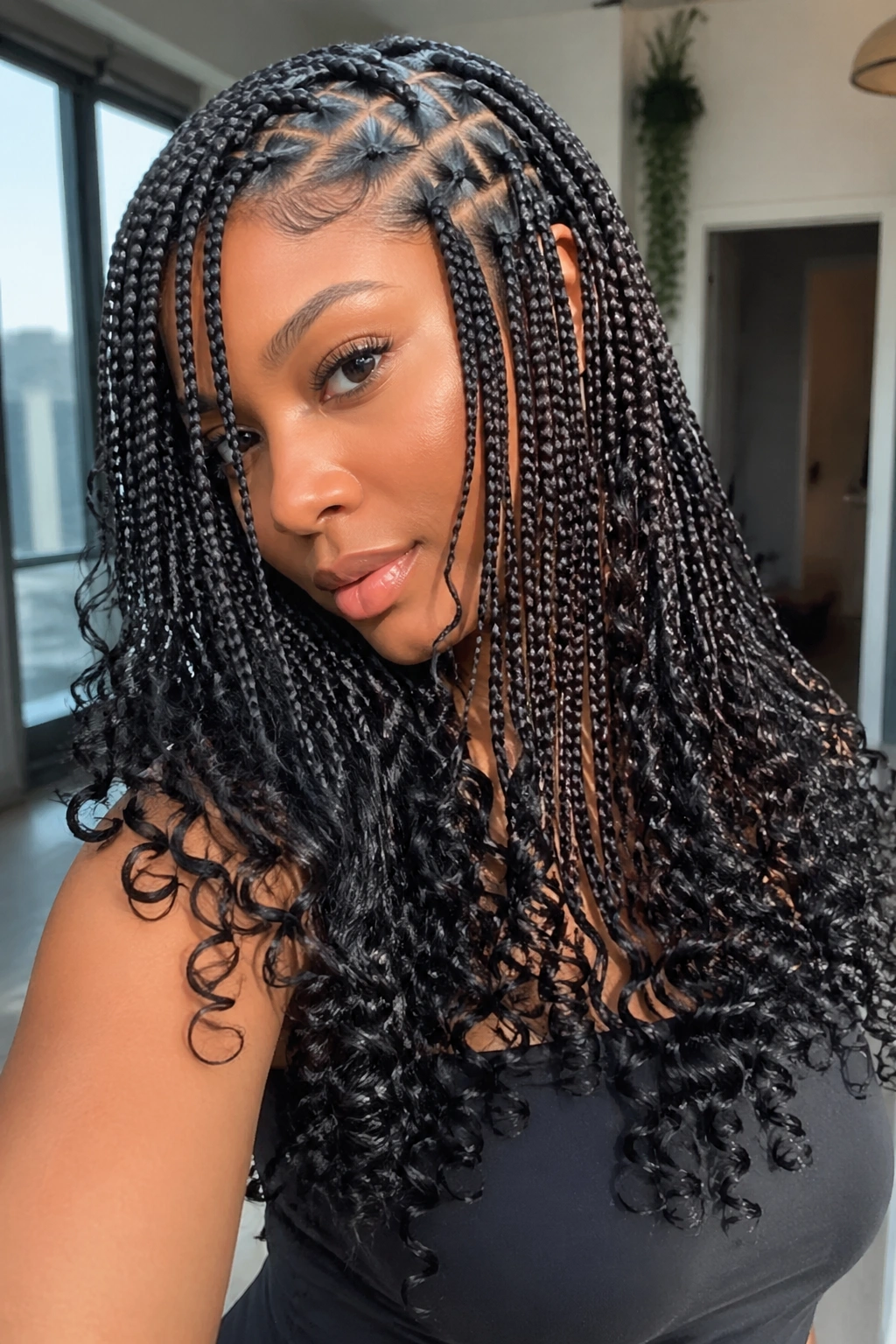
A deep side part changes the balance of the whole head, and the curl flip at the ends adds a little attitude. Instead of ending in a uniform spiral, the braids turn outward or under slightly, which gives the ends a lifted shape.
That lifted finish matters because side parts can make braids feel heavy on one side. The curl flip pushes back against that. It gives the eye a reason to keep moving down the braid instead of stopping at the root. If you have strong cheekbones or a sharp jawline, this shape is especially flattering because it draws the braid line across the face.
This version works well at collarbone to mid-back length. Shorter and the flip can feel cramped. Longer and the side sweep gets dragged down by the weight. In the middle, it lands just right.
A deep side part is not subtle, and that’s exactly why it looks good here.
18. Triangle-Part Box Braids With Beads and Curly Tails
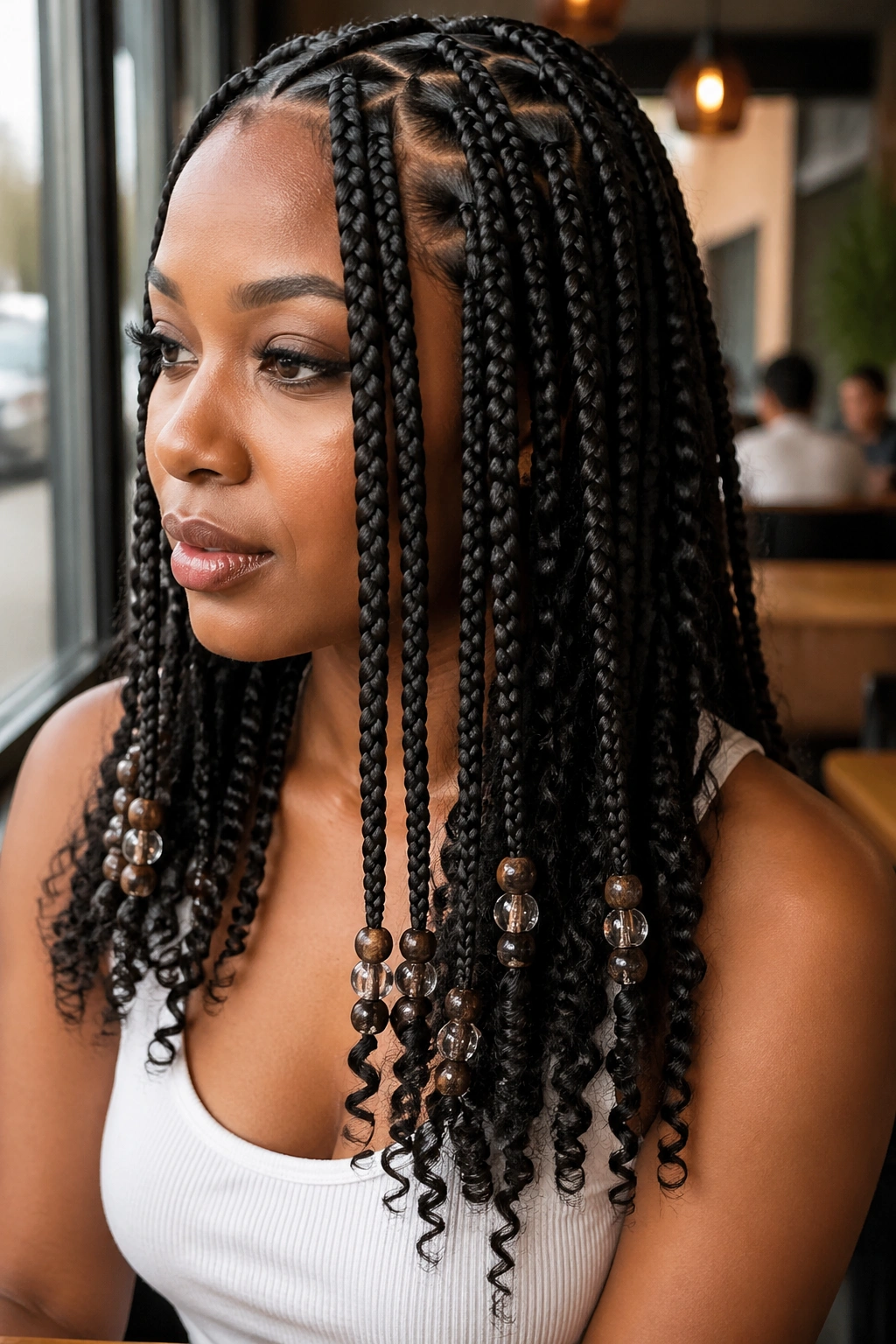
Beads change the sound and the feel of braids. They make the ends click a little, swing a little, and look more finished without taking away from the triangle pattern at the scalp.
The trick is placement. Put the beads where they won’t crush the curls. If they sit too low, they flatten the end shape. If they sit too high, the braid can look overloaded near the bottom third. A small stack of clear or gold beads just above the curly tails usually does the job.
This style is playful, but it can still look clean if you keep the bead count low. Two or three per braid is often enough. More than that starts to feel fussy, and the curls lose their breathing room.
It’s a nice option if you want the triangle parts to feel a little more decorative. The beads give structure, the curls soften the finish, and the combo has a bit of movement every time you turn your head.
19. Triangle-Part Box Braids With Two-Tone Curly Ends
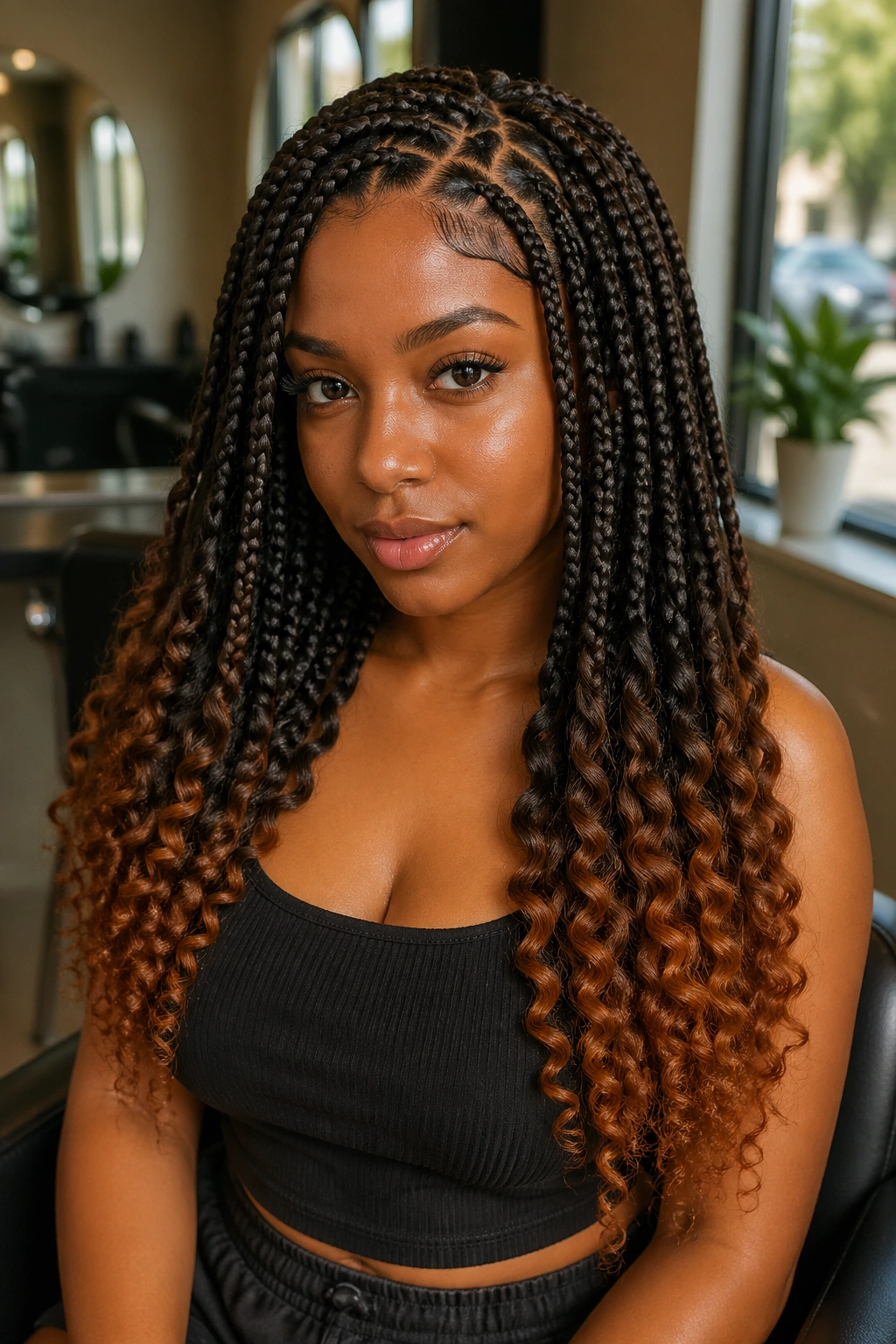
Two-tone ends can do more for triangle-part braids than people expect. When the base braid stays one color and the curled ends shift into another shade, the whole style gets a clear focal point at the bottom. That makes the curl pattern easier to see and gives the triangle parts a cleaner frame.
Chocolate-and-caramel, black-to-brown, auburn-to-copper — those kinds of pairings work because the transition looks soft instead of sudden. Keep the color shift at the last third of the braid, not halfway up. If the change starts too high, the braid can look chopped in two.
This is the kind of style that photographs well without needing extra shine spray or accessories. The color contrast does some of the heavy lifting. Still, the curls need to be defined. Flat ends kill the whole effect.
If you like the idea of color but don’t want the entire head loud, two-tone curly ends are a smart compromise.
20. Triangle-Part Box Braids With Big Curly Ends and a Slicked Base
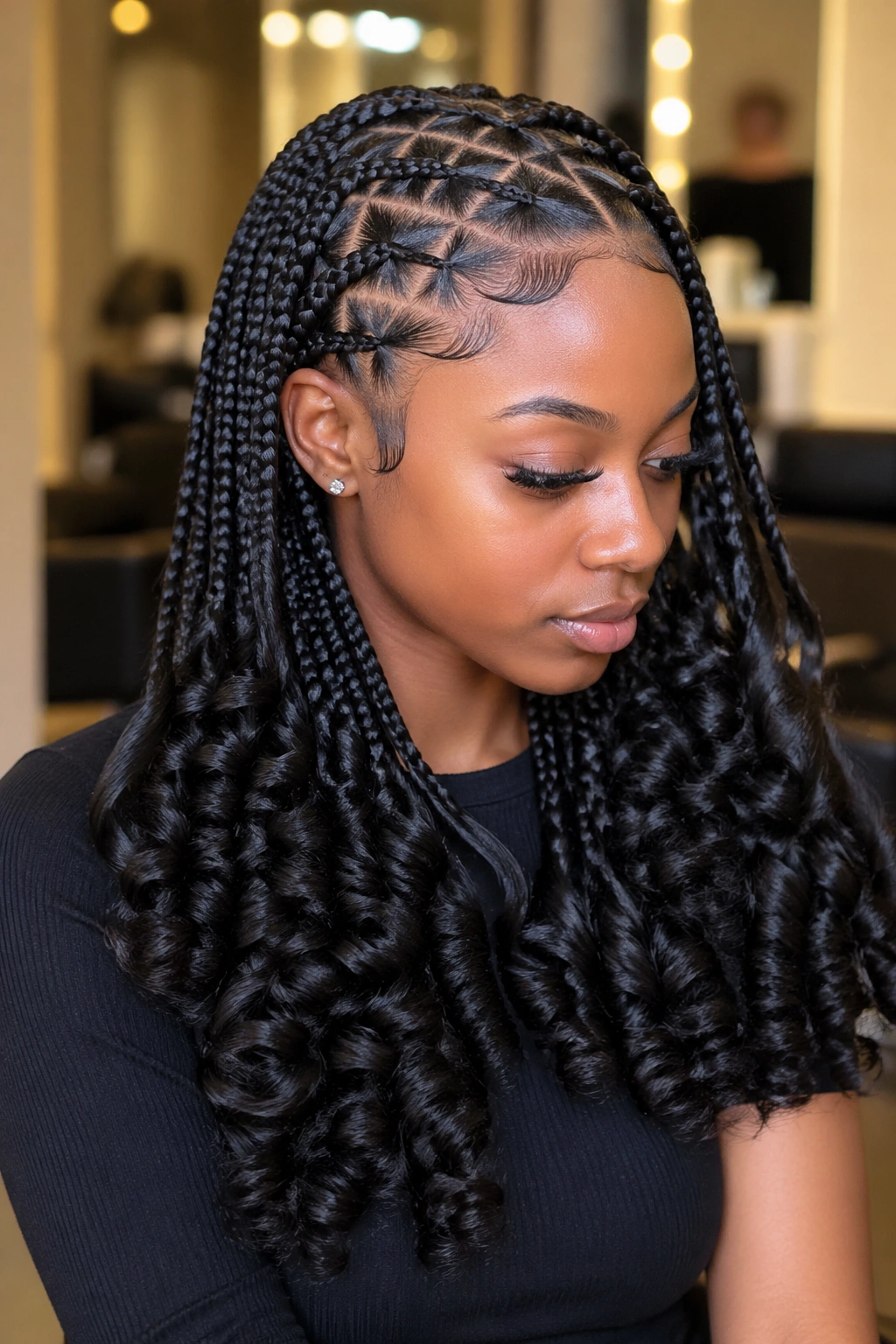
This is the one that looks dramatic without looking messy. The roots are smooth, the triangle parts are crisp, and the curls at the ends are big enough to steal attention. That contrast is the whole point.
A slicked base works best when it stays close to the scalp and doesn’t pile up product around the hairline. Too much gel makes the parts look sticky instead of clean. A small amount of edge control or foam is enough if the braids are installed neatly. Let the curls be the big visual note. Don’t crowd them with shine from root to tip.
The oversized curl finish gives this style a soft, almost dressy shape. It’s a good choice when you want the braids to feel finished without adding cuffs, beads, or color. Everything is in the shape itself. Clean triangle sections. Smooth start. Big, loose curl at the end.
A little extra drama never hurts. Especially here.
Final Thoughts
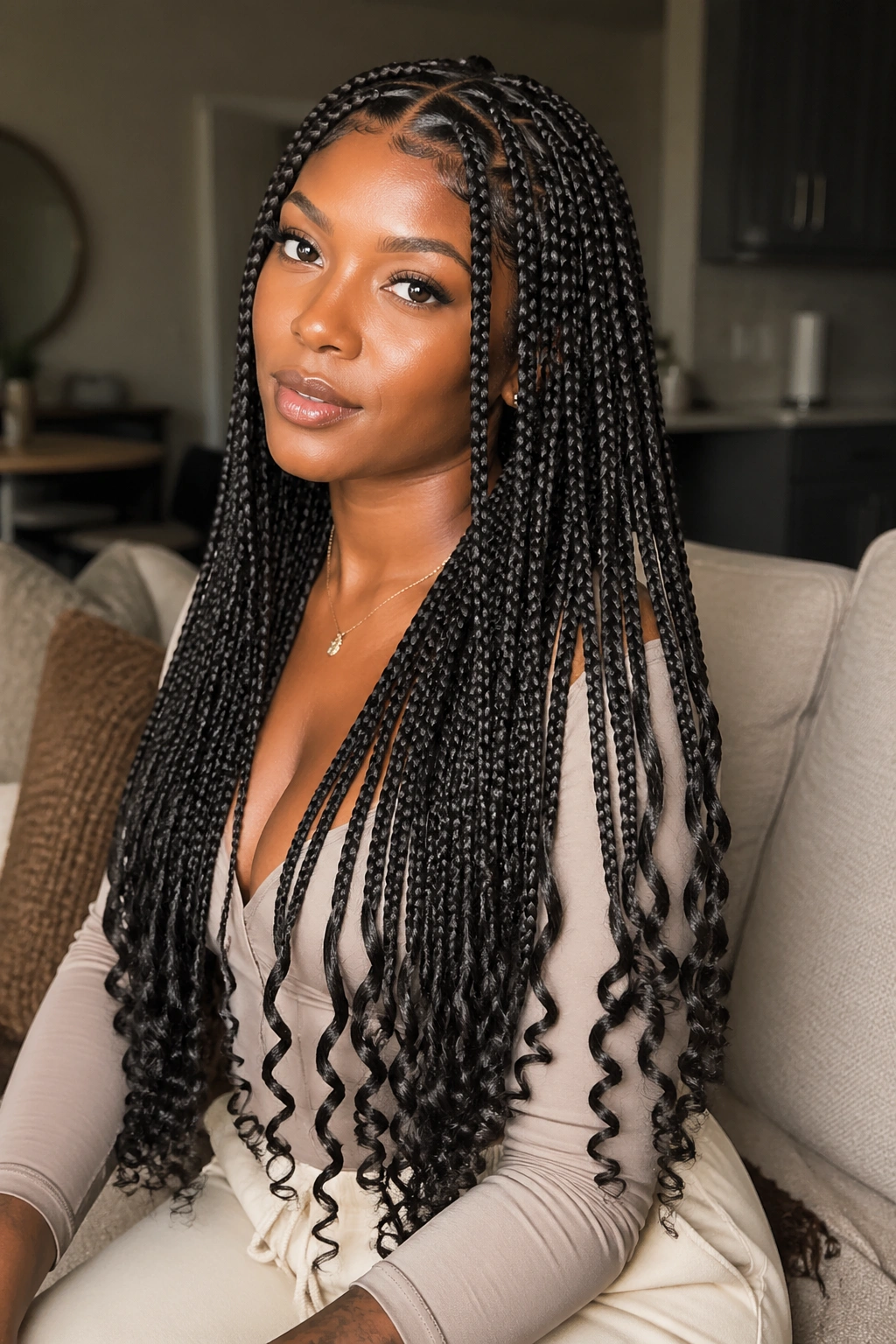
Triangle-part box braids with curly ends work because they solve two problems at once: they make the scalp pattern more interesting, and they keep the finish from feeling stiff. That’s the reason the style has range. You can go neat, soft, bold, or decorative without changing the basic braid structure.
The smartest choice is the one that fits your day-to-day life. If you want low fuss, stick with medium lengths and a simple curl pattern. If you want the hair to do more of the talking, lean into color, cuffs, or a bigger curl at the end. The triangle parting will still do its job underneath.
And if you’re sitting in a chair deciding between two versions, pick the one you’ll still like when the mousse has settled and the mirror is no longer flattering. That’s the one that usually holds up.