

A low ponytail with bangs is one of those effortless-looking hairstyles that actually works harder than you’d think—and when it’s executed well, it’s surprisingly flattering for nearly every face shape and hair type. The combination of a relaxed, face-framing ponytail at the nape of your neck plus a bold or soft fringe on your forehead creates a balance that feels both polished and undone at the same time. It’s the kind of look you can wear to the office, to a casual weekend brunch, or even dressed up for an evening out, depending on how you style it.
What makes this style so appealing right now is that it moves away from the super-tight, pulled-back aesthetic that dominated for years. Instead, it embraces softness, movement, and a bit of texture. The bangs add personality and dimension, breaking up the severity of a low pony while adding an element of intrigue. Whether you’re drawn to wispy bangs that blend into face-framing layers, blunt thick bangs for maximum impact, or side-swept bangs that feel romantic and loose, there’s a version of this style that will work for you.
The beauty of pairing bangs with a low ponytail is that you get the practical benefits of pulling your hair back—keeping it off your face and neck while looking put-together—without sacrificing the softer, more personalized look that bangs provide. This isn’t a minimalist style; it’s a statement that says you’ve thought about your hair and you know what works for your face.
1. Classic Straight Bangs With Sleek Low Ponytail
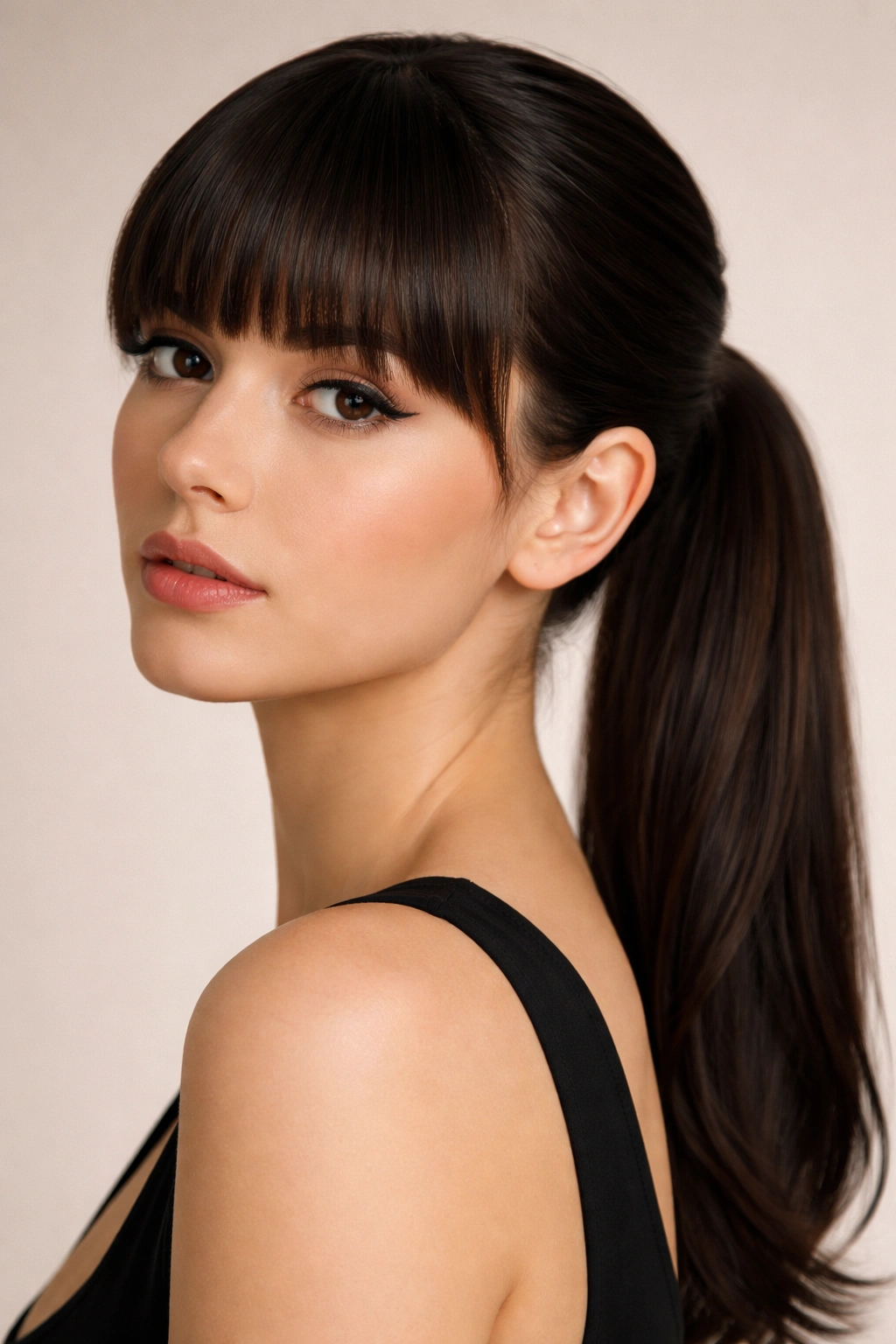
The most timeless take on this look pairs blunt, straight-across bangs with an ultra-smooth, sleek low ponytail. Think of bangs that hit right at your eyebrows, cut in a perfectly horizontal line that frames your face with precision. The ponytail sits low on the back of your head, pulled tightly enough to look intentional but not so tight that it creates tension at your hairline.
Why It Works for Almost Everyone
Straight bangs create a strong horizontal line across your forehead, which can actually balance a rounder face and add definition to an angular one. Paired with a sleek ponytail, this is the most sophisticated version of this style—it reads as intentional and editorial. The key is that the bangs and the ponytail work together to frame your face without overwhelming it. The bangs draw attention to your eyes, while the low ponytail keeps the rest of your hair structured and neat.
How to Perfect This Look
Start with hair that’s been blow-dried smooth using a paddle brush and a smoothing serum or anti-frizz cream to tame flyaways. Use a flat iron to get your bangs impossibly straight—one or two passes should do it. Pull your hair back into a low ponytail, positioning it just above the nape of your neck. Use a fine-tooth comb to smooth the sides and back, and secure with a clear elastic or a thin silk hair tie to avoid tugging. Finish with a light hairspray to hold everything in place without adding stiffness.
Pro tip: This style looks sharpest when your bangs are freshly trimmed and your ponytail has no flyaways or baby hairs. A monthly bang trim and weekly touch-ups with a flat iron keep this look looking intentional.
2. Wispy Parted Bangs With Textured Low Ponytail
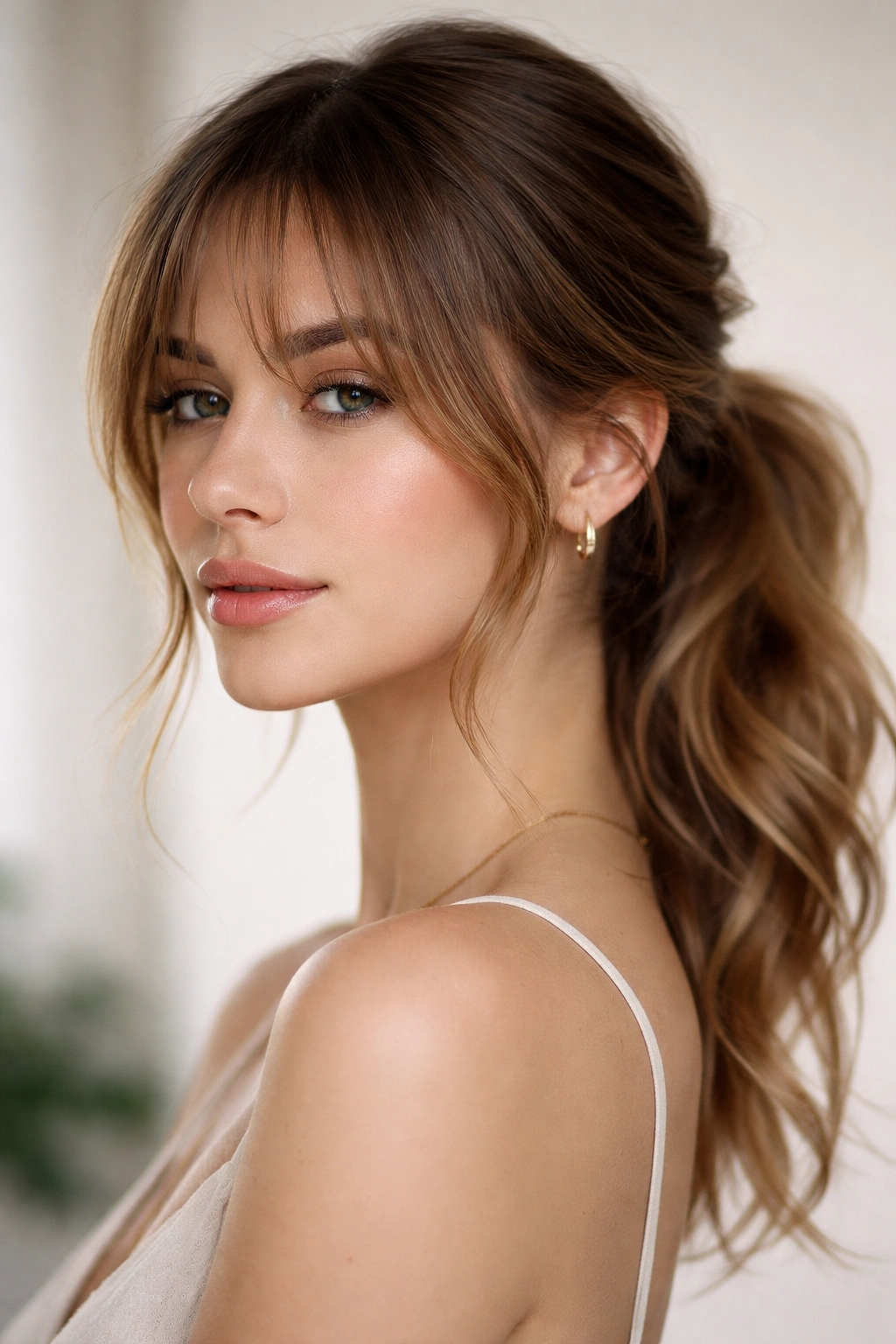
Here’s a softer approach: parted bangs that sweep gently across your forehead, paired with a textured low ponytail that feels loose and piecey rather than tightly structured. These bangs are shorter in the center and longer on the sides, creating a frame that’s flattering and romantic.
What Makes This Version Approachable
Wispy bangs are inherently more forgiving than blunt ones—they work with a broader range of face shapes and are easier to grow out if you change your mind. When paired with a textured ponytail, this look leans into the whole “effortlessly put-together” vibe. The movement in both the bangs and the ponytail means that the style looks intentional even when it’s imperfect, which honestly makes it feel more real and wearable.
Building the Texture
Start with damp hair and apply a texturizing spray or light mousse to the roots. Blow-dry your hair with a round brush, scrunching as you go to encourage natural wave and volume. Create your part and use a curling iron or wand to add subtle waves throughout your ponytail section. Pull your hair back into a low ponytail, but don’t secure it too tightly—let some texture and movement show. Gently pull at the ponytail base to loosen it slightly and create a fuller appearance. Use bobby pins to secure any flyaways, and finish with a flexible-hold hairspray.
Worth knowing: This style actually looks better after 24-48 hours when the texture has really set. Sleeping on it after styling enhances the tousled effect.
3. Curtain Bangs With Soft Rounded Low Ponytail
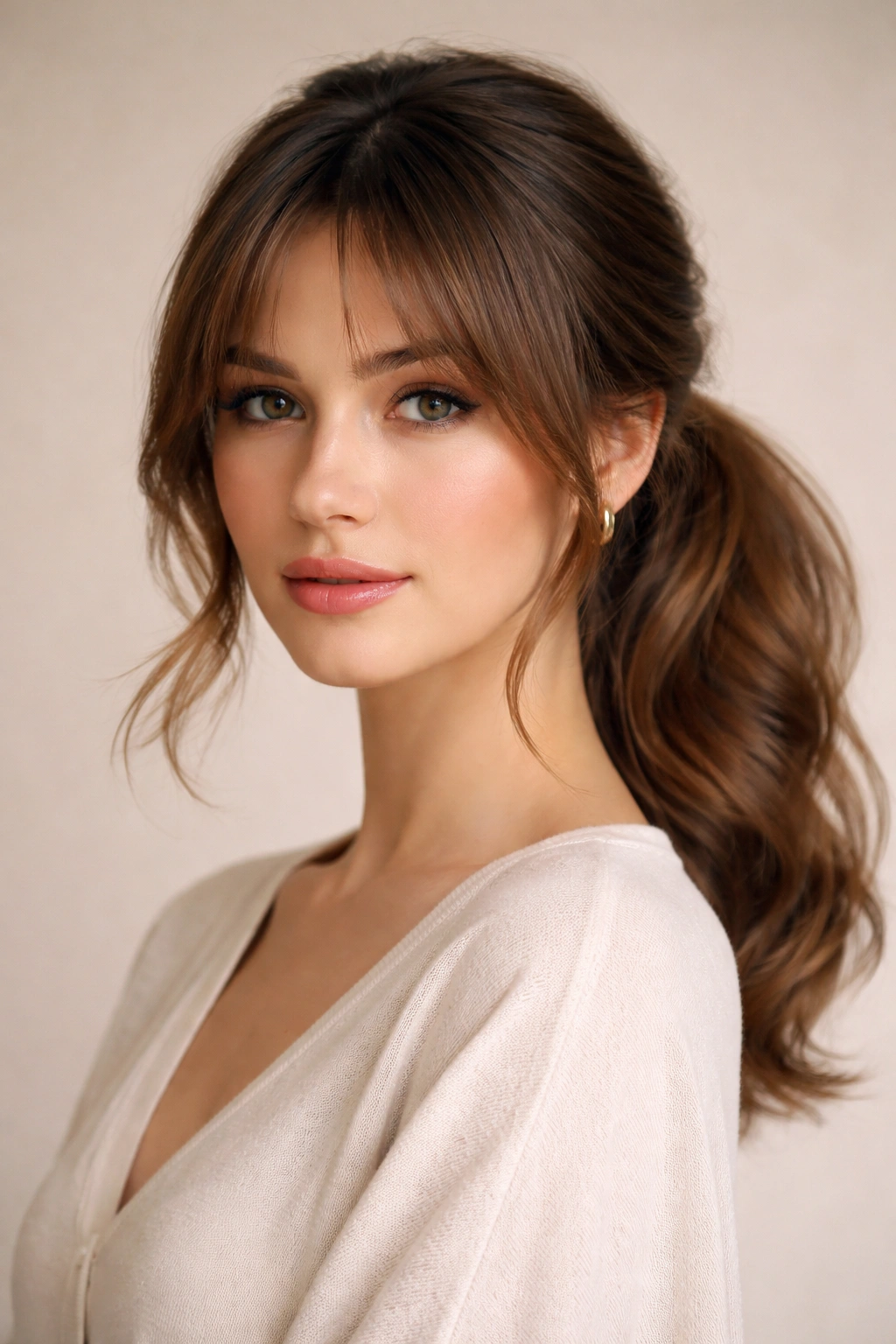
Curtain bangs—those classic parted-in-the-middle bangs that frame both sides of your face—pair beautifully with a soft, rounded low ponytail. The bangs create two gentle frames around your face, while the ponytail sits in a round, gathered shape at the base of your head rather than stretched tight.
The Psychology of This Combination
There’s something inherently flattering about this look because you’re getting the face-framing benefit of the curtain bangs without the severity of a tight style. The rounded ponytail softens the back of your head and neck, making the overall effect feel feminine and approachable. This works especially well for square or angular faces because the soft curves counterbalance straight lines.
Achieving the Shape
Blow-dry your bangs with a round brush, curling the brush slightly outward from your center part to encourage the bangs to sweep away from your face naturally. For the ponytail, create texture first using a curling iron on your hair from the mid-lengths down. Gather your ponytail and secure it loosely—this is important. Then, strategically pull at sections of the ponytail near the base to create a rounded, voluminous shape. You can also tease the ponytail slightly at the base to build height and softness. Finish with hairspray to lock in the shape.
Insider note: This style is actually easier to achieve with slightly wavy or curled hair, so if you have straight hair, adding waves first is your secret weapon.
4. Thick Blunt Bangs With Braided Low Ponytail
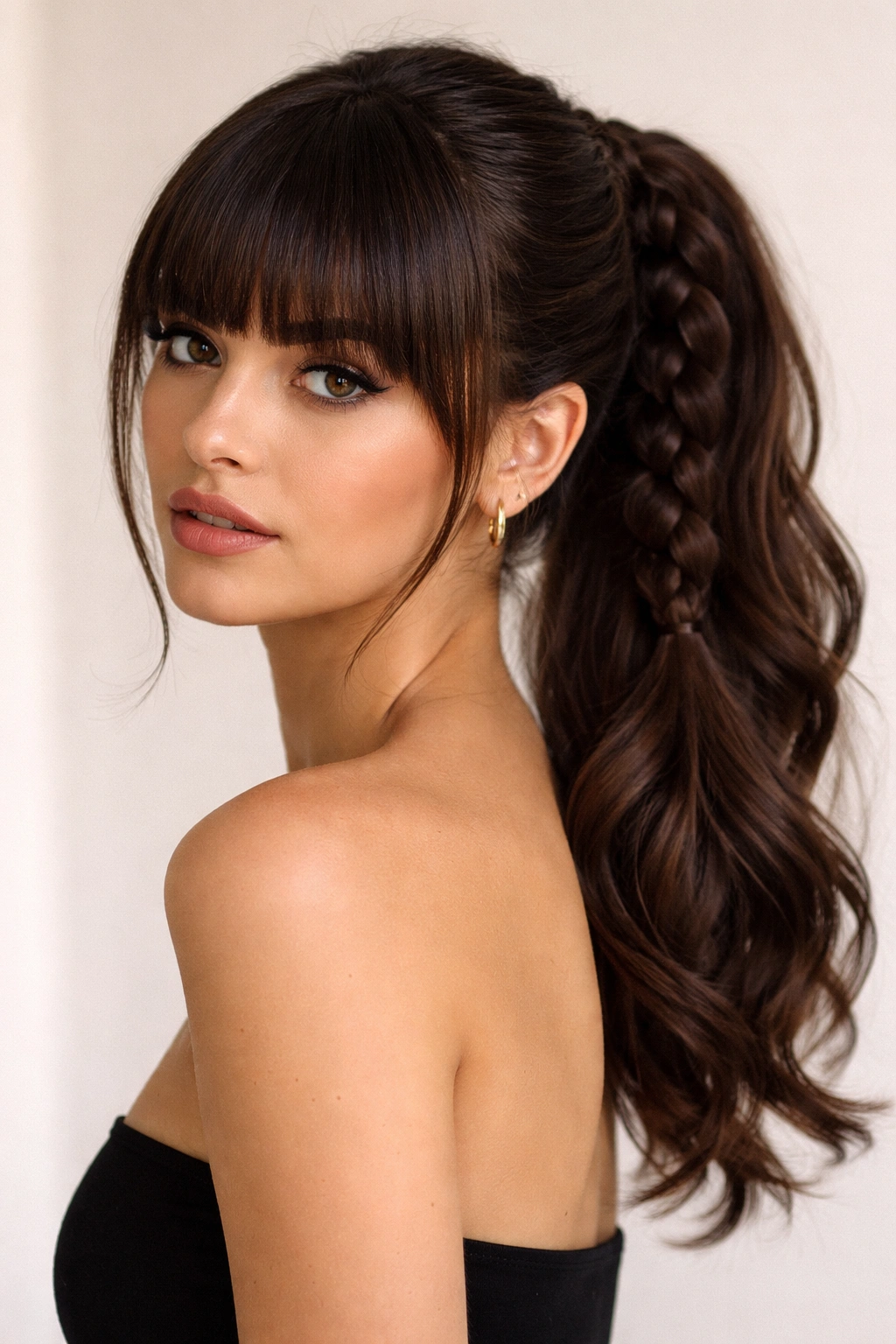
If you want to make a statement, go bold: thick, blunt bangs that create a strong visual statement, paired with a French braid that runs from the crown down to a low ponytail at the nape of your neck. The braid adds texture and visual interest to the back while the bangs command attention in the front.
Why This Look Is So Striking
Thick bangs are high-impact because they cover more of your forehead and create a stronger frame for your face. When you pair them with a braided ponytail, you’re creating a look that’s visually complex and interesting without being overdone. The braid gives the back of your head sophistication and detail, while the bangs give your face personality. This combination reads as intentional and fashion-forward.
Mastering the Braid
Start with damp hair and apply a light texturizing spray. Blow-dry your hair with volume at the roots. Section off your hair at the crown and begin a French braid, adding sections of hair as you work your way down toward the nape of your neck. When you reach the base, secure all the loose hair into a ponytail with the braided section. Tighten the braid slightly by gently pulling the edges to make it fuller and more prominent. You can leave the ponytail ends straight or curl them for extra dimension.
Real talk: This style requires steady hands and some practice. If braiding isn’t your strong suit, a loose three-strand braid is just as beautiful and much more forgiving.
5. Side-Swept Bangs With Romantically Loosened Low Ponytail
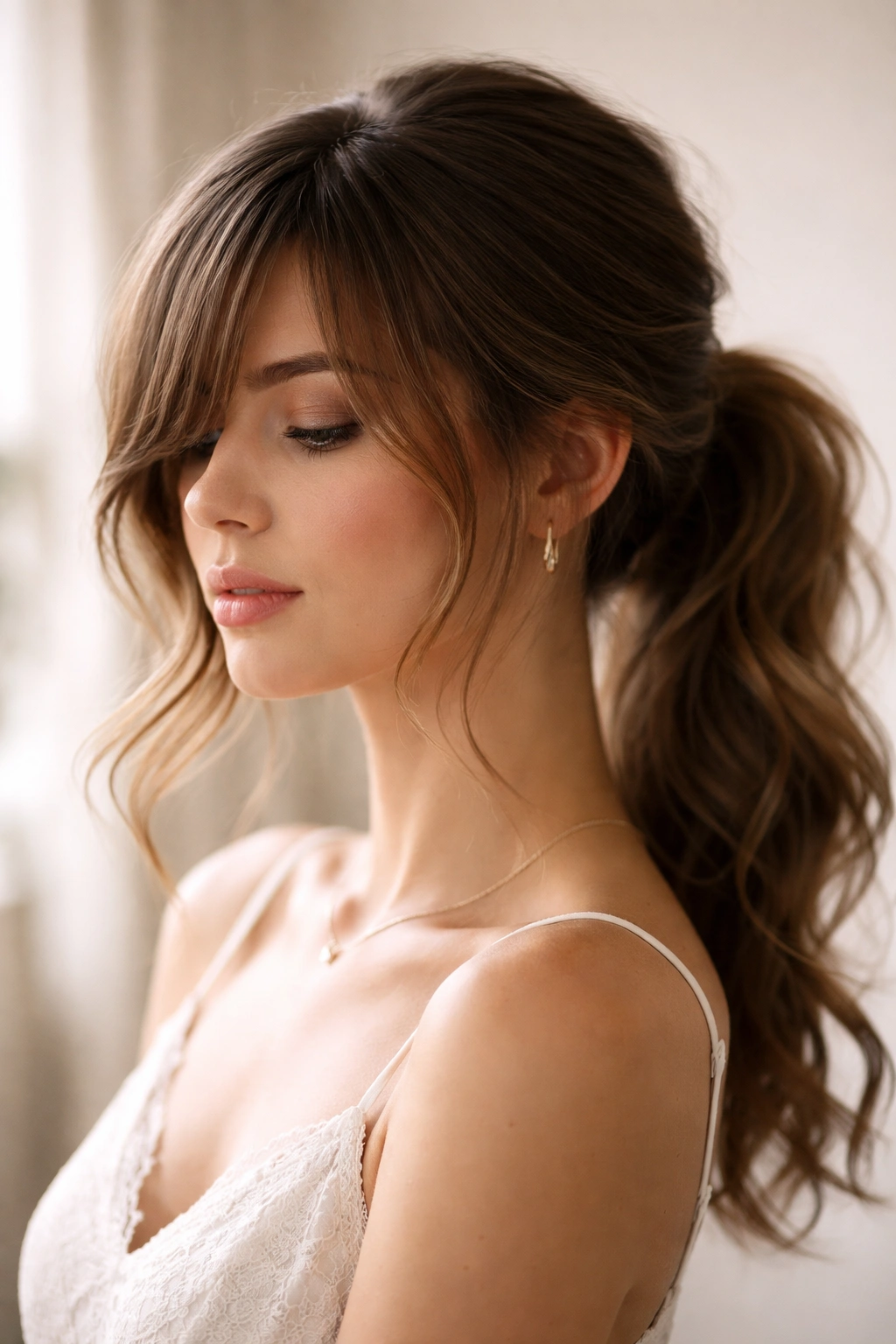
Here’s the romantic version: side-swept bangs that fall across one side of your face in a graceful arc, paired with a deliberately loosened, slightly messy low ponytail that feels lived-in and effortless. This is the look of someone who didn’t try too hard but somehow looks put-together anyway.
The Effortless Appeal
Side-swept bangs are incredibly flattering because they work with most face shapes and create a soft, asymmetrical frame. When you pair them with a deliberately imperfect ponytail—one where you’ve intentionally left some layers down and pulled the tie slightly loose—you get a look that’s polished but not stiff. It’s the hairstyle equivalent of a perfectly worn-in denim jacket.
Nailing the Intentional Messiness
This is one of those styles that’s actually harder than it looks, because achieving effortless-looking requires precision. Start with hair that has some natural texture—either from waves or from a texturizing spray. Blow-dry your bangs to sweep to one side, using a flat iron if needed to get that smooth, continuous curve. Blow-dry the rest of your hair with movement and volume. Pull your hair back into a low ponytail, but leave several face-framing layers down on both sides. Secure the ponytail loosely and then deliberately pull at the base to loosen it further. Let strands fall naturally where they will, and tuck them behind your ear on one side if needed.
Pro tip: This style works best with dirty hair (hair that’s 2-3 days old) because it holds texture better. Fresh-washed hair tends to be too slippery for this effortlessly-loose aesthetic.
6. Wispy Layered Bangs With Piece-y Textured Low Ponytail
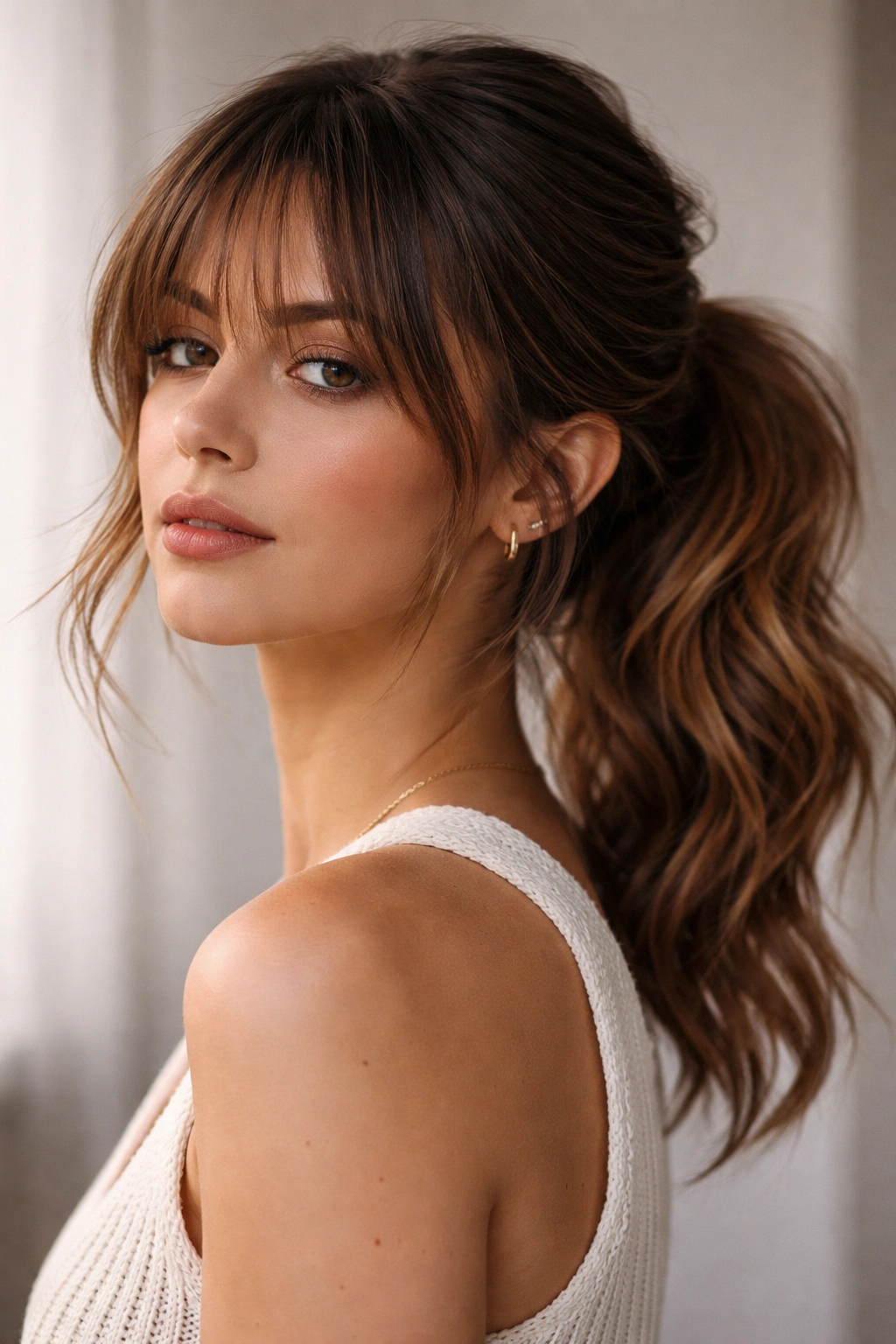
For a thoroughly modern take, try wispy layered bangs—shorter pieces mixed in with longer strands to create depth and movement—paired with a visibly piece-y low ponytail where individual sections of hair are defined and textured rather than blended together.
What Makes This Style Contemporary
This version leans into visible texture and dimension rather than trying to smooth everything into one cohesive shape. The bangs have layers within the bangs, creating complexity. The ponytail is deliberately not smooth—you can see individual sections, strands, and curl pattern. It’s a style that celebrates dimension and movement rather than sleekness.
Creating Intentional Dimension
Apply a texturizing spray or sea salt spray to damp hair, then blow-dry with a round brush to add volume. Use a curling wand on random sections of your hair to create waves, leaving some sections straight or less curled. This randomness is the point. Gather your hair into a low ponytail, but don’t worry about making it smooth. You can even braid a small section, leave a section loose, and create visual variety. The ponytail should look like it has been touched by many different textures and techniques.
Worth knowing: This style is actually easier to achieve if you’re willing to embrace the less-perfect aesthetic. Overthinking it will undermine the whole vibe.
7. Micro Bangs With Voluminous Low Ponytail
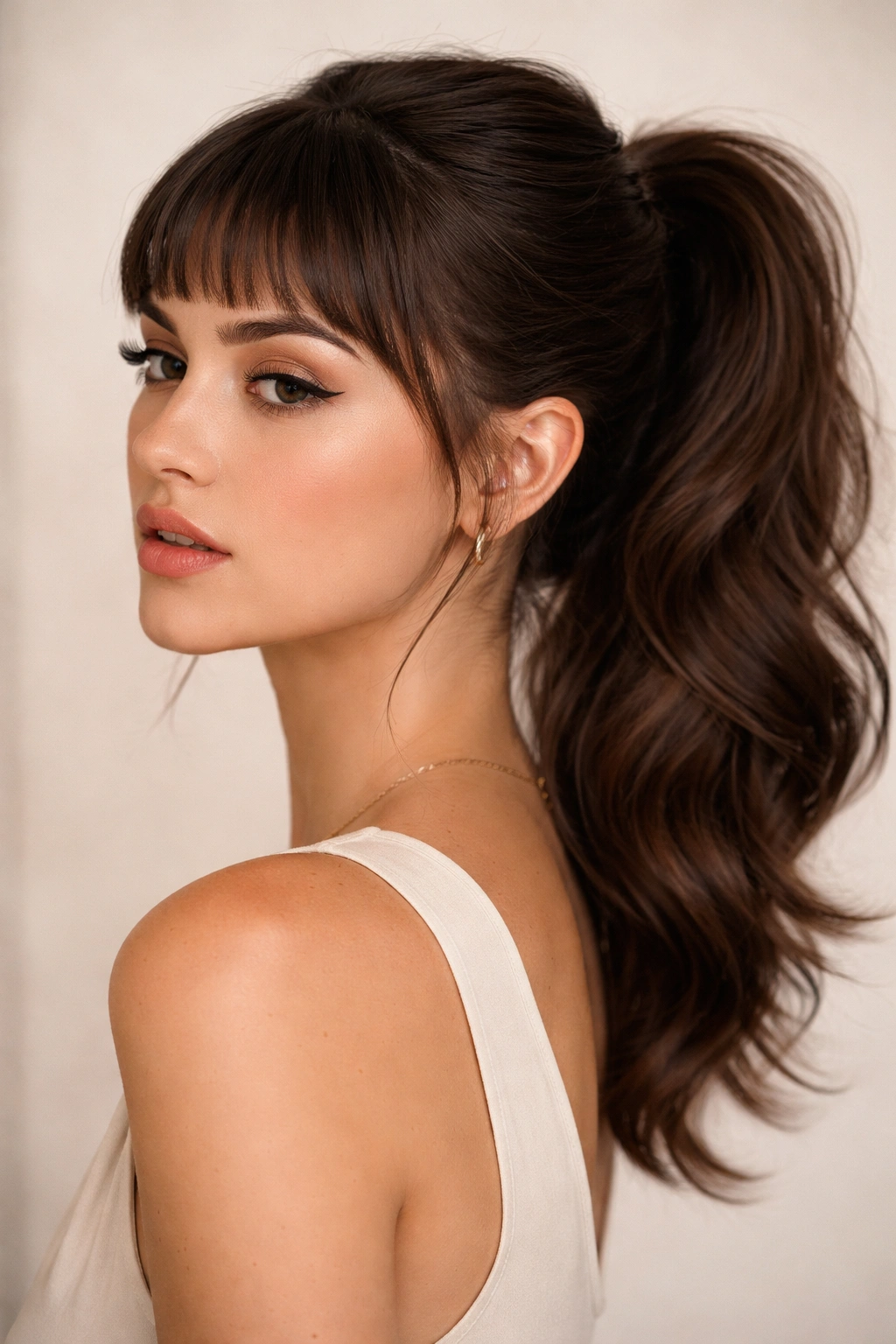
Want to be bold? Go with micro bangs—super short, ending just below your eyebrows—paired with a dramatically voluminous low ponytail that compensates with serious height and fullness at the base of your head.
The Visual Balance
Micro bangs are a statement piece. They’re unexpected and require confidence. When you balance them with a high-volume ponytail, you’re creating an interesting visual proportion: a lot of forehead showing (because the bangs are so short) but a lot of hair volume in the back. This creates an interesting silhouette and a look that’s definitely fashion-forward.
Building Serious Volume
Start with volumizing mousse applied to your roots while your hair is still damp. Blow-dry your hair with a large round brush, lifting the roots and focusing on creating volume at the crown and throughout the mid-lengths. Use a curling iron to create bouncy waves throughout your hair, especially in the sections that will become your ponytail. Pull your hair back, but instead of placing your ponytail at the nape, position it slightly higher—think mid-back of your head. Use a volumizing spray before securing the ponytail to amplify the height. Tease the ponytail base generously to build a rounded, significant shape.
Real talk: This style requires a commitment to blow-drying and styling. It’s not a wash-and-go option, but the impact is absolutely worth it.
8. Grown-Out Bangs (Transitional) With Delicate Low Ponytail
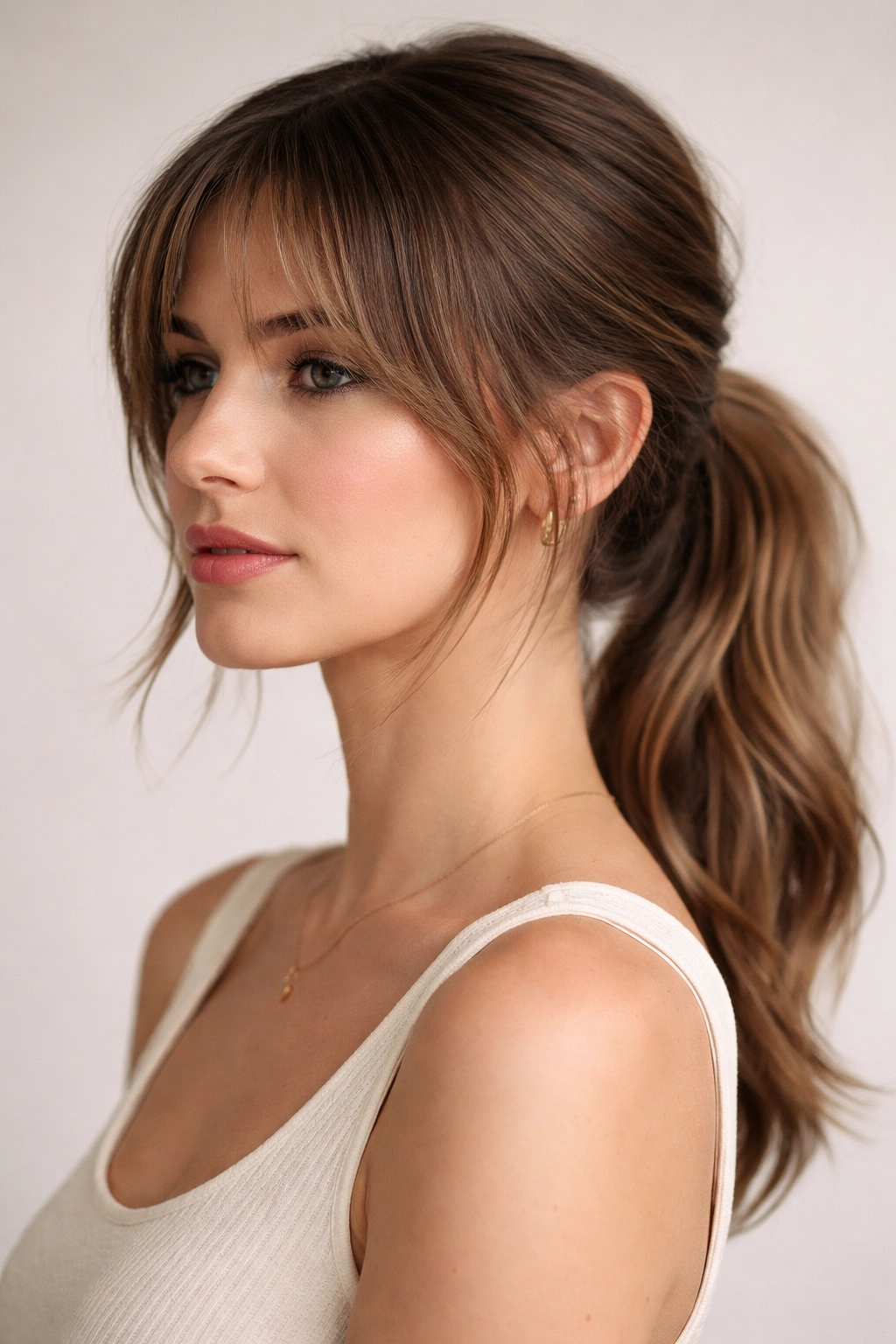
Not everyone wants to commit fully to bangs. If you’re growing out old bangs or testing whether a bang style works for you, try grown-out bangs that blend into face-framing layers, paired with a delicate, understated low ponytail. It’s a gentle, low-pressure way to incorporate the bang aesthetic.
Why This Works as a Transition
Grown-out bangs naturally create layers around your face as they lengthen, so you don’t feel like you’re fully committing to a bang look but you still get face-framing benefits. Pairing this with a simple, delicate low ponytail keeps the focus on the soft layers around your face rather than overwhelming your styling routine.
Styling for Softness
Apply a smoothing serum to damp hair and blow-dry with a paddle brush for a sleek base. Use a small-barrel curling iron to add subtle waves to your hair, especially around your face and in the ponytail sections. Pull your hair back into a low ponytail—nothing fancy, just a clean gather. Leave your face-framing layers mostly down, and tuck them behind your ears if you want them out of your face. The layers should fall naturally and move with the rest of your hair.
Insider note: This style is perfect if you’re undecided about bangs because you can gradually trim the bangs shorter or let them grow longer based on how you feel about the look.
9. Blunt Bangs With Slicked-Back Low Ponytail
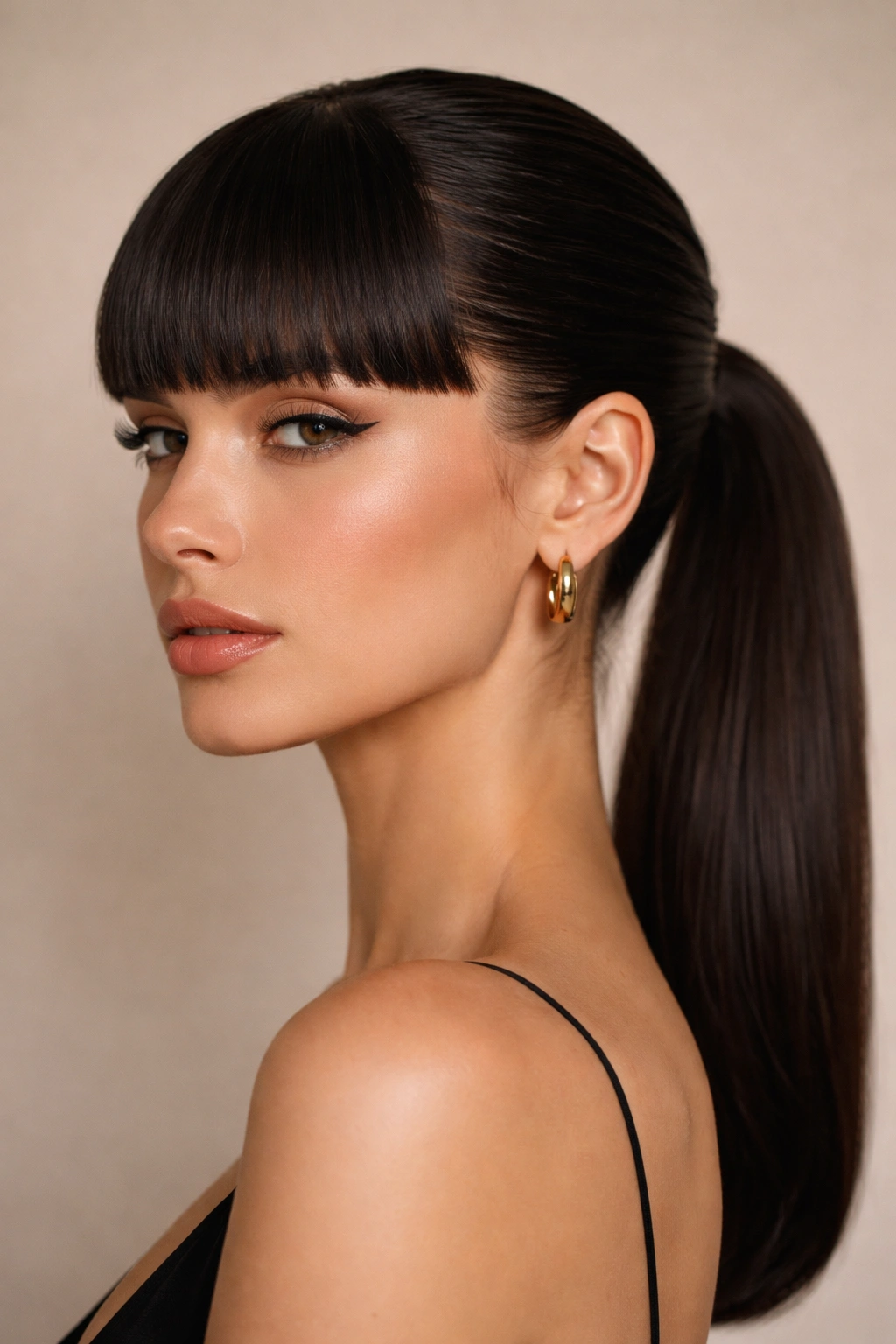
For a more editorial, high-fashion approach, combine thick blunt bangs with a dramatically slicked-back, very tightly gathered low ponytail. The bangs are the only soft part of this style; everything else is about precision and control.
The Sophistication Factor
There’s something undeniably chic about this combination. The blunt bangs soften your face and add interest, while the slicked-back ponytail creates an almost sculptural frame for your head and neck. It’s the kind of look that photographs well and reads as intentional and confident.
Achieving the Slick
Start with a wet ponytail. Apply a strong-hold gel or slicking cream to soaking-wet hair, combing it back tightly with a fine-tooth comb. Use your comb to smooth every last flyaway. Pull your hair into a very low, very tight ponytail and secure with a strong elastic. You can smooth the hair around the ponytail base with more gel to keep flyaways pinned down. Dry your hair with a blow dryer on a low setting if needed. Finish with a strong-hold hairspray to lock in the slickness and keep everything in place.
Pro tip: This is a style that requires regular hair care—slicking your hair back regularly can stress your hairline, so alternate this with looser styles and use a strengthening hair mask regularly.
10. Baby Bangs With Loose Romantic Low Ponytail
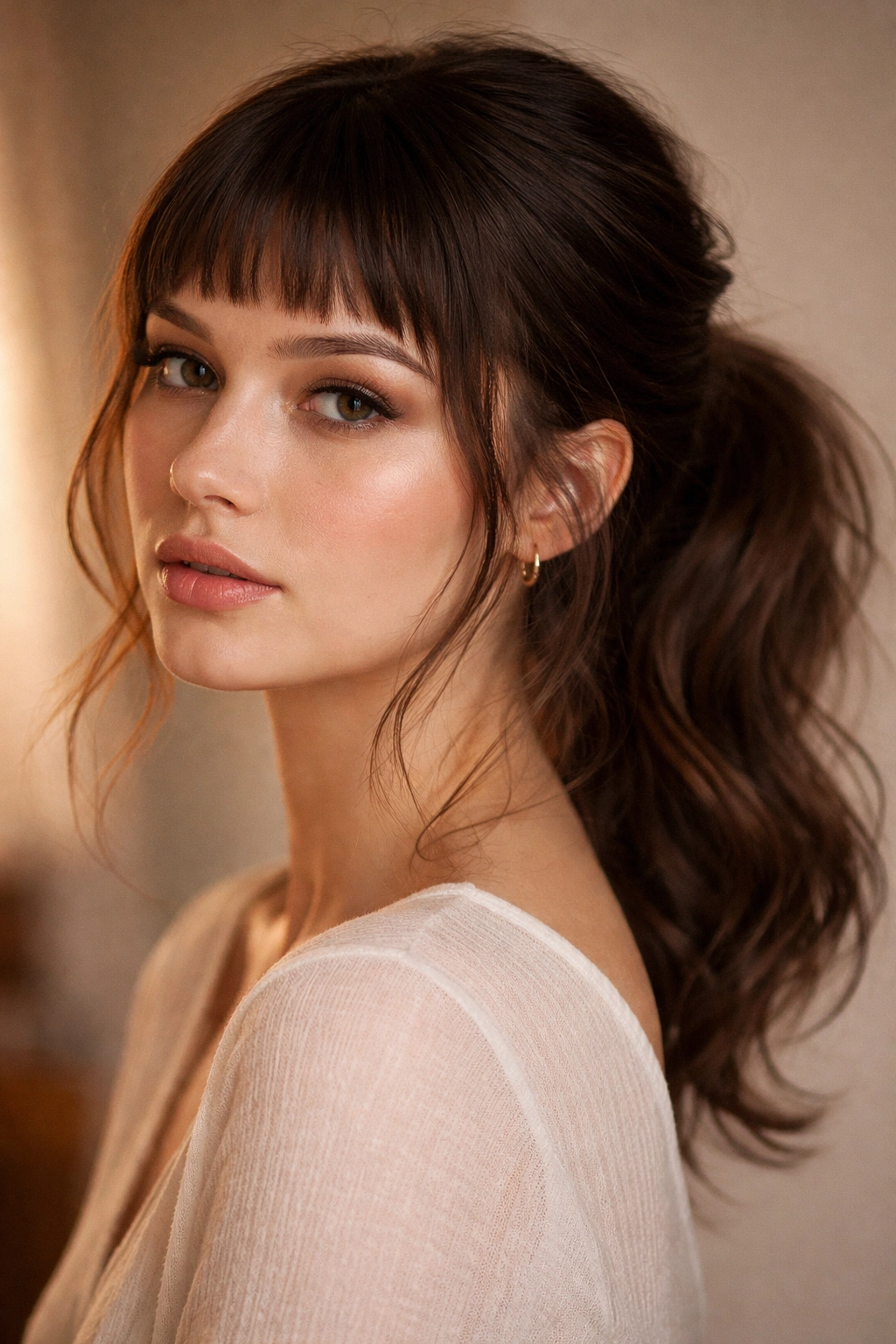
Baby bangs are shorter and more delicate than micro bangs—think just at or slightly above your eyebrows. Pair these with a loose, romantic low ponytail where your hair is textured, slightly wavy, and left deliberately undone.
The Sweet Spot
This combination gives you the bold statement of short bangs without the severe high-fashion edge. The loose romantic ponytail adds femininity and softness, balancing the boldness of the baby bangs. It’s a style that reads as fashion-conscious but also approachable and wearable.
Softening the Contrast
Blow-dry your baby bangs smooth but gently curve them slightly with a round brush to soften the severity. For the ponytail, create soft waves by blow-drying with a round brush and then running a curling iron through sections loosely. Gather your hair into a low ponytail, positioning it at the very base of your head. Pull the tie slightly loose and gently tease the ponytail base to create volume. Leave some face-framing pieces down and tuck them behind one ear.
Worth knowing: Baby bangs look best when they’re freshly trimmed, so plan for a bang trim every 3-4 weeks to maintain the precise length.
11. Choppy Layered Bangs With Shaggy Low Ponytail
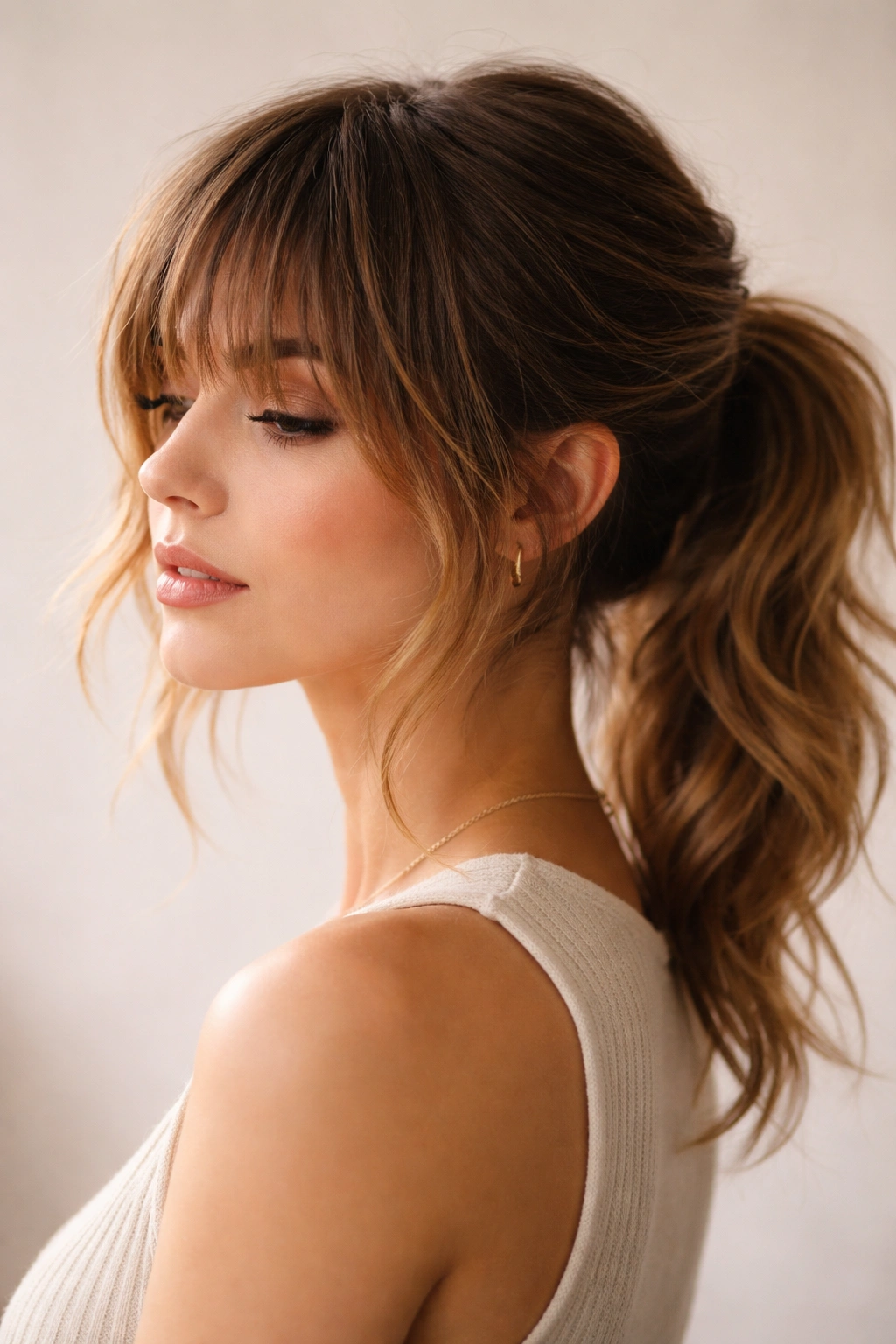
Channel a 70s influence with choppy, layered bangs that have an intentionally piece-y, undone quality, paired with a shaggy low ponytail that celebrates movement and texture throughout.
The Retro-Modern Vibe
This style is all about celebrating your hair’s natural texture and movement. The bangs have real depth and dimension because of the layers, and the shaggy ponytail extends that idea to the back of your head. It’s the kind of look that works beautifully with wavy or curly hair but can be achieved with straight hair too if you’re willing to add some texture.
Creating the Shag
Start with textured hair—either your natural texture or created with a texturizing spray and waves. Don’t aim for smooth or blended; instead, let your layers show. You might even create layers throughout your hair if you don’t already have them. Pull your hair back loosely into a low ponytail, leaving many face-framing pieces down. The ponytail itself should be visible as separate sections rather than one unified shape. Apply a flexible-hold texture spray to encourage movement and prevent the style from falling completely flat.
Real talk: This style requires either naturally textured hair or a serious commitment to creating texture regularly with heat tools. But when it works, it’s absolutely stunning.
12. Side-Part Bangs With Asymmetrical Low Ponytail
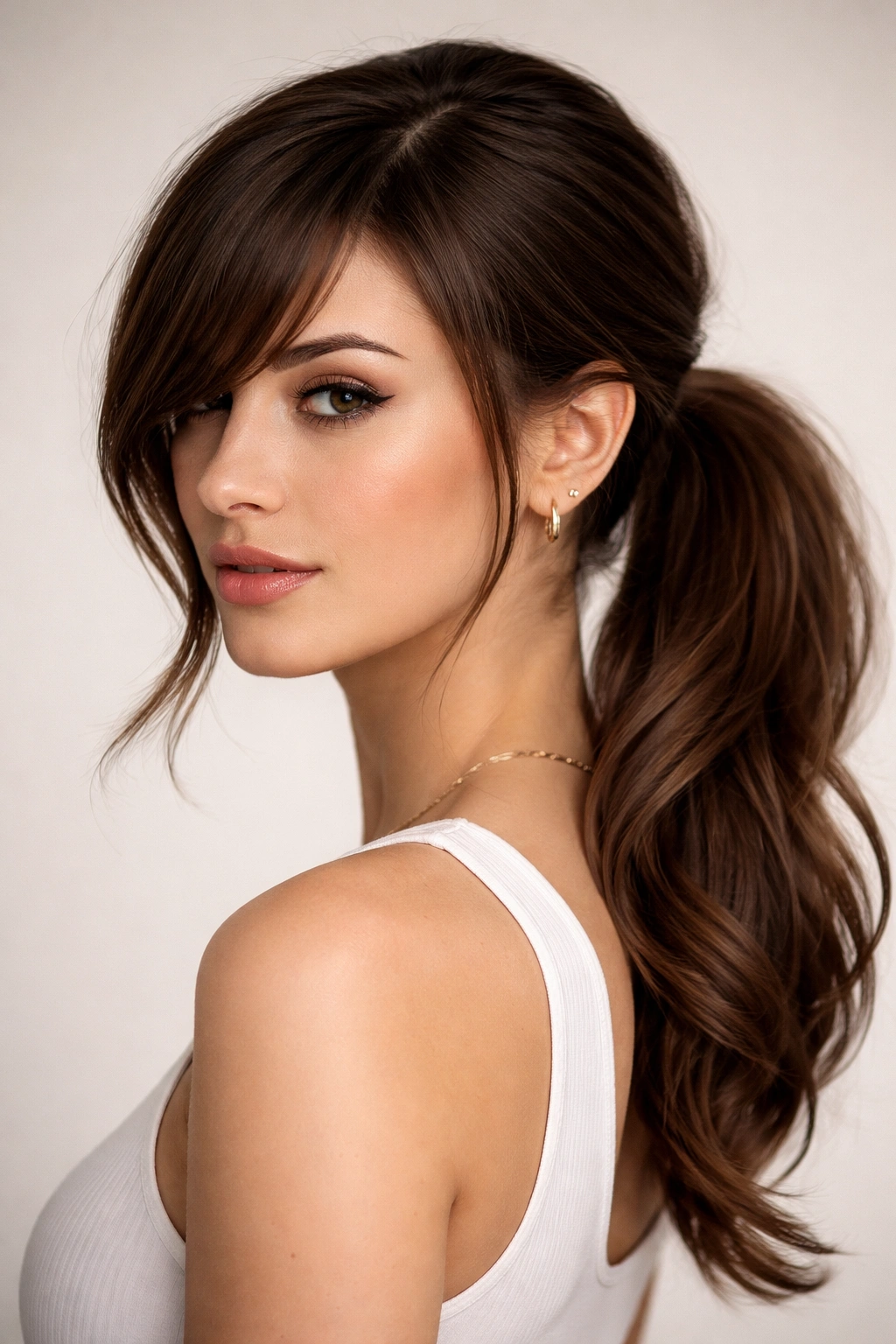
For maximum personality, try bangs styled from a strong side part that sweep dramatically across your forehead, paired with an asymmetrical low ponytail where more hair is gathered on one side than the other.
Why This Works
This is a style that feels intentional and unique. The side-swept bangs create movement and frame your face from one angle, while the asymmetrical ponytail adds an element of surprise and visual interest to the back of your head. It’s definitely a statement look, not a neutral style.
Building the Asymmetry
Create a deep side part and use a flat iron to direct your bangs across your forehead in a long, smooth sweep. For the ponytail, gather your hair into a low position but create an asymmetrical shape by letting more hair fall on one side. You might even French braid one side of your hair and leave the other side loose before pulling everything back, which naturally creates the asymmetry. Secure loosely and pull at the base to loosen further.
Pro tip: This style works best if you’re comfortable with a distinctive look that will get compliments and questions. It’s not subtle, but it’s absolutely memorable.
Styling Products That Make These Styles Work Better
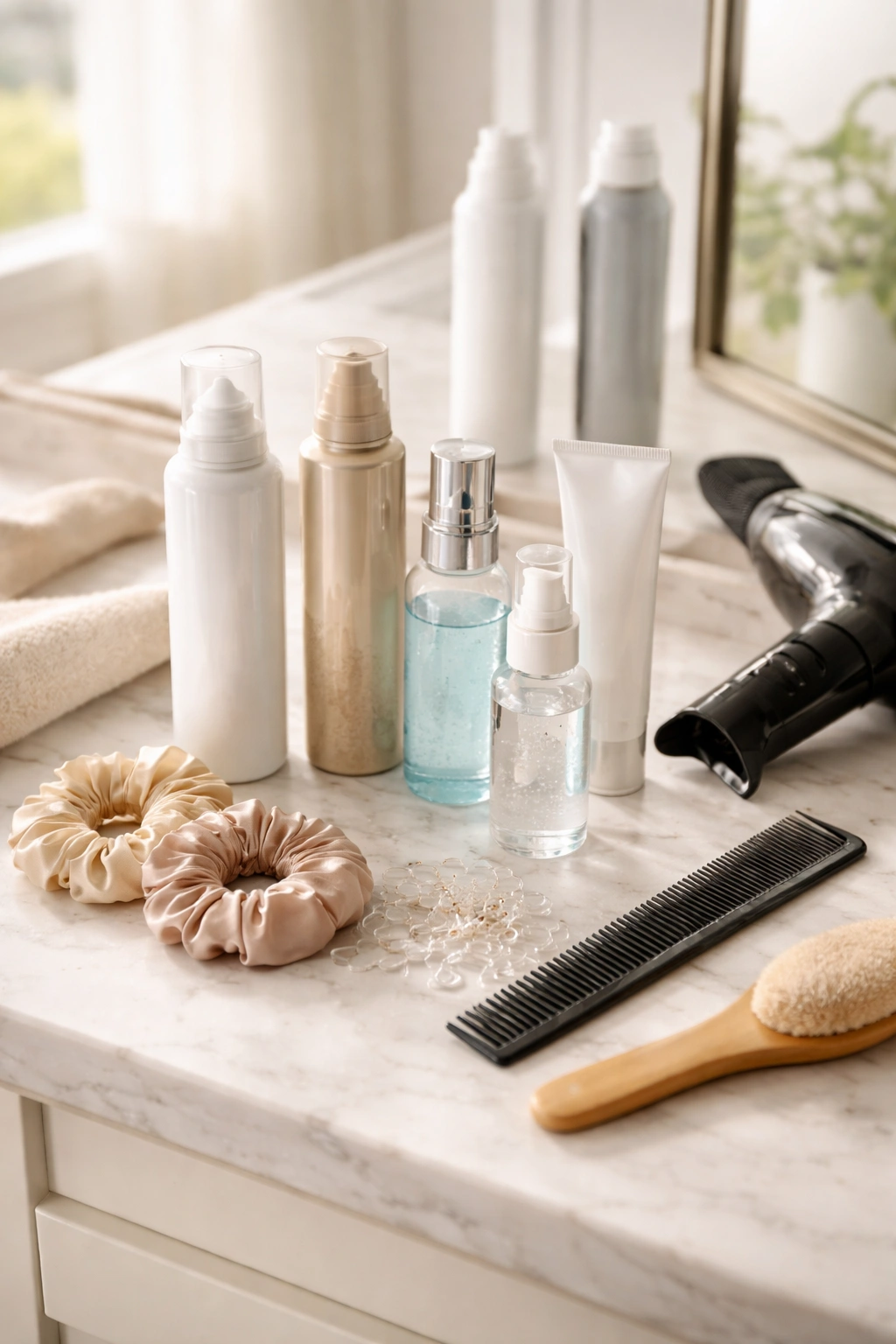
Getting the right tools and products in your arsenal completely changes the game when you’re styling low ponytails with bangs. A volumizing mousse applied to damp roots makes a dramatic difference in how much height and fullness you can achieve in your ponytail—it plumps up each strand and gives you more to work with. Texturizing sprays and sea salt sprays are game-changers for creating grip and movement, especially if your hair is slippery or fine. A smoothing serum or anti-frizz cream keeps flyaways from derailing a sleek ponytail style.
Invest in quality hair ties that won’t tug and tear your hair. Clear silicone elastics or silk scrunchies are genuinely worth the extra cost because they cause less breakage than traditional rubber bands. A fine-tooth comb is essential for smoothing ponytails precisely and catching flyaways that a regular comb would miss. A good blow-dryer with a concentrator nozzle gives you control over where your air flow is going, which matters when you’re trying to direct bangs or create volume.
Hairspray is your final-touch ally, but the type matters. A flexible-hold spray gives you movement and forgiveness, while a strong-hold spray locks everything in place for all-day wear. Keep both on hand depending on the vibe you’re going for. For slicked-back styles, a gel or slicking cream formulated for flyaway control will be your best friend.
Common Mistakes That Undermine These Styles
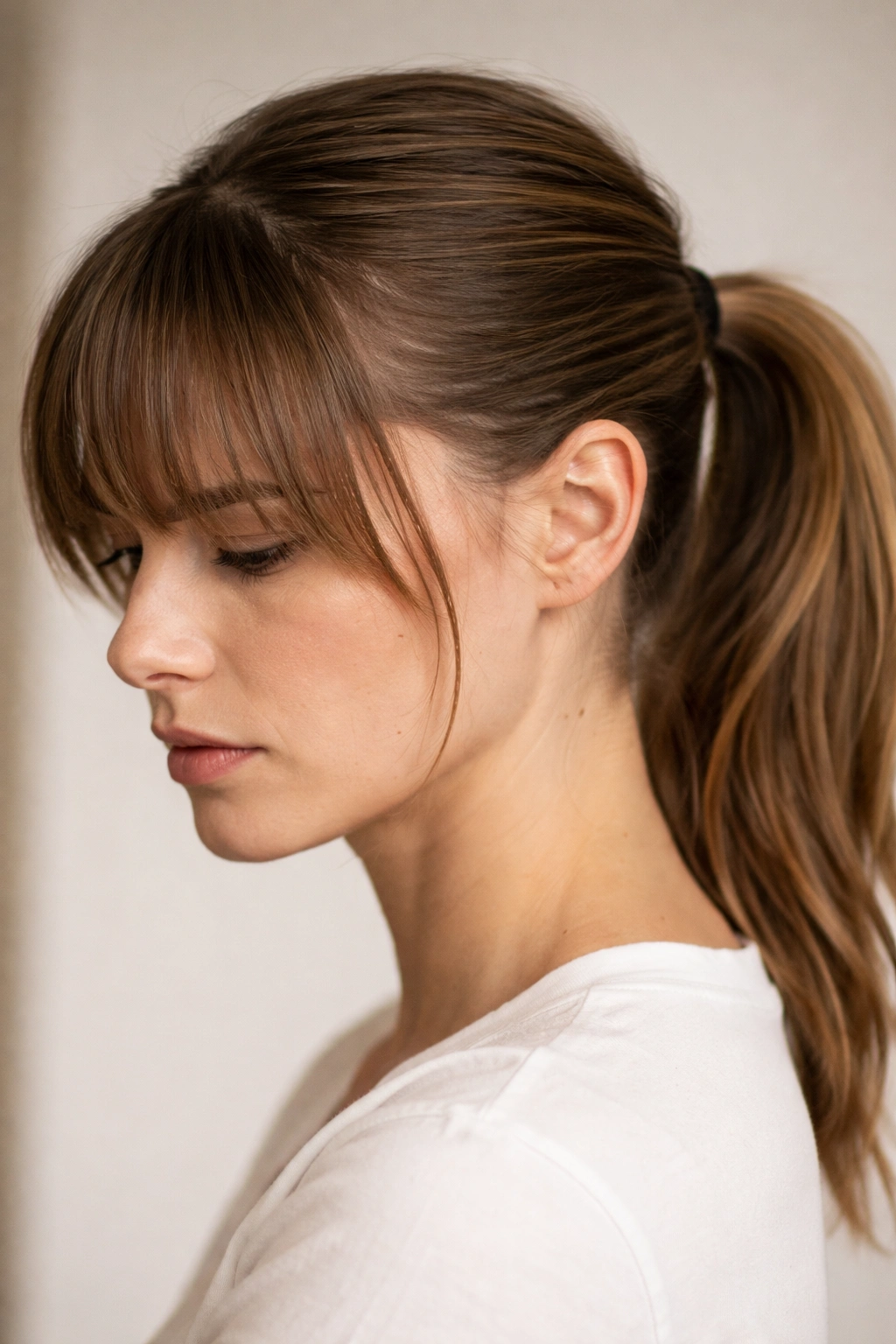
The biggest mistake people make with low ponytails and bangs is pulling the ponytail too tightly. When you pull too tight, you create tension on your hairline, which over time can lead to breakage and hair loss. You also miss the softer, more modern aesthetic that makes this style appealing. Your ponytail should be snug enough to hold all day but loose enough that you can slip a finger under the elastic.
Another common issue is neglecting your bangs. Bangs require regular trims—every 3-4 weeks is ideal to maintain length and shape. As they grow out, they start to get in your eyes and lose their defined appearance. If you’re not willing to maintain bangs regularly, this style isn’t for you, and that’s completely valid.
Many people also make the mistake of creating a low ponytail and then leaving it completely smooth and slick when the style would benefit from some texture and movement. The modern low ponytail with bangs isn’t about sleekness alone; it’s about softness and dimension. Even if you’re going for a more polished version, a little texture in the ponytail usually looks better than absolute smoothness.
One final mistake: using too much product. If you’re heavy-handed with hairspray or gel, your hair ends up looking stiff and unnatural. Start with less than you think you need, and add more if necessary. You want your hair to move and feel like hair, not like it’s been encased in shellac.
How to Choose the Right Variation for Your Face Shape
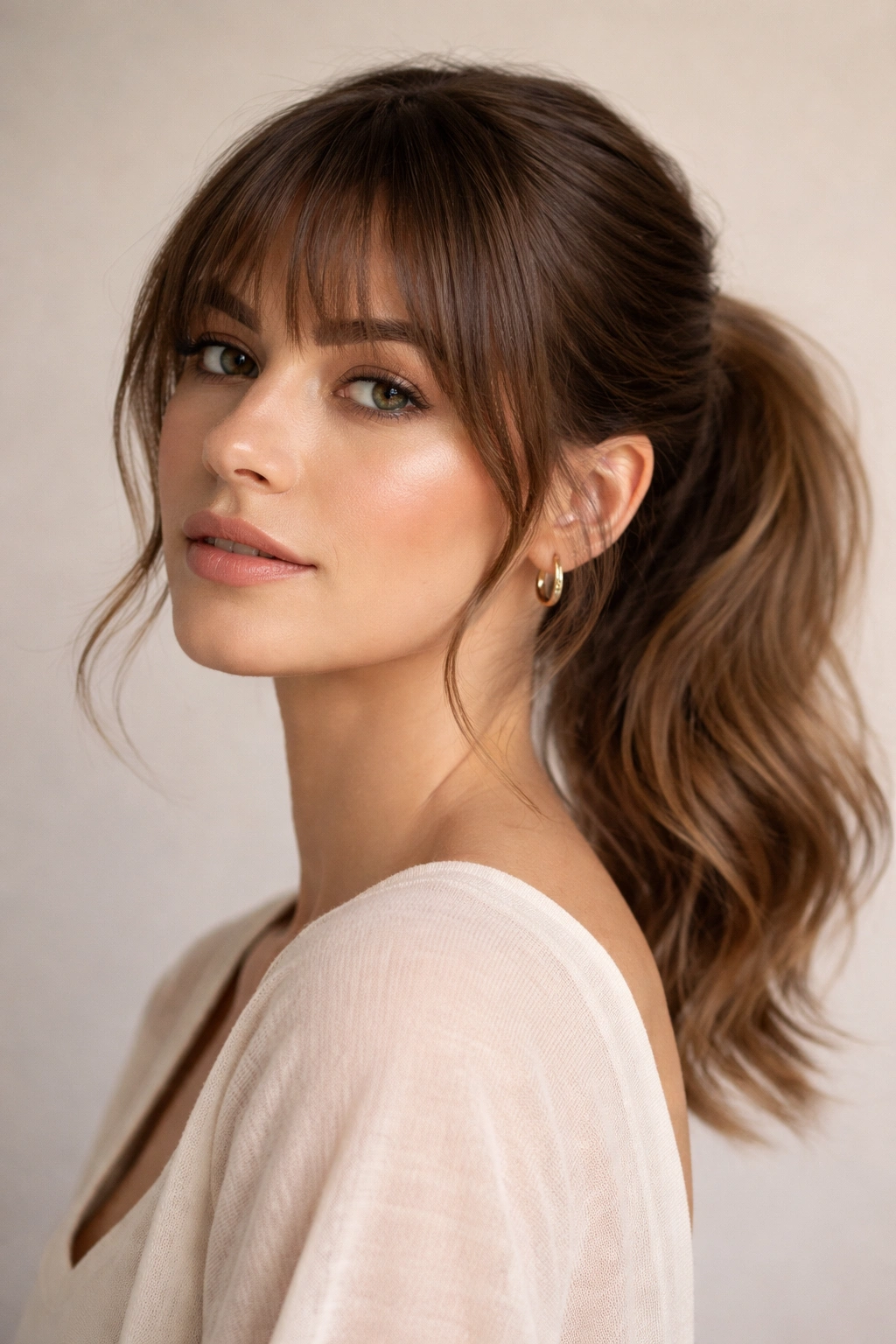
If you have a round face, you’ll do best with styles that create vertical lines and don’t add fullness to the sides of your head. Straight bangs, micro bangs, and blunt bangs can help by creating horizontal lines that balance roundness, and keeping your ponytail smooth rather than fluffy prevents adding width. Side-swept or side-parted bangs also work beautifully because they create asymmetry that makes a rounder face appear more defined.
For square or angular faces, you want to soften angles with curved, wavy elements. Wispy bangs, curtain bangs, and side-swept bangs all work well because they introduce softness and curves. A textured or loosened ponytail also helps by breaking up the structured lines of your face.
If you have an oval face, you’re lucky because nearly every variation works. You can afford to be bolder with your choices—try micro bangs, thick blunt bangs, or asymmetrical styles. Your face shape is naturally balanced, so you have room to experiment.
For heart-shaped faces (wider forehead, narrower chin), bangs are actually ideal because they balance the width of your forehead. Wispy layered bangs, curtain bangs, and side-swept bangs all work beautifully. You want to avoid overly thick bangs that emphasize your forehead width.
Maintaining Your Bangs Between Salon Visits
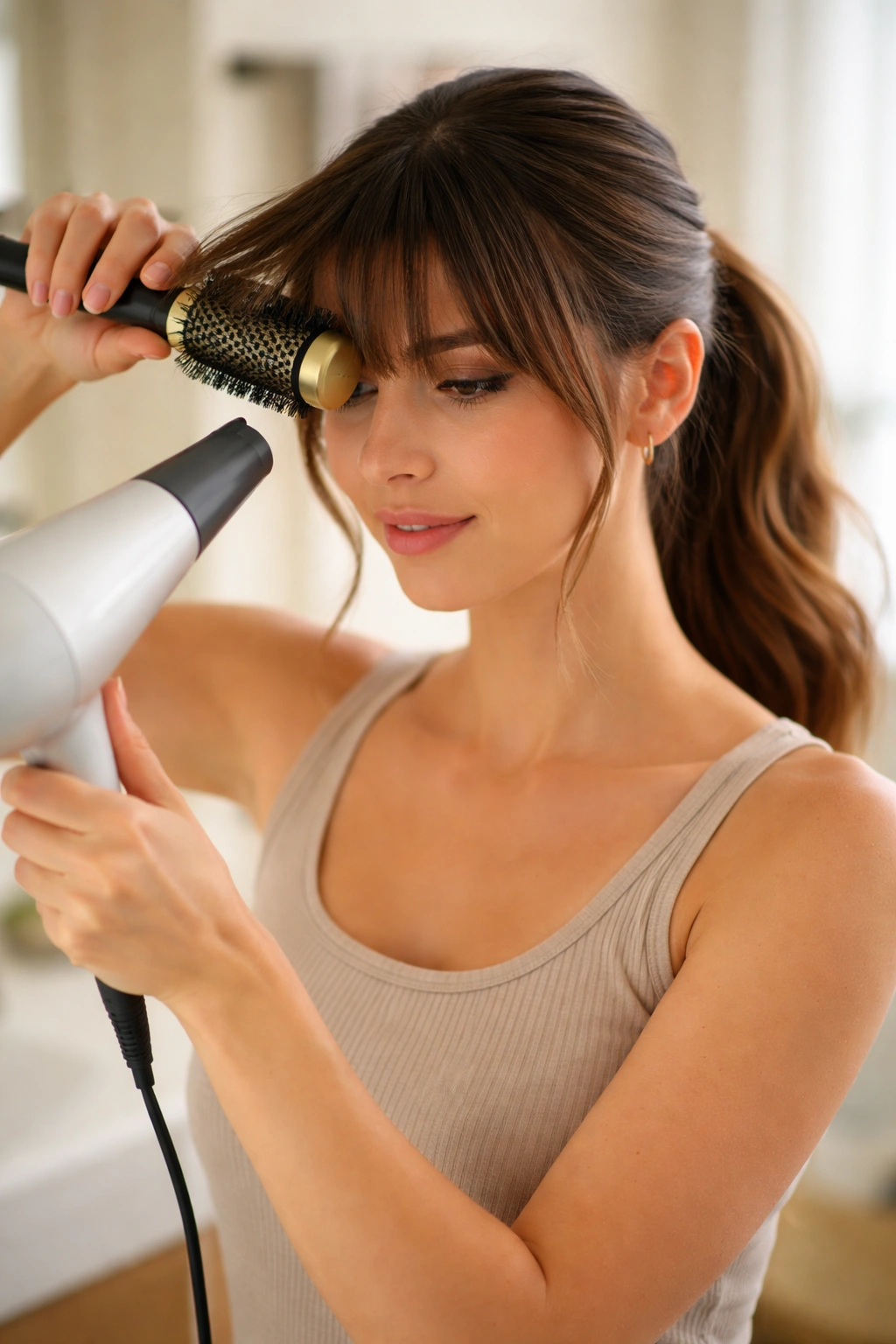
The secret to making your bangs look good between professional trims is keeping them clean and styled consistently. When bangs get greasy, they clump together and lose their shape. Shampooing your hair every other day or using dry shampoo on non-wash days keeps bangs looking fresh. Some people even wash just their bangs and forehead on days they don’t wash their full head of hair.
Blow-drying your bangs properly every morning makes a huge difference in their appearance throughout the day. Never let bangs air-dry completely if you want them to look intentional—a few minutes with a round brush and blow dryer shapes them perfectly. Use a flat iron on the lowest heat setting if you need to smooth them out or redirect them slightly.
If your bangs are getting in your eyes between trims, you can carefully trim them yourself using sharp scissors and very small snips. However, if you’re at all uncertain about your ability to cut straight across, it’s worth waiting for a professional. A bang trim is inexpensive and quick—often just 15-20 minutes—and there’s no point in risking a disaster when it’s such an easy fix.
Final Thoughts
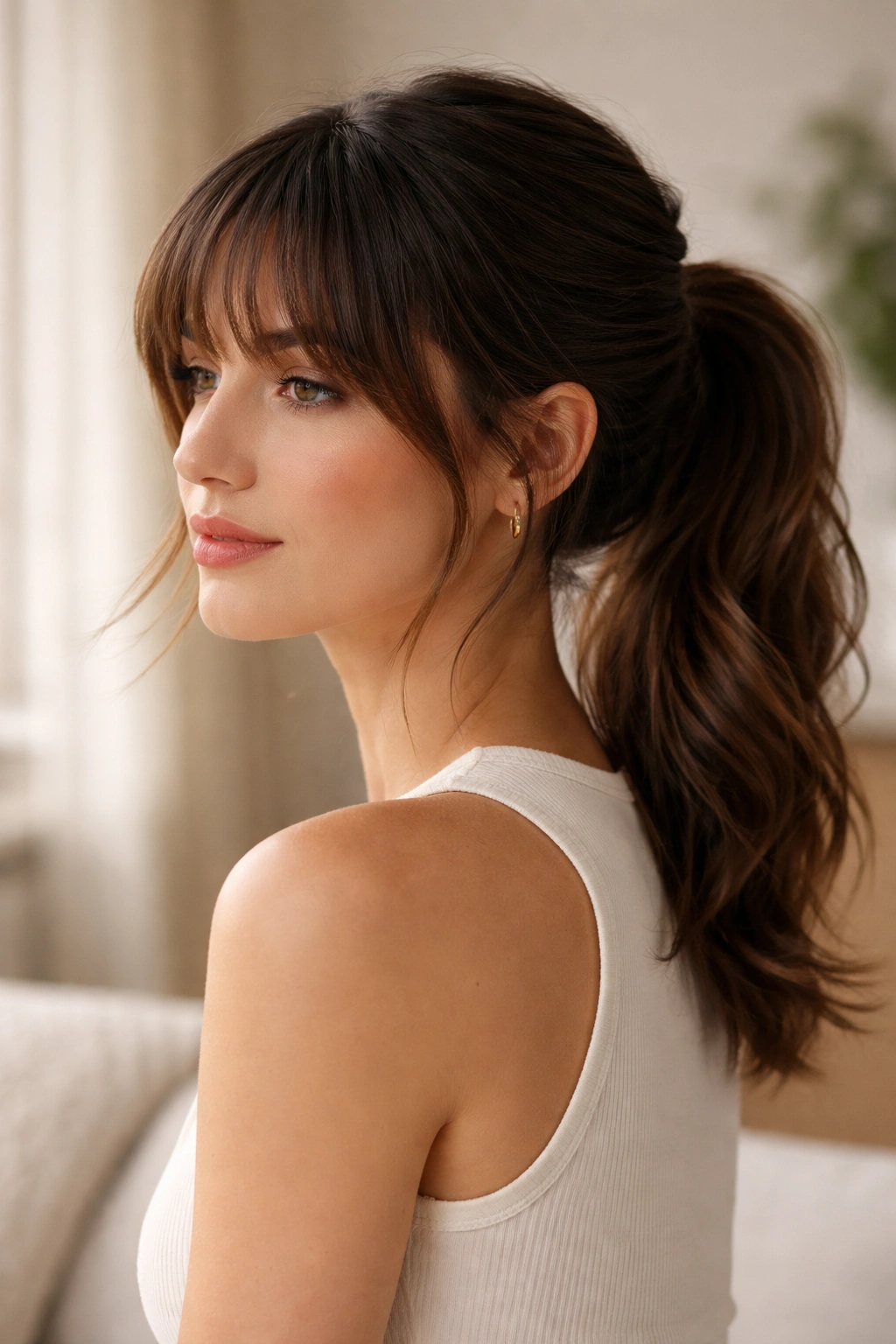
The combination of low ponytails and bangs is so appealing because it gives you the best of both worlds: the practicality and polished appearance of a pulled-back style, plus the personality and face-framing flattery of bangs. Whether you go for classic and sleek, soft and romantic, or bold and statement-making, this style works because it balances structure with softness, polish with ease.
The key to making any version work is understanding your face shape, knowing your hair’s natural texture and how to work with it rather than against it, and being willing to spend a few minutes styling each morning. These aren’t wash-and-go styles, but they’re also not so complicated that they require professional hands every time.
If you’ve been hesitating about trying bangs or a low ponytail separately, combining them might actually be the gateway to both. Start with the version that feels most aligned with your personal style and what you see yourself maintaining regularly. The investment in regular trims and a few good styling products will pay off every single day when you catch your reflection and feel genuinely good about how you look.